
|
| Greg's diary |
| May 2010 |
|
|
|||||||||||||||||||||||||||||||||||||||||||||||||||||||||||||||||||||||||||||
|
|
|
||||||||||||||||||||||||||||||||||||||||||||||||||||||||||||||||||||||||||||||||||||||||
| Saturday, 1 May 2010 | Dereel | Images for 1 May 2010 |
| Top of page | ||
| next day | ||
| last day |
|
Network changeover
|
Topic: technology | Link here |
Today my satellite connection (apparently) changed from Aussie broadband to SkyMesh. No interruption, which of course also means no change of external IP address: it's still 121.200.1.204, and it still resolves to 121-200-1-204.cust.aussiebb.net.. Tried checking the My SkyMesh pages, and was refused login. Sent off the “Forgot your password” form and was returned a message sent in only HTML, which promptly landed in my spam folder. It contained an old user name and password, one that I haven't used for over a year—and it didn't work either. Tried to fill out the support application form—how I hate web forms—and got a message rejecting the message because it wasn't sent from my SkyMesh mail address. Hopefully they're not going to expect me to read WebMail!
Finally called up the support number, 1300 759 637, and spoke to Joel, who confirmed that they were having trouble transferring the account details. You'd think that they'd have that sorted out in advance. In any case, it looks as if I'm going to have to do without access to “My SkyMesh” for a day or two. At least the network connection is no worse than before.
|
RSS issues, continued
|
Topic: technology | Link here |
More playing around with the RSS code today, and changed pubDate to set different minutes for each item. We'll see if that makes any difference; at the very least it will cause yet more entries for some people, something that hasn't gone unnoticed. Mitch Davis contacted me mainly because of the greenhouse, but he also mentioned the number of reposts.
Norbert Wigbels also contacted me with another issue, one that I can't completely fix: the RSS feed includes images. In the original PHP version of my diary, you can click on them and get progressively larger versions of the image. That doesn't work in RSS, because the aggregator stores a static copy of the page. So I do what I can and instead link to the RSS feed itself. This isn't ideal, because it's a lot larger. To add to the problem, and something that I can and should do something about, it seems to lose the position in the page and positions people at the beginning, though most RSS users read from the end. But that will have to wait for a larger overhaul of the showphoto function.
And then Alistair Hogge told me that he was having severe problems with the feed:
There was once a link here to an image at http://coolrhaug.com/images/grog-rss-screendump.png, but it has succumbed to bit rot, and I forgot to save the image.
No idea what happened there; the RSS validator was happy with the feed, and it looks right on the right-hand side as well. The browser was Konqueror, and maybe it has something to do with that.
|
FreeBSD upgrade: even more pain
|
Topic: technology | Link here |
Yesterday's problem building FreeBSD didn't seem to be so serious, but today Yvonne told me that she couldn't start firefox on her machine. She got an incredible number of identical messages, followed by a bus error:
What went wrong there? My best bet was that it was an attempt to install VLC a few days ago; it seems to have installed new libraries. Yvonne's version of firefox was also ancient, so set to installing new versions of that, running into dozens of conflicts along the way. I really should reinstall the whole system, which is what I had intended with the kernel build, but it looks as if I first need to debug make. What a pain!
|
House photos: avoiding the sun
|
Topic: photography | Link here |
The sun was shining again today, something we haven't had for a few days. Did some thinking about the critical panorama from the verandah. Unlike the others, I hadn't tried an HDR version, but today it sounded like a good idea, so tried it out. It's the second of the images below (run the cursor over an image to compare it with its neighbour):


|
|||||||||||||||||||||||
On the face of it, it looks a little better, in particular the part of the garden in the middle of the image. But exactly there is the problem. I take these photos with flash to illuminate the foreground, and I need full power, so it takes about 5 seconds to recharge the flash. And in that time, things move:

|
|
|||||||||

|
|
|||||||||
So it looks like I'll have to give up on that, at least when there's wind. Or maybe I should just accept that only the first image will have flash.
Also, winter is coming, so the sun is lower in the sky, making quite a mess of some of my house photos:

|
|||||||||||||||||||||||
Decided to postpone the remainder of the photos until sidereal noon, which improved the remaining panorama, but made some of the other photos far too hard. Here the same photo taken last week and this week:

|
|||||||||||||||||||||||

|
|||||||||||||||||||||||
|
Beer keg woes
|
Topic: brewing, animals | Link here |
For some time I've had a suspicion that something was wrong with the hoses on my beer kegs. Today I found out why: Piccola has been biting them. Chased her away today, but came back and found the external hose well and truly perforated. Damn! When I replace it, I should put a bit of old garden hose around it.
|
House plants: not enough light
|
Topic: gardening | Link here |
A few months ago we planted some plants in boxes in the kitchen, in a place where there's very little light. Initially they did well, but it didn't last. Only the Spathiphyllum seemed to like the light levels. The Kalanchoe lost all its leaves, and though new ones have come, it's looking anything but happy. Here's a photo taken 3 months ago, and then today (with the box turned the other way):

|
|||||||||||||||||||||||

|
|||||||||||||||||||||||
I had half expected this problem, so moved the other box closer to the window, and planted the Kalanchoe and the other striped leaf in their own pots:

|
|||||||||||||||||||||||

|
|||||||||||||||||||||||

|
|||||||||||||||||||||||
Now only the Spathiphyllum is in the original place, with another plant to keep it company:

|
|||||||||||||||||||||||
Also took another look at the Haworthia, which has been recommended as an interior plant. It flowered a while back, and I didn't cut off the flower stem. A good thing too: it has developed a small bud:

|
|||||||||||||||||||||||

|
|||||||||||||||||||||||
I wonder when I should plant that.
|
Curry pierogi
|
Topic: food and drink | Link here |
Years ago Yvonne wrote down a recipe for a „Curry-Pirogge“ in her handwritten recipe book. It came (apparently) from the German magazine „Stern“, and from time to time we cooked it. It's been a while, though, so it sounded like time to do it again. The recipe we have is basically a giant curry puff, and we decided to use the same filling for it. The results were mixed: it's supposed to be a straight roll, but we ended up with something too long to fit in the oven, so it ended up semicircular:

|
|||||||||||||||||||||||
What does „Pirogge“ mean? We had always thought of some kind of boat, but that's „Piroge“ (English “Pirogue”). The English word for „Pirogge“ is Pierogi. It's of Eastern European origin, and it seems that it's really a kind of dumpling or pasty, more like a curry puff than the recipe we had. It's also supposed to be made with unleavened dough, but that wouldn't work for the enormous thing that we made, so our recipe followed the original recipe and used a bread dough with yeast.
| Sunday, 2 May 2010 | Dereel | |
| Top of page | ||
| previous day | ||
| next day | ||
| last day |
|
RSS: Impasse
|
Topic: technology | Link here |
So, my RSS script changeover is complete—and I am still only getting a single entry per day from ACM Queue. That's clearly some limitation of their grabber; others, such as Google Reader, get it right. I'll stop playing with it for now.
|
lagoon upgrade: more pain
|
Topic: technology | Link here |
So I've more or less come to a halt trying to get lagoon upgraded. I can't build a system because of the make bug. I can't upgrade ports because everything is so out of date. And then Yvonne came and told me that she couldn't start firefox or even an xterm: my attempts to upgrade the ports had somehow messed up the libraries. What a pain! And how fortunate that I had a backup of the system. Restored /usr/local and all was well. But I really must find out what's wrong with make.
|
Preparing for spring
|
Topic: gardening | Link here |
We're into the last month of autumn now, and the weather has been unseasonably cool. That hasn't stopped the weeds growing like wildfire, and it's also clear that it's about time to do some restructuring work. Did some weeding and considering what to do for the spring. In the immediate future, as soon as the weather allows, we're going to have to spray the weeds, and it also looks as if we're going to need a new ride-on mower: this little one I have now is good for detail work, but it's enough work that it keeps us from mowing the lawn.
| Monday, 3 May 2010 | Dereel | Images for 3 May 2010 |
| Top of page | ||
| previous day | ||
| next day | ||
| last day |
|
Who's smashing my letter box?
|
Topic: general | Link here |
Over the last few months the appearance of my letter box has changed significantly. Ten months ago (first photo) it looked OK, but about 3 months ago I noted that the right edge of the brim had been bent. It's relatively solid metal, so that shouldn't be easy:

|
|||||||||||||||||||||||

|
|||||||||||||||||||||||
Since then, further damage has occurred. The pole holding the box has been bent back away from the road, something that's not simple (it's cast in concrete), and the top part has been deformed:

|
|||||||||||||||||||||||

|
|||||||||||||||||||||||
Who would do that? How? It seems reasonable to expect it to be the postal delivery contractors (they're not called postmen here for some reason), but it would require quite an effort, and it doesn't seem to make any sense.
|
How to fry an egg, revisited
|
Topic: food and drink, opinion | Link here |
A couple of years ago I started writing a page on frying eggs. I didn't get very far. But today Sue Blake was discussing the matter on IRC, and I revisited the matter.
The most surprising thing is that we weren't in agreement on what constitutes a good fried egg. Two years I wrote:
It's surprising how difficult it is to make a perfect fried egg, one with the white closely surrounding a perfect soft yolk.
Today I got out my copy of «La cuisine de Madame Saint-Ange», which is known for its detail, and read:
It's an egg with a uniform consistency in all parts: the white just solidified enough to be able to pick it up with a fork, white and creamy; the yolk still liquid, a little thickened, covered with a light white veil which makes it reflect...
But, surprisingly, this isn't what people on IRC think to be a good egg. The white should be browned. I've always looked on that as a sign of overcooking, and maybe it's what encourages obscenities like our William Creek eggs (first photo) or the ones I got in Canberra five years ago:

|
|||||||||||||||||||||||

|
|||||||||||||||||||||||
Clearly there are two issues here: how long to fry the eggs, and how carefully to serve them. Both of these ones fail in the care department, but arguably the second ones would have been acceptable to some people if they had been served with more care. In this connection it's interesting to notice Americanisms like “frypan”, “sunny side up” and “easy over” creeping into Australian usage. I had never heard them until I went to Cupertino with Tandem.
Madame Saint-Ange recommends baking the eggs in an oven rather than frying them (the usual French word, «œufs sur le plat», means “eggs on the plate”, so there's no contradiction here). Did some thinking about that; she recommends small baking dishes, which were apparently available at the time the book was written in the early 20th century. But they sound pretty much like the Chinese saucers I used for my steaming experiments 2 years ago, and I suspect we'd have the same problems. So I'll probably give that one a miss.
Still, Madame Saint-Ange summarizes some of the problems of frying eggs:
if you make them on the stove, the heat only reaches the egg from underneath, in too partial and also too direct a manner. Only the bottom of the egg is warmed. The white hardens to a certain thickness and remains slimy on the surface, while the yolk is barely warm when the white is cooked.
We have always addressed that problem by spooning hot oil over the egg, which cooks it from above as well. That's not so much the issue as keeping them from spreading out, especially if they're older. Rings don't seem to work properly, and in any case give a rather artificial appearance to the result. But it still seems to be the best we have.
|
Pierogi or Pirozhki?
|
Topic: food and drink | Link here |
The curry pieroge we made on Saturday didn't quite match the definition of Pierogi, and Sue Blake had the idea that it might be closer to a Pirozhki (пирожки). From the photos and description, that makes sense, but the Russian page shows various pictures, including ones that look more like Pierogi. At the bottom it also states:
Категория: Пироги
I don't speak Russian, but it's easy enough to transliterate: “Kategoriya: Pirogi”. There's no Russian link on the Pierogi page, but if you follow the Polish link from each page, you end up with Pierogi in each case: it's just an alternate name, and the English pages are misleading. I'd be more inclined to think that what we cooked is a completely separate dish, though. I'd consider finding a new name for it, except that that would muddy the waters further.
|
Weed spraying
|
Topic: gardening | Link here |
Finally the weather was conducive to spraying weeds, and did a fair amount, unfortunately not getting finished. I suppose we'll have to do a lot of weeding by hand, and keep it up.
|
Satellite changeover: still to come
|
Topic: technology | Link here |
I've been keeping a careful eye on my satellite link since the beginning of the month. I've already established that the external IP address hasn't changed, and I've had three outages so far this month, but the latency seems to have improved marginally. Finally managed to log in to My SkyMesh, only to read:
Unfortunately your modem has not yet been transferred, so your usage information is currently unavailable through My SkyMesh.
Approximately 1,000 modems are transferred each day by IPSTAR and they expect the process to be complete by May 17, 2010.
It's difficult to understand why this should take so long. Still, there's no indication that they have a mirror server, let alone one that doesn't get charged towards your data allocation, so took the opportunity to download the latest Ubuntu DVD image.
| Tuesday, 4 May 2010 | Dereel | Images for 4 May 2010 |
| Top of page | ||
| previous day | ||
| next day | ||
| last day |
|
Greenhouse and renovating the succulent bed
|
Topic: gardening | Link here |
Today was supposed to be rainy, but we had bright sunshine, so out with Yvonne to try out my new idea about how to mount the roof of the greenhouse. In exactly the second where I started to lift the roof section, the rain came and quickly made it clear it didn't intend to stop. Something doesn't want me to finish this project.
Two and a half years ago we started on the garden to the east of the house, with a circular bed with succulents (aeonium) in it:

|
|||||||||||||||||||||||
Even at the time, we weren't sure that it would stay that way, but we haven't done much with it. Since this photo we put an Aloe vera in the middle, and at some later date some kind of saltbush established itself. The aeoniums proved to be less attractive than we thought, and the whole thing became pretty overgrown:

|
|||||||||||||||||||||||
So after a good two years we finally came to the conclusion that we needed to renovate it. When the rain let up a bit, we set to work:

|
|||||||||||||||||||||

|
|||||||||||||||||||||
We weren't helped by the weather, which rained off and on, but in the course of the afternoon removed the aeoniums and saltbush, and finally found our aloe, which had become seven individual plants:

|
|||||||||||||||||||||||
I've decided I don't like aloes very much. Unlike agaves, they don't seem to grow bigger, just more, and they look a mess. Admittedly, these ones aren't a good example, since they've hardly had any sun in a year or so, but I've seen it with others. We'll probably take them out too and put in a cycad that's in a less-than-optimal place.
Planted some of the removed plants in the extreme east, in the area between the existing birch trees and the south-east paddock, which looks like being the next phase of the garden:

|
|||||||||||||||||||||

|
|||||||||||||||||||||

|
|||||||||||||||||||||||
Also found what appears to be the remains of a tiny cactus I put in there years ago, and then forgot about:

|
|||||||||||||||||||||||
I wonder if it has survived; at any rate, there's a lot more there than what I planted.
|
Making slides with groff: the pain
|
Topic: technology | Link here |
In two weeks I'm doing a presentation of my weather station software for BLUG. So it's high time to prepare the slides. I've been doing them with groff and my own macros for about 10 years now, but it's been a while since I did any work with them. Some time ago I started on a framework for making this sort of thing easier, but I never finished it, and I have long since forgotten many of the details.
All that made creating the slides anything but easy. It's certainly not an advertisement for the UNIX Way, at any rate, nor are the kludges I needed to make to get it to work at all: modify ghostscript/lib/gs_statd.ps to create a display-specific “page size”, and massage the PostScript output to reposition the images. And for some reason the position on the page had changed, so I had to change the repositioning. The whole thing is almost too hackish to be practical.
One point to Microsoft? Maybe. But the last time I tried anything similar from the Microsoft space, it drove me mad. Maybe that's just a lack of understanding of the tools, but I'm still left with the feeling that I can only do what the developers thought of: it's not extensible. Mine may be incredibly painful, but at the end I get what I want.
|
Network congestion control
|
Topic: technology | Link here |
My attempt to download the Ubuntu DVD failed sometime during the night with ECONNRESET. Given the reliability of the link, I would have been surprised if it had not. In the course of the day restarted many more times. There's a specific pattern to these things: normally the download proceeds at about 100 kB/s, considerably more than it used to from this site—I suspect that Aussie Broadband have upgraded a link somewhere. But then it stalls. tcpdump shows that it waits a long time, then returns an ack with window 0 and what appears to be the wrong position in the stream. This is immediately (< 1 s) followed by an ack for the same position with window 8192. It seems that the congestion control algorithm is broken. On each occasion I have been able to stop the transmission, restart, and it continued at full speed. I'll have to keep more of an eye on this one.
|
Pierogi or Pirozhki, continued
|
Topic: food and drink | Link here |
More discussion about the Pierogi vs Pirozhki debate today. I discovered that the “Категория: Пироги” information I found yesterday was in fact a link, and it led me to the Пирог (Pirog) page. And that does have an English link: to Pie. And then Peter Jeremy asked a Russian colleague, who told him that the information on the Russian page was incorrect, and that the Pirozhki illustrated on the page were in fact Pirogi. Somehow this whole thing is a can of worms. I suspect that the terminology varies according to geography.
To add to the confusion, I put the Pirog page through Google Translate, which came up with something half-way understandable translation which translates “Пирожок” as “patty” (not a word I'm familiar with, but which the OED tells me is a “little pie or pasty”) and “Пирог” as “pie”. So I suppose “pie” is the best translation, and it explains why it's such a difficult term to pin down.
| Wednesday, 5 May 2010 | Dereel | Images for 5 May 2010 |
| Top of page | ||
| previous day | ||
| next day | ||
| last day |
|
Greenhouse: finally progress
|
Topic: gardening | Link here |
The current state of play with erecting the greenhouse was that we had four roof sections, each consisting of a cross-member and two rafters, and we couldn't work out how to mount them. Clearly two of these fitted on each side of the central arch, but the rafters weren't long enough to reach the gussets at the top (thoughtfully mounted on two of the sections):

|
|||||||||||||||||||||||

|
|||||||||||||||||||||||
Since then I had taken another look at the parts and identified screw holes about 20 cm from the bottom of the rafters forming the arch, and decided that they must fit there. The rain let up enough for us to make another attempt. It didn't need to be very long: yes, there were holes on the end rafters, but not on the middle one. Clearly that wasn't the way it was intended either. Somehow the whole thing doesn't seem to fit. And just as we were giving up, it started to rain again.
Did some more head-scratching and looking at the mounting holes. There's only one place on all the rafters where the cross-member would fit, but it's close to the top, so the rafters would have to point down, and the gussets would be at the bottom, where they don't fit. To fit the things, we'd have to remove the gussets. But it turned out that that's the correct way to assemble the roof. The gussets go on the other end of the rafters, close to the cross-members:

|
|||||||||||||||||||||||

|
|||||||||||||||||||||||
Now everything makes sense. There are ventilation flaps along the roof, and they attach to the same kind of gussets. They're upside down in this photo:

|
|||||||||||||||||||||||
Each flap has two gussets, which fit exactly into the holes at the (real) top of the rafters. But that leaves a couple of questions unanswered: first, why were the gussets attached to the wrong end of some of the rafters, and secondly, where do they fit at all? I had already established that one gusset was missing, but now it's beginning to look as if we have three too many. Has somebody (David?) already made an attempt to re-erect the greenhouse, and didn't finish?
|
Slide making: the alternatives
|
Topic: technology | Link here |
Got a surprising amount of feedback about making slides. It seems that there's lots of stuff out there, some of which is clearly not worth pursuing. ewipe didn't even get off the ground: its home page is gone. ImPress didn't: the web pages are badly laid out and overflow their boxes. It's not as bad as some “high profile” web sites, but not good enough for a presentation package. But then, the last “release” was 1.1 Beta 6, some time in mid-2000. pylize, on the other hand, doesn't look bad. If I were starting again, I would probably look more carefully at that one. But now that I have fixed the immediate problems with my groff kludge, I don't see any reason to change.
|
Satellite connection: worse and worse
|
Topic: technology | Link here |
By the end of March, I was getting the impression that my network dropout problems were over. That has definitely changed. There have been 12 in the last four days, 7 of them today, and independently of that, my downloads are hanging all the time. Nevertheless I have managed to miss the smoking gun in my tcpdump traces.
|
RSS: Useful after all
|
Topic: technology | Link here |
Last week, when changing the RSS generation functions for my diary, I installed newsfox, and have been doing a bit of playing around with it. Surprise: it seems relatively useful, particularly for forums. It pulls in feed updates (automatically if desired), it can show the index in chronological format, and the standard display is black on white, which makes many feeds a lot easier to read.
There are two kinds of down side. One is the way people format their feeds, which isn't newsfox's fault. For example, oly-e.de formats its messages as white or light grey on dark grey, and in a mixture of chronological and reverse chronological sequence within a thread. newsfox fixes that, but oly-e.de avenges itself by sending only the first 250 characters of each posting, omitting even the name of the author. To see the rest, you need to click on the title, bringing you back to the original posting, and thus rendering the use of newsfox pretty much useless. The dpreview Olympus forum is even worse: it only provides the header. And then there are things like Yana and Sundance's travel blog, where it only shows some of the entries, though the original includes them all. It's not clear whether this is the fault of the blog site or newsfox.
Then there are things that newsfox could do better. Like so much software, it has no idea of time zones, so the times I get displayed don't match the original feed. It's also one of these horrible single-window things with panes (pains?), so it tries to fit too much into too small a space, with ellipses (…) all over the place:

|
||||||||||||||||||||||
I've found that you can move the message display to the right, which helps a little if you make the window full screen. But wouldn't it be nicer to have a group of windows that all iconify and deiconify at the same time? GIMP goes the multi-window route, but unfortunately you have to iconify and deiconify each window individually, which makes the idea pretty useless.
Apart from that, I thought that one of the ideas of news readers (which is what this really is) was to remove entries when they had been read. But I can't find a way to do it with newsfox. It changes the emphasis, but it leaves the message there, making effective use of chronological sorting difficult.
|
Pierogi and Пирожки: more information
|
Topic: food and drink | Link here |
Mail from Bartosz Fabianowski today:
I read about your pierogi/pirozhki naming dilemma. The answer is actually quite simple: The naming differs between Polish and Russian. In Poland, we call a big pastry a "pieróg" in singular. The little dumplings are called "pierogi", the plural of the previous word. Russians do it differently. They call the pastry "pirozhki" (both singular and a diminutive). The little dumplings are called "vareniki", plural again. If you look at the Wikipedia pages for Polish periogi and Russian vareniki, you will see that they are the same. Pieróg and pirozhki equally match.
| Thursday, 6 May 2010 | Dereel | Images for 6 May 2010 |
| Top of page | ||
| previous day | ||
| next day | ||
| last day |
|
Network changeover: maybe
|
Topic: technology | Link here |
Phone call from Robert at SkyMesh this morning, in reply to my email. What email? I hadn't sent any, not even a web form. I suppose he really meant the phone call I made on Saturday, but I hadn't really expected a call back, certainly not to tell me my new IP address. Still, that's what he did, and he assured me that it would have reverse DNS (it currently doesn't). He also offered to raise the priority of my changeover, but also confirmed that they don't have a mirror server, so I'm happy to stay with Aussie Broadband for the while. And he couldn't give me any information about reliability; they don't monitor it. sigh
|
Greenhouse progress
|
Topic: gardening | Link here |
After yesterday's success with the greenhouse, continued with the rest of the structure, which went well. Got the remainder of the structure in place (I'll screw most things tight later), including one door and rail. Now I only have a couple of things over: the flaps at the top, which need straightening before I can mount them, and a few odds and ends which I can't place.
As I had noted, there are three gussets, engraved “arch gusset”, but which would also fit between the rafter and the wall, explaining their position on one of the roof sections when I started. But there are only three of them, and there's space for at least eight. Have five been lost? Just about everything else seems to be there, and there are the little plastic gussets to hold things in place as well. I think I'll attach them where they seem to contribute most to the structural rigidity.
Apart from that, I have a couple of items that I really can't place. One is a U profile as long as the greenhouse, which looks as if it should fit on top. But there's no obvious way to attach it, and the flaps don't look as if they need anything on top. Wouldn't it be nice to get the instructions, or at least a look at a correctly assembled example?
| Friday, 7 May 2010 | Dereel | Images for 7 May 2010 |
| Top of page | ||
| previous day | ||
| next day | ||
| last day |
|
Eureka: time for a new doctor?
|
Topic: general | Link here |
I'm supposed to have a blood test every three months, followed by a discussion with the doctor. Things don't quite work out that way. I'm not too worried about the blood tests, but seeing the doctor is more and more of a problem: the Eureka Medical Centre doesn't do appointments, and I have to wait up to 2 hours to see the doctor. I can usually plan to do something else during the wait, but it means I have to go in early to get finished before lunch, or alternatively buy lunch in town, something I'd rather not do. And the doctors have wildly varying shifts, so I have to call up in advance to find out when he's there at all. On one occasion I was given incorrect information, so I ended up going into town in vain.
As a result, I keep putting off the doctor's visits. My last appointment was at the end of January, so I could have gone in any time after the beginning of February, but in practice I keep putting it off until I need to have the next blood test; and even then I find excuses to overrun. But today I ran out of excuses. I rang up yesterday and waited forever for somebody to answer the phone, and when she did, she just asked me to hold. Finally I was told he would be there today from 9 to 12, so up early to head in. When I got there, I saw the longest queue I have ever seen there:

|
|||||||||||||||||||||||
From experience, that would have taken 30 minutes to even register—then up to 2 hours to see the doctor, by which time he would have finished for the day. Possibly I wouldn't have had to wait that long, but if the registration queue's that long, I wouldn't bet on it. And it's pay in advance—no refund if you don't see the doctor? So, furious, I left again. It's a real pain; where do I find another doctor? How do I know how good he'll be?
Then went looking for a new jacket, but somehow I'm not made for that sort of thing, and I certainly wasn't in the right frame of mind. I ought to get Yvonne to decide for me. Looked round a few other shops, but after an hour, I was still furious, and went home without having achieved anything.
|
Replacing the gas line
|
Topic: brewing, animals | Link here |
In the afternoon, got round to replacing the gas line that Piccola had chewed through. This stuff is a pain! It's extremely stiff, and when cool it's almost impossible to fit over the fittings. So I've taken to putting the ends in boiling water and then sticking in a chopstick to widen it a bit. Today, though, the chopstick had the wrong profile, and I had to push it in almost its whole length to get it wide enough—and then I couldn't get the bloody thing out again!
Putting that length of tube in hot water was not easy, so decided to warm it a little more in the oven. Ended up having to tie it in a knot to get it in there, and heated to about 150°. Too much, it seems:

|
|||||||||||||||||||||||
At least I got the chopstick out. It's a good thing the stuff's cheap.
Fitting the line at one end required removing the regulator. That required a spanner, of course, and I went to get one of the set of 4 adjustable spanners that I bought recently. It was still in its stiff plastic wrap, and while removing it, managed to cut myself on the plastic. In a society where (allegedly) people can sue microwave oven manufacturers because they can kill dogs, I wonder how people can still use such sharp packaging.
Removed the regulator and fitted the line with no more than the usual pain. When I refitted it, I found that the needle of the high pressure gauge had somehow got itself on the wrong side of the stop:

|
|||||||||||||||||||||||
How did that happen? I can't find any way. I also can't find a way to fix it. Looks as if I'll need a new regulator.
Then I remembered that I had intended to put a protective outer tube around the line. Clearly that needs to be done before putting on the fittings at the end. And, of course, I had forgotten. Ended up cutting the tube lengthwise and fitting it on like that. That, at any rate, worked without further problems:

|
|||||||||||||||||||||||
But what a pain! Hopefully I won't have to do that again in a hurry.
|
More obfuscatory URLs
|
Topic: technology, opinion | Link here |
Last month I observed that people can abuse TinyURL to hide dangerous-looking URLs, and that they even fooled the Apache team that way. Maybe that's a trend. Today I found yet another spam message (“Your mailbox is full. Give us your passwords”) that had found its way past an ever less efficient SpamAssassin. It included a text version:
Nothing unusual in itself. The sender domain has nothing to do with the domain where you're supposed to surrender your personal details, but that's normal. And doubtless there's a link with a name that doesn't match the real link.
But wait—this is the text! And though the two link URLs don't match, they're both in the same domain. Would 4-all.org really host this kind of scam? Who are they, anyway?
whois tells me that they've been around for a couple of years, in the Netherlands, and following the real link shows that they offer a service something like TinyURL, except that they don't replace the URL in the URL window, so you're left thinking that you're still with (relatively kosher) 4-all.org. You really need to look at the page source to see who the real culprit is:
So is legacy-motors.net the culprit? Or have they been owned? Given that they've been around for a while, I'd guess the latter.
|
More weather station pains
|
Topic: general, technology | Link here |
I know that my weather station is pretty flaky and frequently returns invalid information, but lately it's been extreme: dozens of readings with outside temperature -0.1° and wind speeds 70.8 km/h (always these values in each case), and occasional rainfalls that would put Noah's flood to shame, up to 70 metres of rain in a few seconds. Is the thing dying on me?
All this comes from the outside station. It seems to have started since I replaced the batteries last month. Cable problems, maybe? No, the temperature sensor is in the same housing as the transmitter, and the wind and temperature errors always happen in exactly the same records. But last month I put in NiMH rechargeables instead of normal 1.5 V batteries. Is this its way of telling me it doesn't like them? Put in some 1.5 alkalines and got another error almost immediately, but after that there was no further problem—yet. I still need to improve error recovery.
|
Visit from Pam Hay
|
Topic: general | Link here |
Phone call from Pam Hay this afternoon. She was in Walhalla with her mother, and was just on the way back, so she popped in for a brief visit.
| Saturday, 8 May 2010 | Dereel | Images for 8 May 2010 |
| Top of page | ||
| previous day | ||
| next day | ||
| last day |
|
Yet another power failure
|
Topic: general | Link here |
A very short power failure at 7:51 this morning. It's interesting to note that the electronics in the oven can handle short failures; Chris Yeardley has an oven with the same kind of module, and she confirmed that hers survived too. But every failure for even a second requires me to reset several clocks.
|
Network changeover: no improvement in sight
|
Topic: technology | Link here |
The network dropouts continue. Every time I look to see if I have changed IP address; at 12:58 today it finally changed to the new address, which of course doesn't have reverse DNS, as clearly indicated by the IRC logs that Peter Jeremy kept:
The immediate impression is less than stellar, with a 50% drop in TCP speed:
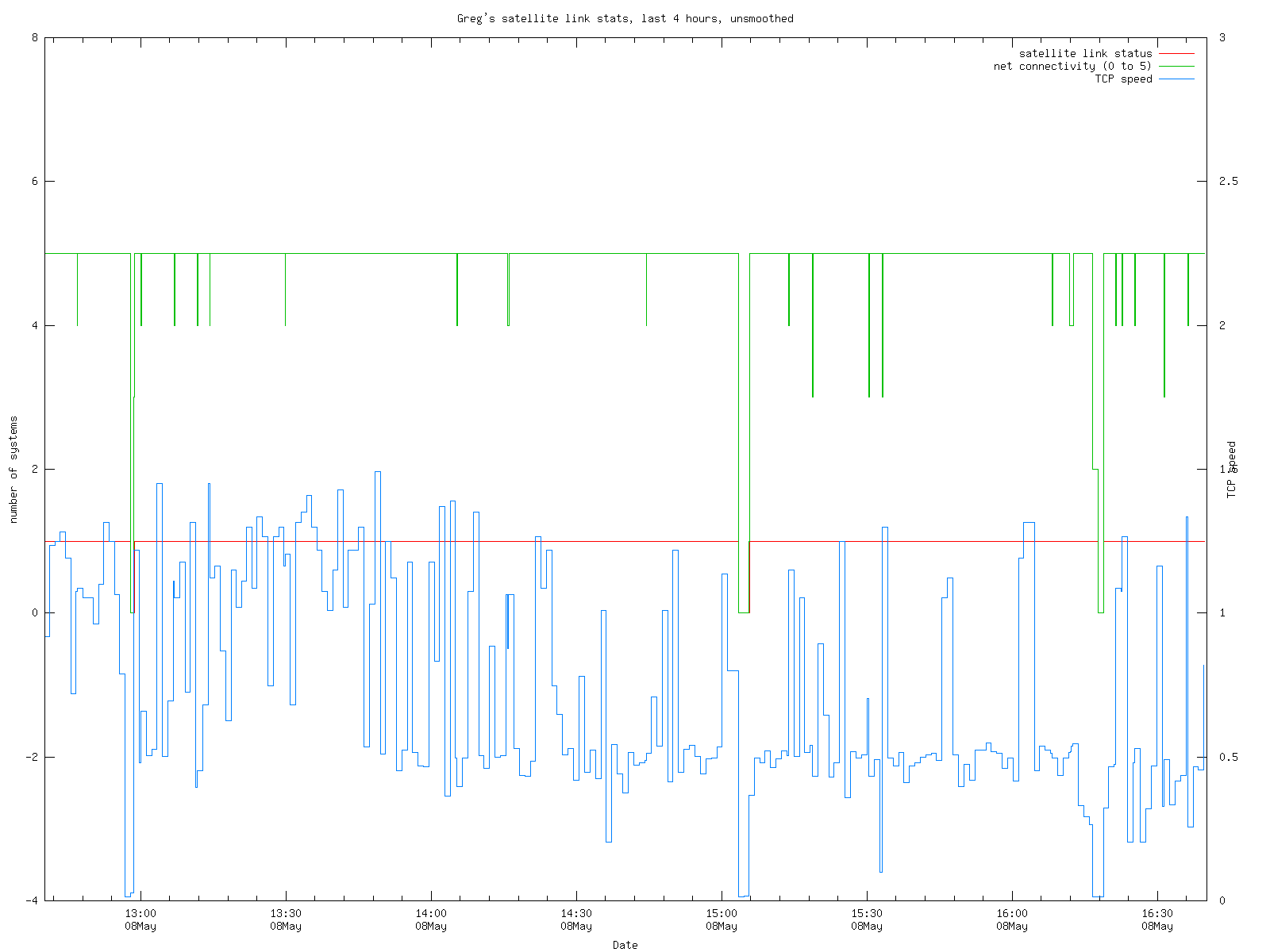
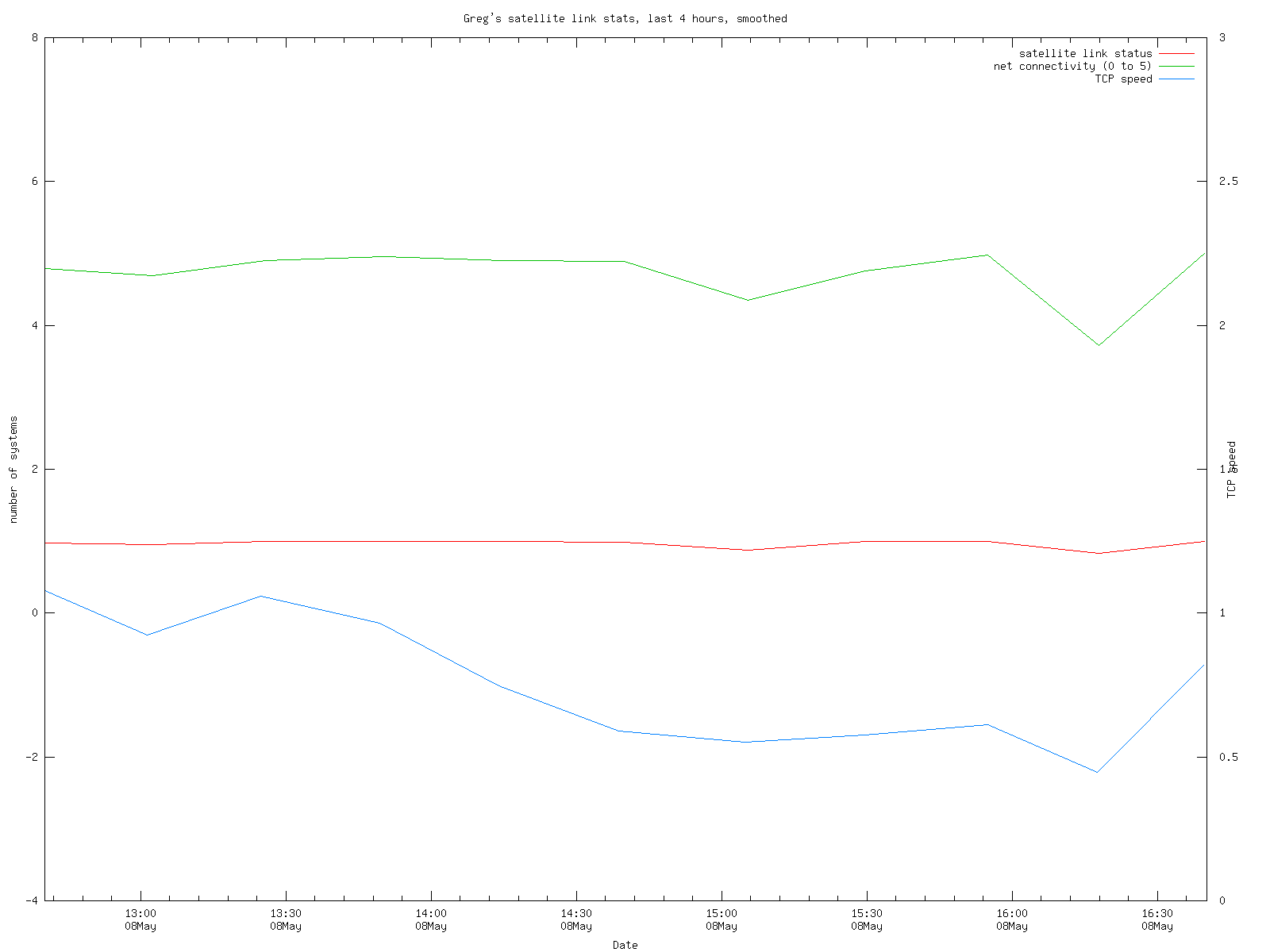
In the course of the day, had no less than 6 outages. Hopefully that's just cutover problems and not an indication of what's to come. But it got me looking for alternatives again. Peter Jeremy tells me that they had 3G connectivity with Optus almost up to our house when they came here three weeks ago, so maybe I should investigate that again.
|
Planting spring bulbs
|
Topic: gardening | Link here |
Some months ago I removed some potted daffodils and tulips, and I've been meaning to plant them almost ever since. Where? We've now removed everything from the original succulent bed:

|
|||||||||||||||||||||||
But we have other things planned for that, and these bulbs flower in early spring, when we're not outside much. So it makes sense to plant them where we'll see them from inside, and the obvious place is to the north of the kitchen, where we normally eat, so planted them in the gravel between the north bed and the house, in groups of three: daffodil, tulip and Watsonia, which will hopefully keep us through most of the spring and into the summer.

|
|||||||||||||||||||||||
While we've only just planted those bulbs, we have a second daffodil (jonquil?) that is already flowering:

|
|||||||||||||||||||||||
I've decided to cut them off and put them in a vase. They last for quite some time, and they have a surprisingly strong (almost overpowering) perfume.
| Topic: general | Link here |
Chris along for dinner in the evening. No silly photos. We seem to have done more than enough. One day I should make an album of them.
| Sunday, 9 May 2010 | Dereel | Images for 9 May 2010 |
| Top of page | ||
| previous day | ||
| next day | ||
| last day |
|
Network: no SMTP
|
Topic: animals, technology | Link here |
We had planned to go riding today, and the weather was ideal. And then I saw:
Further investigation showed that no mail had gone out since midday yesterday, coincidentally the time the satellite network service cut over. I was able to connect to SkyMesh's mail server, and I was just about to complain that they were blocking ports when I found I could also connect to www.lemis.com (also known as ozlabs.org). Called up SkyMesh support and spoke to Ben, who needed some explanation about what was going on (“you can't contact your mail server?”) and put me on hold a couple of times. Finally he accepted that there was a problem, and probably in their configuration, but that nothing could be done until tomorrow.
That was fair enough, but I also pointed out the missing reverse DNS:
Greg: “I was told that my IP address would have reverse DNS”.
Ben: “Where did they say the reverse DNS would be?”
But he says he'll look into that too. In the meantime, put www.lemis.com in my Postfix configuration and confirmed that the mail queue went away.
All that took about 30 minutes, and I was about to go out and saddle up when it occurred to me that the test message I sent myself by way of freebsd.org hadn't come back, so back to look at the log messages again:
My IP address had changed, and the ozlabs configuration refused the new address. Not only did I have to fix the config on ozlabs (to which, fortunately, I have access), but I had to go back and find and manually resend the messages. As it turned out, that didn't take that long, but I didn't know that in advance, didn't want to hold up Chris and Yvonne, and was generally not in the right frame of mind to go riding, so they went without me. Fortunately, the rest went without further incident, but what a pain!
The good news is that the TCP speed seems to have recovered:
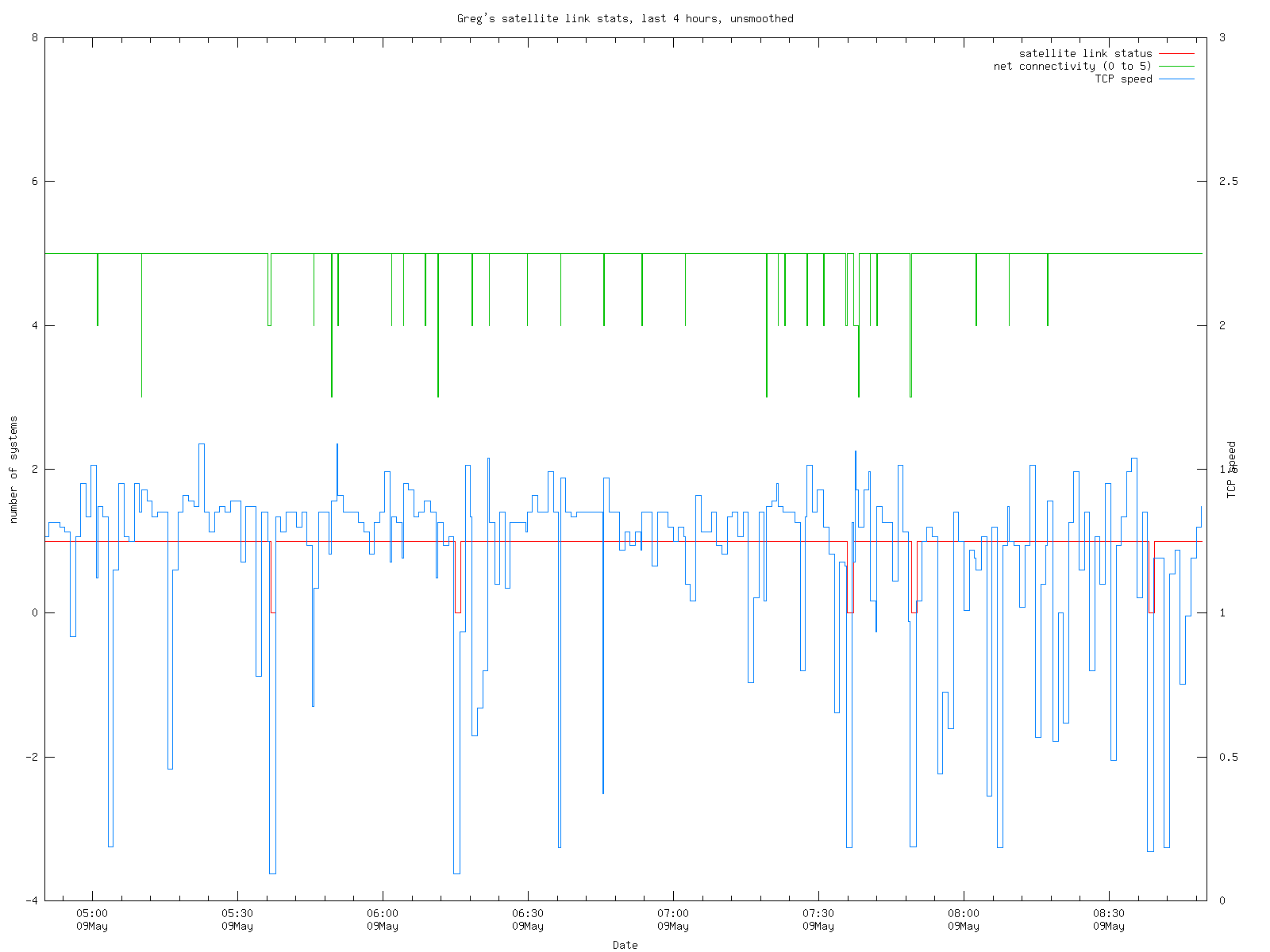
|
Ballarat Bird World
|
Topic: animals, gardening | Link here |
In the afternoon, decided to do something completely different, and off to the Ballarat Bird World to see what they had there. We appear to have been the only guests. The first thing that we saw were no birds at all, just lots of interesting mainly native plants:

|
|||||||||||||||||||||||

|
|||||||||||||||||||||||

|
|||||||||||||||||||||||

|
|||||||||||||||||||||||

|
|||||||||||||||||||||||
The birds were at the other end of the park, mainly in cages:

|
|||||||||||||||||||||||

|
|||||||||||||||||||||||

|
|||||||||||||||||||||||
While we were looking at these birds, Chris, one of the people working at the park, and asked us if we would mind being part of a video they were making, offering us incentives such as half-price tickets next time. I wonder why they need that kind of incentive; it's good enough just to get a free guided tour of the place. Of course we accepted.
Most of it was in the cage with red-tailed black cockatoos (Calyptorhynchus banksii subspecies Macrorhynchus if I understood it correctly), of which they have two friendly males, Cheeky and Jesse. Cheeky is a shoulder cockatoo:

|
|||||||||||||||||||||||

|
|||||||||||||||||||||||

|
|||||||||||||||||||||||
And Jesse doesn't like to be picked up, just to be stroked and be allowed to investigate clothing. It's surprising how gentle they are. They look as if they could bite off a finger if they wanted, but when I held out my hand, Jesse just knocked on it with the curved part of his beak. They're surprisingly agile. It's surprising how accurately they can position the tip of their beak:

|
|||||||||||||||||||||||

|
|||||||||||||||||||||||

|
|||||||||||||||||||||||
The females look different, and for some reason they're not as active. That could just be the individuals, though:

|
|||||||||||||||||||||||
Then past a Major Mitchell cockatoo to the aviary, where we didn't see as many birds as Chris had been expecting. Maybe the flash put them off.

|
|||||||||||||||||||||||

|
|||||||||||||||||||||||

|
|||||||||||||||||||||||
|
Still more plants
|
Topic: gardening | Link here |
On the way home, stopped off at a place in Napoleons where they have plants on sale on the roadside, and ended up spending $53, mainly on pots. Got some “Belladonna lilies”, which I later discovered were Amaryllis, and three plants which I have yet to identify:

|
|||||||||||||||||||||||

|
|||||||||||||||||||||||

|
|||||||||||||||||||||||
While in a gardening mood, attended to the small Salix that Laurel Gordon brought for us last October, and which she suggested we should use as a fake Bonsai. It's not looking happy, but there are a number of buds on the stems:

|
|||||||||||||||||||||||
That's the plant in the foreground; the stuff above is a volunteer Lobelia. I have had the suspicion for some time that the roots are rotting, and that it would be a good idea to re-pot it. Took it out of the pot, and discovered that the roots were in excellent condition: they were about a metre long, and the whole plant was root-bound. So maybe not such a good idea as a bonsai after all. Put it in one of the new pots while we decided where to plant it.

|
|||||||||||||||||||||||

|
|||||||||||||||||||||||
|
Piccola out at night
|
Topic: animals | Link here |
One of the things we decided when we got Piccola was that, though we couldn't bear to see how unhappy she was not being allowed out of the house, she would stay in at night. We thought that getting her to come home in the evening would be easy enough, because that's when we feed her, but lately that doesn't seem to be working. Tonight we spent nearly 30 minutes looking for her, and finally gave up just before she returned by herself. How do we get her to come back at the right time?
| Monday, 10 May 2010 | Dereel | Images for 10 May 2010 |
| Top of page | ||
| previous day | ||
| next day | ||
| last day |
|
Greenhouse: still puzzles
|
Topic: gardening | Link here |
I pretty much have everything in place with the greenhouse now, but there are still a number of things that puzzle me. Chris came over today to take a look, but she couldn't add much:

|
|||||||||||||||||||||||

|
|||||||||||||||||||||||
The problems I have are:
There's nothing at the bottom of the roof to hold the glass in place:

|
|||||||||||||||||||||||

|
|||||||||||||||||||||||
On the other hand, the top side does have a frame:

|
|||||||||||||||||||||||
At first I thought I had missed something out, but there's nowhere to mount anything on that surface.
Part of that could conceivably be explained by the assertion that I have mounted the roof sections the wrong way round after all, but all that seems to fit correctly:

|
|||||||||||||||||||||||

|
|||||||||||||||||||||||
There are three arch gussets left over. It looks as if they might fit between the walls and the rafters, but there are 8 positions and only 3 gussets. I could believe that one gusset could get lost, but 5 sounds less probable.
There are a number of components left over.

|
|||||||||||||||||||||||
The long one is just shorter than the greenhouse, and seems to be designed to fit alongside. But there's only one of them, and the only place a single component that would make sense would be along the top of the roof, and there's no place for it there. It also has only three screw holes: one at one end, and two at an angle close to the other end. That doesn't make much sense to me:

|
|||||||||||||||||||||||

|
|||||||||||||||||||||||
The other three components don't seem to fit anywhere:

|
|||||||||||||||||||||||
I wish I could find somebody else with a Christie's greenhouse for comparison's sake.
|
New succulent bed
|
Topic: gardening | Link here |
While in the garden, finished off the renovation of the succulent bed, using some of our compost in the process. I've decided to sieve it through a wire mesh, which certainly improves the appearance:

|
|||||||||||||||||||||||

|
|||||||||||||||||||||||

|
|||||||||||||||||||||||
How do you transplant a Cycad? Carefully, I suppose, since they're pretty spiky, but I also went to some trouble to get out as many of the roots as possible. I wonder how successful I was:

|
|||||||||||||||||||||||
Planted it in the middle of the round bed, surrounded by some unidentified ground cover that we picked up in Warrnambool a couple of years ago, and with some Gazanias around the outside. Here the development of the bed over the last few years:
|
|||||||||||||||||||||||
|
|||||||||||||||||||||||

|
|||||||||||||||||||||||
|
Ashampoo: context dependent optimization?
|
Topic: photography, technology | Link here |
Yvonne took a lot of photos in the garden while we were doing the work, and I processed them during the afternoon. One of the steps I do is to run it through the Ashampoo photo optimizer to enhance the appearance. It doesn't always improve things, so I always compare the results. Today I had a particularly large number of spectacular failures:

|
|||||||||||||||||||||||

|
|||||||||||||||||||||||

|
|||||||||||||||||||||||

|
|||||||||||||||||||||||

|
|||||||||||||||||||||||

|
|||||||||||||||||||||||

|
|||||||||||||||||||||||

|
|||||||||||||||||||||||
Particularly the first one is astounding. But what's more surprising: this isn't a comparison of unoptimized and “optimized” images. Both images of each pair have been made from the same base image and put through the optimizer. The only difference is that the first one has been done as an individual image, whereas the second one was done in a large batch. I wonder what caused that. Does the optimizer try to learn from other images? If so, it's not doing a very good job. But this is a very old version of the optimizer. I have a newer version, but it's even more point and grunt, and so I never started using it. The other issue here is that all the failed images were taken with Yvonne's Kodak M1093 IS camera. Is there something about those images that upsets Ashampoo? Or the combination of those and images from my E-30?
|
Firefox: glacially slow rendering
|
Topic: technology | Link here |
I'm still using firefox version 3, and over the course of time I've noticed how horribly slow it is in rendering large photo images, such as the “big” version of the images on this page—over 15 seconds for an image on the local web server. Today tried again with Opera, which rendered at acceptable speeds, less than 2 seconds. Time for firefox 3.5? I suppose so, but it's a real pain trying to upgrade things. I'd be use Opera, except that it does other things less well, and it had a habit of leaving no vertical space between images, though it does leave horizontal space. Is that what the standards decree? It seems unlikely, but then I've seen many unlikely things in the web area.
One workaround for the slow rendering problem might be interlaced JPEG images. Did a bit of playing around with that, conveniently helped by ImageMagick's man page for convert:
And that's the only mention of interlace in the man page. To find out what type is, you have to go to the web page. Tried it out, and it worked, but didn't really seem to improve things much. Yes, the image comes more quickly, but the total time is no less, and until it has elapsed, the image is usually in the wrong position.
|
Gardening software
|
Topic: technology, gardening | Link here |
Yvonne is planning a new garden layout. With what tools? Currently a sheet of paper. Wouldn't it be nice to have some drawing software to do the job? Went out looking and found all sorts of stuff, none of which appears to be for UNIX-like operating systems (if you except MacOS). It looks like sketchup might be an option, though the requirements suggest that my Apple is too wimpy to run it. Tomorrow, when the downloads are cheap again.
| Tuesday, 11 May 2010 | Dereel | |
| Top of page | ||
| previous day | ||
| next day | ||
| last day |
|
MacOS X: Who needs backups?
|
Topic: technology | Link here |
I have a pretty rigorous backup schedule for my machines, making a backup every day: level 0 dump at the beginning of the month, level 1 on Saturdays, and level 2 the other days. But some machines get left out of this schedule, notably pain (the Microsoft box) and boskoop (the Apple box), mainly because I hadn't worked out how to do it. In the case of pain I make complete disk images from time to time in order to avoid any strangenesses that might come from restoring partial images. I've done the same with boskoop, mainly out of laziness, but today I decided to add it to the standard backup schedule.
Does Mac OS X have dump? Yes. But it doesn't work:
=== root@boskoop (/dev/ttyp2) /Users/grog 4 -> dump -0uf /dump/boskoop-Darwin/root /
Why not? The man page doesn't say, not even in the BUGS section, but it seems that dump only works on UFS. And the root file system is clearly Apple's HFS+.
So how do you do a backup of that? People suggested that I should use “Time Machine”, which sounds to me like a replacement for cron, but which I'm told is a backup utility. Why does Apple have to come up with such confusing names? Went looking for it, and discovered it's not on my system: I'm running Mac OS 10.4 on my old machine, and “Time Machine” wasn't introduced until 10.5.
So didn't Apple have any backup utility before 10.5? Somebody suggested the Disk Utility so went looking for that. Nothing obvious there; it has a restore but not a backup. But again I'm obviously out-of-date: restore is the new backup. “Mac Help” tells me:
You can use Disk Utility to create a disk image of a single device, folder, or volume. You can use the disk image to transfer files from one computer to another, or burn the image on a CD or DVD and use it to restore the contents of another disk. To learn more about disk images, open Disk Utility, in the /Applications/Utilities folder, and choose Help > Disk Utility Help.
So I did that. And got a page with the headings “Repairing hard drives”, “Erasing disks”, “Partitioning a disk”, “Using RAID sets” and “Using disk images”. It seems that the last is the one I'm looking for, and I'm left with the feeling that the sequence, which is clearly not alphabetic, is in descending order of the importance that Apple places on the function. Also, instead of concentrating on what I'm trying to achieve, the documentation looks at it from the perspective of Apple's baroque implementation. It's also particularly encouraging:
If you created a blank disk image, you may be able to copy files from your hard disk to the image.
Once again I have a disconnect with the mind set of people who write this stuff. It seems that a disk image is just another name for an archive, but I had to find another page to find out how to perform the backup: of course it's a point and click utility, exactly what you want to run in the middle of the night with cron.
And that really seems to be all that Apple offered in the way of backup before Mac OS 10.5. I know that the idea of backups is foreign to non-technical users. But how can you take any vendor seriously when he doesn't even offer a basic backup utility? Yes, it's there now, though I'm not sure I want to look at it, but Mac OS X 10.0 came out in January 1999, and 10.5 was released on 26 October 2007, nearly 9 years later. I've been bitterly disappointed by Mac OS X in many ways, but this really takes the cake.
So what did I do? There's still tar, and that works. How many Apple users even know what that is, and how many of those use it?
|
Gardening software again
|
Topic: technology, gardening | Link here |
As planned, downloaded sketchup and tried it out on the Apple. I don't know whether it's my background or what, but none of this stuff seems to be the slightest bit intuitive. Tried out a few things, but it didn't do what I expected. Clearly any relatively complex program must first be learnt, and there are videos, which I can download in the morning, but I also wonder if there's some issue with running the software over VNC: it seems strange that, when drawing a line, everything seemed to be OK, but the line didn't appear; at some later time it did. So maybe I should try the Microsoft version first. In any case, I'm reminded of the discovery I made in the late 1980s that in many cases the effort required to learn how to use a program isn't worth the trouble.
In the meantime, on the recommendation of many people, I installed xfig, which has a really old-fashioned look about it (Athena widgets, would you believe?), but which seems to do what I expect.
|
Winter on its way
|
Topic: general | Link here |
Yesterday the weather was nice and we did lots of things in the garden; today was completely different:
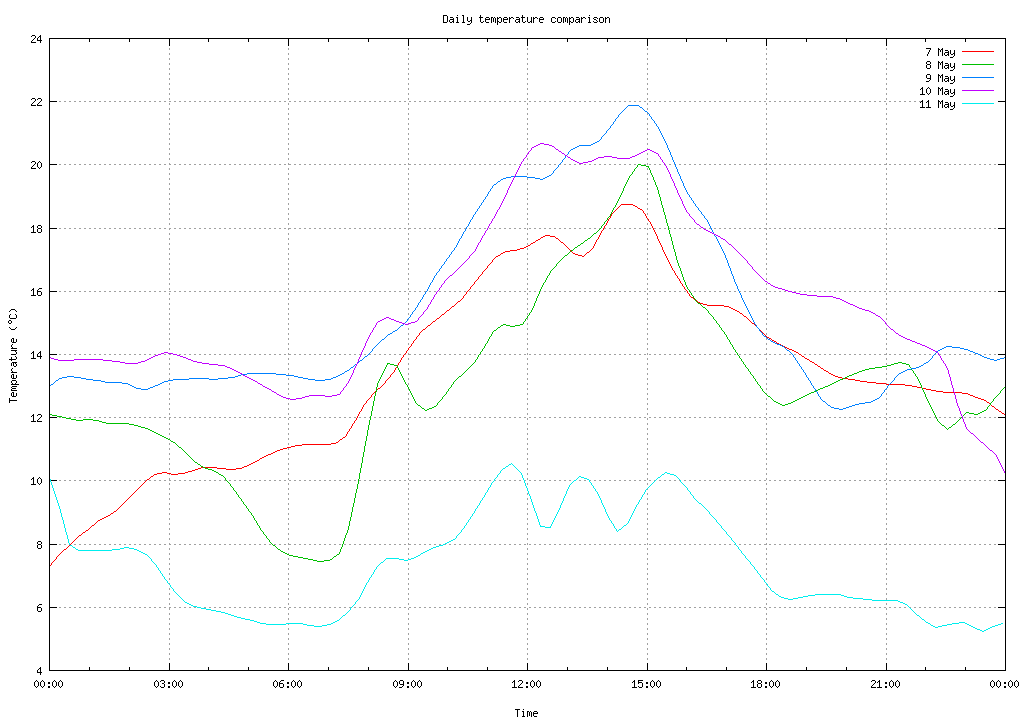
As a result, didn't do very much. It's amazing how miserable it can get when the temperature drops only a little.
|
Deep fried doufu
|
Topic: food and drink | Link here |
When Sue Blake came to the Hackers' barbecue last month, she bought a lot of doufu to live on for the weekend. But then she tried our Indian food and changed her mind, and left the doufu behind. So today we tried a recipe for braised deep fried doufu based on one in “Chinese Home-Style Cooking”, published by the Foreign language press, Beijing, 1990. And it suffers from all the usual problems of cookbooks the world over. I recognized that some of the proportions just had to be wrong, but I still didn't get things right. But it didn't taste that bad; we'll have to improve on it next time round. The only issue is that a dinner with just doufu is a little one-sided.
| Wednesday, 12 May 2010 | Dereel | |
| Top of page | ||
| previous day | ||
| next day | ||
| last day |
|
Satellite connection: worse than ever
|
Topic: technology | Link here |
Int the office this morning to find that my satellite link had been down and up no less than 5 times in the night. And of course we still have no reverse DNS, and no SMTP connectivity to most of the world. Called up SkyMesh support on 1300 662 331, and after 14 minutes waiting was finally connected to Joel, who took another 4 minutes to get my details on his screen—“Sorry, the computer's really slow today”. He confirmed that there were “definitely a few dropouts”, and put me on hold while he spoke with the “senior blokes”, who, he said, were confused about what was going on, and promised that they would call back this afternoon.
In the meantime, did some thinking about the issue, including lots of traceroutes to find out where the problem might lie. Lots of information; the annoying thing seems to be that I can't use TCP with traceroute from here, possibly because BST confuses the issue. But normal traceroute suggests that the problem is quite close to the SkyMesh nodes, as you'd expect. Here's a traceroute to ozlabs.org, which I can reach with SMTP:
=== grog@dereel (/dev/ttypb) ~/public_html/net 111 -> traceroute -e -p 25 www
And here's a traceroute to w3.lemis.com, which isn't reachable:
=== grog@dereel (/dev/ttypb) ~/public_html/net 112 -> traceroute -e -p 25 w3
In all cases, the MTAs I could reach are connected to 203.169.17.38 via Pipe Networks, and the ones I can't read are connected via Vocus. But there's little I can do about that.
That proved not to be the worst thing, though. A couple of hours later I had another dropout. And another. And another. By 13:15 there had been a total of 13 for the day, and we had another 2 in the evening. And round 10:30 the TCP speed halved:
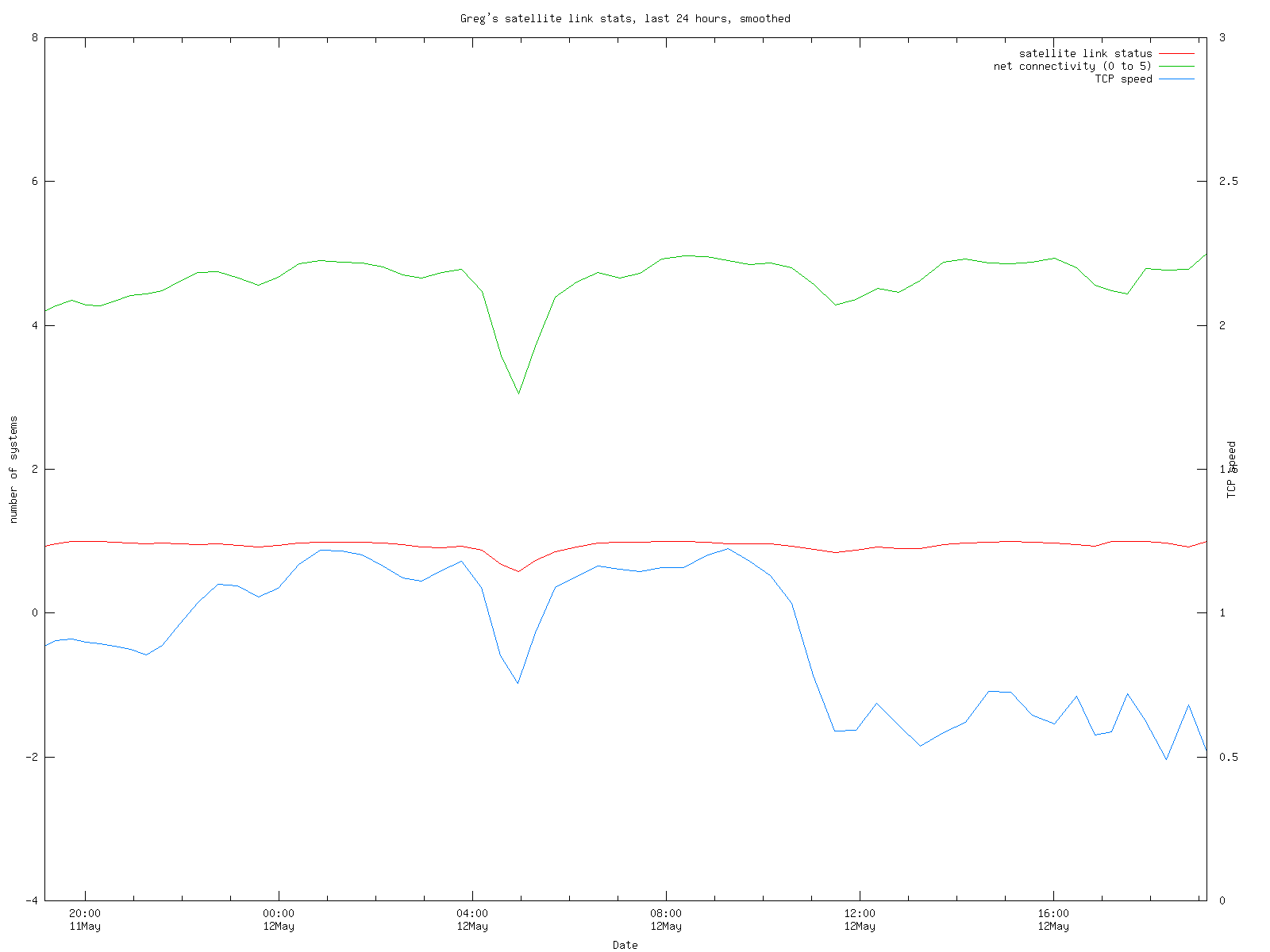
Spent a lot of time looking at alternatives to the situation. It's beginning to look like 3G again. Wouldn't it be nice if Optus could build the Dereel phone tower soon? But I think I might as well invest in an antenna; if only I could be sure that I'd then have coverage.
And of course, no call back from the SkyMesh people. 28 outages in 5 days, and counting:
| Thursday, 13 May 2010 | Dereel | Images for 13 May 2010 |
| Top of page | ||
| previous day | ||
| next day | ||
| last day |
|
GPS navigators
|
Topic: general | Link here |
ALDI had a number of things on offer today, including a cheap GPS navigation system, and I had other things to do in town, so off early with Yvonne to get there when the shop opened: this kind of thing disappears quickly. Last time they opened several minutes early, but today they made up for it by being late. I don't know how many of the systems they had, but they had hidden them at the cash register; I got the second one, and I suppose there were more. Also picked up quite a bit of other stuff for the garden: secateurs, Li-Ion leaf blower (which proves also to suck), Li-Ion hedge trimmer and some bamboo screening.
Then the normal week's food shopping, to Mountain Scenery to order some mulch, and in to town, where we finally found a jacket at Big W—in fact, found two, at quite acceptable prices. Then to David Chestnut looking for a lawn mower—we've decided that we want a ride-on mower after all—but they didn't have anything available, though it looks as if they might in a couple of weeks.
|
ALDI GPS navigator
|
Topic: technology, general | Link here |
Back home, unpacked the toys, most of which required battery charging. The GPS navigator was at least partially charged, but I've never used one before, so I had to RTFM. In fact, there were two little manuals, one entitled “Quick start guide”, which started with useful information: how to get the full user manual, only on the web, and a recommendation to back up the software to a computer:
How to back up your GPS software
Plug the GPS into your computer, it should show as an external hard drive.
Open the drive and copy the main folder onto your computer as a backup file.
I've already commented on this kind of bad language, and also on the backup mentality of commodity computers. So what is a “backup file”? Anyway, it didn't get that far. I plugged the navigator into my Apple, and nothing happened. Investigating the USB bus showed that it was there, but with a strange identification:

|
|
||||||||
Here's the corresponding FreeBSD log file message:
Clearly that's from the device, not the operating system. But how can that show up as a disk? There's every indication that this is down-rev firmware. Did the obvious and tried it with Microsoft (XP), which reported the same messages in a transient little balloon at bottom right, and then refused to find any new hardware when I tried to do something. So finally called up the “support” number, 1 300 886 649, which made me wait for nearly a minute before giving me the option to enter a menu selection (5), and then disconnected me after another 5 minutes. Tried again, and finally I was connected to Sam (a woman), who told me I should install ActiveSync 4.5. What's that? Why do I need it? She couldn't answer that. Followed her instructions, including rebooting the machine (why? Because it's better that way), and nothing of interest happened. Asked to speak to a technician, but there is only one, and he doesn't talk to customers. Finally left her with a complaint saying that I believe I've been given down-rev firmware, and with a request to get a call back. I doubt I'll hear from them.
In the meantime talked to some Microsoft-savvy people on IRC, and discovered that I hadn't installed ActiveSync at all, just saved the install program to disk. And Microsoft's search functions didn't find it because it's called setup.msi, just to make it clear what it belongs to. Ran that and it installed OK and showed a window which didn't make any sense. Rebooted and got the same window again; after a bit of investigation, it appeared to be similar to the “My Computer” window, but apparently showed a directory hierarchy on the GPS receiver. I was able to copy the files off with a point-and-click combination.
So it seems that ActiveSync is a solution to a problem that didn't exist: instead of mounting the device as an external disk, it has introduced some proprietary way of making sure that you have to use only Microsoft's tools to use it. No possibility of using it on an Apple or a BSD machine. And, once again, the documentation is not just misleading but plain wrong. You'd think people were trying to make work for everybody, including themselves.
Then out to play with the device, with mixed results. It's a touch screen device, but given the size and the intended use, this may be the best option, though normally I hate touch screens. The map section is seriously lacking; although it found us, it just put us on “Dirt Road”, and other roads are missing in the map as well. Some of the menus look quite sensible; others are less obvious. For example, I haven't found a way to use it as a map, and I haven't worked out how to zoom in and out on some of the map pages. Clearly I'll have to take some time to get to know this box, not made any easier by the fact that the manufacturer is obviously so in bed with Microsoft that even the manual is in Microsoft “Word” format. But on the whole I'm pleasantly surprised. Just by chance we were watching Goldfinger on TV yesterday and today; that's the film where James Bond's Aston Martin is fitted with a navigator. Science fiction in those days (1964), but this box is only a fraction of the size of the one in the film. How times change.
|
Another fondue
|
Topic: food and drink | Link here |
Fondue again in the evening. What would a fondue be without a coup de mileu? Or two or three?

|
|||||||||||||||||||||||
| Friday, 14 May 2010 | Dereel | Images for 14 May 2010 |
| Top of page | ||
| previous day | ||
| next day | ||
| last day |
|
Ongoing network problems
|
Topic: technology | Link here |
Into the office at about 8:15 this morning, and we had already had four satellite dropouts. And I still don't have reverse DNS. And I still don't have SMTP connectivity. And the promised calls back didn't eventuate. Called up SkyMesh support on 1300 662 331, and this time was connected to Kurt after only 5 minutes waiting. He said they'd have to check the satellite stuff, and that SMTP was blocked by policy, as Ben had told him yesterday. So why didn't they tell me?
The problem is, I have this link under the conditions of the Australian Broadband Guarantee, one of the conditions of which is that I can't change provider. I chose Wideband, later Aussie Broadband, because they didn't do things like that. And one of the conditions of the SkyMesh takeover of Aussie Broadband customers was that the conditions should be the same. So they have no right to block any of my traffic. Told him I couldn't accept that, and that they should enable SMTP by close of business today or I would complain to the Department of Broadband, Communications and the Digital Economy , the administrators of the guarantee. He promised that Robert (who called last week, and who proves to be his boss) would call back in an hour or two. I set a deadline of 13:00, or I would put in my complaint.
All that happened between 9:00 and 13:00 was another measured dropout and several that didn't register. The problem is the way I do my measurements: there are two separate scripts. One pings five different systems, and counts how many respond. The other pings the other end of the satellite link. Pings can fail under normal conditions, so I consider it an outage only if both of these programs get no response from any of these systems. But the 5 pings are sequential, so if we have a short dropout, I might still get a response. Did some work on my network failure program to add an -a option, which considers all satellite link ping failures to be a dropout. The result was very different:
=== grog@dereel (/dev/ttypb) ~/public_html/net 120 -> sort satlinkstats.all satlinkstats | ~/src/net-failures -c -s 2010-5-13 -e 2010-5-13
=== grog@dereel (/dev/ttypb) ~/public_html/net 121 -> sort satlinkstats.all satlinkstats | ~/src/net-failures -c -s 2010-5-13 -e 2010-5-13 -a
But it's difficult to believe that I really had 32 dropouts yesterday. I don't think that this option makes much sense.
By 13:00, I still had not heard back, though I had requested a call from Paul Rees, the managing director of SkyMesh. Called up the sales department, and of course he hadn't been informed. He was working from home, but called me back within 20 minutes and we had a long discussion, from which a number of things emerged:
Based on Paul's immediate and patient response, I'm sure that it was the first he had heard of the issue. While Kurt told me that Robert is the support manager, Paul said that he was the help desk manager, and that they have other support people. I wonder if there's an issue with the help desk. It would certainly explain my dissatisfaction with my previous treatment, and justify my insistence on speaking with Paul.
They do monitor dropouts from their end, based on IPStar's log files; apparently it's a behemoth script that runs in the early hours of the morning and takes up to 5 days to cycle through all connections.
The problem that requires the clear channel (which Paul calls “special class of service”) appears to be a bug in the modem firmware. As we had already gleaned on IRC, the modems use a form of TDM, and they don't always use the time slot. While a modem is inactive, another may take over the time slot, and the first modem has no alternative than to reset, presumably to negotiate a free slot. That makes sense—the modem firmware really is unbelievably buggy, but this suggests that it may be inherent in the design. They seem to be “working on it”, but if they can't even get a web interface that doesn't require Microsoft “Internet Explorer” to work, I don't have much hope.
Based on my dropouts, he was sure that I was not on a clear channel. Based on my measurements, I was sure that I was. He said he would check, and that if I was still getting that many disconnects, it was almost certainly an issue with the modem. I said that I didn't think so, but if changing the modem would fix the problem, I'd accept it. I just don't want to pay money for a new modem if the problem is elsewhere, and so far there's nothing that I can see that points to the modem. He's going to get IPStar to give a suggestion. It seems that they get on better with IPStar than Aussie Broadband did.
He later confirmed that yes, I was on a clear channel, and sent me a printout of IPStar's logs for my modem, conveniently upside-down—I think this is the first time I've seen partially reverse chronological log files. For today we had:
Apart from a spurious claim that the modem was powered down, this tallies quite well with my own logs:
The only difference was the dropout at 04:43, which IPStar didn't register. Checked the log files and found:
Paul attributed this to “greater sensitivity” of my scripts, but clearly there's more to it than that. Still, let's fix the big problems first. Another issue that doesn't look like the modem was a complete dropout for about 80 seconds in the late afternoon:
That's clearly not modem-related. To be observed.
Got a call back from Brett, an engineer who knew what he's talking about, later. Yes, they'll give me SMTP connectivity, but that will require reconfiguring the routers, and they'll pull it in some time next week along with some other changes. That sounds reasonable enough. He also went into more detail about why they think it's a modem issue: in particular, he thinks it could be a misconfiguration, so on Monday we'll go through a complete reconfiguration of the modem.
|
ALDI GPS navigator: defective?
|
Topic: technology | Link here |
Discussing the GPS navigator on IRC, Daniel O'Connor told me that it appeared that the software is based on “Windows Mobile”, a kind of Microsoft “Windows”. That would probably explain why they chose ActiveSync: it is probably part of the SDK. And it's clearly a solution for another problem: how Microsoft can ensure that the devices can only connect to a Microsoft-based computer. That's good for Microsoft, but not for the manufacturer of the GPS. Still, it makes sense.
Contrary to my expectations, I really did get a call back from Sam about the unit. Based on the USB ID string, the technician had determined that the unit is defective, and I should send it back. sigh. What a mess this stuff is! She also confirmed that the unit can't connect to an Apple, and that it shows up under Microsoft as a “mobile device” and not an external disk. So clearly it doesn't work as documented. I'm sure that the unit is as good or bad as any other—we did confirm that the firmware revisions are the latest ones—so this is just another indication of how much mess this combination of incompetent programming and incorrect documentation makes.
|
Nerine, not Ixia
|
Topic: gardening | Link here |
Message from Laurel Gordon including a photo of a Nerine (first photo). It's what I had previously been told was an Ixia (second photo).

|
|||||||||||||||||||||||

|
|||||||||||||||||||||||
| Saturday, 15 May 2010 | Dereel | Images for 15 May 2010 |
| Top of page | ||
| previous day | ||
| next day | ||
| last day |
|
System crash, and the end of an era?
|
Topic: technology | Link here |
A couple of days ago Yvonne had problems with her computer: it kept spontaneously resetting shortly after boot. It sounded like a motherboard problem, so I grabbed another one, put it in the machine, and the problem didn't recur. So interesting that I didn't even mention it in this diary.
Today was photo day, and one of the steps is to make a backup of the photo hierarchy. I do that with rsync to a USB-mounted external disk. Due to the flakiness of the old (pre release 8) FreeBSD USB stack, I don't do this on my own machine: all you need to do is to turn the drive off before umounting it, and the system crashes, requiring hours of fsck and various boot-time tweaks that I still haven't ironed out. So I do it across the network to lagoon, Yvonne's machine. So far we haven't crashed the system.
Today was the day, though. Not only did the system crash—in the middle of the backup—but I couldn't reboot. The boot loader found the second-level boot, but then it couldn't find anything else on the disk. Took it and put it into my test box, and discovered that the disk was well and truly trashed. Most of the root directory looked OK, but some parts were completely wiped:
=== root@swamp (/dev/ttyp0) /lagoon 2 -> ls -l
It took a while to realise that this was the same motherboard that had caused me untold grief in cvr2, and which I had removed because of that. The symptoms match exactly: somehow the USB bus is broken, and using it results in overwritten disks. I really need to label these things better.
But how to recover? I only had one functional motherboard left, the dual processor machine I bought a couple of months ago to replace the one damaged by Powercor last November. Clearly it's good enough: it's a 2.8 GHz dual processor machine with 2 GB memory, and for the first time ever I've been able to build a usable machine with no plug-in cards at all: everything is on the motherboard. Much faster than either of the boards she had before.
But what should I put on it? Building a new FreeBSD machine is becoming more and more of an issue. I had planned and started an upgrade anyway last month, but given it up because of some weird bug that seems to bite only me. And though building ports from source seems like a good idea, and in the past I've supported it, it's becoming more and more fragile in the course of time: I would bet that I wouldn't be able to install all the software I wanted to without some configuration or compilation issues. And somehow, though processors are now nearly 1000 times faster than they were when I started using FreeBSD, building software takes about the same time. As I wrote in 1993:
How long does it take?
It is very difficult to gauge the length of time a port will take to complete. If a port takes a long time, it's not usually because of the speed of the machine you use: few packages take more than a few hours to compile on a fast workstation. Even the complete X11R6 windowing system takes only about 4 hours on a 66 MHz Intel 486 PC.
So I decided to give her my Ubuntu disk, which has most of the stuff on it already. If she likes it, it'll stay that way. Somehow it's like the end of an era: using Linux instead of BSD simply because it's easier. Of course, it's not as simple as that, but it seems to be the first step. Sad, somehow. In my experience, BSD has always been cleaner and more reliable, but it's getting a bit rough at the edges.
|
Another biriani
|
Topic: food and drink | Link here |
It's been a while since we made a lamb biriani, so had another crack at it. It's a lot of work, and it kept me busy most of the afternoon. Yvonne helped a bit and found some weaknesses in my description. It's always good to have somebody else test your docco for you. Emptied a surprising number of jars of various ingredients, including 2 jars of cardamoms and two cans of ghee—in each case almost empty.
Somehow I'm not completely happy with the results. I need to think why. Chris and Yvonne were both happy with it.
| Sunday, 16 May 2010 | Dereel | Images for 16 May 2010 |
| Top of page | ||
| previous day | ||
| next day | ||
| last day |
|
Getting Ubuntu up and flying
|
Topic: technology | Link here |
The first part of migrating Yvonne to Ubuntu was relatively simple: I already had a disk with an installation of 9.10 on it, so all I had to do was add a user. But that immediately caused problems with NFS, because user and group IDs were different. Presumably as a result, mutt refused to access her (NFS-mounted) inbox. Spent a while trying to work out how to change that, and in the end just edited /etc/passwd, /etc/shadow and /etc/group. That included swapping the groups disk and mail. disk is used only for /var/lib/dumpdates, it seems, which is strange in view of the fact that the system doesn't have dump and restore. Hopefully the change of group won't mess up mail.
FreeBSD does have dump and restore, and that's how I backed up Yvonne's files. Started with a restore of the level 0 dump I took at the beginning of the month (on a FreeBSD system, of course; dump and restore are horribly system-dependent), and after working its way through 6 GB of compressed dump, restore returned—nothing. Only an empty directory tree.
Much more investigation revealed that the dump had somehow been aborted in the middle, possibly by the machine powering down (no, there was no power failure at the time). Went back to the old disk, which I thought had been readable yesterday, and discovered that the inode for /home/yvonne was completely trashed. Did that happen since yesterday? It's hard to believe, since I had mounted the disk read-only. Tried fsck, but it left nothing of /home/yvonne and very little of interest in /home/lost+found. So back to the dumps. The level 0 dump of 1 April was OK, and I had a level 1 dump on 30 April and another on 14 May, so the only data I might have lost would have been between 30 April and 1 May, probably very little. Spent much time restoring that.
|
mutt opens inbox read-only
|
Topic: technology | Link here |
But mutt still refused to open the inbox read-write. Did a bit of searching, but everything pointed towards incorrect permissions. The permissions were right, and there were no error messages, but it came up with the folder read-only, and refused to change it. At the very least there should have been a message. Finally gave up and built a debug version of mutt and went through with gdb. To its credit, the code is relatively readable—something that's becoming rare nowadays—and after a while I found it invoking mutt_dotlock, which failed. And no error message. I should fix that when I have the rest of the system up and running. Running the same command from the shell worked. And then I re-read the permissions on mutt_dotlock. They should be like this:
=== root@zaphod (/dev/pts/11) /home/yvonne 135 -> wh mutt mutt_dotlock
wh is a little bash function that finds all occurrences of an executable and shows them in PATH order with the inode number. I added the first link for /usr/local/bin/mutt_dotlock because that's where FreeBSD expects to find it, and I used the FreeBSD version for debugging. The problem, of course, was the setgid bit (the s in -rwxr-sr-x). I had -rwxr-xr-x, so it couldn't lock. But why doesn't it say anything?
That's not the only thing, though. This version of mutt is newer, and they've changed the syntax of the alternates command. Previously it was a variable, and now it's a command, and the syntax itself is different:
It would have been nice to at least have an explanation in the error message, preferably pointing to the wiki entry describing the changes.
|
Ubuntu summary: after 1 day
|
Topic: technology | Link here |
By the end of the day, we had a number of things working, and in fact not too many which still needed attention:
For some reason, Yvonne's firefox doesn't understand Emacs key bindings any more. The trick used to be to have a file ~/.gtkrc-2.0 with the line
But that didn't seem to work for her. Confusingly, it does for me.
The mouse didn't work correctly. That's to be expected: since the sad demise of the middle button, I've taken to remapping it to the left side key (for operation by the right thumb). I still need to find out how to do that with Linux.
And then, of course, there were a number of programs to install, including xv, which will be fun: it's too old for Linux, so I'll have to build it myself.
|
Outgoing mail blocked after all
|
Topic: technology | Link here |
After discovering the SMTP blockage at SkyMesh, I also discovered that they had forgotten to block some systems, those connected to Pipe Networks, and I used that to send my mail. But maybe somebody at SkyMesh is reading this diary; sometime on Thursday afternoon they blocked that too, and once again I didn't find out until today. What the hell. I once had a tunnel for sending mail (I forget why; maybe it was because I was sending it from remote locations where SMTP was blocked), so reinstated that. That'll work until we get things working properly.
|
Making the house plants happy
|
Topic: gardening | Link here |
It's been a little over two weeks since we moved the plants into the kitchen to a position with more light. I think the Schefflera is looking happier:

|
|||||||||||||||||||||||

|
|||||||||||||||||||||||
That loop in the middle of the stem looks like the beginnings of a new branch, complete with the leaves.
Also brought in a flower stem of one of the ginger-like plants that we have in the garden. I don't know what they're called, but they have a particularly sweet scent, and I thought they'd be good in the house. But they don't seem to last. These photos were taken a few hours after I brought them in, and already the flowers are wilting:

|
|||||||||||||||||||||||

|
|||||||||||||||||||||||
| Monday, 17 May 2010 | Dereel | Images for 17 May 2010 |
| Top of page | ||
| previous day | ||
| next day | ||
| last day |
|
Ubuntu: off the beaten track
|
Topic: technology | Link here |
So now I have Ubuntu running on Yvonne's machine, but there are still a number of things to do. The most important was getting xv running on the machine. No package is available on the Ubuntu sites, so went googling and found a number of links: http://itnewscast.com/xv-image-viewer-ubuntu-704, http://www.halibutdepot.org/xv/building_xv_on_ubuntu.html and https://lists.ubuntu.com/archives/ubuntu-users/2006-May/076683.html. Somewhere in there I found the reason there's no package: development stopped in 1994, but people have produced various patches to bring it up to date. But the licence conditions prohibit distribution of modified versions, something that's about as out of date as the base source. This is one case where the FreeBSD approach wins.
The first step was to install a surprising number of packages. By the time I had finished, I had installed patch, libx11-dev, libc6-dev, libtiff-dev, zlib-bin, zlibc, libpng3, libpng12-dev, libpng12-0, zlib1g, zlib1g-dev, libjpeg62-dev, libtiff4-dev, libtiff4, libjasper-dev, libxt-dev, xutils-dev, csh, exif and libimage-exiftool-perl. After that, decided to start with the FreeBSD port and re-run configure. Tried to compile and got a missing header file machine/endian.h. There's a good reason it's missing: it in Linux it's (/usr/include/)endian.h, not (/usr/include/)machine/endian.h. The latter is a BSDism. Somehow the original Makefile had been completely replaced (built with imake, no less), and it defined a variable CSRG_BASED. To get things right, I had to extract and patch the sources, and then build again. And then I got an error in tiff/. Looking at tiff/Makefile, it looks like another FreeBSD hack:
That's Sam Leffler and John Baldwin, both of the FreeBSD project. But it turns out that that was in the original. The real problem was running ranlib (remember that?), and also a redefined sys_errlist. Ended up doing a couple of little patches, and then the thing built. Quite a hack, and certainly not even close to the FreeBSD ports system. But that was to be expected.
Another strangeness:
=== root@zaphod (/dev/pts/11) /src/FreeBSD/ports/graphics/xv/work/xv-3.10a 108 -> make clean all
Checked and found yes, there's a cleandir in that directory, and it's marked executable. So why didn't it run?
=== root@zaphod (/dev/pts/11) /src/FreeBSD/ports/graphics/xv/work/xv-3.10a 109 -> ./cleandir jpeg
So why didn't that message appear from make? It makes things very confusing. Installing csh (another indication of the age of this code) fixed that.
Another unexpected issue was that the resulting executable didn't handle screen refresh correctly. When we first tried it, it didn't change images when a new one was selected; we had to physically move the window before it would refresh. While I was pondering that one, it “fixed” itself, but in case I have to follow up, it seems that xmon might be what I'm looking for—another program for which a port exists in FreeBSD, but not in Ubuntu.
We don't play many games, but years ago I hacked Keith Packard's kklondike, and since then it seems to have disappeared. Found other card games, of course, and installed kpat, xpat2 and aisleriot, but the two Klondike games seem rather pedestrian in comparison: you need to move every card. I'll have to find out how to get hold of kklondike. It's not in the Ubuntu packages, but maybe it's available elsewhere.
|
Air travel: the terrorists have won
|
Topic: opinion, general | Link here |
In the course of my career I have spent more time in aeroplanes than most people. In the fractionally more than a year from 8 May 2005 to 17 May 2006 I flew to North America twice and to Europe 4 times, including once round the world—52 individual flights, or just under one per week. But flying is not what it used to be. Over the decades, terrorists have killed hundreds of innocent people, and round the world authorities continually ramp up security. In the process, they find occupations for brainless morons who revel in their ability to make passengers' life a misery. In the 1980s I used to enjoy travel, certainly helped by Pan Am's policy of giving free first class upgrades to their frequent fliers. But gradually I came to dread the start of a new trip. Once I was under way it was OK, but the dread came again every time. By this time four years ago I was ready to scream at the treatment I was getting. And I haven't flown since. At the beginning of the last time I didn't fly for four years, I was four years old. Another indication of my change in lifestyle.
But why do I dread flying? It's not just the security thugs who make people's life a misery; the airlines seem to be doing their part too. Clearly all this mistreatment costs a lot of money, and they're in trouble. You can understand that, but not that they think that mistreating their passengers is a way to get more passengers.
The real thing, though, is: yes, the terrorists have won. People are scared of them, and they've crippled the air industry. But despite everything that has happened, air travel is an order of magnitude safer than other forms of travel. I won't even start about horses, but car accidents kill orders of magnitude more people than terrorists ever have. And nobody pays much attention to ABC's emetic news bulletin about how yet another driver collided with a tree (how do they aim so well?), or VicRoads' stupid slogans.
I had a link to the stupid slogans, http://www.arrivealive.vic.gov.au/initiatives/safer_roads_and_roadsides/speed_and_sp/speed_limits_save_lives.html, but the site address has gone away.
Clearly they should take some lessons from the terrorists.
|
Weather station presentation
|
Topic: technology, general | Link here |
Tomorrow I'm doing a presentation about my weather station software, and finished the slides. It's funny how starting these things is the most difficult; refining them, even adding images, is relatively trivial.
|
Curry plants: survival?
|
Topic: gardening | Link here |
Last month Peter Jeremy brought me some curry plant suckers, and we planted them. How are they doing? Hard to say. They're not exactly thriving, but they've been in the pots for over a month now, and they don't look any the worse for it. So I suspect things will pick up when spring comes. Here the original plant and then two of my pots:

|
|||||||||||||||||||||||

|
|||||||||||||||||||||||

|
|||||||||||||||||||||||
|
New sourdough starter?
|
Topic: food and drink | Link here |
Baked some bread and also made some kimchi today. It's interesting that both of them use lactobacillus. And then I had an idea: I've been pondering the relatively little lift that my current sourdough starter gives, and Sue Blake was talking recently about making one from scratch, so took some ripe kimchi and added flour and water:

|
|||||||||||||||||||||||

|
|||||||||||||||||||||||
It'll be interesting to see how that works out; hopefully not the way of my last attempt.
| Tuesday, 18 May 2010 | Dereel | Images for 18 May 2010 |
| Top of page | ||
| previous day | ||
| next day | ||
| last day |
|
ALDI GPS navigator: more investigation
|
Topic: technology | Link here |
A couple of days ago I tried out the ALDI GPS navigator without first reading the instructions. Clearly this is a case of “If all else fails, read the manual”. But that makes an assumption:
First I looked at the booklet entitled “Go cruise Navigation System”, 42 pages in length. It refers to a stylus that wasn't delivered. It tells me how to play MP3s. It tells me how to play videos. It tells me how to read e-books. It tells me how to view photos. It doesn't tell me how to navigate.
So I looked at the other booklet, entitled “Quick start guide”. It contains 21 pages, including 6 of EULA containing the startling agreements:
1.1 This Agreement has been entered into by and between Nav N Go Kft. (registered seat: 23 Bérc utca, H-1016 Budapest, Hungary; Company reg.no.: 01-09-891838) as Licensor (hereinafter: Licensor) and You as the User (hereinafter: User; the User and the Licensor jointly referred to as: Parties) in subject of the use of the software product specified in this Agreement.
...
9.5 The parties hereby agree that - depending on the nature of the dispute - either the Pest Central District Court (Pesti Központi Kerületi Bíróság) or the Metropolitan Court of Budapest (Fvárosi Bíróság) will have exclusive jurisdiction to rule on any disputes arising in connection with this Agreement.
The Quick start guide is just that. It contains less information than I have already gleaned by playing with the document. Clearly the meat of the instructions is in the Microsoft “Word” formatted manual. So went to look at that. My Microsoft laptop was in the car waiting to go to the University this evening, so I read it with Apple's “TextEdit”, which, once I persuaded it to show more than a tiny cutout of the document, showed all sorts of strange things:

|
|
||||||||
Gave up on that and tried with OpenOffice on Yvonne's computer. With a bit of mouse-pushing that went quite well, but the results were less than useful:

|
|
||||||||
In fact, all images (including presumably icon images in this example) were missing. The document was completely useless. Bad marks for “TextEdit” and OpenOffice? I asked somebody with a Microsoft “Word” to convert it for me. But that didn't work either: the original document is broken. The strange text in the “TextEdit” document is apparently error messages. The best we can guess is that the document refers to images what were in the same directory as the source file, but they weren't included on the web. So it's completely useless. About the only thing of interest was the statement:
Using a stylus
You do not need a stylus to use Navigation Software. Tap the buttons and the map with your fingertips.
Called up the help line again and after 11 minutes was connected with Sam, with whom I had spoken last week. When she heard my name, we were disconnected. Coincidence? Who knows? After another 13 minutes I was connected with Jake, who wanted my email address to send the document. I'm reluctant to do that sort of thing with people from the Microsoft space: most of the time it ends up as spam, or in a format that is so illegible that I don't want to read it. But clearly this was a time to make an exception. And, of course, no documentation came.
How can people this incompetent stay in business?
|
Credit card expiry
|
Topic: technology, gardening | Link here |
My credit card expires at the end of the month. Rather against my intentions, I didn't change the supplier (it's relatively expensive, gives me Frequent Flyer points, which I clearly don't need any more, and the security is ridiculous), so the new card expires in 2014. And I've received a number of reminders to update online information, like this one from eBay:
This is a courtesy reminder that the following credit/debit card on file for your eBay account will soon expire:
...
To update your credit/debit card information:
1. Go to the eBay Home page.
2. Click My eBay at the top of the page, and sign in with your eBay User ID and password.
3. Click the "Seller Account" link (beneath My Account in the left navigation menu).
4. Follow the instructions for updating your payment method.
OK, that made sense, so I followed the instructions. At point 3, there was no "My Account" link on the left, just an "Account" tab at the top. That had a drop-down menu with "Seller Account", so I selected that. Where are the instructions? I don't know. All I saw was a section "Payment methods for Seller Fees", telling me that I have only PayPal as a payment method. So what is this all about? Yet another case of loose ends and inaccurate documentation? Interestingly, PayPal hasn't sent me a reminder.
|
Weather software presentation
|
Topic: technology, gardening | Link here |
Into town with Chris to talk to BLUG about my weather station software, and also took the opportunity to try out the GPS navigator in earnest. It's really annoying that I can't modify the destination: I give an address or geographical coordinates. Clearly the former is easier, but it's often not very accurate. How do I move the destination? In Google Maps you just drag the point to where you want it. But that doesn't seem to work here. Also, the speed indication was missing in the map display, though I had seen it before. Stopped a couple of times to play with the thing, but no joy with the speed indication.
What we did see was steam coming out of the bonnet of the car. Opened it up, and the steam was coming from the vicinity of the cylinder head. Looks like a head gasket, which would probably mean the end of this 20-year-old car. What timing! Especially as Josh had contacted me to say that he would be late, and that I should start without him. Called up Yvonne and got her to come and pick us up, and then on to the University, arriving only 8 minutes late, but then ran into trouble with the projector, since only Josh knew how to set it up. Ended up using my own, which I had brought with me for exactly that eventuality.
Apart from that, another presentation. There were fewer people present than I had expected, but as usual we went over time, and we had quite a discussion.
| Wednesday, 19 May 2010 | Dereel | Images for 19 May 2010 |
| Top of page | ||
| previous day | ||
| next day | ||
| last day |
|
Car repair
|
Topic: general | Link here |
Out this morning to go and look at what had happened to my car last night. Good news: it was a hose after all.

|
|||||||||||||||||||||||

|
|||||||||||||||||||||||
It's leading in to the inlet manifold. I wonder what that's for. It could be for heating it, except that I thought that that was no longer necessary with fuel-injected engines, and there's no exit pipe. Down to see Paul Sperber at Ballarat Automotive in Sebastopol to leave the car for repair, but he did it on the spot. 15 minutes later and $27 poorer, I was off again. A good thing to: Paul confirmed my suspicions that a new head gasket would cost in the order of $1000, more than the car is worth.
|
GPS experience
|
Topic: technology | Link here |
On the way into Sebastopol, continued playing with the GPS navigator, or more specifically the navigation software. It does some things quite well, others not nearly as well. For example, it has misplaced the town of Enfield by about 3 km. On the other hand, it knows many of the speed limits along the way, and informs you with an indication on the screen and also a verbal message if you go more than 1 or 2 km/h over the limit—but only then. These limits, when it gets them right, are very accurate, within a few metres of the sign. But wouldn't it be a good idea to have at least the option to display the limit on the screen all the time, even if you're not exceeding it?
There were also some minor inaccuracies in the road data. The turnoff from the Midland Highway to Ballarat-Colac road has recently been remodeled to make it more difficult to turn into (“road safety”, I suppose), and the map data doesn't seem to have picked it up: when I turned off, I got the message “recalculating”, which apparently means “you have deviated from my route, and I need to start again to work out how to get you to your destination”. It did it again in Napoleons, where I turned off to see if the roadside plant sales had anything interesting (they didn't). In each case, it also changed from 3D display mode to 2D display mode, which I can only consider to be a bug.
Still no mail from Tempo Australia, of course, so decided to follow up on the presumed name of the manufacturer of the software, Nav N Go. That proved much more successful; in conjunction with the “About” screen on the navigator, which tells me that the software is “GPS IN-CAR Navigation 8.3.4.135494”, I was able to deduce that it's really Nav N Go iGO 8 (you have to love these StudLycApS), and finally found the correct documentation, a slightly different version of the broken document that I downloaded yesterday. Here that document, then the correct version:
|
|
|
||||||||

|
|
||||||||
It's not exactly the same: the name “Nav N Go iGO 8” has been replaced with the more generic “Navigation Software”, and some features described in the manual are not present, notably the choice between 3D maps, 2D maps with north at the top, and 2D maps with travel direction at the top. The device only offers one 2D representation, which seems to switch top from north to travel direction for reasons I haven't understood yet. Also, the manual shows a couple of alternative icons, presumably used in different devices. But it tells me much more about the device, and makes it look better than I had thought.
|
More mail woes
|
Topic: technology | Link here |
Chris tells me that SpamAssassin on our external mail site is still claiming that all mail is from far in the future. We ran into this problem at the beginning of the year, and I fixed it there, but forgot to do it on the external server, where only Chris uses SpamAssassin. Did that today and understood the issues of the completion codes of sa-update. I ran it with the -D (debug, really verbose) option, and the first time it completed with:
I then ran it a second time, and got:
But wouldn't it be nice for it to tell you that if you're not running in “debug” mode?
In the process, noted how long some of these processes have been running:
=== root@w3 (/dev/ttyp2) /usr/local/etc/postfix 33 -> ps aux|grep spam
For that length of time, the CPU usage is quite reasonable. Maybe the recently spawned child does most of the work.
On the home front, finally SkyMesh have unblocked SMTP for me, and they've put reverse mapping on my external gateway address (sat-gw-ext.lemis.com), and even the dropouts have become less frequent. All fine? Not quite. Yvonne came in with details of a message that she had sent, both to me and to a mailing list, and neither person got it. Took a look at the logs and found:
Delivered via SpamAssassin service? Where? I had to look at the log of a successful delivery to see the difference:
This message, too, was delivered by the Spamassassin service, but then it got another connection to send the message on. It seems that this doesn't happen in cases where both I and an external list are involved. At Stephen Rothwell's suggestion, added a line to main.cf:
That seems to have done the trick. But what a pain!
| Thursday, 20 May 2010 | Dereel | Images for 20 May 2010 |
| Top of page | ||
| previous day | ||
| next day | ||
| last day |
| Topic: gardening | Link here |
Finally I don't have so much computer work to do, and the weather was sunny and almost without wind, ideal weather for spraying glyphosate in the garden. Did that, and also planted a few plants, notably the grevilleas that we have been trying to propagate from cuttings. These rectangular cross-sections plastic tubes are really not very good: it's almost impossible to get the soil out in one piece, and two of the three grevilleas that I took out came with almost no soil at all and very little roots. I wonder why; they've been in there for a while, and for a time they looked as if they were growing.
|
Sourdough starter: add yeast
|
Topic: food and drink | Link here |
The sourdough starter that I started from flour and kimchi a few days ago doesn't seem to have done very much:
|
|||||||||||||||||||||||

|
|||||||||||||||||||||||
It has become a lot more liquid, and it smells of Lactobacillus, so maybe that side of things is working, but judging by the lack of bubbles, there doesn't seem to be any yeast in it. If I leave it open to the air I might get some, but why not help on a little? Put in a gram or so of baker's yeast to see what happens. What should happen is that the yeast will die in the acid surroundings, but maybe there's some part of the yeast that can handle it. This isn't the same as just adding yeast to a sourdough to bake bread of course, any more than this starter would be kimchi: whatever yeast is left in the sourdough will be a component of the sourdough after a few generations. In the evening, yes, it had risen. But that might be the only time.
|
Chicken phyllo
|
Topic: food and drink | Link here |
Yvonne was also in an adventurous mood and made an experimental chicken phyllo dish:

|
|||||||||||||||||||||||

|
|||||||||||||||||||||||
Interesting, but probably needs more work. I suspect basil would be a good addition.
| Friday, 21 May 2010 | Dereel | Images for 21 May 2010 |
| Top of page | ||
| previous day | ||
| next day | ||
| last day |
|
Poor TV reception
|
Topic: multimedia, technology | Link here |
Occasionally we get a TV recording that is really messed up, and that's what we had at the beginning of the week. And the next day. And yesterday. Gradually it dawned on me that it was only with SBS. Stopped MythTV and ran tzap to confirm that yes, the signal was much weaker than other channels. Called up SBS on 1 800 500 727 and was connected to Alan, who sounded both like he knew what he was talking about and that he cared. But he didn't have any other reports of poor signal quality, and their own records didn't show anything, so he wanted me to find at least two other people having trouble with SBS reception. He asked if the reception was still bad right now (it had been an hour earlier), but I was running some comparative runs of tzap and couldn't tell him at the time. He said he'd call back later.
In the meantime, decided to go to the neighbours and see if they had digital TV. First to Helen and Robert across the road. Yes, they have digital TV (and Helen was watching it), but she didn't know if they had SBS or not. They did, of course, and the reception was perfect.
So: problem must be in our place. Antenna? Connections? Tried reconnecting the latter, without effect. Then I tried the “Microsoft solution”: reboot. To my immense surprise, that did the trick. But why? I stopped and restarted the processes, and you wouldn't think that something like relative signal strength would be a software problem. Anyway, another one to remember.
And yes, Alan did call back, and I told him the news. He must be the first sensible and helpful person I've run into at SBS.
|
Sourdough progress
|
Topic: food and drink | Link here |
Fed yesterday's sourdough again twice today, the way it's supposed to be, and each time got a fair amount of bubbling. That can't be from the sugar in the original yeast, so it looks as if some kind of symbiosis has already started. Here's the result before and after the “feeding” in the evening:

|
|||||||||||||||||||||||

|
|||||||||||||||||||||||
|
GPS navigator: feedback
|
Topic: technology | Link here |
Mail from Zoltán Rajnai of Nav N Go, referring to my comments about their software. I had considered it a bug that it switches back to 2D view when it recalculates a route. Zoltán tells me it's not a bug, it's a feature, and how to configure it and turn it off:
There's a feature called 'overview mode', where the device switches to 2D North-up view with a pretty low zoom level to give you an overview of the route.
This happens if the distance to the next manuever is above than a configured value.
You can set the configuration for the overview mode in Settings / Navigation settings / Overview mode. There's an option to turn the feature off completely, to set the distance of the next manuever where the overview should kick-in, as well as the your desired zoom level for the overview mode.
It's not quite like that on my navigator, but clearly the people who built it have adapted the software somewhat. Still, the option's there, and though it doesn't make much sense to me (yet), the fact that I can turn it off if I don't like it means that I don't have any cause for complaint. It's also nice to get feedback—a far cry from Tempo Australia, who still haven't replied to my email.
|
Kipfler potatoes: worth the trouble?
|
Topic: gardening, food and drink | Link here |
One of the potato varieties we planted in the spring were Kipfler, which seems to come from Austria (and not Germany, as many pages claim). They're supposed to be particularly tasty. But they're double the price of other seed potatoes (a moot point, I suppose, since you only buy them once), and the shape makes them difficult to process. Today we ate some: after 30 minutes, they were still hard, and in the end we decided they're not worth the trouble. The other kind (“Dutch cream”, which may come from Holland) is easier in all respects, and if anything I think it tastes better.
| Saturday, 22 May 2010 | Dereel | Images for 22 May 2010 |
| Top of page | ||
| previous day | ||
| next day | ||
| last day |
|
First frost of winter
|
Topic: gardening, general | Link here |
Overnight the temperatures sank below zero, the first real frost we have had this winter:

|
|||||||||||||||||||||||

|
|||||||||||||||||||||||

|
|||||||||||||||||||||||

|
|||||||||||||||||||||||
We had a very light one a couple of days ago, but it doesn't seem to have done much harm beyond the Pandorea pandorana (Wonga Wonga vine), which is looking a little unhappy already:

|
|||||||||||||||||||||||
Hopefully it will come good in the spring.
|
Weather station surprises
|
Topic: technology, general | Link here |
Came in to the office this morning to find yet more erroneous values from the weather station, which was claiming a low temperature of -3276.7° and a dew point temperature of -3301.2° for a period of 5 minutes between 6:49 and 6:54. Went and changed them to NULL, as I've been doing with other invalid readings, but in the past invalid readings involved more than just the temperatures, and this time only the temperatures looked wrong. Then I noticed the temperatures either side of this time period: 0.0°. And looking at the reported temperature again, it looked more than familiar: 0x8001. So this brain-damaged weather station is reporting temperatures in sign/magnitude format instead of twos-complement, and the temperature was really -0.1°. More source code mods needed. The incorrect value for the dew point is based on the incorrect temperature.
|
Sourdough progress
|
Topic: food and drink | Link here |
Another two generations of sourdough today:

|
|||||||||||||||||||||||

|
|||||||||||||||||||||||

|
|||||||||||||||||||||||

|
|||||||||||||||||||||||
It's bubbling away nicely, and I can't imagine this is just the bread yeast. It must be getting sugar from somewhere, and I don't know of any Saccharomyces that can do that.
|
More Ashampoo pessimization
|
Topic: photography | Link here |
Photo day today, and this time had more photos than ever to optimize. And again I got some very poor results:
|
|||||||||||||||||||||||

|
|||||||||||||||||||||||
Once again, this isn't a comparison of non-optimized and optimized: it's a comparison of optimized and batch optimized. This happened to two photos, both from a different camera (the Olympus E-30 for most of them, and the Nikon “Coolpix” L1 for these two photos only). I wonder if there's a connection.
|
Understanding panoramas
|
Topic: photography | Link here |
Took my verandah panorama with the wrong lens this morning, the Zuiko Digital ED 12-60mm F2.8-4.0 SWD at 12 mm instead of the Zuiko Digital ED 9-18mm F4.0-5.6 at 9 mm. I repeated the shots when I realized my error, but decided to process the original one as well. The results weren't what I expected:

|
|||||||||||||||||||||||

|
|||||||||||||||||||||||
The individual component photos were taken at the same angles, so the top one (12 mm) is wider. That's to be expected, but the perspective is completely different. In the top photo, the Crassula falcata on the table on the right is directly in a line with the Agapanthus on the floor, but in the bottom photo it's to the right. Spent a lot of time puzzling about this one, but I've come to the conclusion that I must have had the camera just a fraction further to the left for the first set of photos. It's amazing how small differences make the resultant photo look completely different.
|
More HDR experiments
|
Topic: photography | Link here |
The autumn sunshine outside gave me the idea to have another go at creating an HDR photo looking out of the house. Unfortunately, the brilliance of the sun outside suffers as a result:

|
|||||||||||||||||||||||
I wonder if there's a way to tweak that.
| Sunday, 23 May 2010 | Dereel | Images for 23 May 2010 |
| Top of page | ||
| previous day | ||
| next day | ||
| last day |
|
Darah in pain?
|
Topic: animals, general | Link here |
Nice weather again, so out riding this morning with Yvonne (on Carlotta) and Chris (on Dacio). Down to the Dereel air strip:

|
|||||||||||||||||||||||
Round then, we had to turn around, because Carlotta was getting tired. But on the way back, Darah stumbled a couple of times, the same way she had last time, and at one point (fortunately just before we got home) she was in enough pain that I had to dismount. It looks like there is something wrong there; something for the vet to look at. Hopefully it's not too serious.
|
Garden work and greenhouse puzzles
|
Topic: gardening | Link here |
Did some half-hearted work in the garden in the afternoon. Tidied up the area round the bird bath: removed the grass bush that had sprung up there and moved the remains to the south-east corner of the garden. I don't know if it will survive (or would have if we hadn't moved it, for that matter): it's not clear whether they're annual or perennial. Also removed the dead creepers from the Eiffel Tower, where the pandoreas are still looking happy, and did some much-needed weeding at the extreme east.
Then more thinking about the greenhouse. I still don't understand some of the details. We've decided to leave the left-over components out for the moment, in the hope that they can be attached later if necessary, and concentrate on getting the glass in. But we still have the question of the roof. We've already established that things look wrong at the bottom of the surface. In particular, there's nowhere to seat the glass:
|
|||||||||||||||||||||||
David Yeardley should know, but he is currently in the Persian Gulf and unable to look for himself—for some reason his company won't allow web access, or allow email of more than 50 kB, which makes it difficult to send photos. But Chris contacted him, and he replied that things looked correct, and that we should attach the glass at the bottom cross-member with some of the metal S-strips that are used for the glass. Found a sheet of glass (the rest is still at the Yeardley's) and put it in place, held by the thicker-than-normal bolts we bought. Problem: the cross-member is bent down on the inside, so the S-strips won't fit. And the thickness of the rafters means that there's an air gap between the glass and the cross-member. Given that the sides have a rubber seal to keep the air out, this seems wrong:

|
|||||||||||||||||||||||

|
|||||||||||||||||||||||
| Monday, 24 May 2010 | Dereel | Images for 24 May 2010 |
| Top of page | ||
| previous day | ||
| next day | ||
| last day |
|
Progress with greenhouse?
|
Topic: gardening | Link here |
I still don't know what's wrong with the greenhouse, but finally got round to doing what I should have done a long time ago and called up the manufacturer in Dunedin. Spoke to Grant, who told me that they had had the assembly instructions online (locally, it seems) until about a month ago, when the machine with the information on it died—implicitly, there was no backup. Growl. If I had called them up at the beginning, I might now have the assembly instructions. Sent him an email with more details. Hopefully they can find something.
| Topic: food and drink | Link here |
Seekh kebab for dinner this evening. It's a lot of work, and somehow the balance is still wrong. Yvonne and I shared the work, and I decided to mix the final mixture in the Kenwood Chef mixer. You'd think it were ideal, but in fact it's pretty useless. After 5 minutes of mixing and manually folding in the various components, the best we had was:

|
|||||||||||||||||||||||
I could have done it by hand in a fraction of that time. The mixer seems to only work with very specific loads.
| Tuesday, 25 May 2010 | Dereel → Melbourne → Dereel | Images for 25 May 2010 |
| Top of page | ||
| previous day | ||
| next day | ||
| last day |
|
Navigating to Melbourne
|
Topic: technology, general | Link here |
Off to Melbourne shopping today. This was also the first time I used the GPS navigator in earnest. The result? Parts of it are excellent.
I had intended to go to MSY in Brooklyn, but—surprisingly—we got off so early that we would have arrived in Brooklyn before they opened, so decided to go to Springvale first instead.
The navigator wanted to take me to Melbourne via Ballarat, not my favourite way via Geelong, and I had to tell it to go via Bannockburn. To my surprise, it found a better way around Rokewood than I had been able to find for myself, despite some careful examination of the maps. But in Bannockburn it got confused when I turned left instead of right after the level crossing, recalculated, and told me to take a right turn about 300 metres later—but there was no road. After Bannockburn it forgot all about speed limits, and it didn't know the way I took from Bannockburn to Lara. Then things were good again: it does quite a good job in the city, though even there it reports the speed limits very inaccurately. But it knows about speed cameras and red light cameras—it proves that Melbourne is full of them, and I wasn't able to recognize many of them. That warning alone is worth the price of the device.
Got to the Springvale shopping centre without difficulty, and parked in front of the Nan Yang supermarket. The only problem: we had wanted to go to Balkan Meats and Smallgoods first. Did our shopping and then entered the correct destination. Off we went, doing a couple of U turns where I suspect we weren't allowed, and ended up being brought back to a place 20 metres behind our start. It seems that I had set the destination to Balkan Meats and Smallgoods, but they appear to have closed down. It would make sense for the device to tell you when the drive (in this case about 2.5 km) is that much longer than going by foot.
Then off to Hindustan Imports in Dandenong South, which worked well, and then back with the intention to continue to the Wursthütte, but on the way decided that we could make it to the Queen Victoria Market before it closed, so changed the destination on the fly.
That had mixed results: it took me exactly to the destination, getting through the mess south of the city much better than I have ever done on my own. But it dumped us about 500 m from the market: I hadn't entered the address correctly, and I'm still not sure how to do so without a street address. Finding my way manually was an order of magnitude more pain than the navigator. I think it's proved its utility, though I still have a lot to learn about how to use it.
An obvious indication of that was the final destination, MSY, I had put in a route via Bannockburn, since I had originally intended to go there first—so it wanted to take me first to Bannockburn and then to Brooklyn. Clearly that's not the way to force a preferred route.
Once I entered the destination address, it wanted to take me over a toll road, which I ignored. Finally got there with relatively little difficulty, though it's irritating that moving from a frontage road to the main road is reported as “turn right, then turn left”. To be investigated. At least both routes looked an order of magnitude more sensible than what Google Maps later calculated. The way I went was 10.4 km and estimated 11:28 minutes, the “fast” method on the navigator was 13.3 km and estimated 11:26 (!) minutes. Google Maps had distances of 11.7 km (21 minutes) and 17.4 km (27 minutes).
Of course, what's in an estimate? I've already established that Google Maps is far too conservative, but it seems that the navigator is conservative too. On our way home it estimated an arrival time of 16:22; in fact, we arrived at about 16:05. It kept correcting the arrival time as we went, of course. I wonder if it's also learning.
|
MSY in Brooklyn
|
Topic: technology | Link here |
MSY is a bit of a pain. The first time I went there, in Clayton, I had over an hour's wait. The couple of times I've been in Brooklyn were much faster, and today was no exception, but in the past they never had exactly what I had chosen. So today I went in and asked for their cheapest AMD processor, a matching motherboard and 1 GB of memory. All went very quickly, total cost $173. It's still amazing how cheap these things have become. When I started in the business, the Control Data 7600 was the measure of high performance: 2 CPUs with a 27.5 ns cycle time (36 MHz), each with 10 functional units, giving a theoretical maximum throughput of about 730 MIPS. Its memory maxed out at a little under 9 MB.
The Athlon X2 245 I bought today also has 2 CPUs, each with 4 functional units and a cycle time of 345 ps (2.9 GHz). Using the same invalid method as for the 7600, it would thus theoretically be able to perform about 23 GIPS. I only bought 1 GB of memory, or rather more than 100 times the maximum memory of the 7600.
Both of these sets of values are simplistic and unattainable; if they're equally unattainable, they can still serve as a crude comparison. It really does seem that the Athlon is about 20 times as fast as the 7600. That wouldn't be so surprising in itself, but the fact that I can go into a nondescript shop and buy one almost without thinking about it still takes some getting used to.
| Wednesday, 26 May 2010 | Dereel | Images for 26 May 2010 |
| Top of page | ||
| previous day | ||
| next day | ||
| last day |
|
Hardware: no longer a cost factor
|
Topic: technology, opinion, photography | Link here |
Only yesterday I bought a low-end computer motherboard and memory for $173, and a couple of weeks ago the ALDI GPS navigator for $89. It occurs to me that the latter contains detailed maps of all the major cities in Australia, as well as tolerable maps of the country. If I had just bought the maps I need—say, the VicRoads country street directory, Melway, and Sydway and Adelaide street directories, I would probably be in for double that. Not to mention the lessened chance of being caught in a speed trap, which costs over $200.
What about map updates? The navigator conveniently points me at https://www.naviextras.com/, where I can buy lots of maps for prices comparable to or exceeding the cost of the navigator. What I can't find there is an update for my current maps. It almost looks as if it will be cheaper to buy a new navigator (with maps) than the maps by themselves.
Today I got yet another example. I've subscribed to Heise-Verlags new quarterly magazine on digital photography, and as a result received a “free gift” of a 4 GB SDHC card, sent airmail from Germany, with Yet Another Way of writing my address:

|
||||||||||||||||||||||
The card is useful—it's a class 6 card. The ones we have are 8 GB, but they're also class 2, and I was able to confirm that the new one was considerably faster in Yvonne's Kodak M1093 IS. But they don't cost much—in fact, less than the 12 € postage.
|
Spring cleaning
|
Topic: general | Link here |
Yesterday's purchases needed to be stored somewhere, of course. Many things needed to be put in the pantry, which is not the world's largest: it measures 1.4 × 0.8 metres, and in the course of the last nearly 3 years, it has become particularly cluttered. Finally bit the bullet and decided that today was the day to tidy it up:

|
|||||||||||||||||||||||

|
|||||||||||||||||||||||
That took pretty much all day, and in the process I discovered some really old jars:

|
|||||||||||||||||||||||
I've been using the same labels for my jars for nearly 30 years now, and this is different. The bottom two lines are also written in the handwriting of my first wife. I wonder if the contents are that old, or whether we've refilled them.
Also found a lot of other stuff; the oldest with use-by date expired on 16 August 1999. And a lot of dried herbs of the kind we have growing in the garden. Ended up with a big basket of stuff which Yvonne took over to Chris, much of which ended up in the chicken coop or the rubbish bin.
|
Cramped panoramas and fake ring flashes
|
Topic: photography | Link here |
Having tidied up, I needed photos, of course. How do you take a photo in a cramped area like that? A panorama, of course.
That wasn't even as easy as I thought. To get the maximum vertical coverage, it makes sense to set the camera vertically and get the width by taking more individual photos. But that doesn't work with my rails: the camera is no longer above the axis of the panorama head, in fact about 20 cm away. In this situation, that would give impossible parallax errors. So I ended up taking a horizontal panorama, which only got a fraction of the height:

|
|||||||||||||||||||||||
It's clear that I need more hardware, something like a bracket that will tilt the camera independently of the focusing rail. The lighting also greatly needs improving, so I can see myself doing a number of experiments. But these photos brought out another detail I hadn't noticed before: my “ring flash” is in fact a left/right illumination only, as the reflections on the glass jars clearly show:

|
|||||||||||||||||||||||
Is that a problem? Both kinds are available on the market, and they're for different things. In this case, if it had been round, I probably wouldn't have had so many shadows. Maybe I should experiment with other ring flash attachments—but how do you know which ones have round illumination?
|
Vinum adulterated
|
Topic: technology | Link here |
Mail from Peter Ludikovsky today, pointing out that the content on http://www.vinumvm.org/ looks strange. I deregistered the domain a year or two ago after it became clear that there was no future for Vinum. It was on the cards that a domain squatter would take it over, and that's what happened. But no porn or other objectionable content; instead the squatter (Kevin Dunham, 463 Heather Road, Penticton BC V2A 6N8, Canada; I wonder if he's related to Jerry) seems to be subtly modifying the pages.
| Thursday, 27 May 2010 | Dereel | Images for 27 May 2010 |
| Top of page | ||
| previous day | ||
| next day | ||
| last day |
|
Building X clients under Ubuntu
|
Topic: technology | Link here |
Yvonne is still not very happy about the Klondike Solitaire games available with Ubuntu, and wants the old version that Keith Packard wrote decades ago. How difficult can it be? I just need to compile it, after all. But this system comes without sources, even without header files. Which ones should I install? In the end, I installed them all—and they ended up in individual trees in my home directory! What a pain. How do I bend the paths to work at all? I suppose it's at least partially due to the fact that I have to learn all this stuff all over again. But why install sources in somebody's home directory? I'm taken back to the situation when I wrote Porting UNIX Software.
|
GPS documentation: finally
|
Topic: technology | Link here |
Still no proper reply to my mail to Tempo Australia, but took another look on the web site. Finally they have the manual for my GPS navigator online, but only very recently. As firefox half told me:

|
|
||||||||
Wouldn't it be nice to get rid of this mutilation?
|
Panorama hardware
|
Topic: photography | Link here |
So I need more hardware for taking panoramas—maybe. Spent some time investigating what's on the market, and came up with a set of requirements:
Leveling is worth thinking about in more detail. My problem was that the tripod was frequently not on level ground, so the central column wasn't vertical, and I was looking for a leveller that would swivel relative to the tripod head below it. But that's not necessary: if you level the tripod head and then leave it static and rotate the bracket relative to the head, you've achieved the same thing. Probably for this reason, none of the hardware I found has a separate swivel function.
I already have the ability to rotate the camera about the nodal point (criterion 1), and criterion 4, the equally-spaced rotation is more “nice to have” than “must have”, but the other two are important. I've mentioned the trouble levelling the camera, and the immediate cause of my search is the vertical orientation, which I just can't get at the moment. There are devices that seem fulfil all of the requirements. But the prices blew me away! And they don't really seem to relate to the utility of the device. It's clear that I've left the domain of commodity equipment.
The simplest ones only fulfil criterion 2. They only rotate on the level. They're barely better than a pan(orama) and tilt head: the only real advantage is that they have a degree scale. The cheapest I found was the Lenspen adaptor plate at US $17.
Novoflex seems to be a name that you'll find everywhere in the panorama game, and it's one you have to pay for. If $17 is too little to spend, you can spend up to $725 to get something very similar to the Lenspen, the Universal Pro panorama plate. Compared to the LensPen it's “Pro”, of course, and undoubtedly better quality. It offers click stops at preset intervals (criterion 4, 8 steps between 10° and 60°), while with the LensPen you have to read the angles manually. For another $130 you can get a quick release plate that maintains the nodal point distances and helps with changeover from horizontal to vertical, though I wouldn't call it automatic. That's a total of $855, for which you can buy quite a good DSLR body, but it does fulfil all criteria.
Of course, if you have money to burn, you don't need to stop there. The Novoflex VR-PRO kit costs US $1,245 and fulfils all requirements, though I'm still not sure how good the change from horizontal to vertical is.
The Vista Panorama bracket seems to fulfil criterion 3, the ability to switch from horizontal to vertical, but it appears to be only manual. With a pan head it would also fulfil criterion 1. It doesn't seem to address the other requirements, which makes its price (US $149, or $119 on eBay) rather high.
The first adaptor I saw was on eBay, and irritatingly doesn't have a non-eBay page that I can find. The price blew me away: about US $288. It wasn't until I looked more carefully that I found that this is in fact not a bad price by comparison. It fulfils all the requirements above, including—it seems—gimbal-based automatic switching from horizontal to vertical, and 10 swivel increments between 5° and 60°. About the only thing it doesn't have is a second rotation plate for the camera when mounted vertically; but you can buy a LensPen for $17.
Then there's another similar product on the market, also eBay. It's difficult to say what it does, because the description is so poor, and the photos show the thing only folded together. But it doesn't seem to have the gimbal mounting, and it costs US $366, $78 or so more than the other, so I think it would lose out.
Then there are things like the GigaPan Epic 100, which not only gives you a mount, but also a computer to process the panorama for you. I can't see much use in that, but maybe others do. In this price range I'd prefer to pick the best component for each function, rather than take a grab bag.
| Topic: gardening | Link here |
A little weeding in the garden. I should do a lot. The rightmost section of the compost heap has probably reached capacity, and I need to consolidate the leftmost and middle sections:

|
|||||||||||||||||||||||
There's a surprising amount of uncomposted material there. I shouldn't put in so much hard stuff.
|
Experiments
|
Topic: photography | Link here |
While thinking about the panorama hardware, decided to do some experimental 2-D panoramas in the pantry: 3 stripes, one above the other, each of 7 photos. The results were useful in that they showed that I hadn't thought things through:

|
|||||||||||||||||||||||
Decided to do it in two steps: first seven vertical panoramas of three photos each, then stitch them together. But I didn't get that far: the first vertical panorama failed to stitch. It's not surprising. I tried to add manual control points, but at first I thought I had chosen the wrong images. I couldn't work out any communality:

|
|||||||||||||||||||||||

|
|||||||||||||||||||||||
The problem is the extreme parallax: you can't just jack up the tripod and take a photo from the other side. In these images, it looks as if the underside of the shelf at the top is the same in both cases; in fact, the shelf at the top of the lower image is the shelf in the middle of the top image. The illusion is so complete that Hugin is completely confused by the other two images. The control points are all around the shelving and the support:

|
||||||||||||||||||||||
In summary: don't do that, then. The simple way is just to tilt the camera, but that won't create the effect I want. Maybe there is no way to do so.
While in an experimentative mood, took some photos of my office with the lights off, illuminated only by the LEDs in various equipment. This, too, was not a success, not even the optimized version (on the right):

|
|||||||||||||||||||||||

|
|||||||||||||||||||||||
I probably need just a little light to make the foreground visible.
Since then, I have changed my processing. Fifteen years later I came up with this (run the cursor over an image to compare it with its neighbour)
Image title: Office 2 orig Dimensions: 4032 x 3024, 1123 kB Make a single page with this image Hide this image Make this image a thumbnail Make thumbnails of all images on this page Make this image small again Display small version of all images on this page All images taken on Thursday, 27 May 2010, thumbnails All images taken on Thursday, 27 May 2010, small Diary entry for Thursday, 27 May 2010 Complete exposure details

Image title: Office 2 Dimensions: 4049 x 3024, 8998 kB Make a single page with this image Hide this image Make this image a thumbnail Make thumbnails of all images on this page Make this image small again Display small version of all images on this page All images taken on Thursday, 27 May 2010, thumbnails All images taken on Thursday, 27 May 2010, small Diary entry for Thursday, 27 May 2010 Complete exposure details
|
Sourdough and mushrooms
|
Topic: food and drink | Link here |
I've been dragging my feet on the sourdough starter. It's been 3 days since I started the last step, but maybe that's not such a bad thing. How long does the Lactobacillus need to adapt itself to the new material? Once the culture has established itself, it should be a matter of hours, but maybe it needs longer at the beginning. Anyway, it still looked happy enough today, and it was still bubbling mildly:

|
|||||||||||||||||||||||
Also ate some “King Oyster” mushrooms that we had bought in Springvale the other day. They're nice and fleshy, but I wonder if we could have done better than to put them in stir-fry noodles.

|
|||||||||||||||||||||||
| Friday, 28 May 2010 | Dereel | Images for 28 May 2010 |
| Top of page | ||
| previous day | ||
| next day | ||
| last day |
|
eBay reminders and contact
|
Topic: technology | Link here |
Another message from eBay today, reminding me to update my credit card details. This time in HTML, but with just as vague information on how to do it. Since I pay by PayPal and not credit card, that's a strange thing. Tried the “Contact Us”, but of course, Real Web Presence doesn't use email or telephones (in fact, I think they do, or did, but they hide it well), and all I got was a FAQ page where I could enter my “question”, “Why are you sending me credit card expiration reminders, when I pay via PayPal?”. To judge by the input field it was too long for the attention span of the typical webmaster—only about 65% fitted. And what reply did I get?

|
||||||||||||||||||||||
“Select one of these inappropriate replies and we'll tell you how to contact us”. There's an alternative, of course: ignore the whole stupidity.
|
GPS in real life
|
Topic: technology, general | Link here |
Yvonne went shopping today, so I set up the GPS navigator for her. She came back with the information that it had hung itself up, and she had to power it down. That's happened before. I must keep an eye on it.
|
Settling in
|
Topic: general | Link here |
Now that the ideas of building a new house are on ice, it's time to get back to things we had planned to do here. Not too early: there's stuff lying around here that I've been putting off for nearly 2 years. Today put in a dustbin under the kitchen sink, which I found enough to keep me going for the day.
| Saturday, 29 May 2010 | Dereel → Heywood → Dereel | Images for 29 May 2010 |
| Top of page | ||
| previous day | ||
| next day | ||
| last day |
|
GPS Navigator: in the country
|
Topic: general, animals, technology | Link here |
Earlier this week I tried out the GPS navigator going through Melbourne, and I was quite positively impressed. Today we set off for Heywood: I have finally given in to Yvonne's desire to get a new dog, so we set off to Macklin Shepherds to look at a German Shepherd Dog. And of course we used the navigator to get there.
How good was the route it calculated? It certainly found the little roads that I used to get between Adelaide and Dereel three years ago, and which I use whenever I go in that direction. But after that? How can you tell? Like Google Maps, the itinerary doesn't give you any town names. Unlike Google maps, the overview map is far too low-resolution to recognize anything. So my VicRoads country street directory isn't so redundant after all: to find the route, I had to step through the itinerary and compare with the map. Very tedious, and at one point I got the wrong itinerary because I had somehow managed to not delete a “via” (an intermediate point) that I had wanted to put in at Port Fairy, but then decided against. If I hadn't compared the route, I might not have noticed until we were close to Port Fairy. The route it calculated proved to be quite reasonable, though, corresponding pretty much to the one that Google Maps calculated.
On the way, it occurred to us that we should find fuel, preferably at a co-branded Woolworths/Caltex station, where we get 4¢ per litre discount. Isn't it nice to have that kind of information available at your fingertips? We also considered going to an ALDI branch, since they were sold out of some of the specials that Yvonne wanted to buy yesterday. And of course, since the navigator came from ALDI, the locations of all their branches were stored in it. There are others as well, in the category “Shopping”, but there's a separate category “Aldi Poi” [sic]. It proved there was both a petrol station and ALDI very close together on our way in Hamilton, so I entered them as on-the-way stops. It wasn't until much later that I discovered that that completely changed our itinerary, adding 16 km.
About 20 km before Hamilton, the navigator froze up. The display remained, but it didn't do anything, and there was no way to turn it off:

|
|||||||||||||||||||||||

|
|
|||||||||
The blue LED at bottom left is the charge LED, and it is only illuminated when the USB cable (connector on the left, currently without a cable) is connected. Blue means “fully charged”, and red means “charging”. Under the circumstances when the photo was taken (a couple of hours later), it shouldn't be illuminated at all, since the USB cable isn't connected.
And of course the indicated speed is nonsense.
Continued to Hamilton on manual and found ALDI and Woolworths, and even got our specials at ALDI. After some examination of the unit, decided that the little hole above the charge LED might be a reset hole, so back into ALDI and asked for a paper clip (something I should carry with me). But no, it didn't help. It did get the attention of the store manager, who I think is called Kate. She wasn't able to help much, but it wasn't for lack of good will. She did tell me that they've sold “lots” of them, and they haven't had much trouble.
So we left the thing to discharge the batteries, which according to the manual are supposed to last about 3 hours. It didn't quite make that, but they lasted over 2½. Finally it lost power on the way home shortly before Woolsthorpe. And yes, it came back little the worse for wear, though some settings seem to have changed. But it didn't take us through Woolsthorpe: it took us up Harris Road and then told us to turn right into a paddock with no sign of a road anywhere. Went on, and it calculated another route along Bromfields Road, which must count as one of the roughest roads anything has recommended to me:

|
|||||||||||||||||||||||
Fortunately, it was the only unpaved road. But, strangely, the route it calculated back to Dereel was nothing like the one it calculated on the way there, nor like the one that Google Maps calculated (which, not surprisingly, is same as in the other direction). It's also not the same as the one it calculated from Heywood, which didn't make the mistake about going cross-country. As I was able to confirm later, it happened because the route started shortly before Woolsthorpe. Interestingly, the route from Woolsthorpe to Mortlake was actually better than the normal routes.
More minor errors: in Mortlake it told us to take the wrong exit from a roundabout, and the “time remaining” logic seems a little dubious, as I had already noted on Tuesday. From about Mortlake it was clear to me that we would get home at about 14:50, but it continued predicting 15:15 until shortly before we got home, where it gradually oscillated towards the correct arrival time, including giving an arrival time of the current minute when we were still over 4 km away. We finally got there at about 14:51.
So: what do I do now? Clearly either the unit or the software is defective. The extent of the problem suggests that it's the unit. I could take it back to ALDI and get a refund, no questions asked. And then buy something else. But that would mean making all the same discoveries all over again, and if I don't like it as much, tough luck. I can also have it replaced under warranty—maybe. Clearly there's a lot of room for improvement, and I'm sure it'll happen over the next few years. But in particular the lack of overview of routes really irritates me, and it's such an obvious requirement that it's possible that other manufacturers have done a better job. But it's certainly worth its money, though it's a pity we still need paper maps. More thinking needed.
|
A new puppy for Yvonne
|
Topic: animals | Link here |
Our visit in Heywood was to look at the mother of a puppy that Yvonne had booked in advance: their puppies are booked out before they're born. But Linda Maclean had just had a refusal, so we did have the opportunity to pick up a dog (no choice, however). Took a look round, and as I suspected, Yvonne decided she liked the dog, kennel name Macklin Preto, who was born on 1 April 2010:

|
|||||||||||||||||||||||
Off again within the hour, stopping a couple of times to let the dog vomit.

|
|||||||||||||||||||||||
He's a friendly enough thing, and has already taken to following Yvonne around. The cats behaved predictably, but even by the evening things were already looking better, and Piccola was showing some interest in him.
| Sunday, 30 May 2010 | Dereel | Images for 30 May 2010 |
| Top of page | ||
| previous day | ||
| next day | ||
| last day |
|
Three years, part one
|
Topic: general, gardening | Link here |
Three years ago today we were searching for houses in the Dereel area, and we first saw the house we're living in. It wasn't exactly love at first sight, but a whole lot better than the others we had seen, and within 1½ months we had moved in. I took some photos of the house at the time, and every year since then I've tried to recreate the garden photos from the same point of view. Did so again today; clearly things have changed a lot:
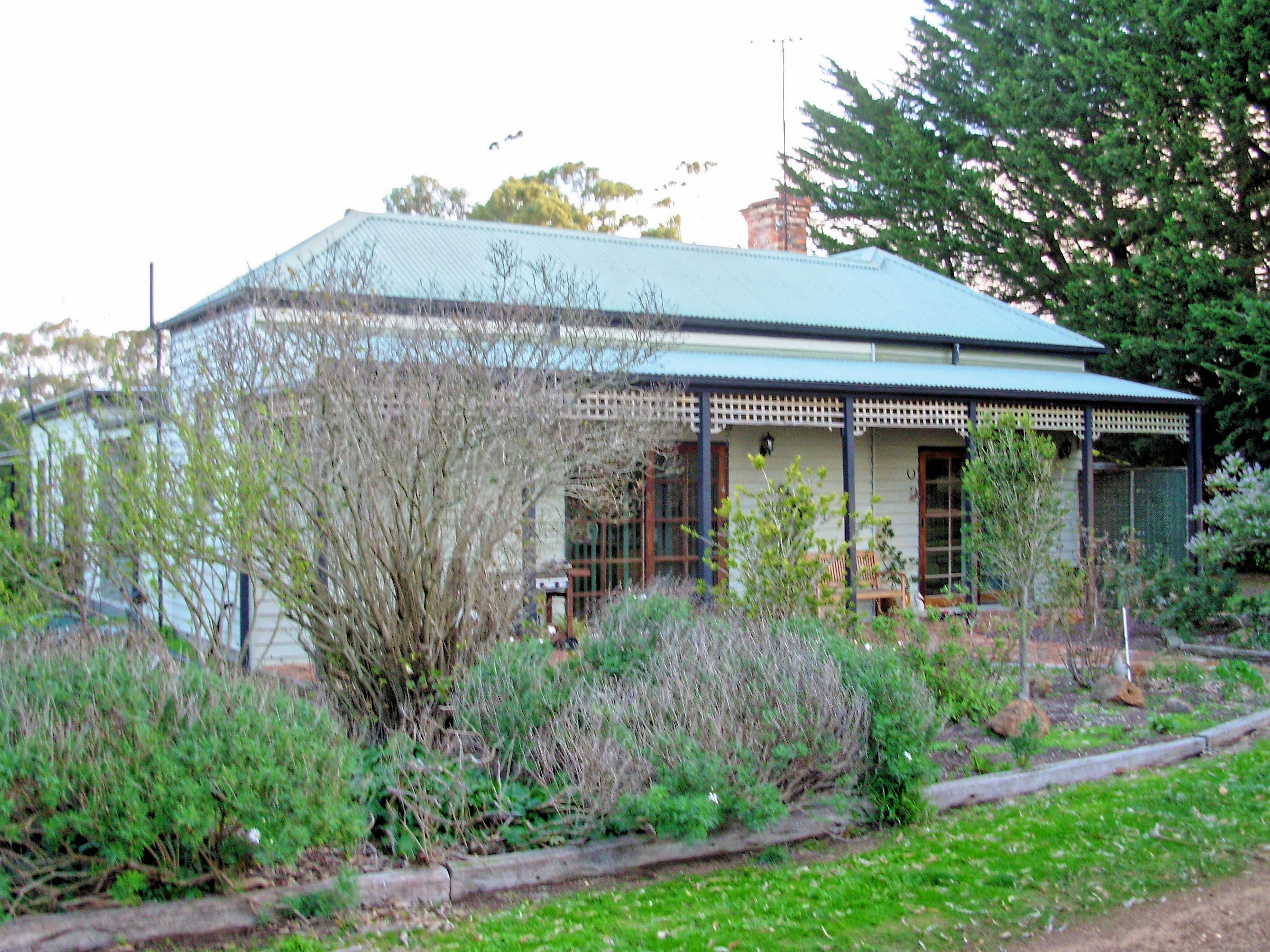
|
|||||||||||||||||||||||

|
|||||||||||||||||||||||
When we first saw the house, the daisy bushes had a couple of solitary flowers on them. Since then, they've bloomed relatively well, presumably because of the irrigation we installed, though they're getting a bit old now. It's also interesting to note how much the Callistemons have grown, despite relatively heavy pruning. On the left, the tall yellow-blooming trees don't seem to have been there at all when we first saw the house. The one on the right definitely self-seeded. They're almost certainly Senna aciphylla, and that link suggests that they're weeds.

|
|||||||||||||||||||||||

|
|||||||||||||||||||||||
Here, of course, the big difference is the verandah. If I had taken the original photo from a little further away, the difference would be even more impressive. The smaller of the two birch trees (now almost without leaves) has now grown into the left of the photo.
When we first saw the house, we had little idea of how we would use the area. The remainder of the photos are a good indication of that: they're of areas we hardly use.

|
|||||||||||||||||||||||

|
|||||||||||||||||||||||
In this photo, the increase in the size of the taller birch tree is evident. And a number of the trees below have also grown significantly.

|
|||||||||||||||||||||||

|
|||||||||||||||||||||||

|
|||||||||||||||||||||||

|
|||||||||||||||||||||||
|
Darah and the chiropractor
|
Topic: animals | Link here |
Caroline Hamilton, the equine chiropractor, came along this morning to take a look at Darah, who has been stumbling a lot. She found a lot wrong with her, probably starting from the hip, but now extending along the whole left side of the body. It looks as if she'll recover though, not a foregone conclusion for a 17 year old horse, but it'll be a while before I can ride her again.

|
|||||||||||||||||||||||

|
|||||||||||||||||||||||

|
|||||||||||||||||||||||
|
Panorama brackets revisited
|
Topic: photography, opinion | Link here |
I've been doing a lot of thinking about panorama brackets, and it's clear that my previous criteria could have been stated more logically:
The first criterion is the important one; you can achieve the other two by other means. And that shows how difficult it is to determine whether the offerings on eBay are useful or not. About all you can see is that the people who took the photos didn't understand the problems, as evidenced by the best photo from the eBay vendor LinkDelight:

|
|
||||||||
The camera is too low—the axis of the lens must be the same as the axis of the pivot above—and it's pointing in the wrong direction to allow more than one of the pivot axes to go through the nodal point. There's also no adjustment along the lens axis. You could fix both of these by turning the camera to the right and lifting it to the pivot axis, but then the pivot would just rotate the camera around the lens axis. I can't think of any locations of interest there except for vertical and horizontal; it would be useless for vertical panoramas. What's missing here is a third rail. If we left the camera in the orientation it has and mounted it on a rail enabling it to be moved along the lens axis, it might work. But this bracket doesn't seem to have that.
Then took a look at Wikipedia and found—as so often nowadays—a lot of useful information, including a description page with an animated GIF with an amazingly incongruous background. There are also a lot of links to follow, including a do-it-yourself “Nodal Samurai” for $2.50 in some unspecified currency (the page comes from the UK, so it's not local). The unusual name is clearly a word play on Nodal Ninja, another manufacturer of this kind of equipment. More stuff to investigate.
|
GNOME and Ubuntu: too Microsoft-like?
|
Topic: technology | Link here |
Yvonne has been using Ubuntu on her machine for two weeks now. We still don't have all the wrinkles ironed out: xv is still misbehaving, not updating a display until the window is moved. And even Yvonne, who doesn't keep many windows on the screen, ran into layout problems with GNOME window manager: it puts them all at the bottom, and at some point there's not enough space to put any text in them. This makes it almost impossible to maintain an overview, or even find a window once it has been iconified. I suppose it's one of the reasons browsers added tabs: a restrictive workaround for a severely restrictive and unchangeable layout policy.
We could solve the second problem by installing fvwm as the window manager; I seem to recall that that worked in the past. The problem with xv also looks like a window manager issue, so I'll postpone looking at that until I have fvwm running. I don't even want to think about building kklondike.
|
Roast beef and Yorkshire pudding
|
Topic: food and drink | Link here |
Chris Yeardley over for dinner. She had given us a piece of beef to roast, nothing particularly unusual (though it was a surprisingly good piece of meat). But somehow things went wrong yet again—I never had trouble in the distant past, but this is the third time I've been disappointed in the Yorkshire pudding. Last time the Kenwood mixer didn't mix properly, so this time I helped it by hand, which was necessary. But the pudding didn't rise—why? This is exactly the same recipe I always use.
The beef didn't quite do what I wanted either. According to the old English book I have, it should be cooked in a hot oven for 20 minutes/lb and 15 minutes over. Our piece of meat weighed 1.25 kg, or 2.75 lb, so the time should have been 70 minutes. In fact, it was done in 45 minutes. What went wrong? The fan? Or a British idea that roast beef should be cooked through? This is Georgina Horley's “Good food on a budget”, normally a well-balanced book.
|
Getting used to Nemo
|
Topic: animals | Link here |
So, we've decided on a name for the dog: Nemo. He spent most of the day following Yvonne around, and gradually the cats are getting less concerned about him, though Lilac in particular goes out of her way to avoid him:

|
|||||||||||||||||||||||

|
|||||||||||||||||||||||
| Monday, 31 May 2010 | Dereel | Images for 31 May 2010 |
| Top of page | ||
| previous day |
|
New computer for Yvonne
|
Topic: technology | Link here |
Two weeks ago I had thought I could save myself work by migrating Yvonne's computer from FreeBSD to Ubuntu Linux. I think I can now safely say that it hasn't saved me any work, and it doesn't look like doing so in the immediate future. If you want Microsoft-space GUIs and lots of pushing mice around, OK, but if you want to have some control over the environment, it's more pain than it's worth. So today I finally put together the machine I bought last week and started installing FreeBSD on it.
That's still a pain; there seems to be no way to avoid it. I installed 8.0-RELEASE because it was the most recent DVD I have, and with SkyMesh I no longer have free downloads from a mirror server. Upgrading to the current stable (8.1-PRERELEASE) was straightforward enough, and I didn't run into the problems with groff fonts that have been bugging me lately. But then came the ports. Spent most of the afternoon building X, which seems to have been deliberately split up to make installation more difficult. For reasons I don't understand, the build failed because perl was missing. Presumably the dependencies are so complicated that it can't be installed automatically. By evening I still wasn't finished—a far cry from my quote earlier this month:
Even the complete X11R6 windowing system takes only about 4 hours on a 66 MHz Intel 486 PC.
|
Conroy's dog fence: what people think
|
Topic: technology | Link here |
The Australian government is still planning their stupid Internet filter, and the latest claim is obviously not only less than accurate, but seems to have annoyed iiNet one of Australia's largest ISPs. They've responded with a pretty clear statement. But then, if Senator Conroy thinks that Internet filtering is even possible, it's not surprising that he completely misunderstands everything else too.
|
Magshop outdoes itself
|
Topic: general | Link here |
Last month I had a particularly painful experience with the Magshop web site. I had expected that the matter would be finished there. But with the latest issue of Money Magazine I got a special offer that I thought might be worth following up. Log in to the web site. My birth date is now 11 April 2010, the day I last accessed the web site (as a new-born, no doubt), and I have no subscriptions.
Called up the help desk line and spoke to Fabian (or was that Fabien? It's really difficult to get them to enunciate mumble more clearly), who was able to confirm that yes, I do have a subscription, and that he would get the web team to find out what went wrong and call me back. I won't hold my breath.
|
Tempo Australia outdo themselves
|
Topic: technology, general, opinion | Link here |
Called Tempo Australia today about the defective GPS navigator. This time there was a different recorded message: “We are experiencing far too many calls right now. Please call back later. Click”. They're certainly doing what they can to confirm my low opinion of them. Maybe I should really return the unit to ALDI.
|
More panorama equipment
|
Topic: photography | Link here |
More investigation of panorama mountings today. Yesterday I looked at the online shops, and today I tried the more logical step of looking for online documentation. On the face of it, Nodal Ninja looks like a good choice, but all the illustrations show it with the camera mounted in portrait position, and there's no obvious way to switch to landscape. Why is all this stuff so complicated?
|
Which ultra-wide angle lens?
|
Topic: photography | Link here |
I've been lusting after the Olympus Zuiko digital ED 7-14mm f/4 super-wide angle lens for some time now, but it's horribly expensive—about US $1500. And now Panasonic has come out with a lens with the same specification for the Micro Four Thirds system, and conveniently hidden its web page behind a variable URL, so I can't quote it. It's still not cheap: it costs about US $1000. But for the difference, I could buy a camera and standard lens to go with it. Which should I choose? “Neither” is a very valid answer. Did some investigation of the Panasonic lens, which wasn't very encouraging: dpreview found lots of problems with it, particularly in conjunction with an Olympus body, though they did praise it. Strangely, they compared it with two other Olympus lenses (both 9-18 mm), but not with the Olympus 7-14 mm.
|
More cooking time woes
|
Topic: food and drink | Link here |
Just yesterday we had trouble with cooking times, and it happened again today. How long do you cook a chicken, and what temperature does it have where when it's done? Answer: for a 2 kg chicken, it takes about 100 minutes, and the breast has a temperature of 88° when it's done. The latter is what I had expected two years ago, but I still hadn't got the times right. Time to start a new page to gather information.
Do you have a comment about something I have written? This is a diary, not a “blog”, and there is deliberately no provision for directly adding comments. It's also not a vehicle for third-party content. But I welcome feedback and try to reply to all messages I receive. See the diary overview for more details. If you do send me a message relating to something I have written, please indicate whether you'd prefer me not to mention your name. Otherwise I'll assume that it's OK to do so.
| Top of page | Previous month | Greg's home page | Today's diary entry | Next month | Greg's photos | Copyright information |


