
|
| Greg's diary |
| November 2012 |
|
|
||||||||||||||||||||||||||||||||||||||||||||||||||||||||||||||||||||||
|
|
|
|||||||||||||||||||||||||||||||||||||||||||||||||||||||||||||||||||||||||||||||||
| Thursday, 1 November 2012 | Dereel | Images for 1 November 2012 |
| Top of page | ||
| next day | ||
| last day |
|
Too cold for gardening
|
Topic: gardening | Link here |
I've done little in the garden recently because it was too hot—33° yesterday, and even warmer before. Today the highest temperature was only 18.1°. That doesn't sound too bad, but it was shortly after midnight. During the day the highest temperature hardly went above 12°. In addition it was raining much of the time, so once again I hardly got anything done.
|
More DxO pain
|
Topic: photography, technology | Link here |
My support issues with DxO Optics “Pro” are getting no better. The one problem that remains is the silly duplicate, incorrectly sorted display of images in the “Process” tab. I've asked four times for this to be addressed, without success, and now I just get the message “This ticket is closed”. Hopefully this is just the individual support person and not the company. Put in another ticket, in German in the hope that somebody else will get it. We'll see.
|
More rotator pain
|
Topic: photography | Link here |
I have to face up to the facts: the Sunwayfoto DDP-64M rotator that I got only 9 months ago is already defective: the detent interval setting knob has worn a groove in the drum inside round the 45 degree setting, and it's getting to the point where I can't set the detents easily. I sent a message to the (eBay) seller a couple of days ago, but didn't get a reply. Tried again via the eBay interface (really a question on a similar item that he had for sale) and got a reply: return it and it will be replaced. That's still a cost factor, of course, but it's nice to know that it can be replaced.
In the meantime, took another look at the Manfrotto setup that it replaced:

The rotator is the only part of this terminally silly 303PLUS bracket that is of much use, so went to see if I could detach it from the rails on top. Yes, up to a point: the base of the rail is screwed to the rotator with a screw that can't be removed without drilling it out, something I don't want to do. But maybe I could use just the rail. Originally I had attached an L bracket to that rail to at least be able to rotate it on a horizontal axis:

|
|||||||||||||||||||||||
When I got the Sunway, I attached a panorama bracket to it via a focusing rail:

|
|||||||||||||||||||||||
So it should be simple to remove the bracket from the rail and attach the panorama bracket to the Manfrotto rail, right? Wrong. Manfrotto have put yet another obstacle in my path. The holes in the rail are offset from the middle:

|
|||||||||||||||||||||||
So yet again the strange design of this device has caused me grief. I could drill more holes, of course, but I still hope to be able to sell the whole thing, and that wouldn't help.
| Friday, 2 November 2012 | Dereel | Images for 2 November 2012 |
| Top of page | ||
| previous day | ||
| next day | ||
| last day |
|
DxO problem: worked around
|
Topic: photography, technology | Link here |
A message from another DxO support person today, an English reply (judging by the name Olivier presumably from a Frenchman) to my German problem report stating once again that my Microsoft “Windows” XP system with 3 GB of memory was too wimpy to run DxO Optics “Pro”, independent of the processor. Never mind that the specifications say a minimum of 2 GB, nor that at the time the problem occurred the system had 2 GB of memory free, nor that the problem also occurs with the 64 bit version of “Windows” 8.
In addition, despite many requests for trace output, he couldn't find it. Never mind that this was in relation to the SMB issues: it was in an earlier bug report that had been closed as “solved”.
All in all, I didn't get the warm fuzzy feeling that people were taking the issues seriously. Still, he wanted a trace, so I gave him a trace. In the process, also put the images—all 2.5 GB of them—on a local NTFS file system so that the SMB issues wouldn't muddy the waters. Sent the whole thing off again. I wonder what I'll hear next.
While playing around later, discovered the solution not to this problem, but to the one I wanted solved. In ticket 3490, I asked and heard:
But that's wrong! It is possible to suppress it, both in release 7 and release 8. The real problem is that preferences are strewn around the program: there's a “Edit → Preferences” menu, a “Palettes” menu in the “Customize” tab, and today I discovered various icons for selection of which images to display, looking like an electronic circuit diagram antenna symbol, which they call “Filter”:

|
|
||||||||
This example shows that I have suppressed the display of all images except the one being processed and any in error; I could suppress them too, but currently I'm playing with it.
That's all I wanted. The bug is still there, but I don't have to see it, so I'm happy with the result, if not with DxO support. If the preferences were all kept in one place, this issue would probably never have arisen. As it is, not even the support people knew the answer.
|
More panorama hardware experiments
|
Topic: photography | Link here |
So I can't mount my panorama head on the the Manfrotto rotator because, stupidly, the holes in the rail are offset from the axis of rotation. But that's not as much of a problem as it appeared to be. All I need to do is to mount the crossrail to perform the adjustment. So did that: it looks as if I'm now prepared for tomorrow's photos with the Manfrotto. It's not as if things are perfect, of course: the second rail positions my bracket in the correct place, but it also sticks out into the image:

|
|||||||||||||||||||||||
I'll have to find a solution for that now. This silly Manfrotto bracket is nothing but pain.
|
More spring flowers
|
Topic: gardening | Link here |
For the past couple of years I've been taking complete photo series of the flowers in the garden every month, and currently I'm doing it in the middle of the month. But at this time of year so many new things are coming out, especially after the recent couple of warm days. We've had some potted grasses for years, and they haven't done very well. One didn't even want to sit up in its pot. A few months back I moved it from the (big eastern) verandah to the north verandah, near the entrance to the kitchen. It seems to like the change and is now flowering for the first time:

|
|||||||||||||||||||||||

|
|||||||||||||||||||||||
The roses looked a little unhappy last year, so I've given them a lot more fertilizer. That seems to be what they needed. Now we have Iceberg and Banksia roses (the latter flowering for the first time) on the garden arch:

|
|||||||||||||||||||||||

|
|||||||||||||||||||||||

|
|||||||||||||||||||||||
And the “Monsieur Tillier” and „Gruss an Aachen“ roses are flowering happily:

|
|||||||||||||||||||||||

|
|||||||||||||||||||||||
Other plants seem to be doing so much better than in previous years. The Clematis “Vagabond” continues to flower, while the “Pearl d'azure” is still thinking about it; the Grevillea longistyla x johnsonii “Elegance” is flowering like never before, and the Alstroemeria is going overboard, but I can't really do much about it until the autumn, so we're going to have a big show this year.

|
|||||||||||||||||||||||

|
|||||||||||||||||||||||

|
|||||||||||||||||||||||
And the Limonium perezii and the unspecified Erodium are flowering for the first time:

|
|||||||||||||||||||||||

|
|||||||||||||||||||||||
In addition, the Camellia japonica is still flowering, though it's pretty much over and done with now. But that's been over three months since it started flowering.

|
|||||||||||||||||||||||
| Saturday, 3 November 2012 | Dereel | Images for 3 November 2012 |
| Top of page | ||
| previous day | ||
| next day | ||
| last day |
|
Ballarat Gardens in Spring, day 1
|
Topic: gardening | Link here |
First (real!) day of Ballarat Gardens in Spring today, and off to the two gardens to the north-west: Coravaal and Kylie Rose's garden. We've been to Coravaal before, and we probably wouldn't have gone again if we had had to pay for it. Still, it's probably the nicest garden I've seen in all years, and I was interested to see how it had developed.
Almost before we started Yvonne found something she liked the look of: a slice of tree trunk, about 60 cm in diameter and 50 cm long, which she wanted to use as a mounting block for mounting horses. Somehow got that into the boot of the car, and then round to look at the garden.
It's difficult to remember what the garden looked like a year ago; clearly I have photos, but they don't show what I missed. This year we found a series of ponds to the south of the house, planted with Australian native plants. It looks very nice, but it's amazing how difficult it is to get good photos of this kind of plant:

|
|||||||||||||||||||||||

|
|||||||||||||||||||||||

|
|||||||||||||||||||||||
Bought a Lily of the Valley and got some free ixias, then on to Kylie Rose's garden. Parking is a problem:

|
|||||||||||||||||||||||
The garden itself isn't my kind of garden, which is why we didn't visit it last year. But it has some interesting ideas, including this dry area recently planted with succulents:

|
|||||||||||||||||||||||

|
|||||||||||||||||||||||
That might be an idea for us for the new house.
|
DxO bug: “solved”
|
Topic: photography, technology, opinion | Link here |
Mail from a Pascal at DxO support today. One sentence: “Die Lösung sehe sie hier” (“you see the solution here”). Further investigation shows that there was a video clip attached, showing how to set the sort order in the image browser.
What's wrong with this picture? It's strangely out of focus, for one thing. But more to the point:
It doesn't explain why it should be a solution. I think this may be my fault: DxO seems not to handle German support well. Both the people who responded have typical French names, and this might be an attempt to answer the question without writing more than absolutely essential in German.
It refers to the image browser, not the “process” tab. There's no corresponding icon in the “process” tab, and the settings in the image browser don't have any effect on the “process” tab. Language difficulties or not, they could have checked this.
The nature of the incorrect sorting is unrelated to any of the possible sort orders they offer (by name, size, “extension” and so on).
Surely commercial software support can't all be this bad? Under the circumstances, though, it's clear why so many bugs remain: “support” filters them all out before software development can hear of them. It's a good thing that I can get rid of the display (which, sadly, needs to be reset every time I start the program).
|
Photo processing speed
|
Topic: photography, technology | Link here |
House photo day today. Together with the photos from the open gardens, a total of 168 photos to process. It was also the first day I've done any serious processing with DxO Optics “Pro” version 8, and some of the settings are different from version 7. Processed about 50 of the photos before it occurred to me that the settings I had weren't optimal, and I had to start again. And I'm back to 2 minutes per image processing time.
Or am I? Later in the first, abortive processing it seemed to get faster. So I kept track of the creation timestamps of the output files. Here's a partial list, from the beginning and the end:
At the beginning it took 3:14 to process two images; at the end it took 1:27, hardly more than half the time. Why? If I could get any sense out of DxO support, they might tell me why, but as it is, I'll just have to continue guessing.
|
House photo issues
|
Topic: photography | Link here |
The house photos went smoothly enough with the Manfrotto rotator and bits of the panorama bracket. As expected, I had difficulty with today's verandah panorama: the end of one of the Manfrotto rails intruded into the lower parts, and I had to mask it off. I removed the outer knob, so it wasn't quite as bad, but the bottom 8 images all had masks like this:

|
|
||||||||

|
|
||||||||
|
More network issues
|
Topic: technology, opinion | Link here |
For a change, I didn't have a network connectivity dropout today, though it was hard to tell: in mid-afternoon connectivity dropped to a minimum, with ping times as high as 20 seconds. Looking at my logs, I found:
That's an interesting cell ID. All the ones I've sen so far are 8 digits, but this was only 3. Further investigation showed that it was a GPRS cell. No wonder things were slow! Stopping and restarting the ppp process didn't help, but removing and replacing the (USB) modem did. In the process went through a surprising number of cells:
Roll on theradiation tower!
|
Radiation tower: when?
|
Topic: general, technology, opinion | Link here |
As a result, did a bit of investigation about the state of Wendy's appeal to VCAT. Not good: according to this discussion the date for the hearing has still not been set, after over 6 months. It should have been heard (and dismissed) by now. And there are suggestions that NBN may then postpone the erection until 2015! Under those circumstances, I wonder if we shouldn't be looking to build somewhere else.
| Sunday, 4 November 2012 | Dereel | Images for 4 November 2012 |
| Top of page | ||
| previous day | ||
| next day | ||
| last day |
|
Ballarat Gardens in Spring, day 2
|
Topic: gardening, general | Link here |
On with the Ballarat Gardens in Spring today. In principle we only had one garden to see, The Ridge in Buninyong. Very nice place with a stunning view:

|
|||||||||||||||||||||||
They've put a lot of effort into the garden on the north side, with many hedges and geometric layouts:

|
|||||||||||||||||||||||

|
|||||||||||||||||||||||
After that, on to Dunnstown House again to give some cuttings to Susan, then back home again via Enfield to see what properties were for sale there. Didn't find much.
|
Little garden work
|
Topic: gardening | Link here |
It's warm again—lately it's either too hot or too cold—and I didn't get much done in the garden, but I did get as far as putting in the stakes for the tomatoes. This all takes a surprising amount of time. The tomatoes themselves won't be that much work, I hope.
|
Finally: almost perfect panorama head
|
Topic: photography, opinion | Link here |
While surfing around, came across this announcement. Sunwayfoto has brought out a new panorama head:
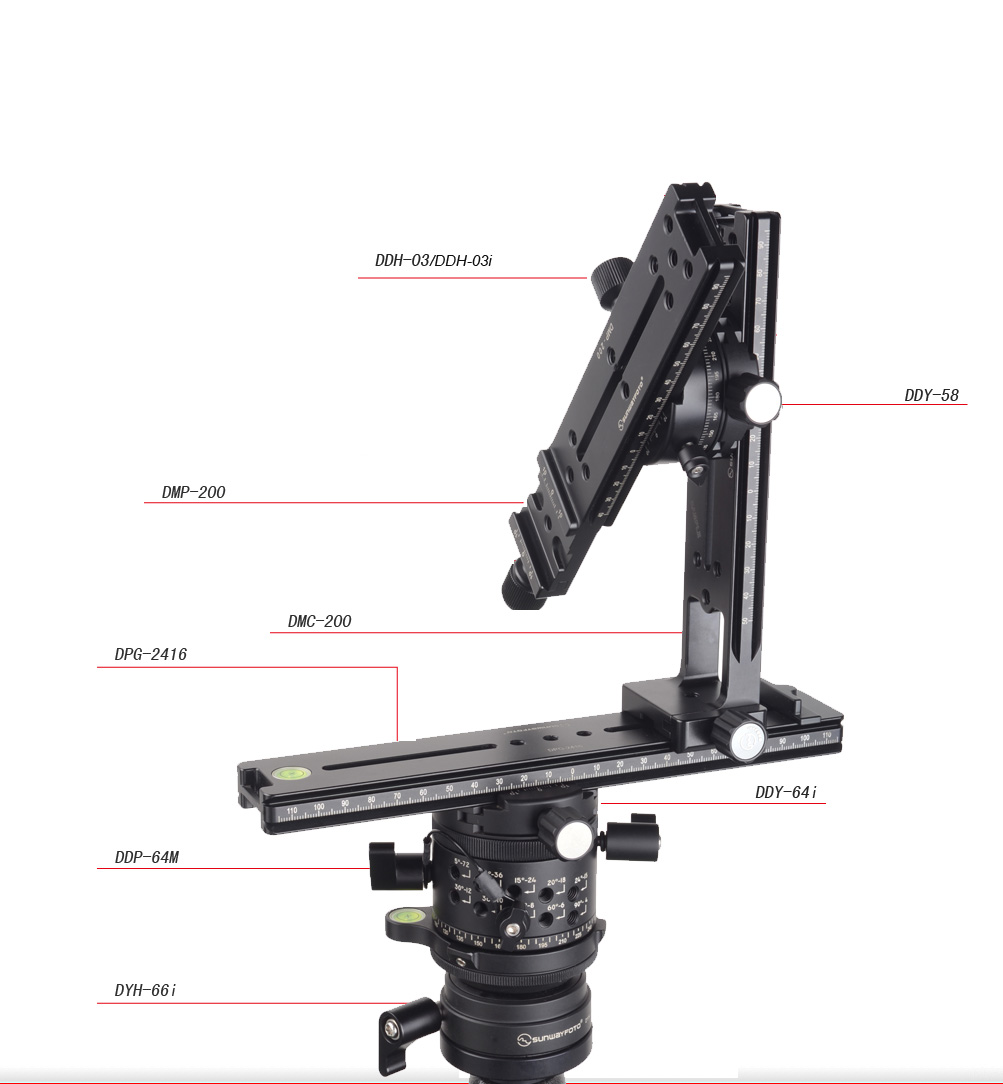
The original image had the URL http://www.sunwayfoto.com/uploadfile/CKEditor/pano-3-4(2).jpg, but this is no longer valid. I believe this is the same thing.
I've always been able to find fault with commercially available heads, including my own, but this one is difficult to fault. Looking at my requirements list, we have:
Rotate the camera in three directions about the entrance pupil of the lens.
The vertical axis is the rotator at the bottom, and the horizontal axis perpendicular to the lens axis is done by the rotator on the right, conveniently with degree markings. As mentioned in the article, rotation along the lens axis really only needs to be 90°: landscape or portrait format. And that's done by relocating the upper rotator onto the horizontal rail.
Level the camera independently of the tripod, to make it possible to rotate the camera about a vertical axis.
That's done by the levelling base below the bottom rotator.
Revisiting this a couple of years later, after I had bought one of these rotators, I wouldn't do so again. It worked well initially, but wore out in a matter of months. The replacement did not better.
Rotate the camera in specific increments for equally-spaced images. At the very least, provide angular markings so that you can set them yourself.
That's done by the bottom rotator.
Provide a level indicator (usually a spirit level).
There are two: one on the levelling base, and one on the horizontal rail.
Provide scales for accurately positioning the camera, in particular a scale parallel to the lens axis to help set the entrance pupil position.
They're there.
For rotators: allow setting the start position.
One of the side levers on the rotator allows this.
So: surely there must be something wrong with it. And of course there is. Firstly, I'm not sure how easy it is to change the mounting from portrait (shown) to landscape. My panorama head has an L bracket to do that. But that would be possible here too—in fact, my L bracket would fit.
And the other problem? The price. The cheapest price I have found is $650. For that price you can buy an entry-level DSLR with kit lens and have money left over. Certainly it's nothing to tempt me right now. But why is it so expensive? It's made in China, where things are usually cheap, but you can only buy it in the USA. Is there some artificial markup at work here?
| Monday, 5 November 2012 | Dereel → Geelong → Dereel | Images for 5 November 2012 |
| Top of page | ||
| previous day | ||
| next day | ||
| last day |
|
More property searches
|
Topic: general | Link here |
Investigation on the web showed that there are a couple of properties on offer in Enfield after all: a house and a vacant plot. In principle a vacant plot has a lot going for it: we end up with a new house matching our expectations and with guarantee for roughly the same price as a used one, and we don't have the cash flow issue where we have to finance the new house before selling the old one.
Off to Enfield to take a look. The house looked OK, but a bit small. But the vacant plot, in Grevillea Drive: where is it? Even the web page isn't sure: it gives the address as “Lot 30/46 Grevillea Road [sic]”. But what's the lot number, and what's the street number? No idea. There are houses on both 30 and 46. Drove the entire length of the road, in the process finding evidence of at least one further (4 digit) numbering system, and 3 properties for sale, none of them interesting and none matching the description. Time to call the agent, but for some reason we didn't get around to it today.
|
Off to Geelong
|
Topic: general, photography, food and drink, gardening | Link here |
In the afternoon to Geelong to have my teeth looked at. All in good shape, in fact in as good shape as they've been since I started paying more attention to my oral hygiene 6½ years ago.
I had brought a photographic magazine with me to read in the waiting room. Leela saw it and asked me to take a look at his camera, which he uses (or intends to use) for dental photography. A Canon EOS 600D with a 100 mm macro and third party ring flash. Took a look at it: it was set to manual exposure, 1/200s (I think) and f/5.6. That seems to be a very wide aperture for the kind of work he's doing, but I couldn't find a way of changing it in manual mode: there's only one wheel, which doubles for shutter speed in S mode and aperture in A mode, but in M mode it sets the shutter speed. The flash doesn't seem to communicate with the camera: even when it's on, you can set any shutter speed. Made a few suggestions and left it at that.
I had a question for him: where do I find an Indian grocer? I believe that he is Indian or similar, and he wasn't surprised by the question, but he didn't have an answer: he doesn't live in Geelong. So off down Ryrie St, where I had found one a while back, and indeed they're still there, despite my expectations. Got some atta, and the salesperson expressed surprise that I would go to the trouble of making my own chapatis. I told him about the use of the Italian pasta machine, and he was really excited about the idea. I wonder if it'll catch on.
Finally to Bunnings to buy some potting mix and some stakes for the tomatoes. Everything spread around the large outside area, and I had to make a couple of iterations before I found what I needed. Strangely, bamboo stakes are cheaper than wooden ones, and I expect much more durable, so bought a number of them.
|
Mixing photos
|
Topic: photography, technology | Link here |
Yvonne showed me a funny photo yesterday, a statue with holes in it—clearly a montage of two photos. It was on “here today, gone tomorrow” Facebook, so I can't find it any more. “I can do that too”, I said, thinking of Hugin, so I set to to take some experimental photos.
The first one didn't work at all well: the control points were all detected correctly, but the resultant image looked nothing like what I expected. At a guess took another series with a second image to the right:

|
|||||||||||||||||||||||

|
|||||||||||||||||||||||

|
|||||||||||||||||||||||
In principle I only need the first two, but when I try to stitch them, I find (in the fast Panorama preview) the same problem I had yesterday:

|
|
||||||||
This is a small part of the preview, up near the top of the window. There's much more below, and the exposure is all over the place. What went wrong there? My guess was that it's related to only having a single view. That's why I took a new sequence including the third image. I couldn't just add it: the alignment failed after first deleting its log file. Starting again with all three images worked:

|
|
||||||||
Once I had done that, I could exclude the additional image from the photo and start a bit of cutting out bits and pieces with the help of the Fast Panorama preview:

|
|
||||||||
But the resultant image looked completely different:

|
|||||||||||||||||||||||
OK, RTFM time. The masks aren't completely binding, as the tutorial explains: the blender still has a choice of where to get the parts of the image from. OK, how about an include mask? Yes, that works. The specified parts of the image are included. So is the rest: it looks identical to the first component image.
As I understand it, what I need is an include mask on what I want to include and a corresponding exclude mask on all the other images. I've tried doing that manually, but it's painful. There's also the possibility of saving a mask and loading it on another image, then changing the type of mask. That works, but the mask coordinate relate to the individual source image, not the final result, so they don't necessarily land in the same place in the final image. Maybe there's a solution to that (SMOP?), but I don't see it.
| Tuesday, 6 November 2012 | Dereel → Napoleons → Dereel | Images for 6 November 2012 |
| Top of page | ||
| previous day | ||
| next day | ||
| last day |
|
New lens
|
Topic: photography | Link here |
It's been some time since I bought a new lens for my camera system. The last was the SMC Macro-Takumar 50 mm f/4 that I bought in August 2010. But for some time I've had my eye on an Olympus Zuiko Digital 18-180mm F3.5-6.3. Why? Arguably it has the worst optical quality of any current Olympus lens, and I already have lenses that cover 12-60 mm and 70-300 mm. But exactly that's the problem: not so much the missing 10 mm in the middle as the fact that I have to use 2 lenses. Particularly when taking photos of horses, I continually move in pretty much the focal lengths of this lens. So when I found one on eBay for $250 starting price, I bid up to $262. But there were no other bidders, and I got it for $250.
Today it arrived in Napoleons, so off to pick it up. Back home, Yvonne was riding in the arena—perfect subject matter. Took a few photos, later discovering that the focal lengths were between 18 mm and 171 mm—pretty much the full range of the lens:

|
|||||||||||||||||||||||

|
|||||||||||||||||||||||

|
|||||||||||||||||||||||
And the image quality? In addition to the issues I mentioned, DxO Optics “Pro” doesn't have any correction module for this lens. So definitely there's no real distortion correction. But the sharpness and chromatic aberration seem perfectly adequate. Here a detail of Zhivago's hair from the left hand side toward the bottom. The “tiny” detail image is at full sensor resolution:

|
|||||||||||||||||||||||

|
|
|||||||||
It's not perfect, but at that resolution nothing is. I'm pleasantly surprised.
One interesting thing about the lens is the lock slider on the side. It's to lock the focal length. It seems that the method used to zoom is reversible: if you press on the lens barrel from the front, it will move and change the focal length. Clearly an indication of the “cheap” construction, but that's a detail.
And now I have nine lenses for my camera! Here are 8 of them; the ninth was the 50 mm Macro-Takumar that I used to take the photo.

|
|||||||||||||||||||||||
From left to right, back to front: Zuiko Digital ED 70-300mm F4.0-5.6, Hanimex 300/5.5, Zuiko Digital ED 12-60mm F2.8-4.0 SWD, Exaktar 135/2.8, Zuiko Digital ED 50mm F2.0 Macro, Zuiko Digital ED 9-18mm F4.0-5.6, 50 mm f/1.4 Super Takumar and Olympus Zuiko Digital 18-180mm F3.5-6.3 I only really use the Olympus lenses and the Macro-Takumar, though the Exaktar can be useful for macros mounted on bellows.
|
AusPost: That'll be $20, more or less
|
Topic: general, opinion | Link here |
While in Napoleons, also posted the Sunwayfoto DDP-64M back to the seller. Before I went, I checked the Australia Post web site and established that it would cost me $13.70 for normal airmail and $19.70 for registered mail. Off to the post office, and they wanted $23! And sure enough, there's a book with the prices in it, and it doesn't resemble the web site at all. For example, the web site starts with a minimum weight category of 500 g. The book had lower prices for parcels of up to 250 g. But the 250-500g range was in the order of $17.
What can cause that? I had to pay the price in the book, of course, but how can a company get away with that? Arranged with Jill, the postmistress, that I'd call up Australia Post and see what's wrong, and possibly get a refund. But first I need to compose myself to handle the brainless idiot I fear I'll reach at the other end.
Peter Jeremy pointed out a disclaimer on the prices page:
Disclaimer: Any charges are a guide only, and are subject to change at the discretion of Australia Post. Please contact your nearest post office for confirmation of all postage rates and charges.
What nonsense is that? Still, they have a feedback form, in which I wrote:
Based on the information on this page, I quoted a price of $19.70 for a registered parcel of 350 g to the USA. But when I got to the post office, they showed me a book with completely unrelated pricing, including different weight categories, and I had to pay $23. So thanks to this page I am $3.30 out of pocket. Yes, I've read the disclaimer. That is unbeleiveable! You shouldn't post this as a "guide". You should show the correct prices!
|
The tomatoes—finally!
|
Topic: gardening | Link here |
Back home, finally got round to planting the tomato plants in the veggie patch. Nicely arranged so that, looking from the gate, the Moneymakers were the furthest 4 on the rightmost row, the Oxheart were in the middle rows at the end, the Principe borghese were on the left row, and the Australian red closest. And then I discovered I had planted an Australian red at the far right, and the only place for the left-over Moneymaker was front left, as far as possible from where it should have gone, and where the Australian Red should have been. Decided to leave it that way and document. But what a lot of work this is! The weed mat doesn't make it any easier, but hopefully it'll make it better for the plants.
Also planted some cuttings of the ornamental vine that have been in water for a few weeks. They're still looking happy, so hopefully they'll strike.
|
Importing honey: YABBA
|
Topic: general, opinion | Link here |
Mail from Andreas Jäger and Christiane Keppler, the beekeepers who were here in January. Their daughters are coming here soon, and they're bringing honey with them.
Are they allowed to do that? Australian import (“quarantine”) laws are very strict, and there's not much you're allowed to import. Took a look on the AQIS web site and discovered they now have an online Import conditions database. So searched for “honey” from “Germany” for “Human Consumption”. The results were unexpected:
Commodity Country EndUse Mushrooms, Armillaria mellea - Fresh, frozen or dried All countries Human consumption Rock melon - Fresh European countries Human consumption
But they have a contact link there, so sent off a message, and then continued my searching. It proves that they don't have any records for honey for human consumption (!), and if you select “All End Uses” you get useful information. Yet Another Bloody Broken Application!
To my surprise, yes, it is possible to import honey into Australia. There are a number of conditions to fulfil, of course, and in particular the fact that Andreas' and Christiane's honey isn't processed will complicate the matter.
Again to my surprise, I got quite a quick response to my query:
I am unsure why your search for honey has returned this result, the ICON database can be quite sensitive to key word, end use and country limitations. I suggest that you search for a single commodity key word first (eg. commodity: 'honey') and leave the country as 'All countries' and end use as 'All end uses'. I have also provided a direct link to the ICON case for honey below.
She also gave me specific details—quite helpful. But I don't get the impression they're
going to do anything to fix the applicationdatabase.
| Wednesday, 7 November 2012 | Dereel | Images for 7 November 2012 |
| Top of page | ||
| previous day | ||
| next day | ||
| last day |
|
Completing the ls work
|
Topic: technology, opinion | Link here |
I've made a number of modifications to ls over the years: the -X option to display file names in hex, the -y option and also the LS_SAMESORT environment variable to work around the mandated breakage in the standards. Most recently I've added the -, option to break large file sizes with commas (or whatever your locale provides). But I still haven't committed any of them. I described the issues a while back, but it's been nearly a month since then.
So finally I prepared the commit. First thing is clear: I have waited far too long. It's been nearly 4 years since I did the LS_SAMESORT stuff, and of course the sources have changed since then. Just untangling what I did and what others did took a considerable amount of time, several hours. I was finally ready to commit, but I think it makes sense to commit in the mornings to that if anything goes wrong, you can fix it easily. So, once again, mañana.
|
Clematis recta: united we stand
|
Topic: gardening | Link here |
This time last year I noted that our Clematis recta, ostensibly a bush, was not really one at all. I had to put up a framework for it to climb over. But that was last year.
Yes, it's not a bush: it's a creeper, but a very strange one. The individual shoots take hold of each other and stiffen the entire structure, so the thing really does look like a bush:

|
|||||||||||||||||||||||

|
|||||||||||||||||||||||
It's also amazing how quickly it grows. A couple of weeks ago there was nothing to be seen.
|
Back to vine pruning
|
Topic: gardening | Link here |
Our ornamental vine is growing very quickly, and this year it produced thousands of tiny grapes that then fell off before they could mature. Presumably they flowered first, since the place has been full of bees.

|
|||||||||||||||||||||||

|
|||||||||||||||||||||||

|
|||||||||||||||||||||||
Apart from that, it's been growing very long shoots, so spent more time pruning it. What with that and the eternal weeding, I had another couple of baskets for the compost.
|
Obama wins!
|
Topic: general, opinion | Link here |
Today was the presidential election in the USA, and many of us listened to the results come in in the course of the afternoon. And of course Barack Obama won. Thank God! It's quite possible that Mitt Romney would have made a better president inside the USA, though I didn't see much evidence. But I'm not there, and neither is the bulk of the world's population. And the last thing the world needs now is Yet Another US President who doesn't know what people in other countries find important. I find it hard to believe that the USA, in its current situation, needs such a president either, but that's for the electorate to decide. But they seem to have made the right decision.
| Thursday, 8 November 2012 | Dereel | Images for 8 November 2012 |
| Top of page | ||
| previous day | ||
| next day | ||
| last day |
|
Finally: the commits
|
Topic: technology | Link here |
Finally I've got round to committing all the patches I have been collecting, and while I was at it also addressed the checklist I made last month. Some of it, anyway. I'm still thinking about the rest, and since the recent change of compiler from gcc to clang, I'm not going to bother about fixing gcc. But clang has the same problem, not to mention the problem of overly verbose and gaudy error messages:
I think that's one for somebody else.
|
Tomatoes, bulbs and arches
|
Topic: gardening | Link here |
The tomatoes I finally planted a couple of days ago aren't looking overly happy. Why? Last year I didn't give them as much care, but they grew as well as the weeds allowed. This year there's weed mat to keep out the weeds, and there's plenty of water. It's also not that hot. So what's the problem? My guess is that I hadn't covered the (black) weed mat, and that it was warming the soil too much. OK, that's easily fixed:

|
|||||||||||||||||||||||
Also more attention to the garden to the south of the verandah. I had done some heavy weeding there only 3 weeks ago, but you wouldn't notice it now. In the meantime the spring bulbs have stopped flowering, creating an amazing number of new bulbs:

|
|||||||||||||||||||||||
Clearly they're going to have to come out and be thinned.
And Yvonne recently bought a couple of cheap garden arches from ALDI. The intention was to keep them for the new house, but who knows when that will happen? And we have 60 days to decide whether we want to keep them or not. So erected one of them.

|
|||||||||||||||||||||||
They're not bad for the price, only $40. Our existing one is not nearly as attractive, and it cost $20 second-hand. The only question now is what we should do with it. I'm in favour of leaving it where it is and planting short-lived plants on it, though the only thing I could find in the nursery area was a couple of Lonicera japonica. Probably we'll end up leaving it here if we ever move house.
| Friday, 9 November 2012 | Dereel | Images for 9 November 2012 |
| Top of page | ||
| previous day | ||
| next day | ||
| last day |
|
Clematis prostrata: united we fall
|
Topic: gardening | Link here |
Only a couple of days ago I noted how the Clematis recta stayed upright by holding on to the other stems. But that requires balance, and wind causes imbalance. Today I found the whole thing had fallen over onto the ground, still as a collection of stems. Put in a bamboo stake, which helped:

|
|||||||||||||||||||||||

|
|||||||||||||||||||||||
Unfortunately the wind is stronger than the stake, so I'll have to find something stronger which isn't immediately visible.
|
Unexpected issues with clang
|
Topic: technology, opinion | Link here |
The FreeBSD project is in the process of changing the C and C++ compiler from gcc to clang, mainly, I think, because of license issues. The transition is going relatively smoothly, and one day I might even get used to the horrible gaudy error messages. And maybe they'll get the compiler to run in less than 2 GB of memory.
But today came a message on the FreeBSD-current mailing list: calendar(1) has “stopped working”. The last serious work on that was done by Chris Yeardley, coincidentally committed a year ago today. So I took a look:
That wasn't in colour, but it clearly comes from clang. Why? From the man page:
The “calendar” file is preprocessed by cpp(1), allowing the inclusion of shared files such as lists of company holidays or meetings. If the shared file is not referenced by a full pathname, cpp(1) searches in the current (or home) directory first, and then in the directory /usr/share/calendar.a Empty lines and lines protected by the C commenting syntax (/* ... */) are ignored.
And looking at the code, it's clear that it was relying on having gcc:
So took a look at how to tell clang to process in “traditional” style, seriously hampered by lack of documentation. Yes, there's a cpp(1) man page, but it's a link to clang(1), and it doesn't document the valid standards beyond this cryptic statement:
So more head-scratching.
|
More source tweaks
|
Topic: technology | Link here |
Yesterday's FreeBSD commits didn't go unchallenged. Somehow my Emacs configuration has reverted to using spaces instead of tabs for indentation, and that's in violation of style(9). So another couple of cosmetic changes.
|
Mowing the lawn
|
Topic: gardening | Link here |
It's been some time since we last mowed the lawn, and it shows. It's really Yvonne's job, but last time she used it, she had trouble with the gear lever. We called CJ in, but it worked for him. So today I took it out and did a rough mow of the worst parts; the rest probably needs the hand mower anyway. And yes, there's some issue which I could work around, apparently related to changing into reverse. Hopefully we can fix it soon.
| Saturday, 10 November 2012 | Dereel | Images for 10 November 2012 |
| Top of page | ||
| previous day | ||
| next day | ||
| last day |
|
Pointy hat for grog
|
Topic: technology | Link here |
Into the office this morning: I was less than thorough on my last commit to ls, and Peter Wemm had cleaned up the mess. I had replaced space sequences with corresponding tabs everywhere. That's desired in indentation, largely irrelevant in comments, but it makes a real mess of format strings, and ls -l no longer lined up. Another pointy hat for my collection.
|
Radiation tower affects property values
|
Topic: general, opinion, technology | Link here |
One of the objections raised to the radiation tower in Bannockburn on 13 March 2012 was that the presence of the tower would greatly devalue the property. Elaine J. Stroud-Kaminski of 2895 Colac-Ballarat Road, Dereel, on the corner of Swamp Road, claimed the presence would greatly devalue the property, by between $60,000 to $100,000. That's clearly nonsense, since the online property valuations suggest that the property is only worth about $150,000, but possibly she believes it, since the house is now up for sale.
The truth, of course, looks very different. Got a call today from a bloke who didn't give his name, but who was thinking of moving to Dereel and wanted to know what the current state of play was. When I told him that it could be years, he thanked me and suggested that he'd probably look elsewhere. Another victim of Wendy's objection. It would have been funny if he had been thinking of buying the Kaminski's house.
|
Tanduri nan
|
Topic: food and drink | Link here |
Indian food tonight, and lately I've been serving chapatis. But for a change I thought I'd try Tanduri nan. First question, of course, as always, is the recipe. Found a number of them, which varied in many details. Some wanted baking powder, others wanted yeast, one wanted both. None, of course, wanted sourdough, though clearly that must be the traditional way.
Spent some time playing around and finally came to a recipe that really worked. It wasn't until some time later that I discovered I already had a recipe, one that uses sourdough, but which I apparently never tried.
But I'm wondering if this kind of nan is the appropriate accompaniment. The requirement of a single egg sets a minimum batch size of about 500 g flour, which is far more than we needed, and though we only ate half, we were completely bloated later. I think it'll be back to chapatis next time.
| Sunday, 11 November 2012 | Dereel | Images for 11 November 2012 |
| Top of page | ||
| previous day | ||
| next day | ||
| last day |
|
DxO problem report: success!
|
Topic: photography, technology, opinion | Link here |
It's been well over two months since I reported a problem to DxO: the “Process” tab of DxO Optics “Pro” now displays all images, taking a long time to do so, and they're out of order. After three attempts to get the support person to read the problem report, I got the—incorrect—information that there was no way to suppress the display. When I asked him yet again to address the issue of the incorrect sort order, he closed the ticket without any further answer.
So I entered another ticket, this time in German to get a different support person, and got an inappropriate answer. Asked again, and finally I got a suitable answer:
Das "Problem" ist bekannt und wird zukünftig gelöst. Wir können leider noch nicht sagen wann
The “problem” is known and will be solved in the future. Unfortunately we can't yet say when that will be.
Still, they've finally understood. Given the time it has taken me to get them to look at it, I hope “is known” means “is now known”.
Am I being unfair to DxO? Hard to say. I suspect that the support people are mainly there to help people who are having difficulty with the product, not for handling bug reports. But there should be some way of reporting bugs that doesn't take 2 months, 3 support people and 6 attempts.
|
Garden in late spring
|
Topic: gardening, opinion | Link here |
Not surprisingly the garden is filling out nicely, and it has changed considerably in appearance since last month. But the biggest difference seems to be the volume of the flowers. Last year I took the photos nearly 2 weeks later, and particularly at this time of year it's difficult to compare. But some things are clear:
The Hebes are not looking nearly as happy as last year. Last year they looked like this, and this year there's almost nothing to be seen:

|
|||||||||||||||||||||||
I had thought that it might be due to inadequate fertilizer, but I've addressed that. Maybe it's just the time of year; it seems that the month before there wasn't much either.
I've had blue Tradescantias for some time, but finally one of the ground covers we picked up somewhere has started flowering, and it's clearly a Tradescantia too:

|
|||||||||||||||||||||||

|
|||||||||||||||||||||||
And of course there are new plants, notably the Hesperaloe parviflora that we bought in Lambley Nursery last April, the Plumbago auriculata that we bought on Australia Day, the yellow-flowering Aeonium that I bought two years ago and the “native gladiolus” that I bought at Coravaal last year:

|
|||||||||||||||||||||||

|
|||||||||||||||||||||||

|
|||||||||||||||||||||||

|
|||||||||||||||||||||||
And the Geranium dissectum (I think) that I planted to the south of the verandah two years ago is finally looking happy:

|
|||||||||||||||||||||||
I had the impression that it was older, but I can't find any reference.
But the real thing is how healthy things are looking this year. Here a couple of random photos:

|
|||||||||||||||||||||||

|
|||||||||||||||||||||||

|
|||||||||||||||||||||||
The view from the north of the house last year and then yesterday shows it too:

|
|||||||||||||||||||||||

|
|||||||||||||||||||||||
|
Garden routine
|
Topic: gardening | Link here |
Apart from processing the photos, also managed to do a bit of weeding. Despite the increased pace recently, sometimes I think that the weeds are winning. Removed a whole lot of stuff from south of the verandah.
| Monday, 12 November 2012 | Dereel | |
| Top of page | ||
| previous day | ||
| next day | ||
| last day |
|
Researching Dr. Livingstone
|
Topic: history, technology, opinion | Link here |
A couple of days ago my daily cron job sent me a calendar entry that looked wrong:
“Livingston”? That should be “Livingstone”—shouldn't it? Checked in the source of all knowledge and confirmed it. But also that the date was 27 October 1871. OK, we can fix that, so I did, and committed it.
This morning I had not one but 5 messages awaiting me from Marc Balmer, who had successively discovered that the German Wikipedia had 28 October, and that the entries for Stanley in both languages had 10 November. Clearly something's wrong.
Spent a couple of hours messing around, finally finding an online copy of Stanley's book “How I found Livingstone”. That goes into lots of detail, and it's clear that the date is 10 November. But there's more! Wikipedia also claims:
This famous phrase may be a fabrication, as Stanley tore out of his diary the pages relating to the encounter.
So: the book I have is the book, not his diary. Where's his diary? It's available, but not for free online. But the State Library of Victoria has a copy, so I should take a look next time I'm in Melbourne.
Somehow hacking code is simpler.
|
Another X hang!
|
Topic: technology | Link here |
It's been well over a month since I installed the new nVidia driver for X and solved my X hang problems. I thought. Today it happened again, again under similar circumstances. The symptoms are not quite the same: It's slower now, and it's possible to move the mouse cursor a little from the edge of the monitor before it jumps back. But it's just as fatal.
In fact, it would seem it was more. My ΛΟC monitor came back in 1280×1024 resolution. Investigating the log files showed:
How could that happen? I don't know, and clearly it's unlikely to have anything to do with the crash. Presumably something in the monitor died since I last started X, which would have been a couple of weeks ago. Moving monitors around confirmed that yes, it's a monitor problem and yes, it's here to stay.
OK, I should be able to override the EDID information. That's the way we always did it, and I even had information in the X config file. But how do I get the driver to ignore the (non-existent!) EDID info? The manual tells me: there are a number of options. Put them in the config file and got:
All well and good, but it didn't pay any attention to my HorizSync and VertRefresh specifications either. This suggests that the options are worthless, since there's nothing at all to go on, and it came up in 640×480 mode. But there are other options too: the CustomEDID option allows you to specify a file with the EDID contents, and from this page I discovered that the nvidia-settings program can save the monitors EDID to a file, something I was looking for some weeks ago. Tried it on the other monitors, and it worked fine.
But how do I get the EDID for the ΛΟC monitor? That's the problem in the first place. But Google is your friend, and it came up with this page, which contained:
So: all I need to do is convert this into binary and store it in a file. How do you do that? A number of people on IRC discussed doing it with Perl, but I don't do Perl. Instead wrote a rather crappy C program which did the job, and had the results before they had finished their discussion—the wrong way round: I was using 64 bit quantities for convenience, and endianness comes into the equation. What's the function to turn things the right way round? I recalled htonl and friends, but that's only 32 bit. Nowadays there's a whole lot of new functions, but the man page only refers to byteorder(9), a kernel interface. But that's the one! The function I was looking for was htobe64. Why is this in section 9? It's not a kernel function. It should be in section 3. There is a byteorder(3), but it's just the old htonl and friends. Another thing to fix, I suppose, if I can stand the bikeshed.
So: finally I had my EDID, the right way round. Did it look good?
=== grog@eureka (/dev/pts/6) ~/EDID 6 -> hexdump -C LOS.bin
=== grog@eureka (/dev/pts/6) ~/EDID 7 -> hexdump -C BenQ-G2400W.bin
Look at that bottom line: the model is clearly visible in the BenQ EDID, but the corresponding field in the ΛΟC EDID proves to be the serial number. Is this a valid EDID? Where's the text AOC?
For the fun of it, tried it out, with this configuration entry in the Screen section:
It worked. And it knew the monitor name:
Where did it get that from? Investigation shows that there's a 3 character capital letter only manufacturer abbreviation hidden 5 bits per character somewhere in the binary. BenQ is too long, so it needs to be put in a different field.
So: a couple of hours work and I had it running. From now on I save the EDID of every monitor I use.
|
More weeding
|
Topic: gardening | Link here |
Didn't find much time in the garden today. More weeding round the north side of the pond.
| Tuesday, 13 November 2012 | Dereel → Ballarat → Dereel | Images for 13 November 2012 |
| Top of page | ||
| previous day | ||
| next day | ||
| last day |
|
Painting the house
|
Topic: general | Link here |
Bryan Jackson and his wife Irene along early this morning to start painting the house, which is sorely in need of it:

|
|||||||||||||||||||||||

|
|||||||||||||||||||||||
Bryan had thought that the weatherboards themselves were OK, but at least one is rotten:

|
|||||||||||||||||||||||
They set to to clean the surfaces, while I attended to clearing the vegetation away from the house, with some surprising and not very pleasant results. While clearing creepers from the baseboards, barely touched a bend in the drainpipe:

|
|||||||||||||||||||||||

|
|||||||||||||||||||||||
The repair will be relatively trivial—good thing Bryan is here—but that's several hundred litres of drinking water that we lost.
Also tidied away the creepers on the north side of the verandah (left end of the wall image above), in the process discovering that the roll of mesh that was supposed to keep dirt out of the downpipe was in fact about 20 cm away, having been carried off by the creepers:

|
|||||||||||||||||||||||

|
|||||||||||||||||||||||
In the afternoon in to town to buy some paint and a new weatherboard. What a time it all takes!
|
Another mystery solved
|
Topic: gardening | Link here |
While in town, in to visit the Friends of the Ballarat Botanical Gardens with a sick looking Loropetalum chinense and a mystery flower:

|
|||||||||||||||||||||||
Yvonne Curbach took one look at a distance of 5 metres and said “Watsonia”. I didn't agree. Bruce Holland took one look and said “Watsonia”. So now I'm more confused than ever. They don't look that much like the plants that I've been calling “Watsonia”:

|
|||||||||||||||||||||||
At least the Loropetalum was simple (and embarrassing): Yvonne pointed at the little creepy-crawlies on the underside of the leaf. Oil spray needed.
|
Reprocessing panoramas
|
Topic: photography | Link here |
A couple of days ago I posted a comparison of the north view of the house this time last year and today. Apart from the surprising difference in the appearance, the photos themselves looked different: a year ago I wasn't using DxO Optics “Pro”, and it shows. So I set to to reprocess all the photos I took on 27 November 2011. Not an easy undertaking: I took 596 photos! The complete panorama set for a weekend, all with 3 bracketed HDR, and also the garden photos. Just processing them took 5 hours, 17 minutes, and creating the tone-mapped HDR images took another 2¾ hours. But finally I could start restitching—and found that the results were far inferior to last year. The verandah centre panorama was supposedly (just) a “very good fit” with average error 1.0 pixel and maximum 3.5, but the results don't bear that out:

|
|||||||||||||||||||||||

|
|||||||||||||||||||||||

|
|||||||||||||||||||||||

|
|
|||||||||
Why is that? I started with the existing project file, but first did a realignment, which came out as “very good”. In the meantime the source images have been corrected for distortion. Could it be that something in the project file remembers the non-corrected images? To be investigated.
| Wednesday, 14 November 2012 | Dereel | Images for 14 November 2012 |
| Top of page | ||
| previous day | ||
| next day | ||
| last day |
|
Maintenance continues
|
Topic: general | Link here |
Bryan and Irene continued with the maintenance work today, replacing the weatherboard, fixing the downpipe, and discovering some dry rot at one corner of the house:

|
|||||||||||||||||||||||

|
|||||||||||||||||||||||

|
|||||||||||||||||||||||

|
|||||||||||||||||||||||
It proves that the material of the downpipe had not deteriorated, which is a good thing; otherwise we would have the prospect of having to replace a lot of the stuff. Clearly I just had a lucky strike with the hedge trimmer.
Bryan had also noticed a loose plank above the roof of the north verandah, just above Irene in the first photo above, and went to close it up. But he couldn't: there are possums inside. He can't get them out, because they're dangerous, and he can't nail them: they'd die, and that would stink the place out. I wonder who can rid us of the animals.
|
Sourdough bread rolls
|
Topic: food and drink, opinion | Link here |
I've been baking my own bread for years now, mainly because we can't get anything similar in Australia. But lately we've been having trouble even with normal wheat bread and bread rolls. So yesterday I revived a white bread starter and tried a new approach: instead of making each batch from a starter, which takes about 2 days, I'd keep quantities of sourdough sufficient to make a batch in only one step. Made a total of 1 kg of sourdough, divided it into four batches: three for the fridge, one for some bread rolls today. I had intended to make four rolls with 250 g of flour, but I made a mess of my calculations, and by the time I had the proportions right, I ended up with 7.
And things went well. From preparation to baking took about 4 hours. Baked them in the small toaster oven, which has thermostatic control, and ended up with something very credible for a first attempt. Sesame seed on top is very aromatic; I don't know why. Maybe because they were still very fresh. Now the experimentation can start; here's the recipe.
|
More panorama reprocessing
|
Topic: photography, technology, opinion | Link here |
Continued looking at my photos of 27 November 2011 today. It seems that it's not a good idea to use the old project files for images that have been reprocessed. Here again the comparison between the original, the reprocessed version using the old project files, and the reprocessed version starting from scratch:
|
|||||||||||||||||||||||
|
|||||||||||||||||||||||

|
|||||||||||||||||||||||
Interestingly, the stitching results were not overly good. The average and maximum error were 1.5 and 11.9 pixels first time round. After deleting all control points over 3 pixels in error, the alignment went down to 1.1 and 3.7 pixels—a little more than the 1.0 and 3.5 of yesterday's bad stitch. So these numbers should be treated with caution.
And it took all day again! Admittedly, that's probably the largest number of photos I have ever taken in one day, and maybe more photos than I ever took with my Pentax Z-1.
|
More car problems
|
Topic: general | Link here |
Yvonne went shopping today, and called me from town telling me her car had broken down—again. But this time it was different, it seems, though I'm not sure the difference she reported were real. But we've seen other reasons, notably that Yvonne keeps running the car until the tank is almost empty, and the fuel indicator is becoming more and more inaccurate. And indeed the indicator showed low fuel. She was just a couple of hundred metres from the petrol station, so she walked over there and tried in vain to borrow a petrol canister. But when she got back, the car ran again, enough to get her to the petrol station and fill up. And indeed, that was the problem. Extracted a promise from her to fill up at the latest when the indicator shows ¼.
|
More USB pain
|
Topic: multimedia, technology, opinion | Link here |
Recently I've been having trouble with the wireless keyboard on teevee, my TV computer. For some reason it can no longer reliably communicate with the USB dongle. It's not the dongle, since the mouse has no difficulty. So yesterday I plugged in a cable USB keyboard.
And then today I could no longer use the remote control! I've been moaning about lirc for years, but lately it's been running well, and I've forgotten how to debug it. Finally found irw and tried it out. No reaction. Ran ktrace against lircd. No input. Took another look at the running lircd process:
That looked straightforward enough. What about the dmesg?
So the keyboard was the culprit! It had taken the device name for the remote control. When I connected it yesterday, the system was already running, so I got the devices the other way round:
That's not the fault of the keyboard, of course. We should have an additional form of device naming; something reflecting vendor and product would seem to make sense, something like /dev/usb/0fe9/9010/0 for the remote control.
But that wasn't the end of it. I dragged out the replacement keyboard that I had bought for exactly this eventuality some time ago and plugged it in. No batteries in it, of course, but that's not an issue. But what did I do with the battery cover? Couldn't find it, and ended up having to tape the batteries in.
And then I came back an hour later and found the keyboard merrily generating the sequence abcdefghijklmnopqrstuvwxyz\n over and over again. What's that? Some kind of test function? Maybe a skillful cat managed to jump on the correct sequence of keys. Removing and replacing the batteries helped.
Isn't having your own multimedia fun?
| Thursday, 15 November 2012 | Dereel | |
| Top of page | ||
| previous day | ||
| next day | ||
| last day |
|
Quiet day
|
Topic: general, gardening | Link here |
Somehow didn't do very much today, not even my customary weeding in the garden. I'm spending too much time in front of a computer.
|
Making df legible
|
Topic: technology | Link here |
Surprisingly there was little feedback on my changes to ls, so today I continued with df, adding a -, option:
=== grog@eureka (/dev/pts/14) /src/FreeBSD/svn/head/bin/df 22 -> df /Photos/
=== grog@eureka (/dev/pts/14) /src/FreeBSD/svn/head/bin/df 23 -> df -, /Photos/
It's interesting to note that commas in sizes are standard in Microsoft's COMMAND.EXE.
Of course, there's no pleasing everybody. Callum Gibson wants 1000 byte blocks. That's what the BLOCKSIZE environment variable is for:
=== grog@eureka (/dev/pts/14) /src/FreeBSD/svn/head/bin/df 24 -> BLOCKSIZE=1000 df -, /Photos/
But it's wrong! The values are unchanged. That's due to the simplistic conversion function, which does integer division and discards the remainder. Fixing it isn't as simple as it should be, since the calculation suffers from potential overflows. Mañana.
| Friday, 16 November 2012 | Dereel | Images for 16 November 2012 |
| Top of page | ||
| previous day | ||
| next day | ||
| last day |
|
House maintenance, continued
|
Topic: general | Link here |
Bryan and Irene Jackson back today to continue work on the house. Before it can look better, it has to look worse:

|
|||||||||||||||||||||||
They managed to finish the east verandah and also part of that wall. It's slow business.
And of course Bryan found another problem: a blocked drain from the kitchen and laundry. My recollections from four years ago are that drain pipes go off in all directions. Hopefully we'll be able to clear the blockage.
|
More df work
|
Topic: technology | Link here |
As planned, more thinking about the changes in df today. The block size calculation was:
No description of the parameters, of course. num is the number of blocks (total, used, free) to be converted. fsbs proves to be the file system fragment size, for UFS at any rate (more specifically, statfs->f_bsize), in which the numbers are reported, and bs is the specified “block size” into which we want to convert it. That's straightforward: num * fsbs / bs. So why the messing around? The comments give the lie: avoid overflow. But why? intmax_t proves to be a 64 bit value, and that's big enough for all file systems—even, it seems, ZFS, which uses 128 bit quantities, but really only uses the lower 64 bits of them (which are, after all, 16 Exabytes). So for the time being at any rate 64 bit calculations are reasonable. But why did we end up with this situation in the first place? Looking back, it seems that this function was originally a macro and was introduced in 4.4BSD:
That's all ancient history, though I suppose it's worth it.
But there's another comparison in that calculation:
Why is it checking for a zero fragment size? And why is it not complaining if it finds one? I don't think it can happen, but just to be on the safe side, I've checked for it elsewhere, “fix” it, and print out a warning:
Also went through the man pages, which are also interesting. FreeBSD df has two options, -b and -P, which are not only identical but which don't do very much: they tell df to display the block counts in units of 512 bytes, which just happens to be the default size. About the only effect they have is to override BLOCKSIZE. So why two? Because -b is typical BSD, but POSIX.1 specifies -P, so we need it for compatibility.
|
Sourdough bread rolls again
|
Topic: food and drink, opinion | Link here |
More experimentation with sourdough bread rolls. They're certainly not too soft—in fact, the ones I made today were tougher than I would have liked. We made some hamburgers with slightly larger ones, and I ended up having to cut the bread with a knife.
But why sourdough? My sourdough rye tastes far superior to bread made with yeast, but with wheat bread you can barely tell the difference. So I'll do more experimentation with yeast.
| Saturday, 17 November 2012 | Dereel | Images for 17 November 2012 |
| Top of page | ||
| previous day | ||
| next day | ||
| last day |
|
Leveling bases
|
Topic: photography, opinion | Link here |
House photo day today. I'm getting increasingly irritated with this silly Manfrotto leveling base, which is difficult to adjust, has too limited travel, and means that I'm continually changing the lengths of the tripod legs—exactly what it's supposed to eliminate.

|
|||||||||||||||||||||||
And for a while I've been thinking that a simple ball head would do as good a job. So today I tried that approach with the el-cheapo ball head that I got with my “Fancier” tripod a few years back:

|
|||||||||||||||||||||||
It's not very steady, but for this job it'll do. And yes, it was easier to adjust, though clearly it's a little underdimensioned for the task. But it's easy enough to get a much better one. The real issue, which also applies to the Manfrotto, is knowing when you're level. The bubble level on the Manfrotto is far superior to the one on the “Fancier”, but both require you to look at them from exactly above, which is difficult because of the height, and also that parts of the panorama bracket could be in the way. You could solve the first problem with a little mirror that you could adjust to point directly at your eye, but the second is more difficult. And how accurate are these things anyway?
Did a bit of browsing through eBay and found a number of inclinometers. Most of them are single-direction only, but there are a couple of devices that have two axes and an accuracy of 0.1°. Is that enough? Measurement required.
|
Strange insect interaction
|
Topic: gardening | Link here |
The new growth on our ornamental Japanese cherry tree looks funny:

|
|||||||||||||||||||||||
While I was looking more closely, saw two insects on one of the leaves. They're clearly different, and one of them at least could fly. But they both flew off together! Of course I didn't have a camera, but I went back later with one and tried to get some photos, with only limited success. The leaves are infested with lots of small beetles:

|
|||||||||||||||||||||||

|
|||||||||||||||||||||||

|
|
|||||||||
But what are all the insects interested in them?

|
|||||||||||||||||||||||

|
|||||||||||||||||||||||

|
|
|||||||||

|
|
|||||||||

|
|||||||||||||||||||||||
The first, of which I unfortunately didn't get a better image, appears to be a bee, but there are no flowers there. Are they milking the beetles?
| Sunday, 18 November 2012 | Dereel | Images for 18 November 2012 |
| Top of page | ||
| previous day | ||
| next day | ||
| last day |
|
gdb: Your friend in need
|
Topic: technology | Link here |
Message in the mail today: I had managed to mess up my change to locale(1). It wasn't immediately obvious why, so I went through with gdb:
That first command was a breakpoint on main. It should have hit there before doing anything. What went wrong? Took a look at the entrance to main and found:
So I had asked for a breakpoint at main, and it placed it 17 bytes further on. Why?
Part of the answer lies in the function linkage. The first two instructions set up the environment so that the stack is pointing to main's stack. A breakpoint at the entry point (0x8048b30) would show the environment of the caller. So normally gdb sets a breakpoint after these instructions, in this case at 0x8048b33. I go into more detail about this in chapter 4 of my kernel debugging tutorial, page 17 and on, particularly page 20.
But why 17 bytes further on? About the only thing I can see there is that the breakpoint has been placed where it can't be executed, since the previous instruction jumps over it. Is this something to do with the change to clang? To be investigated.
|
Bread rolls, with yeast
|
Topic: food and drink, opinion | Link here |
For a change, tried making bread rolls with yeast today, basically using the recipe for pizza dough. Surprise, surprise: they came out very well. Yvonne is perfectly happy with them, but I can see things that need tweaking. Although I baked them the same as for the sourdough rolls (15 minutes at 225°), they came out very dark, almost burnt. And they weren't quite cooked through on the inside. So next time I'll try at 200° and go up to 20 minutes.
|
Cleaning up the cherries
|
Topic: gardening | Link here |
Spent some time today tending to the infested cherry tree. It had produced a number of suckers, which I thought worth planting. It interesting how they work:

|
|||||||||||||||||||||||

|
|||||||||||||||||||||||
The sucker is on an underground rhizome (or similar), and in each case one side has been quite thick and the other thin. The thin side points towards the parent tree; I assume it's intended to be disconnected. And there are various nodules along the way.
Removed the suckers and planted them—17 of them, a number which seems to be recurring in today's diary.
| Monday, 19 November 2012 | Dereel | |
| Top of page | ||
| previous day | ||
| next day | ||
| last day |
|
Another power failure
|
Topic: general | Link here |
Power failure at 7:36 this morning, mercifully brief.
|
FreeBSD compromise fallout
|
Topic: technology | Link here |
A couple of months ago somebody gained access to a couple of machines in the FreeBSD cluster, apparently by stealing an ssh key. There's no evidence that he did any particular harm, but everybody's taking it very seriously.
In my case, I discovered I had private keys on two of the machines, like we all did in the Good Old Days. And it's quite possible they got stolen. So another round of generating new keys, the first in 10 years:
And in the process: which keys do you need? RSA1 is clearly obsolete. But DSA or RSA2? I decided on the later for no better reason than that ssh tries it first. And, of course, ran into problems replacing things, notably on the FreeBSD machines: only the admins can change the keys. So I'll have to wait until they do their thing.
On the positive side, it doesn't look as if anybody has used my private key to compromise other machines:
=== root@www (/dev/ttyp0) /var/log 5 -> bzcat auth.log*2 | grep publickey.*grog | sed 's:.*from :host :; s: port.*::' | sort -u | sh
All of those addresses are the various places I get put after a network disconnect, so things don't look too bad.
|
More gdb investigations
|
Topic: technology | Link here |
So why is gdb setting breakpoints in the wrong place? Why, is gdb setting breakpoints in the wrong place? Did some investigation which proved inconclusive. What I found was:
On FreeBSD-CURRENT on the i386 platform, it sets the breakpoint correctly—if I don't include debug symbols.
On FreeBSD-CURRENT on the i386 platform, it sets the breakpoint 17 bytes from the start if I include debug symbols.
On 9-STABLE amd64 it sets the breakpoint on the entry point. This means that the local variables aren't visible, because they haven't been created yet.
On 9-STABLE i386 without debugging symbols, it sets the breakpoint on the entry point. This means that the local variables aren't visible, because they haven't been created yet.
On 9-STABLE i386 with debugging symbols, it sets the breakpoint 6 bytes later:
But this isn't repeatable. When I came back again, I had the breakpoint on the entry point again.
So: there's clearly some influence here that I don't understand. More head-scratching.
|
Network access for the Friends
|
Topic: technology, opinion | Link here |
Last week I discovered that the Friends of the Ballarat Botanical Gardens are paying an arm and a leg for telephone and Internet access. They've somehow become lumbered with a telephone service with a whopping $44 per month rental—from Telstra, of course—and surprisingly high call costs. The result for last month, for very few calls, was a bill for nearly $60. And the Internet connection is just as bad: $40 for a line that, if I recall correctly, has a 512/128 kB speed and 3 GB cap.
Why am I so vague about speed and traffic? Looking at the ncable.net.au transact.com.au web
site, I can no longer find it. So how about looking at our usage page, something I haven't
done for a while? I had the address saved on a private page: https://accounts.ncable.net.au/index.php/. But now that redirects to https://portal.vic.transact.com.au/, and that times out. Called up technical
support, which for once answered very quickly, and spoke to somebody with a mumbled name,
who didn't disagree when I asked if her name was spelt “Ekta”. She couldn't give me the URL
of the new page, but led me through from the home page to http://transact.com.au/en-VIC/MyTransACT. And then she told me to click on
“Broadband account manager”:

|
|
||||||||
That pointed me to the same URL that had timed out on me. At least I knew why now, and I told her. But she wasn't listening: “Do you have another browser on your computer that you can try?”. I finally got her to connect me to Nick, her supervisor, whose name proved to be Mick. He confirmed that I can only access this information when I'm on one of TransACT's own net connections, and suggested that I go there. I suggested that I go to another ISP, but that didn't seem to worry him.
So went looking and found only two ISPs who seem trustworthy enough to change to: Internode and iiNet (“We're second best”). Internode's web site has gone downhill to the point that I was no longer able to decide what the prices were, so called them up. Yes, the Friends may be a non-profit organization, but they're still a business, because they have more than one computer. And for you, Sir, that'll be $60 for the Internet connection and $35 for the phone! Admittedly it's a lot faster than what we have now, but no cheaper.
iiNet was a different matter. I waited 20 minutes for sales to answer, and heard that we could pay $30 each for the phone and the Internet connection. The salesperson (Esney? Why do these people have such unusual names and mumble them?) told me that I could have opted for callback when the appropriate message came—but it hadn't. I was left with an impression of less than total competence.
So what do we do? I'd like to go to Internode, but that's just too expensive. And it seems that iiNet is the parent company of TransACT, which is a concern. Maybe this silly restriction on account access even comes from them. For the moment more investigation.
|
More bread experiments
|
Topic: food and drink, opinion | Link here |
More bread rolls today. Yvonne wasn't completely happy with yesterday's rolls after all: she wanted them flatter. I wanted them less dense, less brown and baked through, so tried again today. 5% yeast instead of 4%, a bit more oil, and things are looking better. It might even be good enough to stick to, especially as it's very little work in contrast to sourdough.
|
Inclinometers: how accurate?
|
Topic: photography, opinion | Link here |
I've established that I can buy electronic inclinometers with a precision of 0.02° and an accuracy of 0.1° on eBay. Is that enough? What does the Manfrotto leveler do? Tried to measure it today.
|
|||||||||||||||||||||||
Set it up level, and then tried moving one of the wheels until I could see the slightest difference. Measuring with calipers proved to be too inaccurate, but it appeared to be about a 60° rotation of the wheel. What angle is that? The distance between the screws is 7.2 cm, and the pitch of the screws appears to be 1 mm, so the 60° rotation is about 0.16 mm. That's tilting the upper plate along an axis between the other two screws, so it's about 6.2 cm away. That's about 0.15°. So yes, the inclinometer is not only accurate enough, but has a much finer-grained and easier to read display. The only problem is that it's relatively bulky.
| Tuesday, 20 November 2012 | Dereel | Images for 20 November 2012 |
| Top of page | ||
| previous day | ||
| next day | ||
| last day |
|
DxO: your fault after all!
|
Topic: photography, technology, opinion | Link here |
Over a week ago I finally got DxO support to understand a problem report I had sent in, to stop claiming that it was all my fault, and admit that they had a bug that would be fixed “sometime”. It was the culmination of over two months of banging my head against a brick wall, including resubmitting the ticket twice, and it felt so good when it stopped.
And then a couple of days ago I got a message asking if I was running DxO Optics “Pro” in a virtual machine. I was quite impressed that they had gone to the trouble to analyse the logs, which were months old. And of course, when I said “yes”, I got the stereotyped reply (translated from German):
Then we have found the reason for the problem. If you run DxO Optics Pro in a proper machine you won't have such problems.
Why, why, why do they say such things? Are they just trying to annoy me? They don't say which problem they're talking about, but there were three components:
Images in the process tab are sorted incorrectly. They've admitted this is a bug.
Can't suppress the display of images in the process tab. I had an answer to that: “No, you can't”. But it was wrong, and I've found out how to do it, so this problem has been solved too.
Settings don't get saved on exit. This problem has been fixed in a later version, presumably while “support” was trying to blame it on me.
So which problem won't I have? It would be nice to say “then support won't be able to blame things on me”, but that's underestimating their ingenuity. After all, they have already blamed things on my real physical machine that meets their requirements.
Why do they do this? It's detrimental both for their product and their reputation.
|
Piccola on Corella hunt
|
Topic: animals | Link here |
Big noise outside the office this afternoon, and Yvonne called me to say that Piccola had caught a Corella. I didn't believe her—corellas are larger than she is, and relatively aggressive. But she had caught one, and I had to drag her away, much to her disgust.
The bird was clearly the worse for wear, and had difficulty sitting up at first. It made a cry which I first thought was directed at me, but then answers (a little clearer in tone) came from up in the trees around us:

|
|||||||||||||||||||||||

|
|||||||||||||||||||||||
It appears to be a Little Corella (Cacatua sanguinea), though the range map on Wikipedia is clearly inaccurate:
That's not within 200 km of here, but we have lots of corellas here. I left it to its devices, and it tried to hobble off and fly away:

|
|||||||||||||||||||||||

|
|||||||||||||||||||||||
At first I thought it had broken a leg, but it seems that its legs were in better condition than the wings. It slowly walked some distance to one of the trees, where another corella stood guard, and then climbed about 2 metres up a tree, where it stayed for a while before ultimately disappearing:

|
|||||||||||||||||||||||

|
|||||||||||||||||||||||
I wonder if it will survive.
| Wednesday, 21 November 2012 | Dereel | |
| Top of page | ||
| previous day | ||
| next day | ||
| last day |
|
Gizmodo spam?
|
Topic: technology, opinion | Link here |
Strange message in the mail this morning:
Clearly malicious spam. But the interesting part is the email address, gizmodo@lemis.com. It's genuine (or it was at the time, anyway). But I only ever used it for one purpose, to sign up with Gizmodo. So how did the sender get it? I'm continually receiving spam that suggests that well-known sites are involved, such as the continual barrage of “recommendations” from LinkedIn. Wouldn't it be nice if their abuse people would respond? As it is, goodbye Gizmodo.
|
Still more weeding
|
Topic: gardening | Link here |
On with weeding the garden today. I've decided that spraying weeds is not really a good way to control them: there's too much danger of collateral damage, so I can only do it on some of the weeds and then only on a wind-still, dry day. The result is that the others grow even faster. Spent a couple of hours in the south part of the east garden today, rescuing a forgotten rose bush in the process. I've decided to burn all the weeds, since they have too many seeds in them for the compost bin. I now have a wire frame, originally intended to protect bushes from kangaroos, about 1.60 high and 80 cm in diameter, full of weeds drying out and waiting to be burnt.
|
Israel: The firings will continue until morale improves
|
Topic: opinion | Link here |
My Facebook pages look very different from those of most people I know. For one thing, the entries are in more than 10 different languages, including Arabic, Malay, Chinese, Greek and Russian. Of these, I can only barely understand Malay. And lately there have been lots of postings from Aqsa Syarif, a Malaysian aid organization. No idea how I got there, but it's an interesting view into other people's perceptions of the Israeli atrocities in Ghazza.
I've been watching developments in the Eastern Mediterranean with growing concern over the last 18 months. The developments in Syria are bad enough, but I've been horrified by the Israeli attacks on Ghazza. How can the international community sit by and watch that happen? How can Israel, a country founded after the atrocities of the Second World War, trample on the human dignity of its neighbours in such a manner?
Yes, people in Ghazza have been firing rockets at Israel, some of them even doing some harm. Considering the way Israel has prevented them from living normal lives, that's not surprising. But clearly that's unacceptable, and something needs to be done about it. But is this the way? The Torah expresses sentiments considered too harsh nowadays. This version from Leviticus 24:
19. And a man who inflicts an injury upon his fellow man just as he did, so shall be done to him [namely,]
20. fracture for fracture, eye for eye, tooth for tooth. Just as he inflicted an injury upon a person, so shall it be inflicted upon him.
In general, modern interpretations are less drastic. But far from being less drastic, the Israeli government has retaliated out of all proportion in the last week, showing no respect for human dignity or collateral damage. And it's not just the Israeli government: it seems that 90% of the population of Israel (presumably only the Jewish population) agree with the action. What a shameful action for people who have known that kind of suffering first-hand!
One of the reasons that Israel was able to perform such atrocities is because of the military aid they get from the USA. Why does the USA not take a harder stance? Under those circumstances, it's difficult for the USA to criticize Russia for continuing arms deliveries to Syria. And how can the USA develop better ties with the Muslim world when they don't even condemn Israel's actions?
The real issue, though, is that we don't know what's going on. It's all filtered through a press that reports what it thinks is important. It's not necessarily wrong, just one-sided. That's why I've been watching Al Jazeera news over the last year and a half. But they don't give that different a view either. It wasn't until I started researching the details that I discovered that the name of the area is Ghazza and not Gaza—and even Al Jazeera uses the latter spelling. And I still haven't seen well-reasoned explanations for why Russia and China opposed sanctions on Syria.
Revisiting this page 10 years later, it's not clear that this is correct. According to Wikipedia, the Arabic spelling is قِطَاعُ غَزَّةَ (transliterated as Qiṭāʿu Ġazzah).
And now Egypt has brokered a ceasefire. But not just that; also the lifting of some of the many repressions that Israel has placed upon the people of Ghazza. Now why couldn't that have happened earlier? But if it holds, it'll be a win for many people, including the legitimacy of the new Egyptian government. It's about time that something works well in the Arab world.
| Thursday, 22 November 2012 | Dereel | Images for 22 November 2012 |
| Top of page | ||
| previous day | ||
| next day | ||
| last day |
|
dirname: not found
|
Topic: technology, opinion | Link here |
Mail from David Noel today, referring to a problem I had 1½ years ago:
He asked how I solved it. I have no idea. I suspected it might be something to do with environment variables, but despite the verbosity of this diary, I managed to leave out the important part. The best I can find is that newvers.sh shouldn't be run at this point, which suggests some discrepancy in timestamps.
|
Coming up roses
|
Topic: gardening | Link here |
The garden's looking particularly nice at the moment. Clearly the use of much more fertilizer has paid off. The “Phyllis Bide” climbing rose looks better than I have ever seen it, and even the old climbing rose that we moved round the garden several times is now looking happy:

|
|||||||||||||||||||||||

|
|||||||||||||||||||||||
And the combination of Iceberg rose and Clematis “Vagabond” has been flowering for over a month, and the very first “Pearl d'azure” is showing on the right:

|
|||||||||||||||||||||||
And the pelargonium “Rhodo” that we got as a cutting 3 years ago is finally flowering happily:

|
|||||||||||||||||||||||
In addition, the Lonicera “Firecracker” is flowering profusely:

|
|||||||||||||||||||||||
It's not until you look more closely that problems become apparent:

|
|||||||||||||||||||||||

|
|||||||||||||||||||||||
Hopefully a liberal application of pyrethrum will help there.
|
Pizza: finally OK?
|
Topic: food and drink, opinion | Link here |
Pizza again tonight. I've been experimenting literally for years trying to get the base right. I standardized my dough years ago, but cooking it still requires a lot of effort. The issue is to get it to cook properly from underneath without sticking to the pan. Last time I managed to get it to stick badly, mainly because I ignored the experience of the time before. Today I did effectively the same as the time before last, but it came out even better. Interestingly, the pizze also shrank a little and became thicker. I didn't note how long I baked last time, so for the record:
4 minutes from both sides to firm up the base, with oven paper underneath. This requires piercing with a fork to stop the base blowing up too much.
Remove paper, put on topping, bake for about another 12 minutes. Irritatingly the silly clockwork timer on the ovens turned off in the middle, so I'll have to check the times more carefully next time.
| Friday, 23 November 2012 | Dereel | Images for 23 November 2012 |
| Top of page | ||
| previous day | ||
| next day | ||
| last day |
|
Computer education for the next generation
|
Topic: technology, opinion | Link here |
Next year Jashank Jeremy will finish school with the the Higher School Certificate or HSC. Today he complained about the quality of his textbooks, unfairly, I thought:
“Today most mobile phones include digital cameras, internet connectivity using both local 802.11 access points and 3G networks, Bluetooth and also GPS receivers. All these connectivity and other hardware features have resulted in an ever increasing number of innovative Apps coming onto the market.”
As he said, “It's so badly structured, the grammar and spelling is typically terrible, all sorts of things are mentioned and never explained...”. OK, you can't see all that from a random quote; I was rather pleased that they used the term 802.11 and not silly buzzwords like WiFi. But it seems that there's worse. The book is “Software Design and Development - The HSC Course” published by the Parramatta Education Centre, and they have sample Chapters online. The content is horrifying! Leaving aside the poor choice of programming languages for the examples (“Visual Basic” and Pascal), much of the content is very misleading or just plain incorrect. I can't cut and paste, but here a couple of examples from chapter 5, “Implementation of software solutions”:
(Page 251) The CPU needs to communicate with outside devices. Communication is accomplished via interrupts. Essentially, an interrupt is a communication channel in and out of the CPU.
The example shows 8086 assembly code using PC BIOS interrupts. It doesn't mention the BIOS in this connection, only later on:
(Page 264) The BIOS provides the interface between the interface between the operating system and the hardware. BIOS settings are stored in CMOS (Complementary Metal Oxide Semiconductor. CMOS is a type of RAM that requires very little power to retain its contents.
And that's all that it says about the BIOS. So an attentive student who relies on this text will believe that an interrupt is part of the processor, and that it somehow performs I/O. By comparison other details (noted by Andy Farkas) are just amusing:
(P 252) The 8086 assembler instruction adc ax,2dh adds the value 2dh to the value contained in the accumulator. The carry flag, cf, is set if the result of the addition overflows the word size of the processor. The hexadecimal machine language equivalent is 15 2D. In binary, this statement becomes 00010101 00101110.
That's not completely correct: adc ax,2dh adds 0x2d and the carry flag to ax. And I wonder how many people really check the correctness of the binary representation (it's wrong).
Apart from that, there are so many assumptions:
.. if an array called ThisArray is declared with a subscript range of 0 to 10, an attempt to assign a value to ThisArray(11) will cause a runtime error.
Wouldn't that be nice? If it's a constant subscript, it could be caught by the compiler, but it's quite possible for this to happen and not be detected at all.
There are dozens of other errors in the book. How can they get away with it? Don't they have technical reviews? And this is what our next generation learn. The publishers should be ashamed of themselves.
|
Reconsidering
|
Topic: gardening | Link here |
The Viola tricolor that I planted on the verandah last month have not done very well:

|
|||||||||||||||||||||||
OK, I had a number of other plants hanging around, notably a number of red petunias left over from last year, so decided to put them in instead. In the process, discovered that, for some reason, the violas hadn't really taken root, which would explain their unhappy appearance. In any case, the petunias fit better in that space:

|
|||||||||||||||||||||||

|
|||||||||||||||||||||||
Another plant that has died was the Gaura lindheimeri, possibly because it didn't like the soil. Changed the soil and planted some Mirabilis jalapa that have been in another pot for some time.
Also more attention to the vines on the verandah, which are growing very vigorously. I should do this more often; a lot of energy went into growing shoots that I had to cut off.
|
Investigating chest pains
|
Topic: general | Link here |
For the past couple of days I've been having a pain in my chest, not far from the heart. On the face of it, it sounds like a muscular pain, but the position wasn't pleasant. So off today to the doctor, this time Majid Najafi Zeini, whom I haven't seen before. Very thorough, and appears quite sensible. No, these aren't typical symptoms of heart disease, and he agreed with me that it was probably just a muscular pain. But he gave me a prescription for a Nitroglycerine spray just in case.
| Saturday, 24 November 2012 | Dereel | Images for 24 November 2012 |
| Top of page | ||
| previous day | ||
| next day | ||
| last day |
|
Garage sale
|
Topic: general | Link here |
Off to a Garage sale in Enfield (or maybe Dereel after all—it's somewhere between in the middle of nowhere). Not surprisingly, there were very few visitors, and though they had a lot of stuff to sell, there was nothing that really interested us. To make up for that, we missed the “market” in Dereel.
|
New garden view
|
Topic: photography, general, gardening, opinion | Link here |
I've been taking photos of the garden every week for over 5 years now. In that time I've changed the sequence of photos several times, but in the past 18 months, with the exception of a couple of short-lived experiments, things have been pretty stable. But today a new view occurred to me, north from (roughly) the middle of the north verandah:

|
|||||||||||||||||||||||
It's not as if I haven't been taking lots of photos of the area. There's a view from each end of the verandah:

|
|||||||||||||||||||||||

|
|||||||||||||||||||||||
And then there's the view in the other direction, from the other side of the arch in the middle:

|
|||||||||||||||||||||||
The big difference is the arch, which isn't really that apparent in the photos taken from the end. I'll try all three for a week or two, but I'd say I can retire the old ones.
|
Acacia maintenance
|
Topic: gardening | Link here |
According to my weather pages we don't really get much wind here, but nevertheless we have problems as a result. A couple of months ago it blew over our Alyogyne huegelii at the south-west of the eastern garden, and a few days ago it broke a large branch off the Acacia cognata “Lime Magik” next to it. The damage was substantial, splitting the trunk, and I fear another wind would finish it off.

|
|||||||||||||||||||||||

|
|||||||||||||||||||||||
Put in a star dropper to tie it to. But that's not so simple. I did the same with the Alyogyne, and the ties (baling twine) ate into the bark:

|
|||||||||||||||||||||||
Found a roll of plastic in the garage, really intended to be a border for garden beds, but it's soft and pliant, and wrapping it around the bark should solve the problem:

|
|||||||||||||||||||||||
Also removed another branch, which now looked a little out of place. Here the tree afterwards:

|
|||||||||||||||||||||||
And the old branch? Cuttings, of course. Read some pages about the subject, in particular this one, which specifically mentioned the problem of propagating cuttings of Acacia cognata. It doesn't look very promising, but it doesn't cost anything, so planted 10 seedlings. If it doesn't work, I can try again at a better time of year. This page wasn't directly relevant, but it has what looks like good information on other aspects. And this newsletter gives much more information on Acacia cognata.
In passing it's interesting to see how much the plants in this part of the garden have grown in the past 15 months. We've had the acacia for nearly 4 years, but it has really only grown in the last 15 months. So have the other plants, including the Alyogyne (still visible in the first image, taken on 6 August 2011:

|
|||||||||||||||||||||||

|
|||||||||||||||||||||||
It's difficult to believe that it's taken from the same place.
|
Garden in flower
|
Topic: gardening, photography | Link here |
This year I'm continually surprised by how much colour there is in the garden. This view is really brilliant in real life, but it really needs to be expanded to full screen to have the desired effect:

|
|||||||||||||||||||||||
|
More mystery flowers
|
Topic: gardening, photography | Link here |
Walking the dog in the other direction today, I found some tiny flowers on the grass verge of the road:

|
|||||||||||||||||||||||

|
|||||||||||||||||||||||
They're about 1 cm across, an ideal subject for macro photography. Somehow I'm still not completely happy with the results. Time for some focus stacking experiments?
|
Pepper steak sauce
|
Topic: food and drink, opinion | Link here |
Steak for dinner today, and I made my pepper sauce—with a difference. We were out of sour cream, and I tried it with sweet cream. In principle it shouldn't have made any difference, but in fact it came out really thin. Is that because of the cream or what they put in it? In any case, next time I'll make sure we have sour cream.
The new means of cracking the pepper, with the grain mill, has another unexpected consequence: the taste is much more intensive, so that I can probably reduce the quantity by about 30%.
|
Warnings for fast food?
|
Topic: food and drink, opinion | Link here |
I recently heard of the idea of posting warnings on packaging for fast food, like they've been doing (with little effect) on cigarette packages for decades. And then I was somehow confronted with this image, though I've forgotten who pointed me at it:

Maybe that would have more effect than the warnings on cigarettes, because it's not necessarily the consumer who buys them. It would also make sense to add details of nutritional content: that would be an incentive to the manufacturer to limit undesirable ingredients.
| Sunday, 25 November 2012 | Dereel | |
| Top of page | ||
| previous day | ||
| next day | ||
| last day |
|
More garden plants
|
Topic: gardening | Link here |
The Fuchsias that I got as cuttings from Dianne Leahy in April have struck well, and they're about to flower. High time to plant them. Chose the spot in the middle of the east garden just to the south of the row of Buddlejas, where the Ficus benjamina had died, and planted a couple there. Also added drippers, including for the white Abutilon that we got in February, and which wasn't looking overly happy.
|
Metric recipes
|
Topic: food and drink, opinion | Link here |
In my recipe for pepper steak sauce I claim that this is a recipe I got from Sarawak, and that it wasn't generally known. Nowadays that's easy to verify: Google is your friend. And it found lots of pepper steak recipes, but nothing like mine: in general, “pepper” means “capsicum”. So yes, my recipe is a little unusual, though I'm sure you'll find it out there.
But while it has nothing to do with my recipe, this recipe addressed another issue I have: stupid measurements, notably the volumetric measures of solids so common in US recipes. It had a metric alternative:
Since writing this article, food.com saw fit to move the recipe from http://www.food.com/recipes/pepper-steak-12030 to http://www.geniuskitchen.com/recipe/pepper-steak-12030. They didn't see fit to fix the terminally broken units (how do you weigh a steak to the nearest 10 mg? And at what temperature should your water occupy 59.14 ml? 15.555° maybe?).
- 453.59 g beef top round steak, cut 1 inch thick
- 9.85 ml olive oil
- 1 medium onion, sliced thin
- 2 clove garlic, minced
- 236.59 ml beef broth
- 59.14 ml light soy sauce
- 1.23 ml sugar
- 2.46 ml pepper
- 1 stalk celery, sliced
- 1 green bell pepper, sliced thin
- 1 red bell pepper, sliced thin
- 1 yellow bell pepper, sliced thin
- 1 can chopped tomato, drained or 2 medium tomatoes blanched, peeled and cut into wedges
- 9.85 ml cornstarch
- 59.14 ml cold water
“Metric” indeed! They still use units like inches (probably forgotten in the markup) and volumetric measures. 2.46 ml pepper indeed! How can you measure that? All the measurements have been taken from the US original and converted without any thought for practicalities and with a completely inappropriate precision. None of these values should be precise to more that 1%. And it even has 2 cloves of garlic and a medium onion! They're definitely not precise to even 100%.
sigh
| Monday, 26 November 2012 | Dereel | Images for 26 November 2012 |
| Top of page | ||
| previous day | ||
| next day | ||
| last day |
|
More mystery plants
|
Topic: gardening | Link here |
Chris Yeardley told me a while back about some plant that had appeared in one of her horse water troughs, and which cleared the water. We could do with some of that in our garden pond, so over this morning to pick up some:

|
|||||||||||||||||||||||

|
|||||||||||||||||||||||
What is it? No idea. Does it need soil, or is it happy just to be on the ground?
That's not the only plant I can't identify. In the forest I've found what looks like Mistletoe growing on a species of Acacia that's in flower right now:

|
|||||||||||||||||||||||
It attaches to the branch of the tree via a kind of lump:

|
|||||||||||||||||||||||

|
|||||||||||||||||||||||
It doesn't look much like my recollection of mistletoe, but it does have some similarities with other Australian plants, notably the flowers:

|
|||||||||||||||||||||||

|
|||||||||||||||||||||||

|
|||||||||||||||||||||||
Spent some time looking for what it could be and came up with an amazing number of different parasites, all badly documented. This page gives an overview of many of them. At various times I thought it might be a Amyema, maybe an Amyema congener, or a Psittacanthus, but without identifying the species it's difficult to guess at the genus. One for the Friends tomorrow, maybe.
This proved to be Amyema pendula subsp. pendula.
|
Acacias and Mirabilis
|
Topic: gardening | Link here |
This morning started off pretty windy, and I'm still worried about my Acacia cognata “Lime Magik” with the damaged trunk. In the end, took a clamp to hold it together:

|
|||||||||||||||||||||||
I'm still not convinced that it will hold.
Our first Strelitzia reginae is flowering:

|
|||||||||||||||||||||||
In the afternoon, finally got round to planting the remaining Mirabilis jalapa, which don't look overly happy. Hopefully they'll feel better in the soil.
| Tuesday, 27 November 2012 | Dereel → Ballarat → Dereel → Ballarat → Dereel | |
| Top of page | ||
| previous day | ||
| next day | ||
| last day |
|
Twice to Ballarat
|
Topic: general, gardening | Link here |
Into town twice today: first, Yvonne had to take her car in for service, and in the afternoon I had an appointment with Peter O'Connell. Also to the Friends of the Ballarat Botanical Gardens with a whole collection of plants for identification: the mistletoe and water plant I commented on yesterday, along with a sample of the tree it was growing on, and also the “fly plant” that I bought last month.
The mistletoe was known: Lorraine Powell and somebody else (I forget who) took one look at it and said “Mistletoe!”. But nobody could tell me what kind, and I sensed a general disinterest. As Bruce Holland put it: “If you can't eat it or cultivate it, nobody's interested”. They also didn't have Bryan Barlow's book in the ample collection, so I'll have to try the State Library of Victoria.
They also didn't recognize the water plant, but I had more success with the other two. The Acacia was fairly straightforward, though even there they didn't agree in terminology: Lorraine said “light wattle”, and Bruce said “blackwood”, which I would know as Acacia melanoxylon. I couldn't find “light wattle” online, but I note that Acacia melanoxylon is also known as “lightwood”, so I suppose that's what she meant.
And the fly plant? Lorraine just said “Ruscus”, and it looks as if she's right. The “leaves” are really cladodes, and if I understand it correctly, the little flap above the flower is the true leaf. But which species? Wikipedia only describes 2 of the 6 species, but this page describes a third (Ruscus hypophyllum), and implies that mine is probably Ruscus aculeatus, because the flowers only occur on one side of the cladodes, and because it's available in this part of Australia.
There was also some mention of witches, but all I can see there is the name “butcher's broom”. I wonder if the name has changed in the course of time.
| Wednesday, 28 November 2012 | Dereel | |
| Top of page | ||
| previous day | ||
| next day | ||
| last day |
|
Identifying Mistletoes
|
Topic: gardening | Link here |
So far I haven't had much luck identifying my mistletoe, so as planned went to the State Library of Victoria looking for Bryan Barlow's book on the subject. No luck. Further investigation showed that whatever link I was following was wrong. The book isn't by Bryan Barlow (who exists and is active in the area), but by David Watson: “Mistletoes of Southern Australia”, Melbourne: CSIRO Publishing, ISBN 9780643100831. And yes, SLV doesn't just have it, but as an eBook. Found out how to read that, and discovered a number of good illustrations and descriptions. A few days ago I had gradually come to the conclusion that this was a species of Psittacanthus, but the book made it clear that it was an Amyema, specifically an Amyema pendula pendula, the variety that occurs on this side of the Great Dividing Range (there's also an Amyema pendula longifolia on the other side, and not surprisingly it has longer leaves). And also not surprisingly it's the most common mistletoe in the area.
|
eBooks: The pain
|
Topic: technology, opinion | Link here |
I've had to deal with eBooks before, and I wasn't very impressed. At the time the issues were more with the device than the medium. But now that Apple has started bringing out high-resolution displays, I don't suppose it'll be long before eBook readers do the same, and that would fix one of my biggest gripes.
Today, however, I got an eBook from the State Library of Victoria. How do I display it? The library gave me three possibilities: view online for 10 minutes, extend for one day (without saying whether this extension would cost anything), or download the eBook and view offline for a week.
So I tried the first possibility. That worked fine, but of course I had to hurry. And after a while it just hung. The information panel on the left told me that I had used all of the 40 pages I was allowed to download, and didn't give me the option to extend. So I tried the “download”, which requires Adobe Digital Editions, presumably to restrict access to 7 days. And that, of course, is only available for Microsoft and Apple. Tried it on my Microsoft “Windows” 8 preview, but it wanted me to authenticate, something that SLV didn't prepare me for. Tried it without authentication and got unintelligible error message which suggested that the authentication failed, possibly because I can't set the date on this thing.
Round about here I gave up. I had got the information I wanted, and in the process of trying discovered that there was nothing to stop me re-accessing the book for another 10 minutes or 40 pages or whatever the real criterion is. But why do people do this? These silly restrictions make eBooks so much pain that I can't be bothered. If I borrow a book from a lending library, I can use it with less pain for up to 4 weeks, and renew if I want. The time restriction is simply because it's a shared resource, which you can't say about an eBook. And when I hear that companies like Amazon have the capability of revoking access to anything stored on a Kindle, I wonder why people buy them at all.
| Thursday, 29 November 2012 | Dereel | |
| Top of page | ||
| previous day | ||
| next day | ||
| last day |
|
Too hot for anything
|
Topic: general | Link here |
Another hot day today, somewhat out of the blue, hitting 40.9°. Clearly a day for indoors, and even Bryan and Irene, who are still painting the house, decided to call it a day at 10:00. Spent most of the day in front of the computers.
|
Fisheye lenses: worth the trouble?
|
Topic: photography, opinion | Link here |
I'm still grumbling about missing a Zuiko Digital ED 8mm F3.5 Fisheye lens that was on offer on eBay a few months back. It wasn't perfect—a “small” scratch on the edge of the front element, whatever that means—and so it received no bids. I could have had it for $1! At that price the scratch wouldn't be that important: if it was serious, I could still throw away the lens, or, as I recently discovered, replace the front element for $200. That's still a lot less than the $800 best price for a new one.
Now there's another one up for auction, this time in “perfect” condition, and from a camera shop. Do I want one? Potentially it's an option for my weekly panoramas. But how much difference is there between an 8 mm fisheye and a 9 mm rectilinear lens? Did a bit of enquiry on the German Olympus forum and the Hugin mailing list and discovered a number of things:
Even more than elsewhere, in this area there are a surprising number of experts who don't know what they're talking about.
The projection of a fisheye lens is closer to that of a circular panorama than is the projection of a rectilinear lens like my Zuiko Digital ED 9-18mm F4.0-5.6, so the distortion caused by remapping the image shape should be less. It's still not clear to me, though, whether that compensates for the lack of support for this specific fisheye lens by DxO Optics “Pro”.
This difference in angle would greatly reduce the number of images that I would need to take for a particular panorama—only 7 instead of 20 for my verandah centre panorama, for example.
The focal length of a fisheye lens doesn't really say very much about its field of view. The calculation for rectilinear lenses is relatively straightforward, and for the 9 mm lens I get:
But the 8 mm lens is advertised as having 180° on the diagonal. An 8 mm rectilinear lens would have 107°. And then there's another “fisheye” lens from Samyang, also 8 mm focal length, but with only 139.3° across the diagonal (the same lens manages 180° on an APS-C sensor). Clearly the focal length is not sufficient to determine the angle of view.
Further investigation showed that there are different projections for “fisheye” lenses, including some that go beyond 180°, notably the 6 mm f/5.6 Fisheye Nikkor and 6 mm f/2.8 Fisheye Nikkor, both with an angle of view of 220°. Interestingly, the f/5.6 lens has an image diameter of 21.6 mm, the diagonal length of a Four Thirds sensor. There's some information in Wikipedia, but I still need to get my head around it. Under those circumstances it's surprising that the manufacturers don't describe what projection they're using.
So what did I do? Nothing. By evening the price for the lens had passed the $400 I was prepared to pay for it. I'll wait for the next one. I'm also irritated by the fact that, only shortly after I bought my Olympus Zuiko Digital 18-180mm F3.5-6.3 for only $250, another was sold for $100. Clearly it's better to wait.
| Friday, 30 November 2012 | Dereel | Images for 30 November 2012 |
| Top of page | ||
| previous day |
|
Captchamania
|
Topic: technology, opinion | Link here |
I hate Captchas! And they seem to be getting more and more prevalent. A couple of days ago I received a mail message from somebody@inbox.com and replied from an address different from the one he sent the message to. Bang! A reply with subject “My spam filter requires verification of your email address”. Not a problem; I suppose it really does help reduce spam. Follow the link, enter the details—and fill out a particularly emetic Captcha! No, I won't do it. Let him do it if he wants mail from me.
Then today I had the problem again. Yvonne is attending a training session in Rokeby with Robyn Hood next week. And the address was given as “Mayflower Ridge, Rokeby”—just what you need for a GPS navigator or Google Maps. So I went looking, and found the correct address (193 Old Telegraph Road). But that was on an online registration form—with Captcha!

|
|
||||||||
That would be enough to stop me from registering. It's high time that somebody writes a firefox plugin to fill them in for you.
|
Terrine de foies de volaille
|
Topic: food and drink, opinion | Link here |
In recent months we've been eating something approximating to a typical German Abendbrot once a week. It's not easy, because it's so difficult to get the ingredients, notably sausages (German cheese isn't up to much). We had found a reasonably good Leberwurst at ALDI a while back, but it was a special, and we can't get any more. And then it occurred to me: terrine de foies de volaille, which translates roughly as “Terrine of poultry liver”. Not quite a Leberwurst, not even German, but similar enough, and I have a recipe which I have already cooked.
But there we go again. Chicken liver, of course. Also veal liver and lean pork. And sheets of pure pork fat to wrap things in, and also to make the terrine juicier. I didn't even try to get the pork fat, and decided on pork belly to replace both the lean pork and the fat, and gave up on the sheets. But the belly pork (at the price of steaks) was the only thing we could find! Yvonne went all over Ballarat looking for chicken liver, and finally found some—a 2 kg bag!—at the last place she looked. No veal liver, so we used lamb liver instead. And instead of the sheets of pork fat, I used plastic wrap:

|
|||||||||||||||||||||||
One thing I've always had problems with is that terrines need to be compressed while cooling so that they don't come out spongy. Under the circumstances, and given the oval shape of so many terrines, you'd expect them to come with an appropriately shaped stone to compress the content. I used a serving dish instead and some baggage tiedown straps with ratchets. Unfortunately, they're a little big for the job:

|
|||||||||||||||||||||||
And the taste? Surprise, surprise: very good! About the only thing wrong was that they quantities were too small for the terrine. Next time I'll make at least 50% more.
|
Clematis all in bloom
|
Topic: gardening | Link here |
The Clematis “Vagabond” have been in bloom for well over a month, but they're showing no signs of tiring yet. And now the lighter “Pearl d'azure” are also flowering. The Clematis recta have fallen over again (second photo), but they're also in full bloom:

|
|||||||||||||||||||||||

|
|||||||||||||||||||||||
|
Yet another power failure
|
Topic: general | Link here |
Just before 21:00 this evening we had another power failure. And when I called up I was told there was no failure known in our area, and that I should wait to report it—for 10 minutes! Called up again and feigned a life-threatening emergency (waiting time only 5 minutes!), but was told that there had been severe storms in the area, and that 3,000 households had been affected.
There were a couple of images here, but they succumbed to web rot.
So why didn't they have that information on their phone line? Still, with that number of people affected, it was clear that they'd get things back working as quickly as possible. That still meant at least 2 hours, so there wasn't much to do than go to bed. The power finally came back at 3:30, after 6½ hours.
Do you have a comment about something I have written? This is a diary, not a “blog”, and there is deliberately no provision for directly adding comments. It's also not a vehicle for third-party content. But I welcome feedback and try to reply to all messages I receive. See the diary overview for more details. If you do send me a message relating to something I have written, please indicate whether you'd prefer me not to mention your name. Otherwise I'll assume that it's OK to do so.
| Top of page | Previous month | Greg's home page | Today's diary entry | Next month | Greg's photos | Copyright information |


.jpg)


