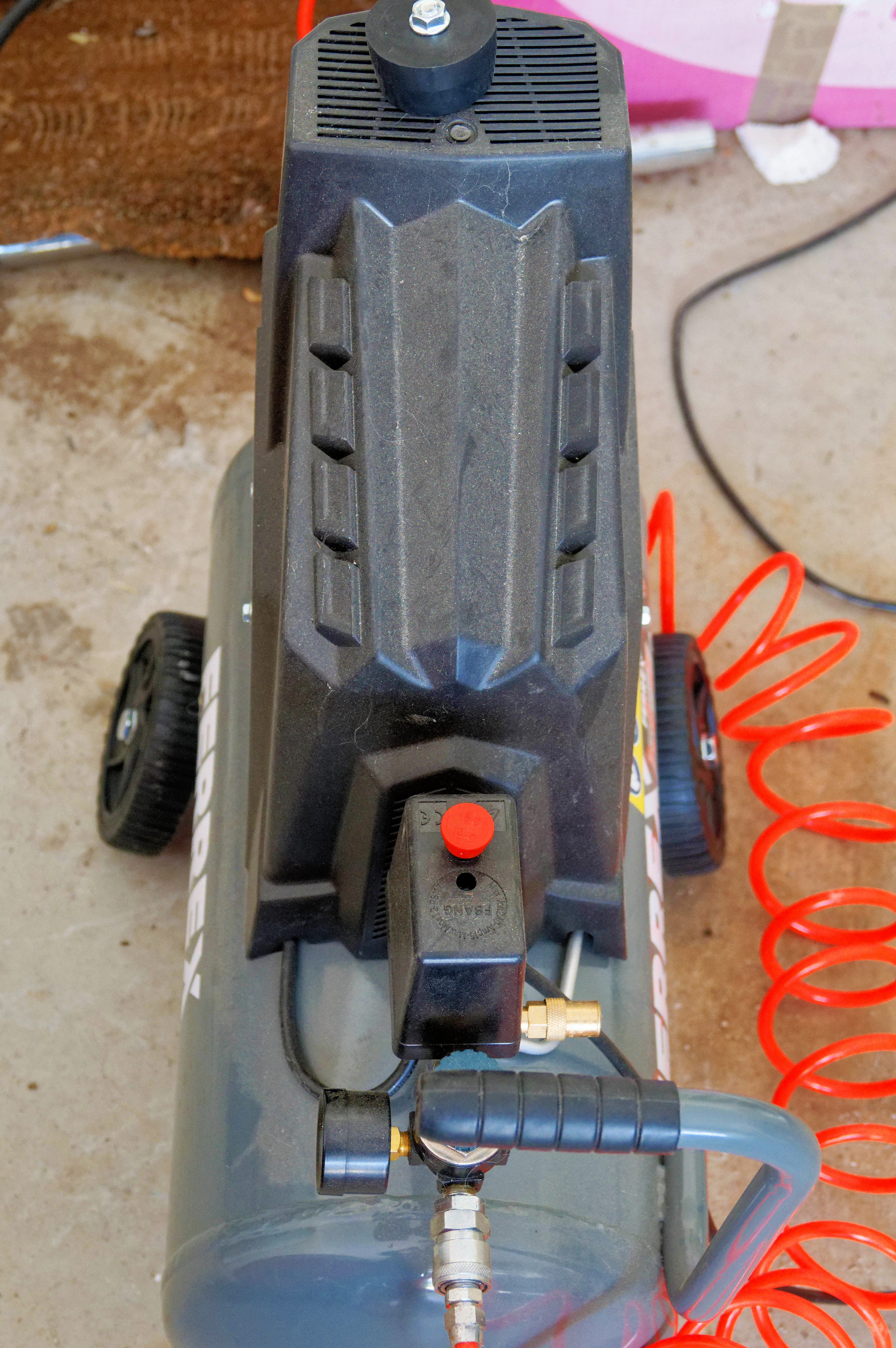
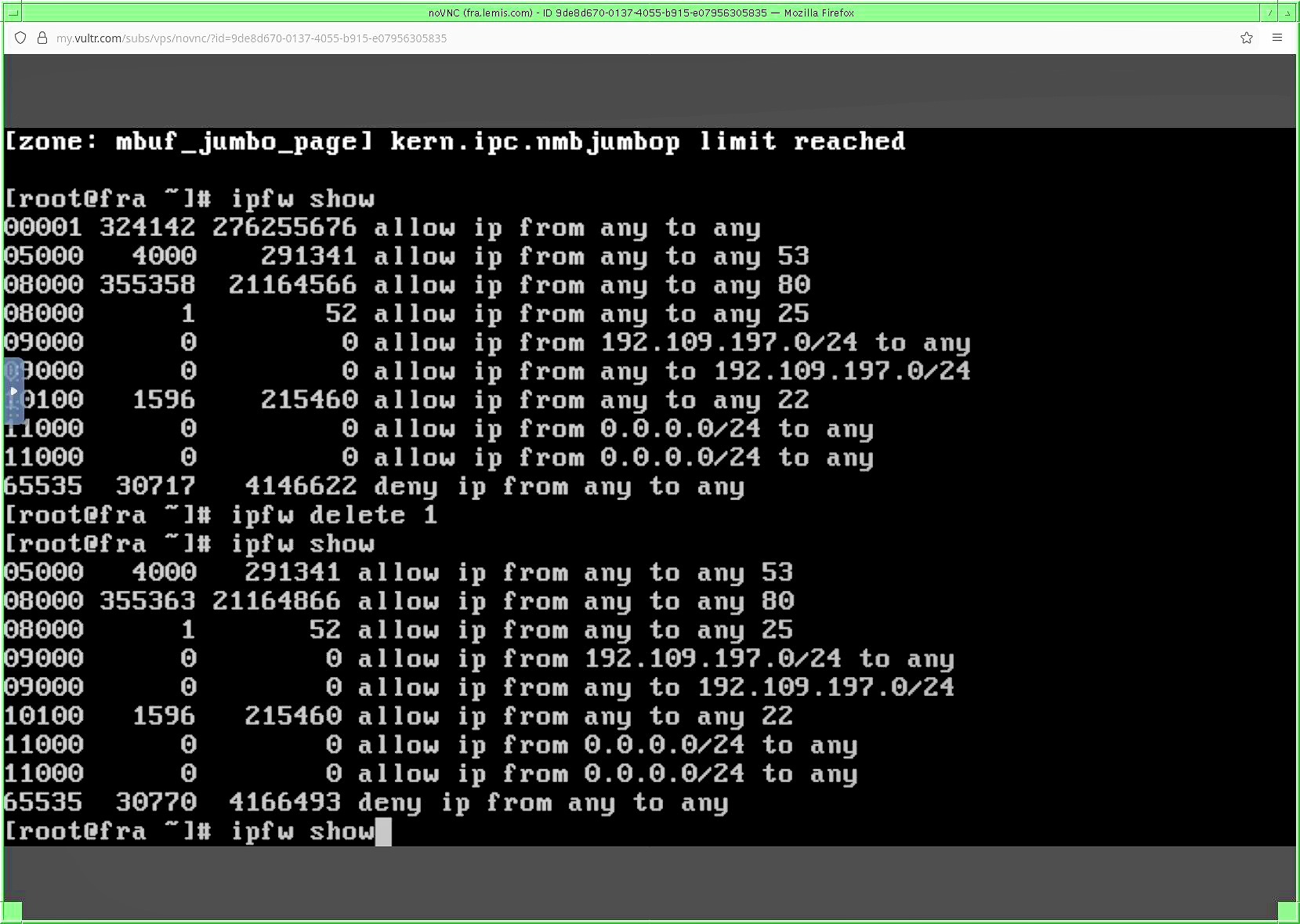
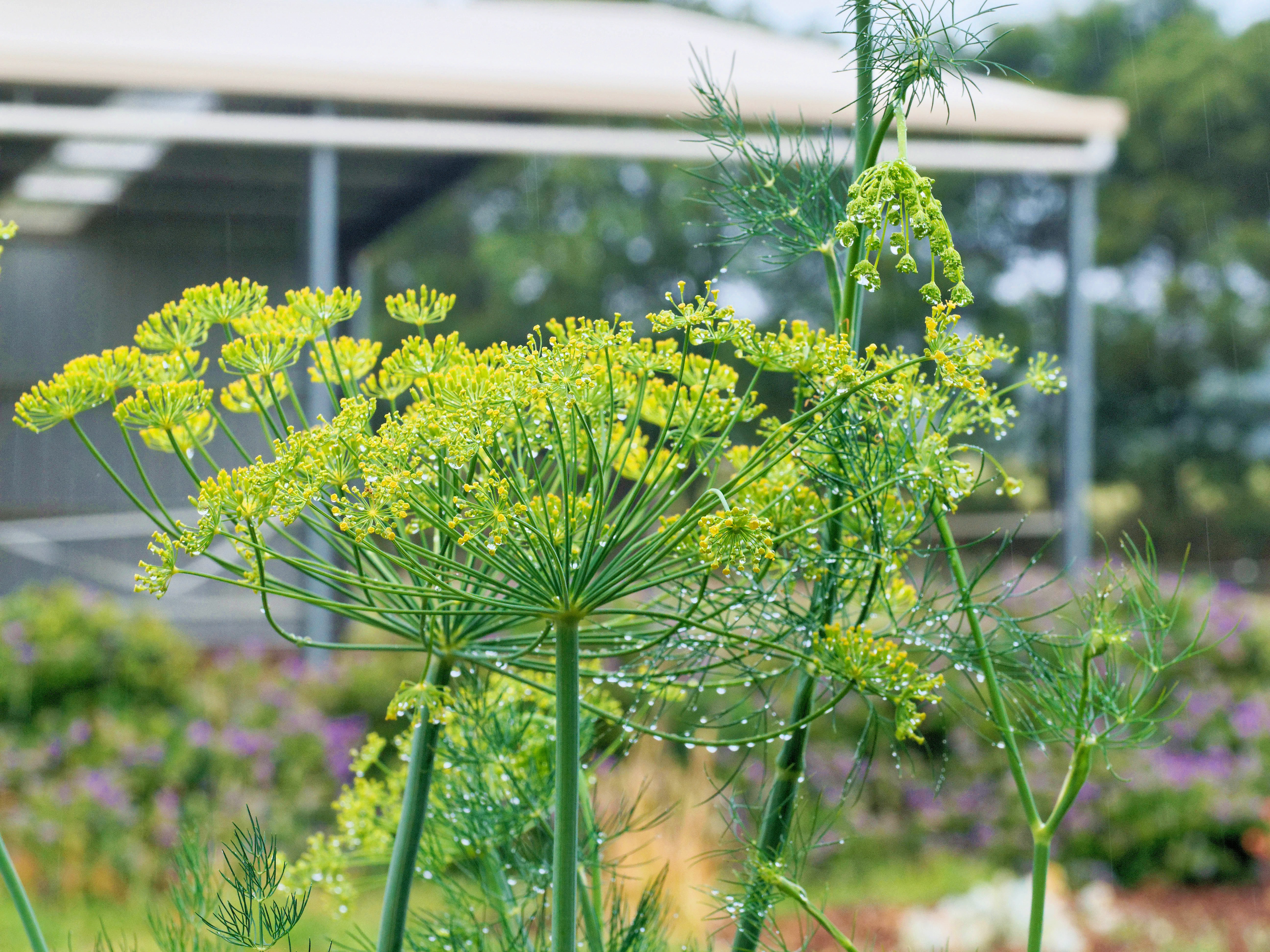
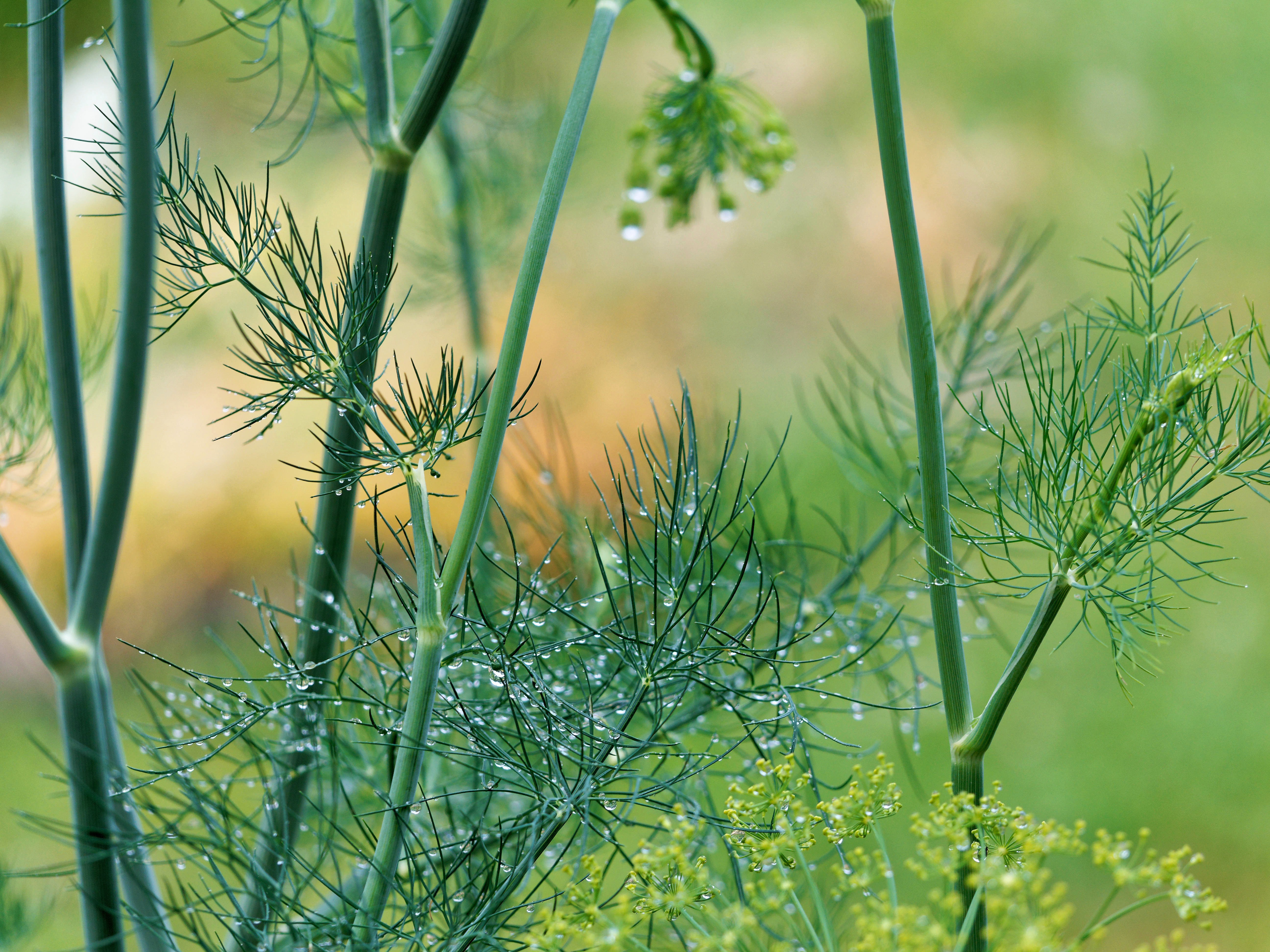
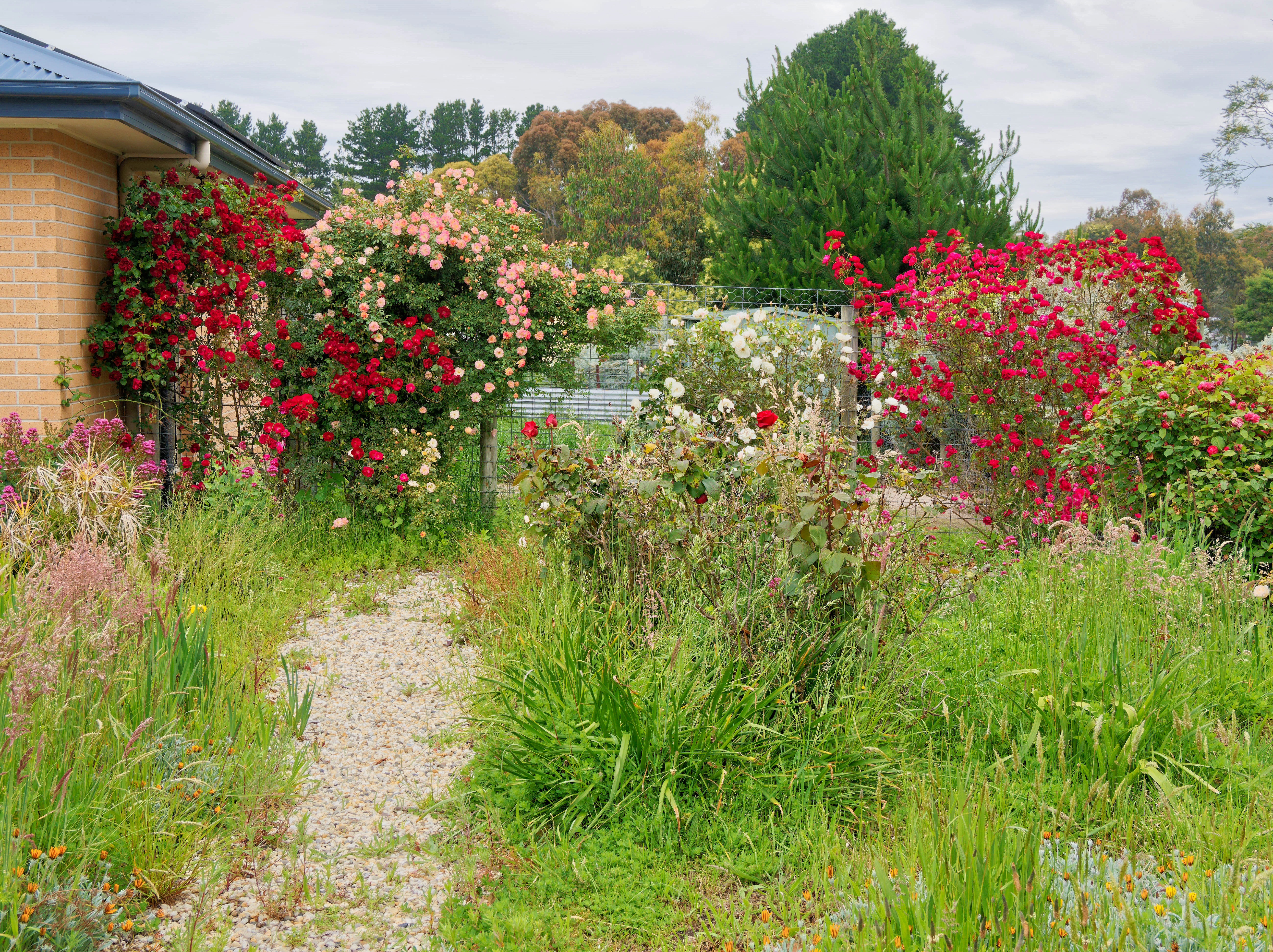
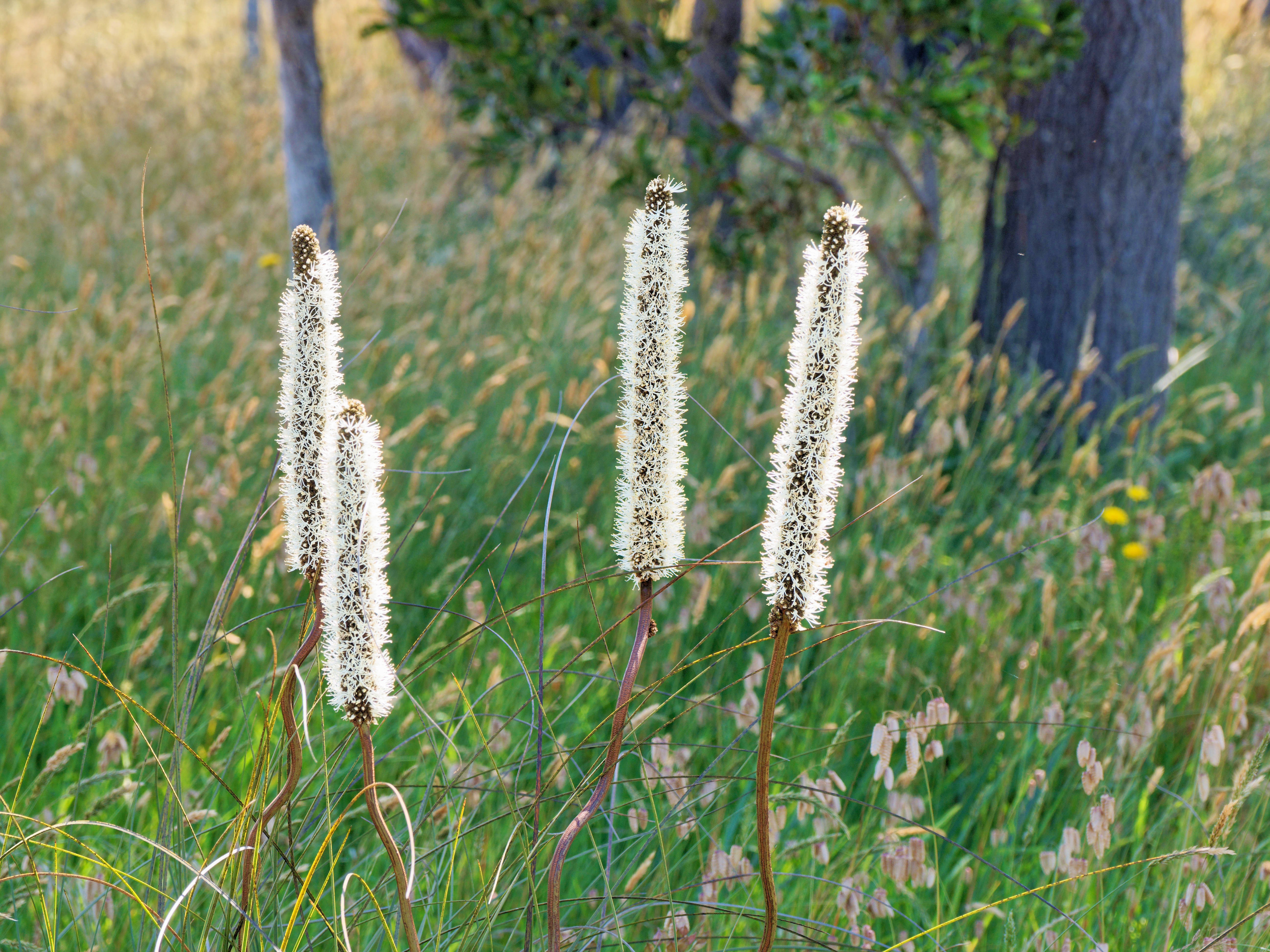
First day of summer today, but you'd have to know it. The maximum temperature was 13.3° in
a month where temperatures regularly exceed 40°. As the ABC news put
it:
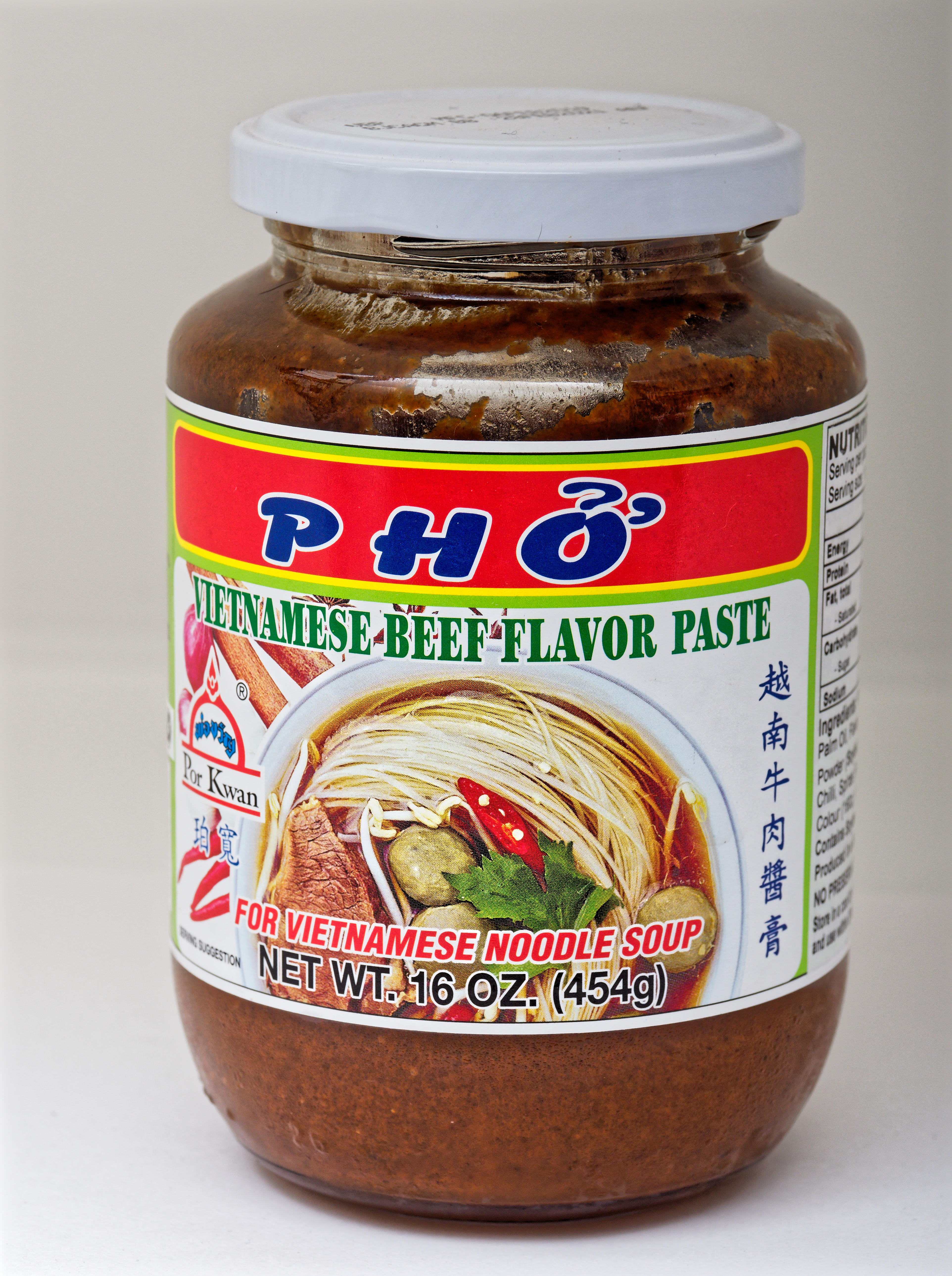
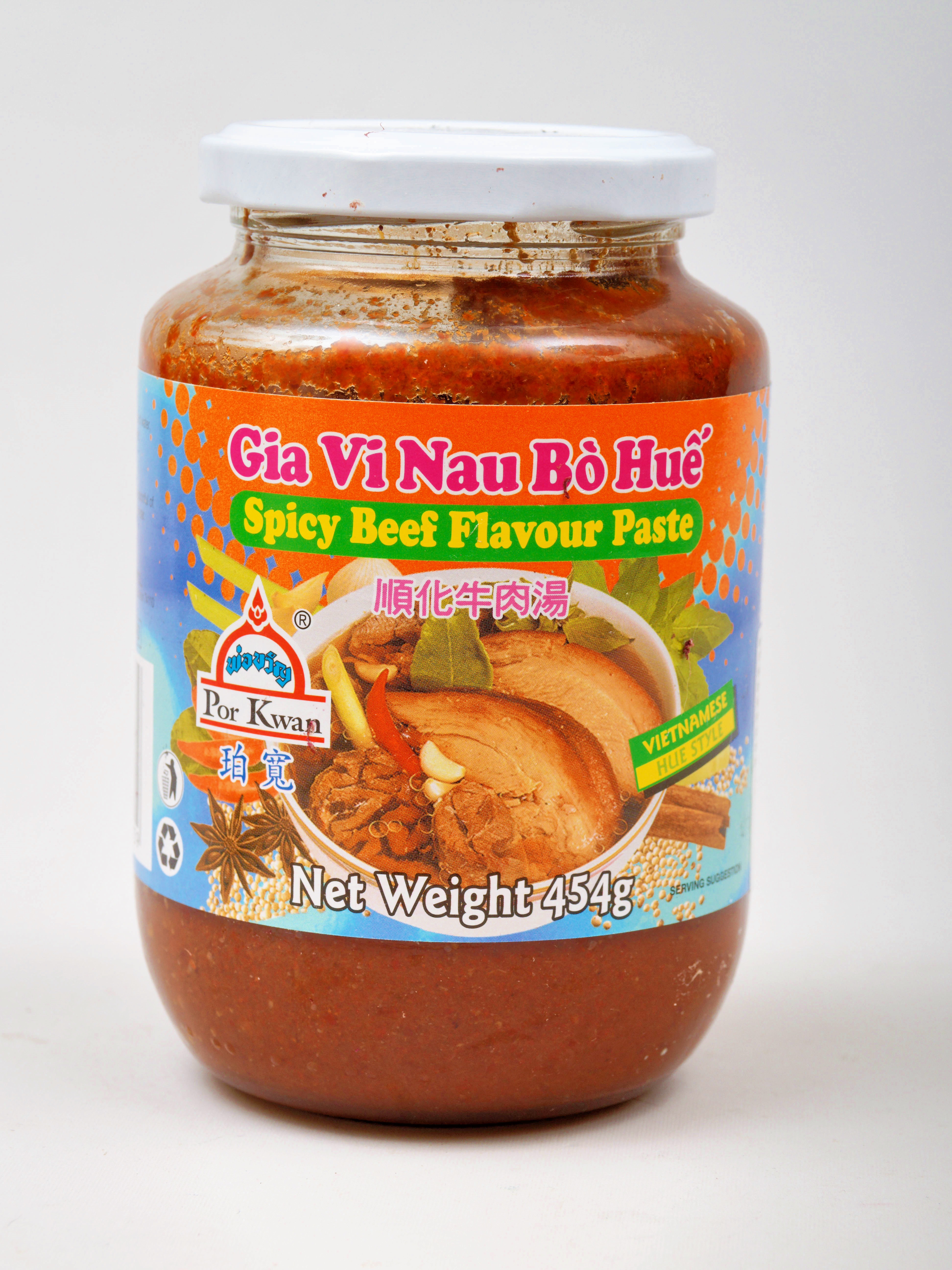
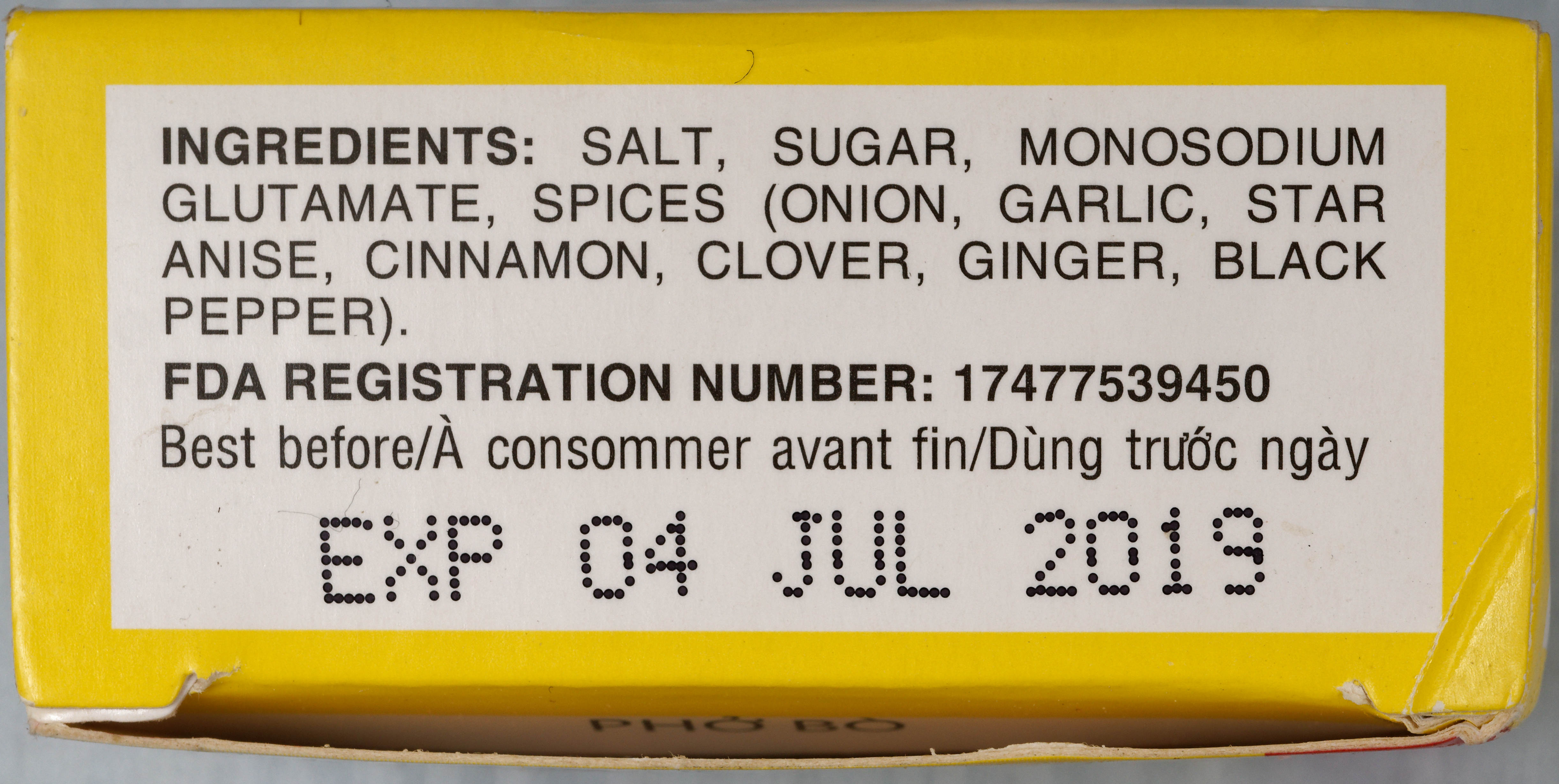
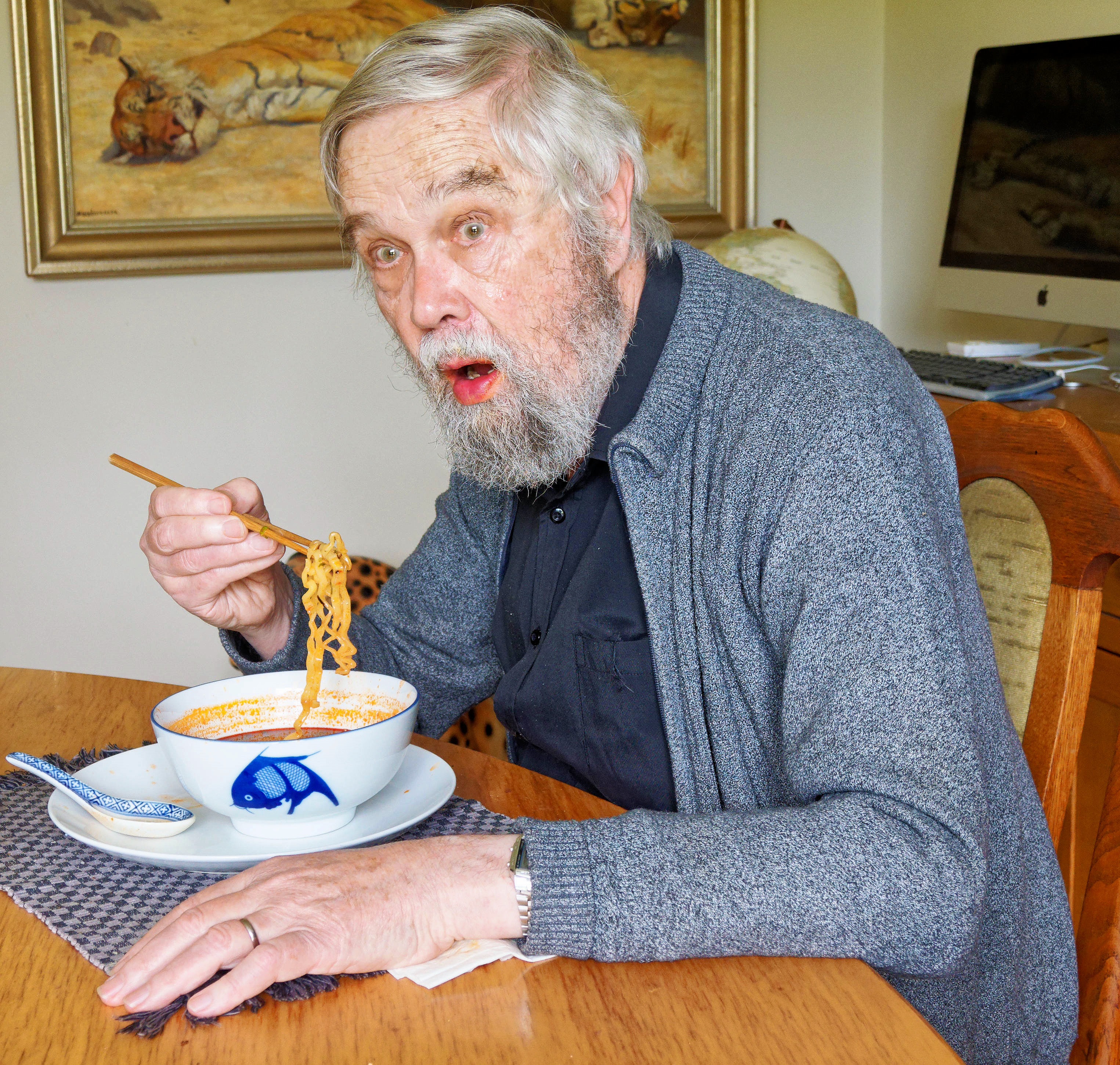
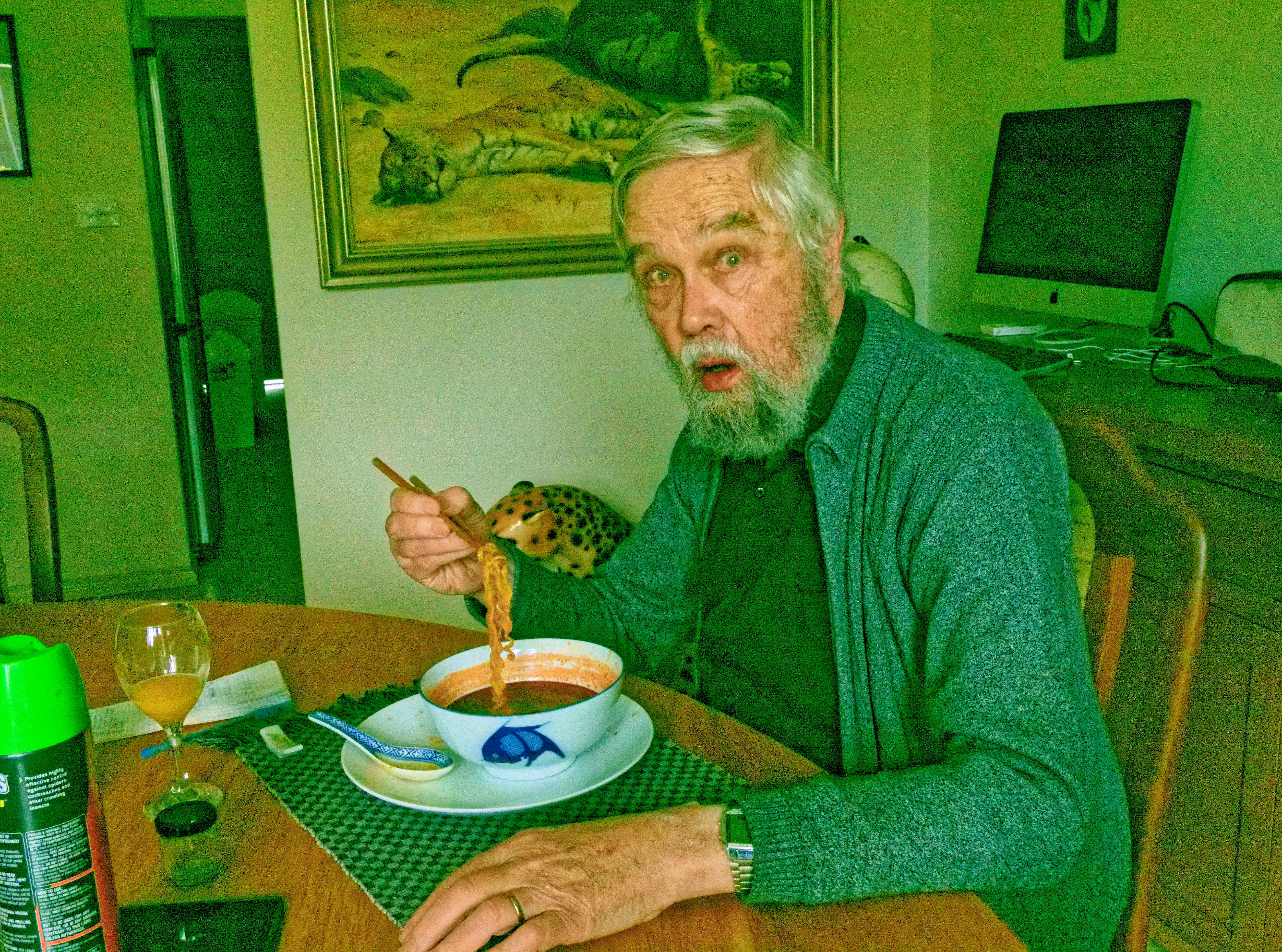
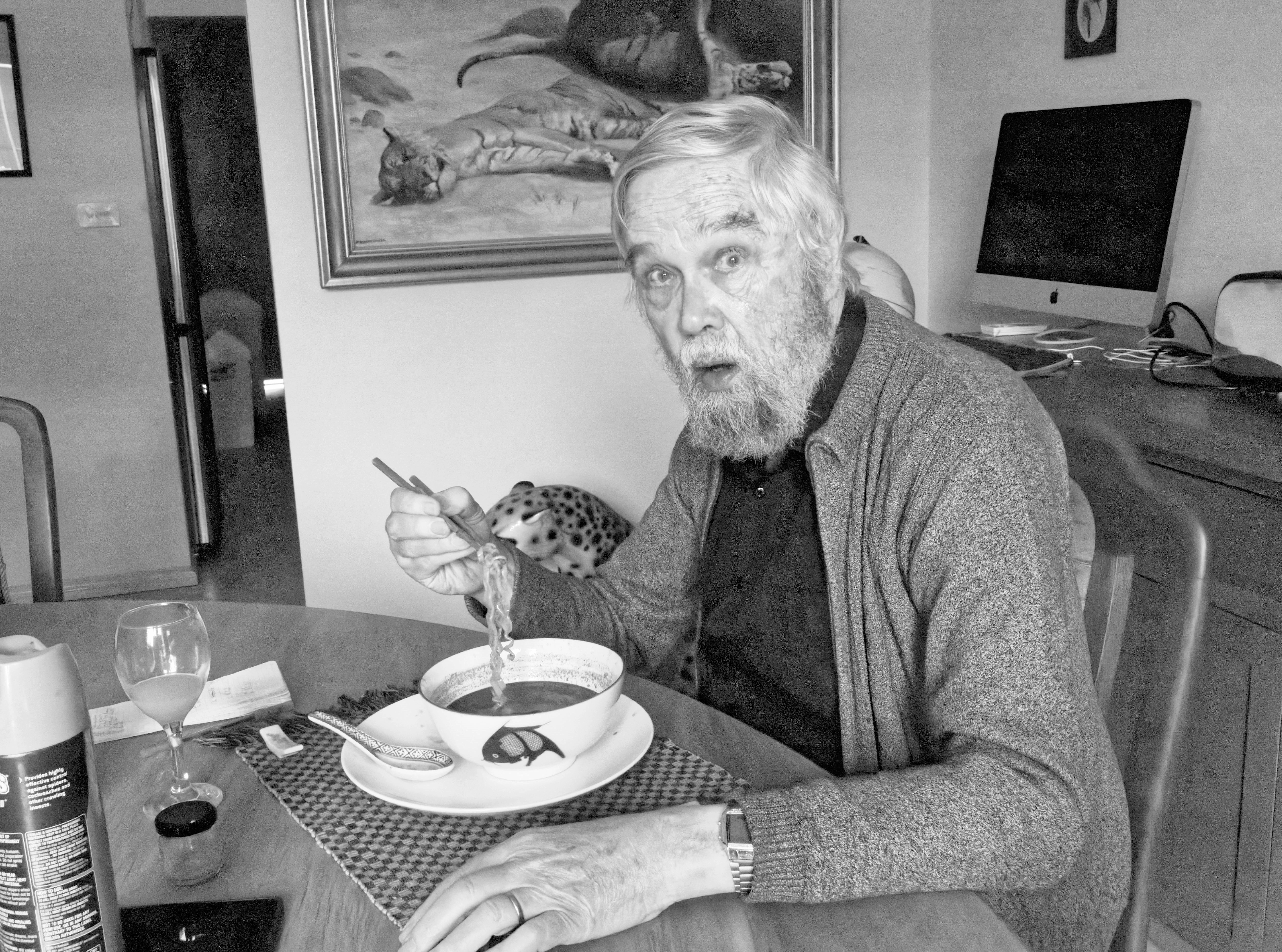
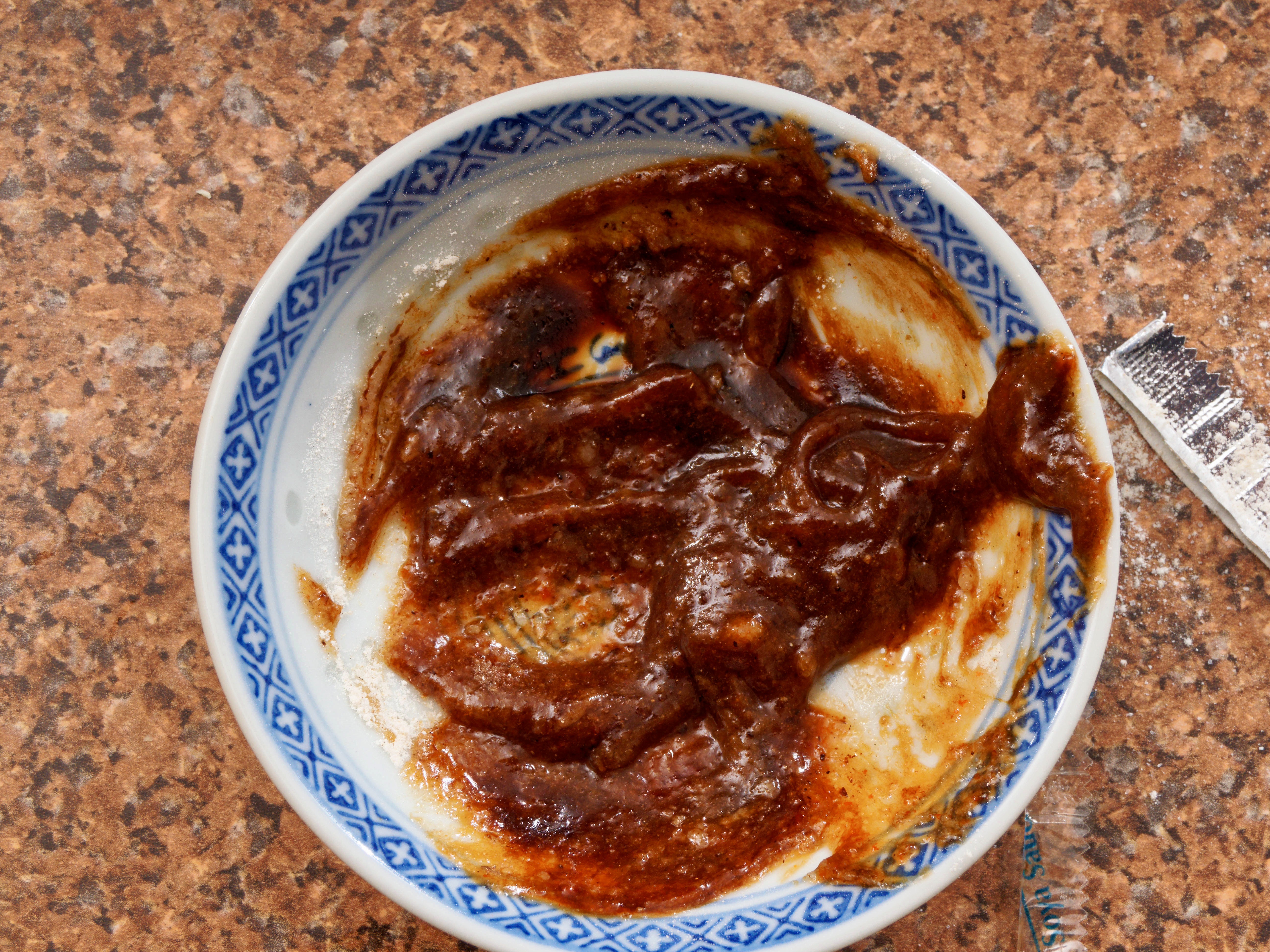
Phở bò for breakfast today. I have two different
jars of paste from Por Kwan, and for the fun of it I chose the other one. I thought. It
seems that they make no less than three different pastes, all with labels that don't say
very much in English:
“Vietnamese Beef Flavor Paste, “Instant Beef Flavour Paste”, “Spicy Beef
Flavour Paste”. Not much difference in English, since they're all Vietnamese, “instant” and
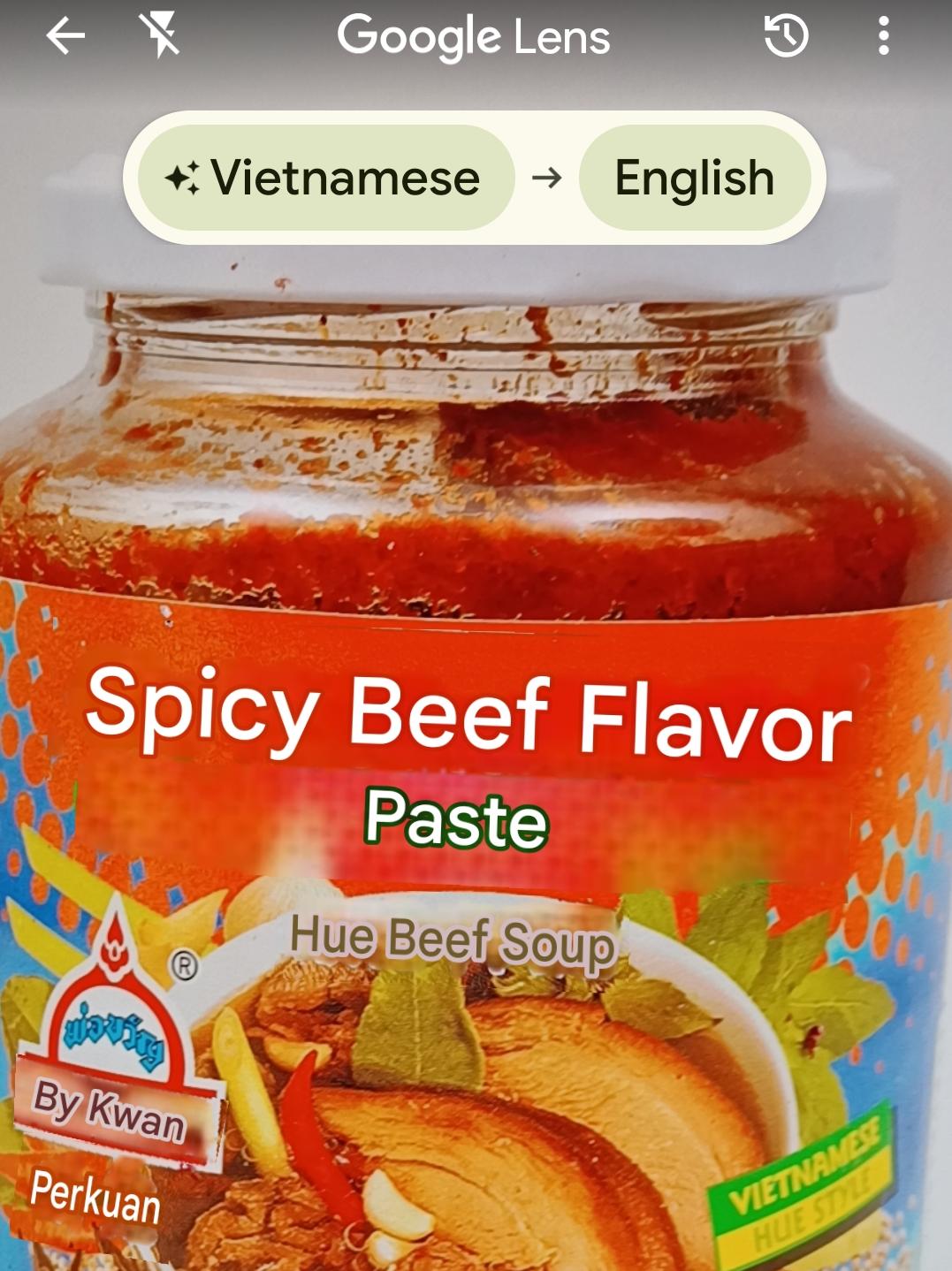
“spicy”. The one I got was the third one. Not much help from Google Translate:
Finally braved RIPE's login
procedures to set up a reverse domain for 192.109.197.0/24. The good news: login
worked. The bad news: it was only the first step. I received a mail
Two-factor authentication (2FA) is mandatory on RIPE NCC Access. To set up 2FA on your
RIPE NCC Access account, please copy and paste the below link in your browser.
More information on how to set up two-factor authentication can be found in the link
below.
Following the link gives me two choices: one of three Authenticatorapplicationapp or a passkey. I had never heard of either, and the instructions are vague: “Then, either
scan the QR-code on the set up screen or enter the secret key manually”. Wha setup screen?
How do I scan it? I need a mobile telephone for security? But it seems
that's becoming more and more a requirement: if you don't have a mobile phone, you don't
exist.
Spent much of the afternoon trying to understand how this fits together. It's worth taking
a step back and considering what they're trying to achieve. For a horrible moment I feared
that they would want me to perform the operations on my phone instead of a Real Computer.
But that doesn't make sense: for any reasonable 2FA you need at least
two devices. I have already ranted about the stupidity of performing 2FA on the same device
(typically phone) from which the request came. But they don't know my phone number, and
even if they did, would they really send me a message round the world? How do they
communicate with the device? I could use hirse.lemis.com, my old Xiaomi Redmi 9T that no longer
works with Australian mobile phone networks, but only if it uses IP (as one would expect from
RIPE).
So what kind of authentication makes sense? What I see is a six digit code. Is that more
secure than a random password? What does make sense is something like face or
fingerprint authentication. That can also be circuvented, but it's an order of magnitude
more secure than silly things like dates of birth.
The real issue is just understanding what they want, especially since they say that once
chosen, the method can't be changed. What if it doesn't work? They allow only three
authenticators: Google
Authenticator, Microsoft and FreeOTP (which they spell as “FREEOTP”).
Then there are the passkeys. OK, a number of sites accept them, so I can use one of them in
case something goes wrong. Spent some time trying to set it up on my computer for
Amazon, but failed. At
one point I got this message:
I'm getting to hate these silly values with lots of *** in them. OK, enter the (6
digit) number. It didn't like it for some reason, and it took me several attempts and lots
of deliberate delays to finally authenticate. But then I got:
What's the Security key? I know the Any key. Have they added another key to the Microsoft
keyboard? Much searching shows that it's a piece of hardware such as the dongles following
FIDO2. And that
makes sense: they're one thing that mobile phones have that Real Computers don't. I need to
follow up on that. What software support do they need? Will they even work on a FreeBSD machine?
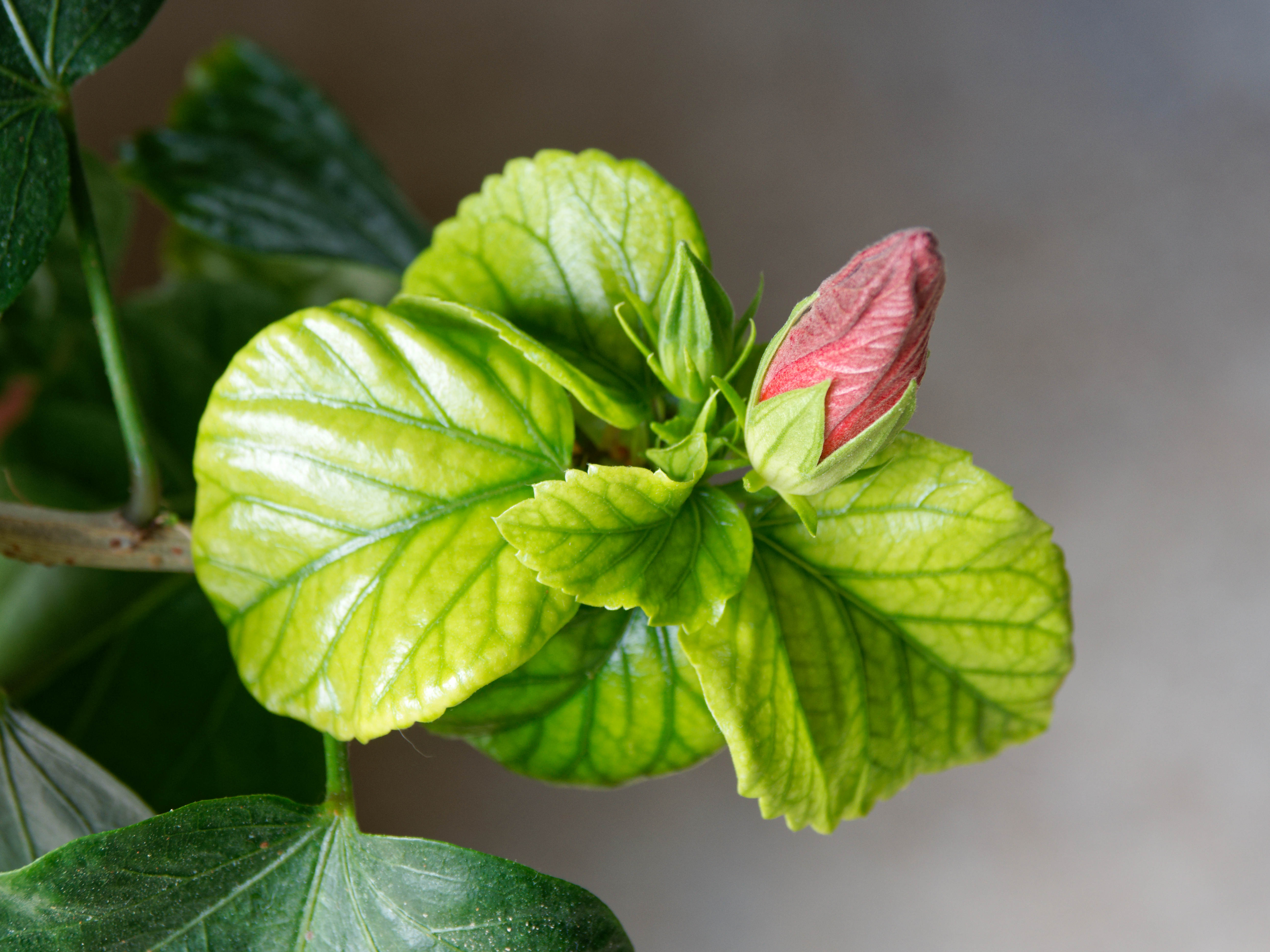
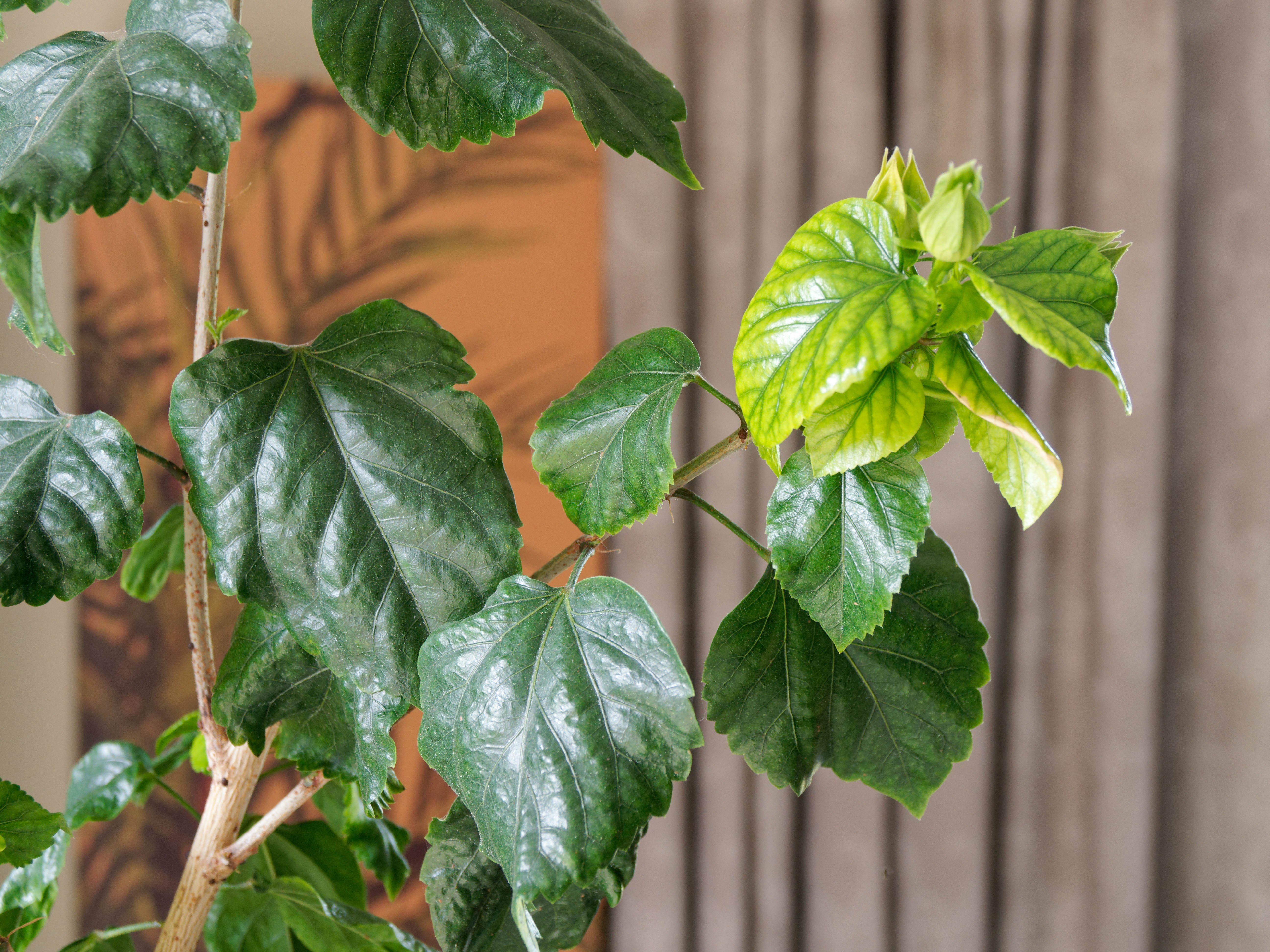
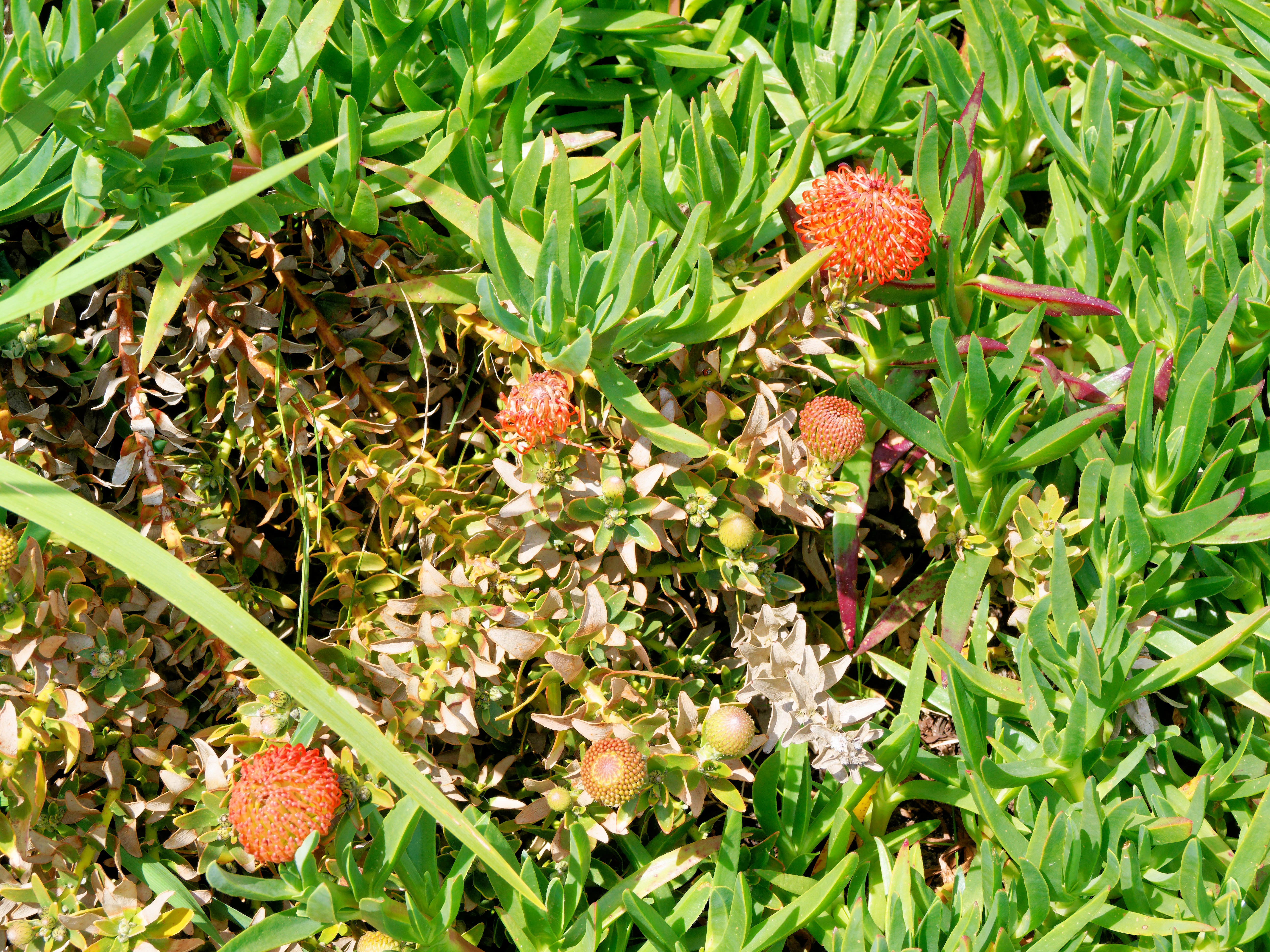
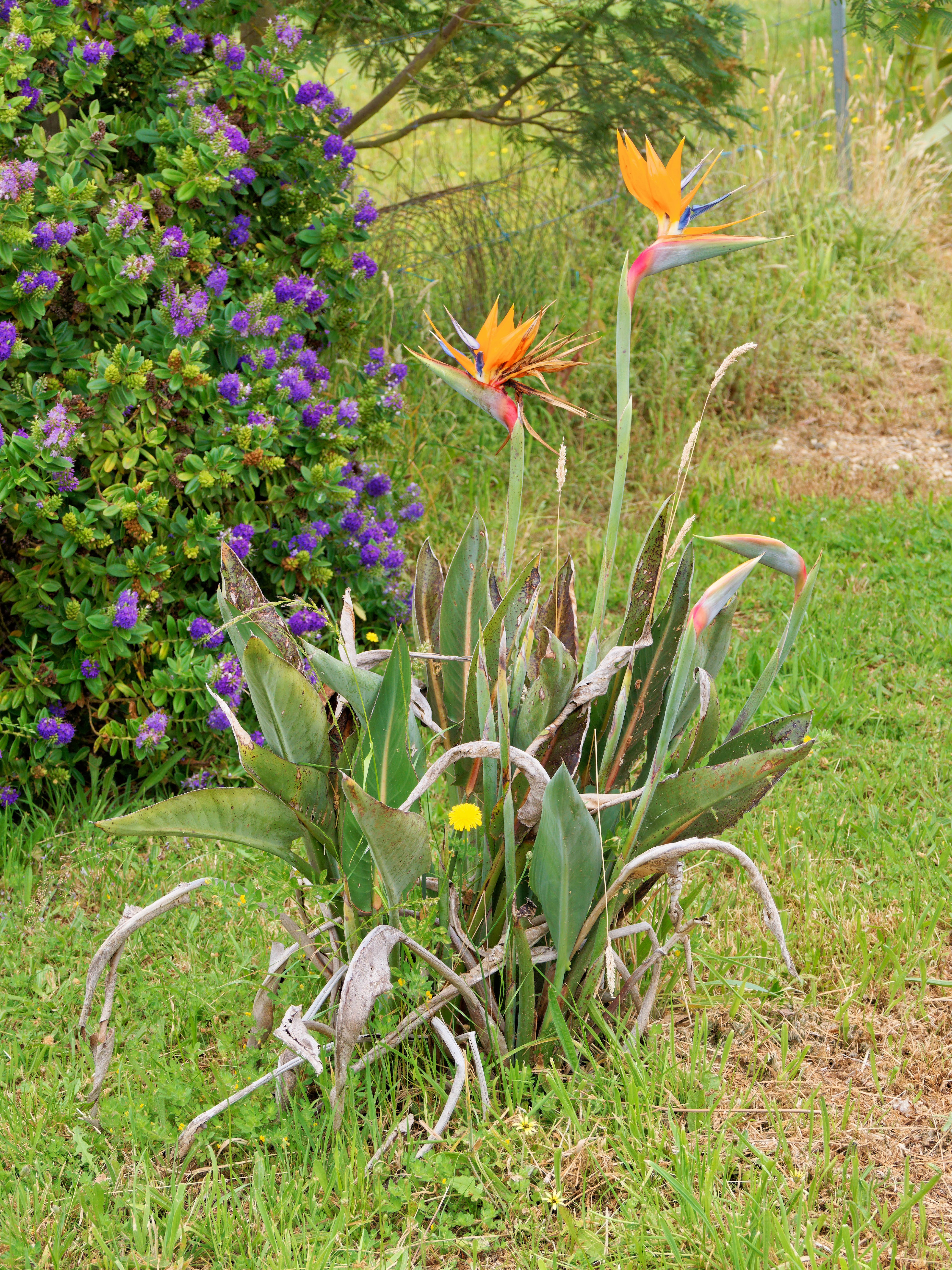
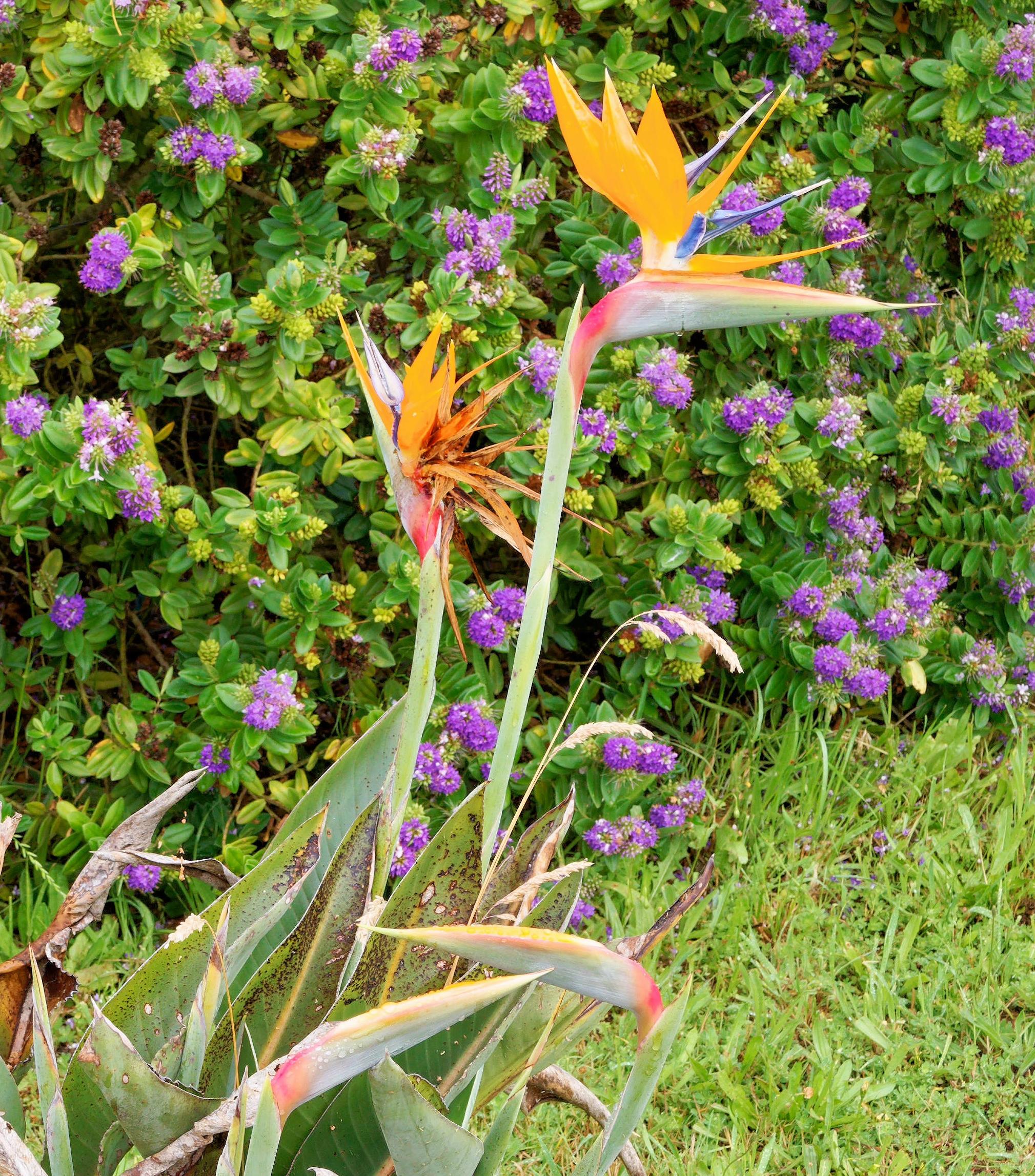
It looks like lack of fertilizer, though I have spread some not so long ago. Try again with
much more fertilizer; hopefully new growth will look better.
The batteries in my bathroom scales are low. On changing them, I discovered that they were
nickel-zinc batteries, and only one was low. That's typical for NiZn batteries, and one of the reasons
I no longer use them much. But on replacing them with normal NiMH batteries, the display was too dim, probably the reason why I put in the NiZn batteries.
Apart from that, the result wasn't what I expected. I had just weighed myself with clothes
and registered 90.8 kg. But now it showed 92.6! A few months back I had similar problems with brand new scales, but this time it was
diffeent. A comparison with Yvonne's scales showed that the
90.8 kg were correct. But when I weighed myself again on my scales, they too showed 90.8
kg.
OK, it seems that the scales don't like the voltage of the NiMH batteries. Replace them
with NiZn. 93.4 kg! A bit later they had reconsidered, and were now showing 91.3 kg. And
much later they again showed 90.8 kg.
What's going on here? Do the scales somehow self-calibrate? It's certainly different from
my last investigations, where the scales were consistently wrong.
Bruno has been transformed by being let
out when he wants, and I think he's still finding out when he wants to be inside and when he
wants to be outside. But to be on the safe side we don't allow him into the Great Outdoors
after sunset. Instead we put him in the “dog run” outside Yvonne's bedroom, where he can't get out.
Until tonight. While watching TV, he appeared on the window ledge and wanted to get in.
And he had a dead superb
fairywren in his mouth! How did that happen?
It proved that he dug under the fence in the dog run. But what was the fairywren doing out
alone at night? Still, it was his first bird in nearly 10 months. Hopefully they'll keep away from him from now on.
Where are all these failure messages coming from? On the face of it it could be a bug in my
PHP code. But the only plausible
place for a bug would be in responding to a 404 error, and they didn't happen. The best I
can do is to just not report errors that have a referrer http://www.lemis.com.
But today I got a whole lot of other errors:
1304 N + 03-12-2025 To groggyhimself@ World Wide Web Owner ( 78) N + Broken link: /grog/Photos/20160213/small/Radioactive.png <- http://www.lemis.com/grog/diary-feb2016.php?dirdate=20160205
1305 N * 03-12-2025 To groggyhimself@ World Wide Web Owner ( 78) N * Broken link: /grog/Photos/20160213/small/Confusion-symbol.png <- http://www.lemis.com/grog/diary-feb2016.php?dirdate=20160205
1306 N * 03-12-2025 To groggyhimself@ World Wide Web Owner ( 78) N * Broken link: /grog/Photos/20160213/small/Mining-symbol.png <- http://www.lemis.com/grog/diary-feb2016.php?dirdate=20160205
1307 N * 03-12-2025 To groggyhimself@ World Wide Web Owner ( 78) N * Broken link: /grog/Photos/20160213/small/Information-symbol.png <- http://www.lemis.com/grog/diary-feb2016.php?dirdate=20160205
1308 N * 03-12-2025 To groggyhimself@ World Wide Web Owner ( 78) N * Broken link: /grog/Photos/20160213/small/Extruder-symbol.png <- http://www.lemis.com/grog/diary-feb2016.php?dirdate=20160205
...
recognize fire symbols. Then there is confusion (represented by the <?php oneimage
("/grog/Photos/20160213/small/Confusion-symbol.png", "confusion symbol", 40, 42, 1); ?>
symbol), radioactive waste (represented by the <?php oneimage
("/grog/Photos/20160213/small/Radioactive.png", "radioactive waste symbol", 50, 48, 1); ?>),
mining (represented by the <?php oneimage ("/grog/Photos/20160213/small/Mining-symbol.png",
"mining symbol", 45, 44, 1); ?>), information (represented by the <?php oneimage
("/grog/Photos/20160213/small/Information-symbol.png", "information symbol", 50, 41, 1); ?>
symbol) and extruders (represented by the <?php oneimage
("/grog/Photos/20160213/small/Extruder-symbol.png", "extruder symbol", 44, 41, 1); ?>
symbol). What do they really mean? Running the cursor over them gives you insight: the web
...
Oh. When I moved my images to DigitalOcean I had to rewrite my already convoluted showphoto ()
function to point to DigitalOcean when the
subdirectories Photos/*/big/, Photos/*/small/ or Photos/*/tiny/ were
referenced on the external web sites. But I didn't do it for oneimage ().
More pain!
In fact, it was simpler than it should have been. Just
prepend https://lemis.nyc3.digitaloceanspaces.com/ to the URL for local images.
Looking back, that shouldn't have worked: it should already have
had http://www.lemis.com/ there. But so far it seems to have worked, though I went
through a lot of pain relearning PHP in the process.
I've made phat si-io a number of times, but
it's still not perfect. This morning, since I still have a cabbage, I tried with that
instead of gai lan, and also
tried a number of different changes.
The problem: wok hei. That's a
flavour nuance that I haven't quite understood, but it's related to cooking over high heat
in a wok. Google Translate is completely useless. It translates the term into simplified
Chinese as 我开黑 (I play with friends), or into traditional Chinese as 我看黑 (I see
black). Wikipedia wrote it
“wohkhei”, and claims that it is a Cantonese word meaning
“the breath of the wok”. It also gives the spellings 镬气 (simplified), which Google
Translate translates as “gas", and 鑊氣 (traditional), which it doesn't translate. And then
MARION has a page on
the subject.
But this is Thai. Google Translate tells me that it is กระทะ เฮ้ (kratha ḥê). Is it right?
At least it translates it the same way from simplified and traditional Chinese. In English,
I get “gas” or “wok hei”, neither very useful.
So how do I get my กระทะ เฮ้, when I don't even know what it is? My best bet is that it's
something that's slightly charred, thus the continual recommendations to cook the noodles
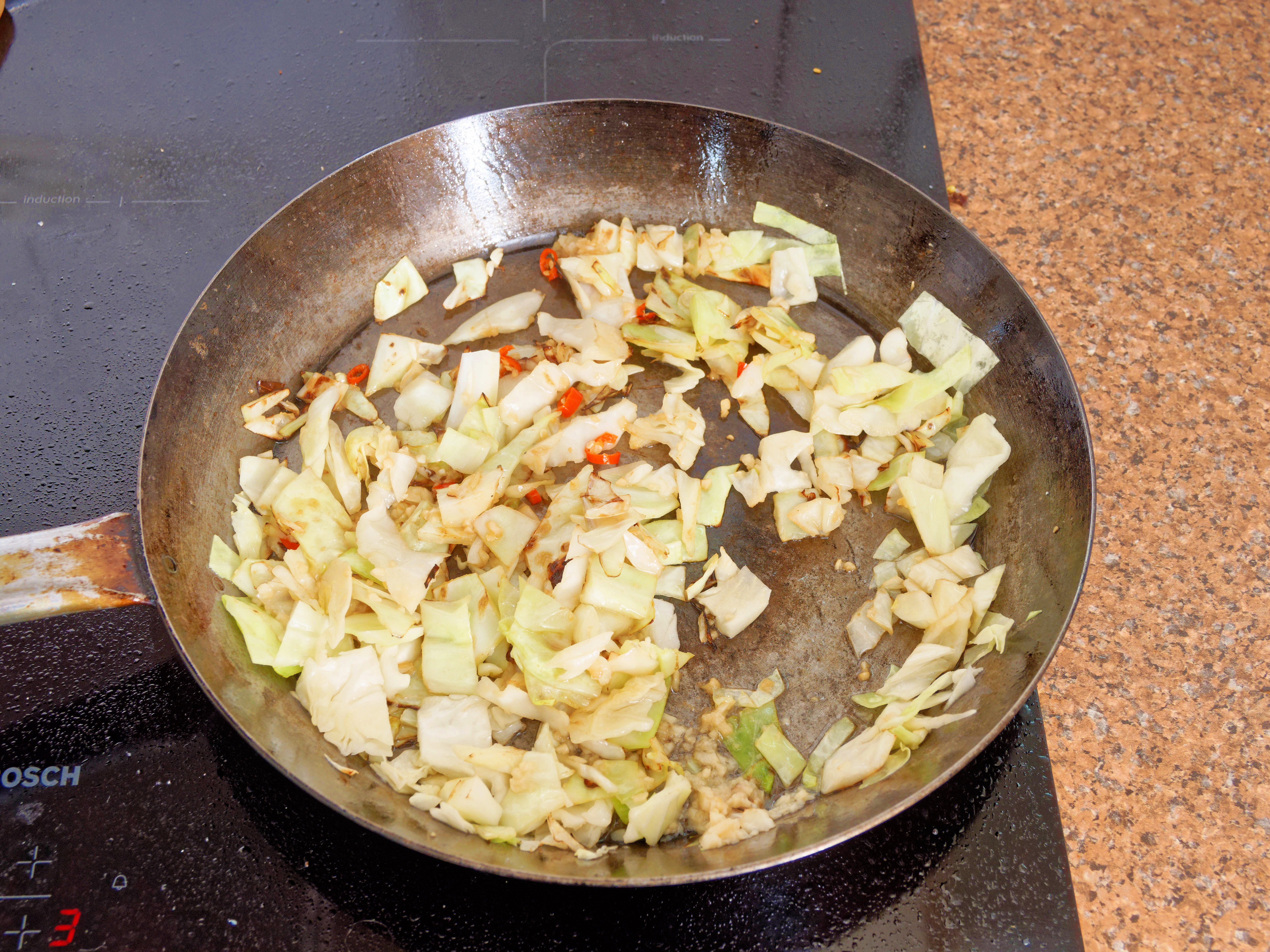
very hot and by themselves. But you can char cabbage too, so that's what I did:
And then there are the noodles. I freeze them and then thaw them when I need them, and
they're a little moist. So I left them to dry out for 40 minutes before frying:
But they still stuck. There's something basically wrong in the recipes that I have: fry the
noodles with the sauce in a very hot wok. But that doesn't work: “very hot” should mean
200° or more, but the sauce boils at round 110°. So I fried the noodles in oil first and
then added the sauce. They still stuck, and left a lot of residue:
That's probably because of the lack of green (gai lan) and yellow (egg yolks).
The other issue that is probably more interesting is that the steel pan in which I made them
is slightly convex, so any oil drains to the sides. That's the exact opposite of what a wok
would do. So next time I'll at least use a wok.
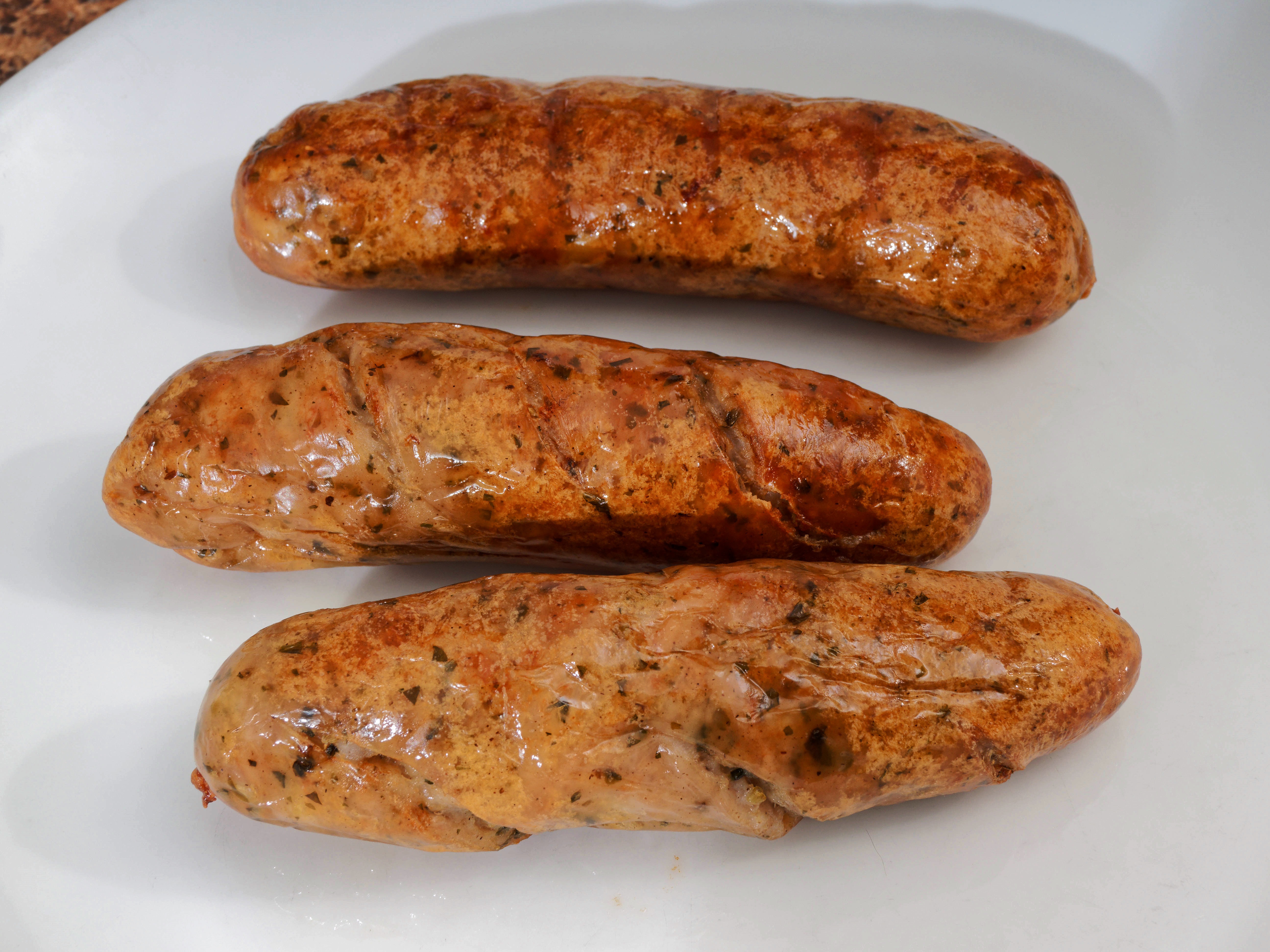
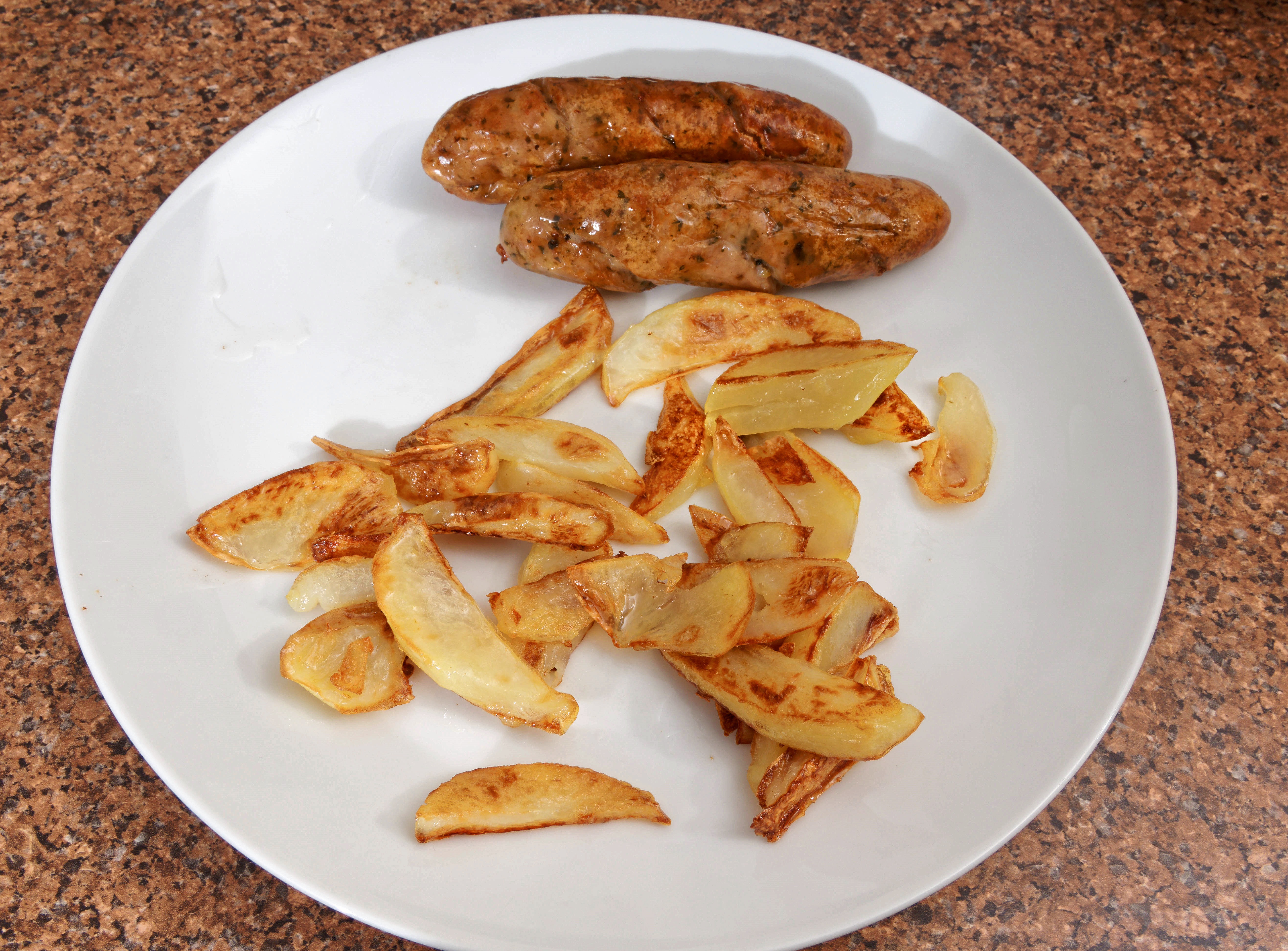
Bratwurst for dinner today.
Normally I fry them, but why? Despite the name („Brat“ could be taken to mean “fry”), they
should be grilled. Just what we want for the hair dryer.
OK, off to YouTube and looked for some clips,
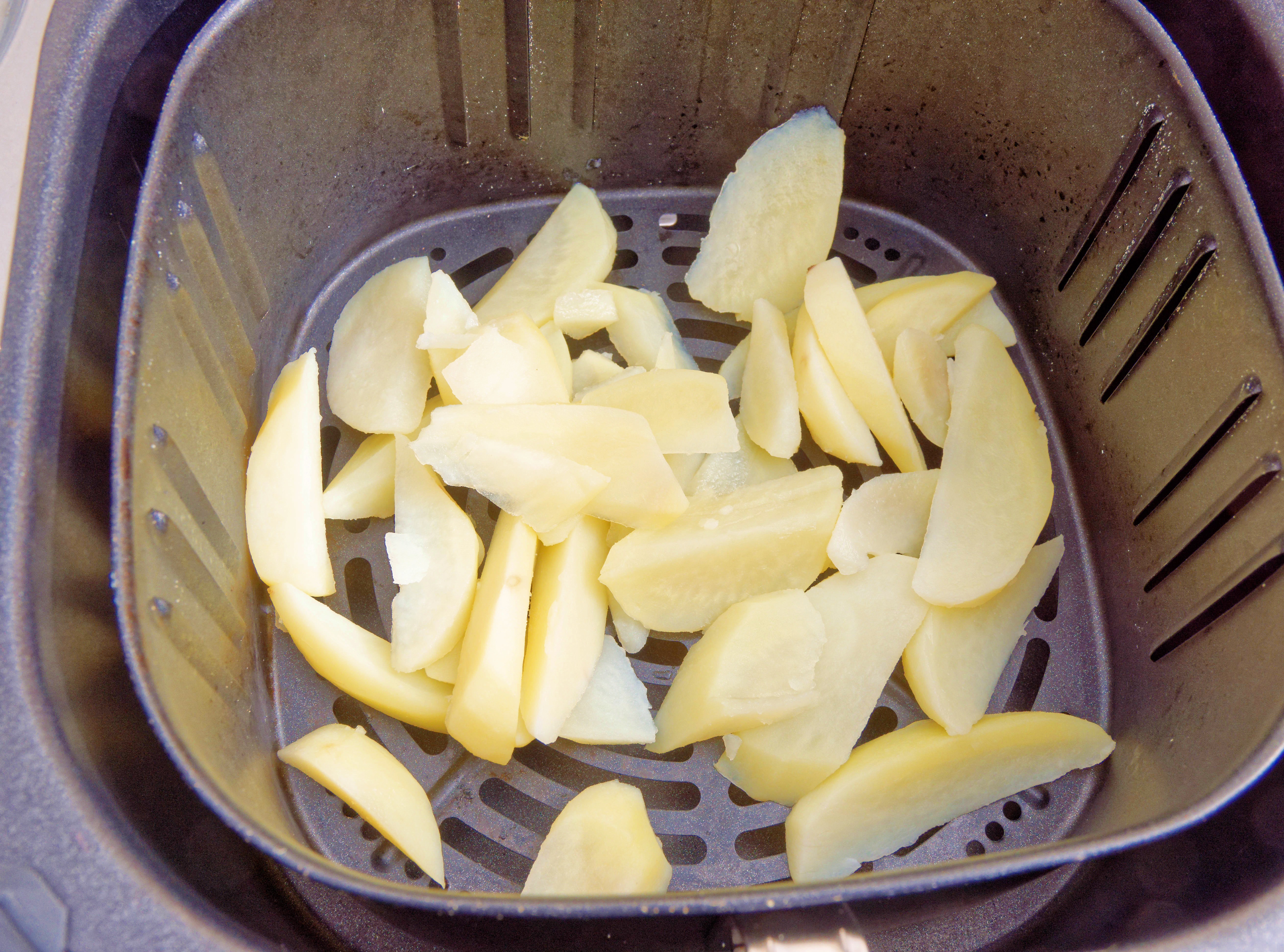
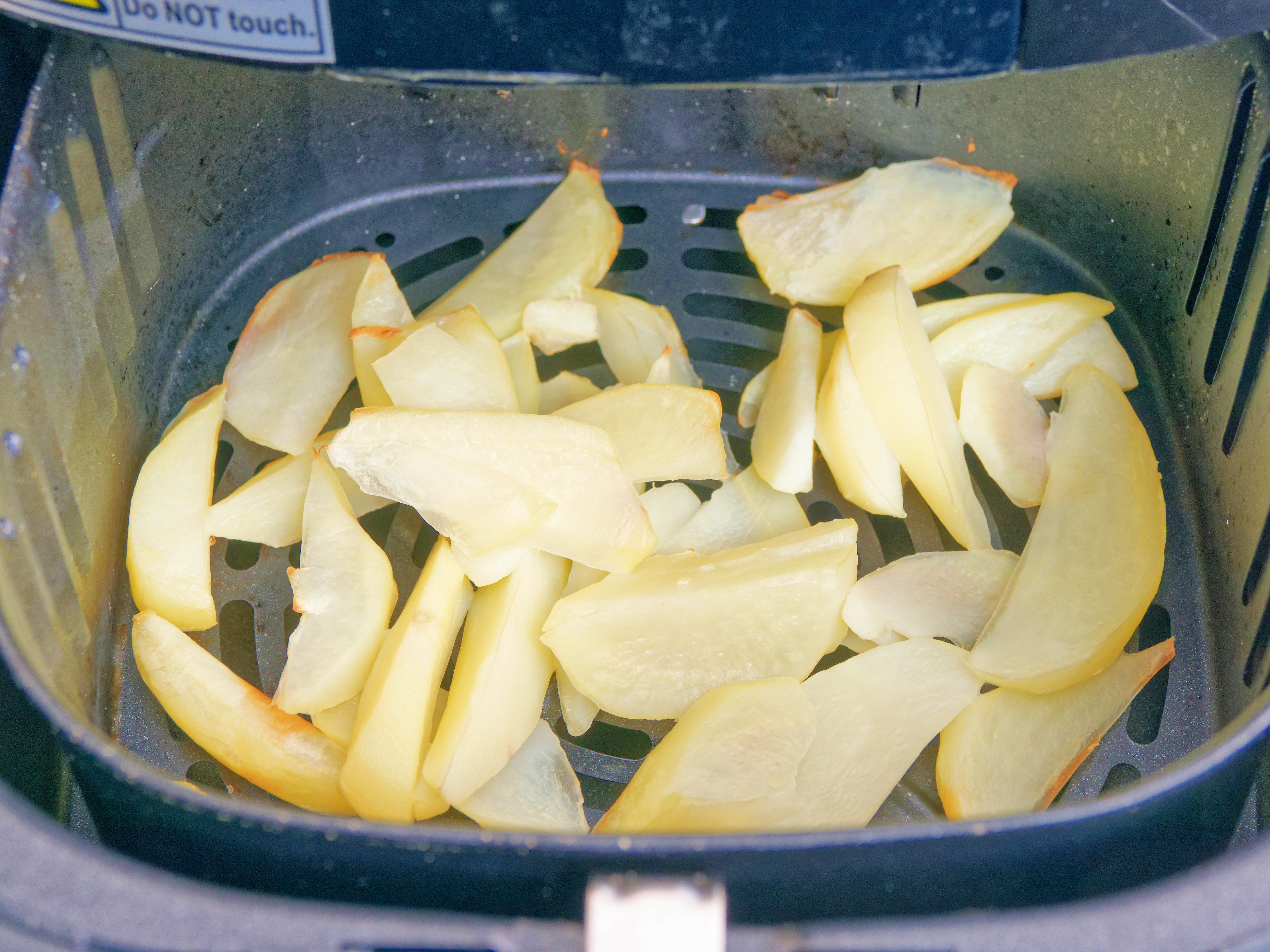
coming up with this one. Slit the sausages like Laugenstangen to avoid having them burst, then grill for 10 minutes at 160°. Turn
and grill further for another 3 minutes at 180°. And while you're at it, grill some
potatoes in a second “air fryer” for 10 minutes at 180°.
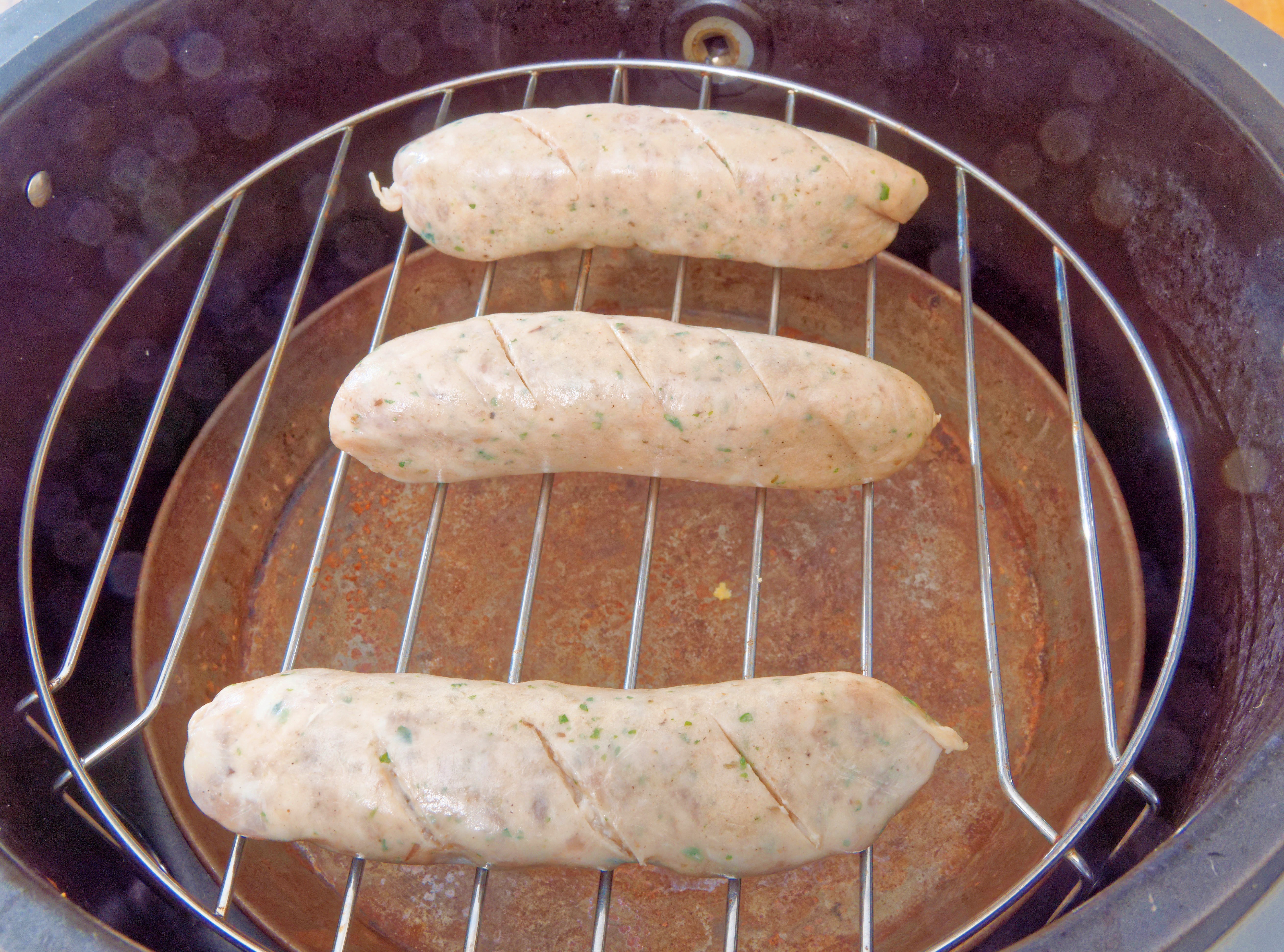
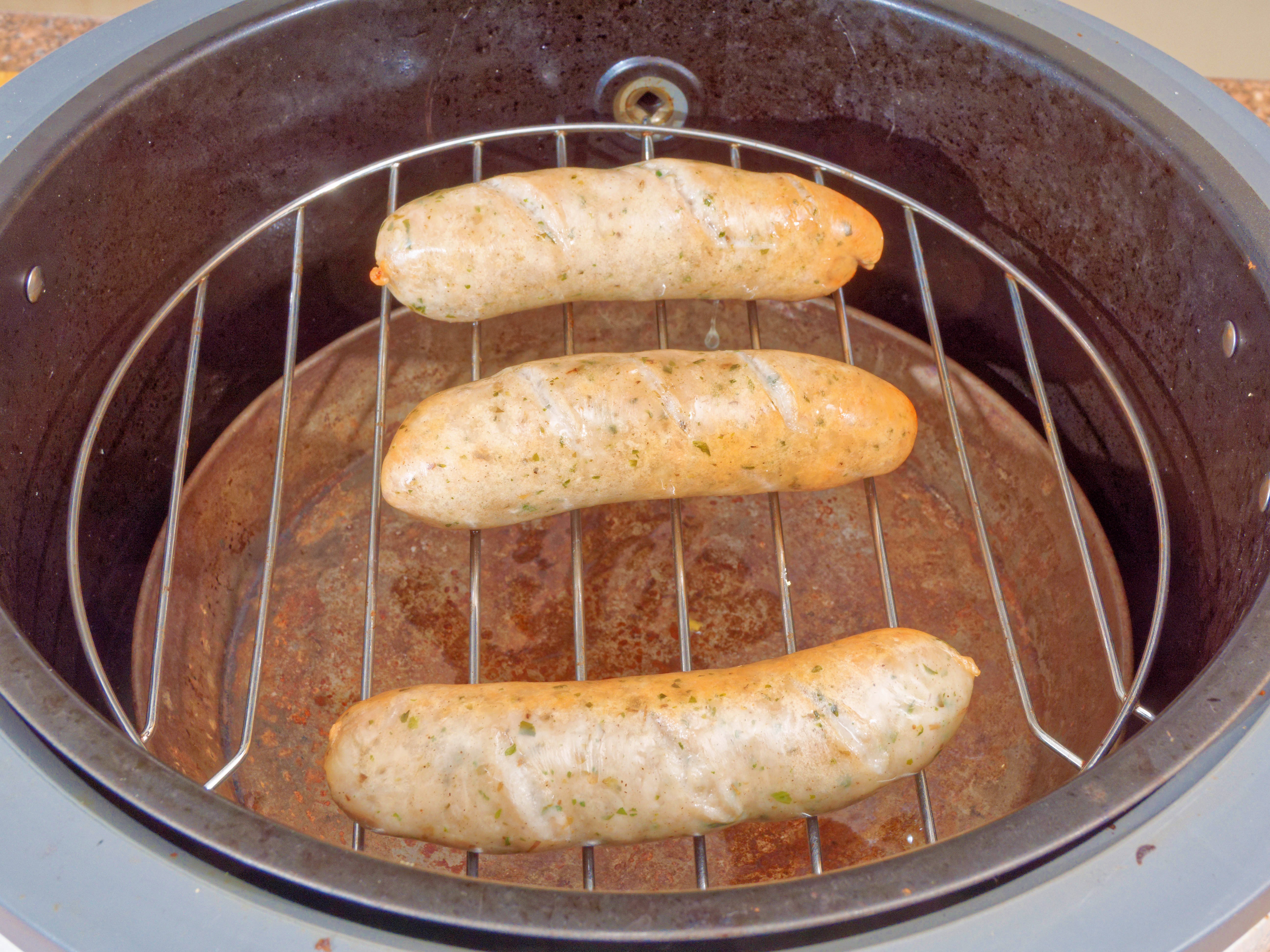
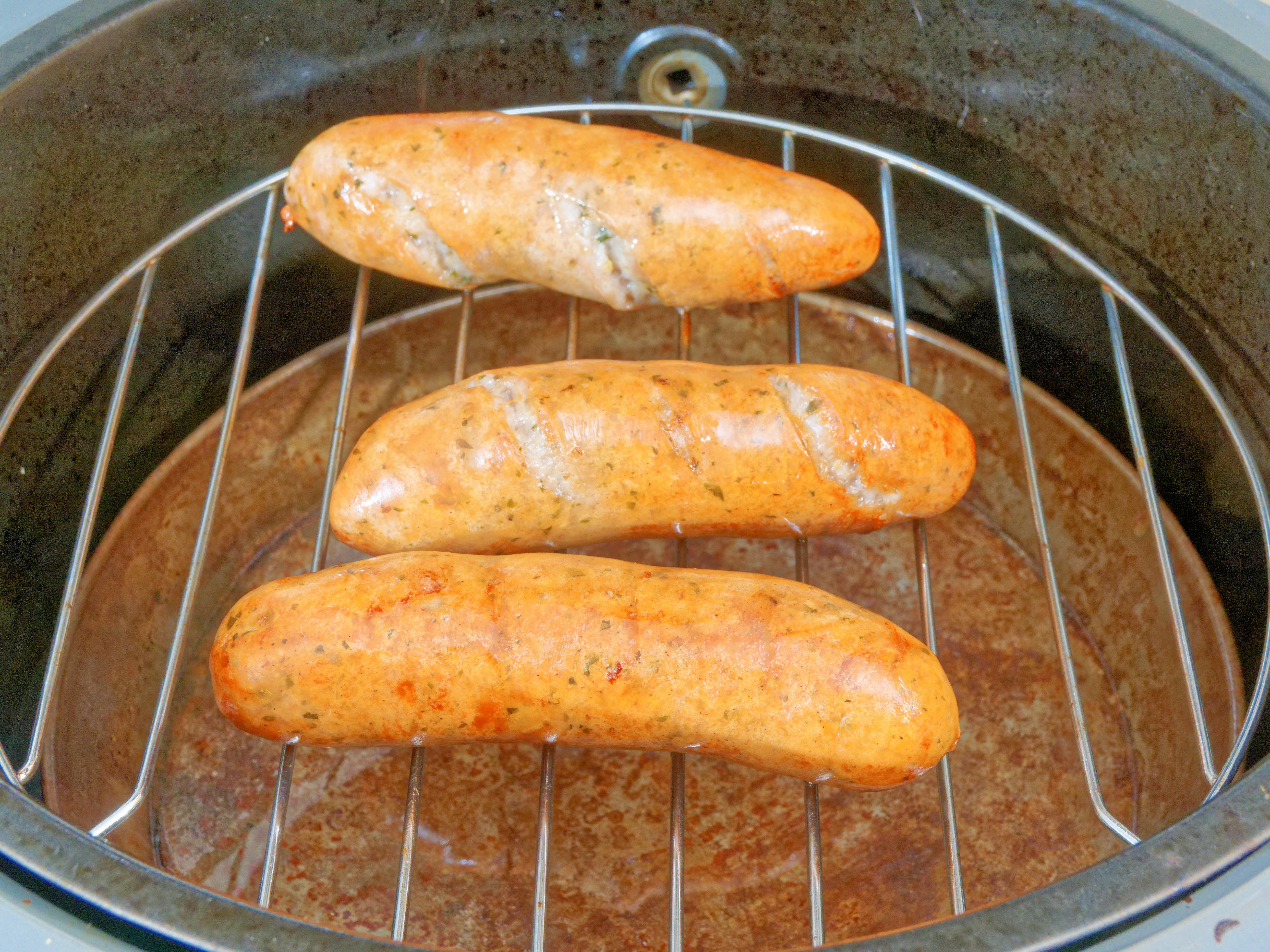
OK, we can do that. Slit and grill for 10 minutes. Here before and after:
What a lot of work! And of course I should have read my diary, which told me 14 minutes at 210°. And apart from that, I now have two dirty
“air fryers”, so that'll be another dishwasher full.
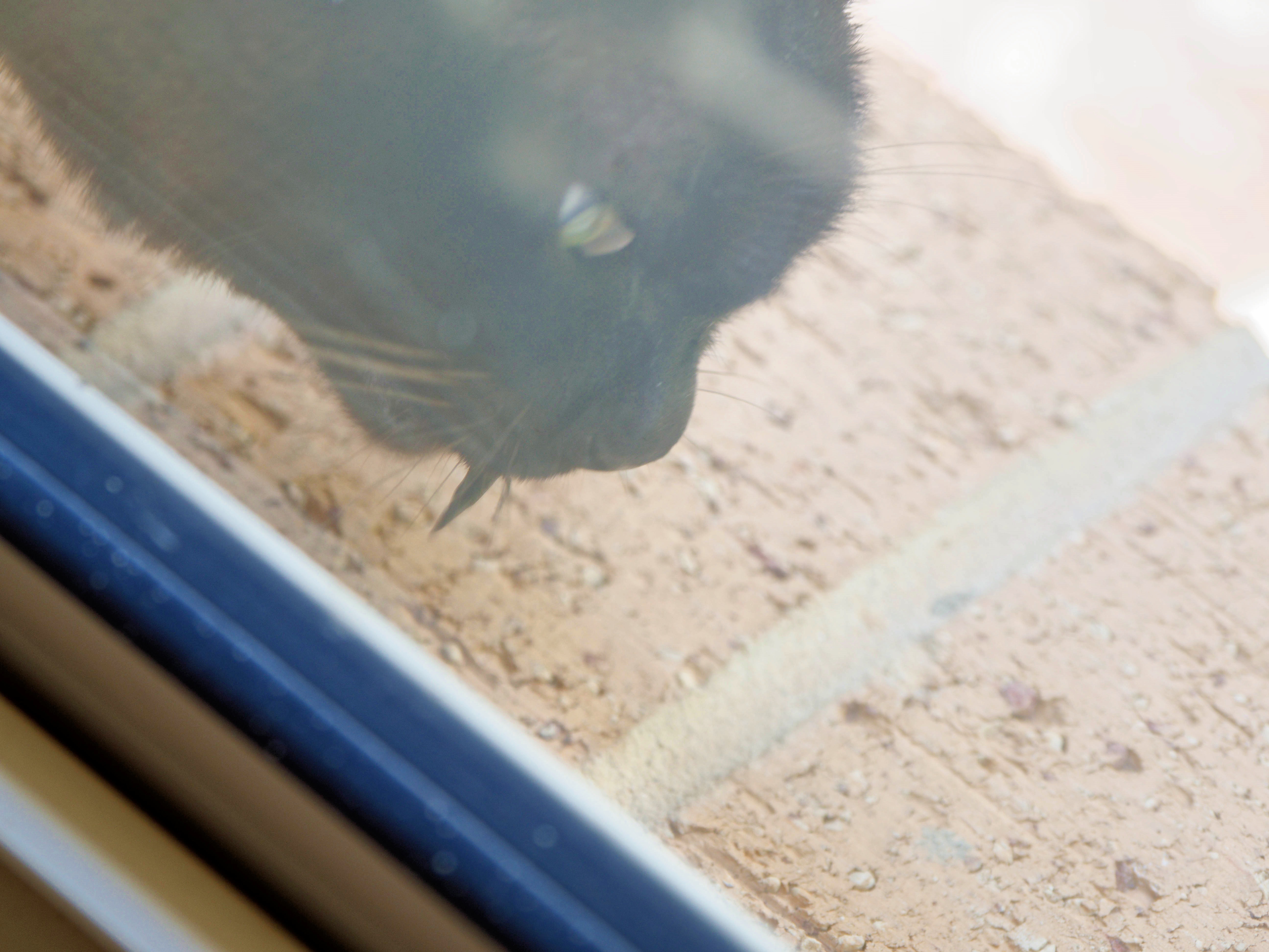
Like Bruno, Mona typically comes into the house via a specific
lounge room window. But today she looked different: something sticking out of her mouth.
On closer examination it proved to be the bottom half of a lizard. Off to get my camera,
but when I got back there was only this to be seen:
Yesterday the temperature reached 34.1°, and today it was 32.1° (or 26°, as the BoM predicted). Gradually it's beginning to look like
spring.
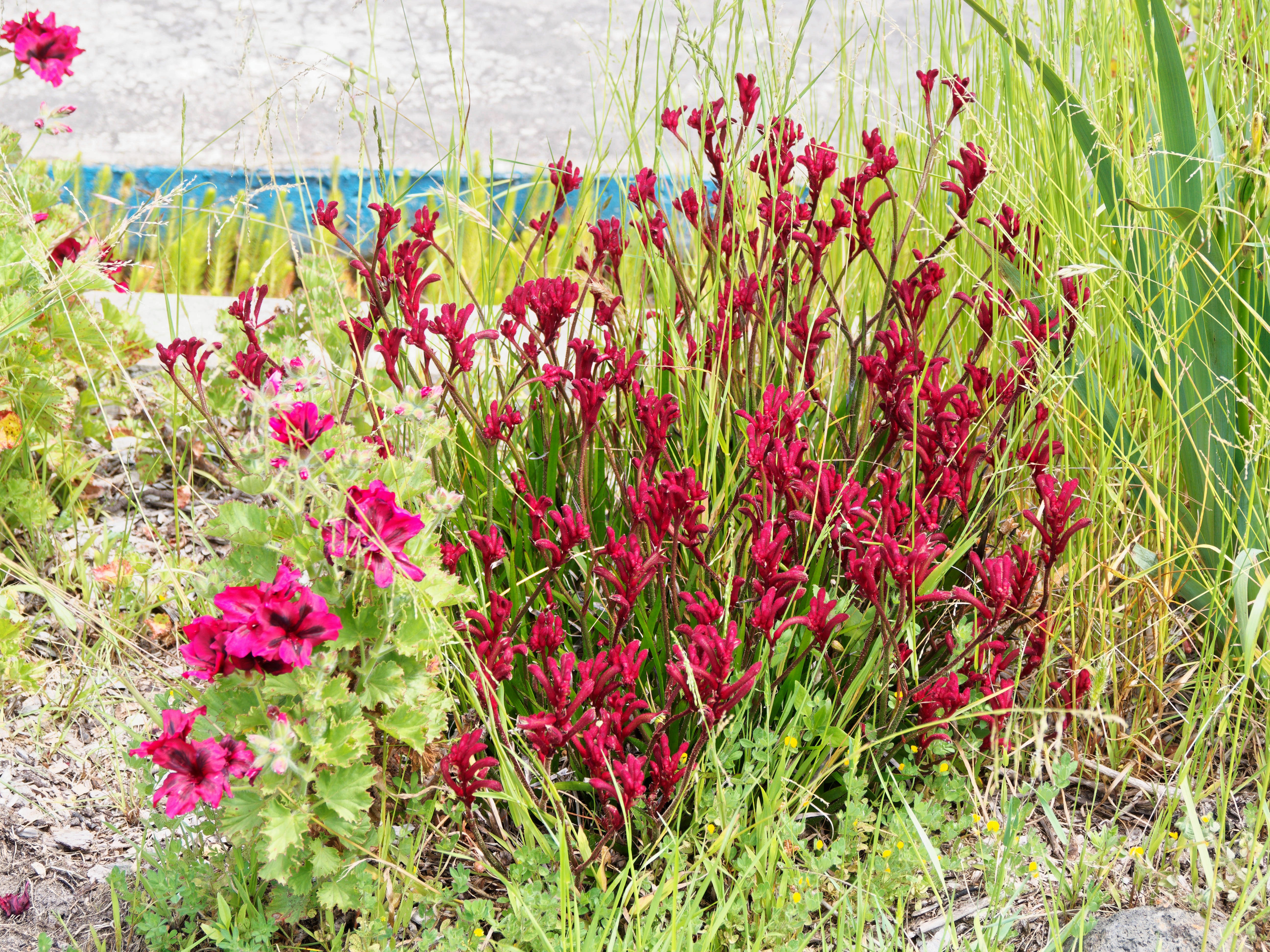
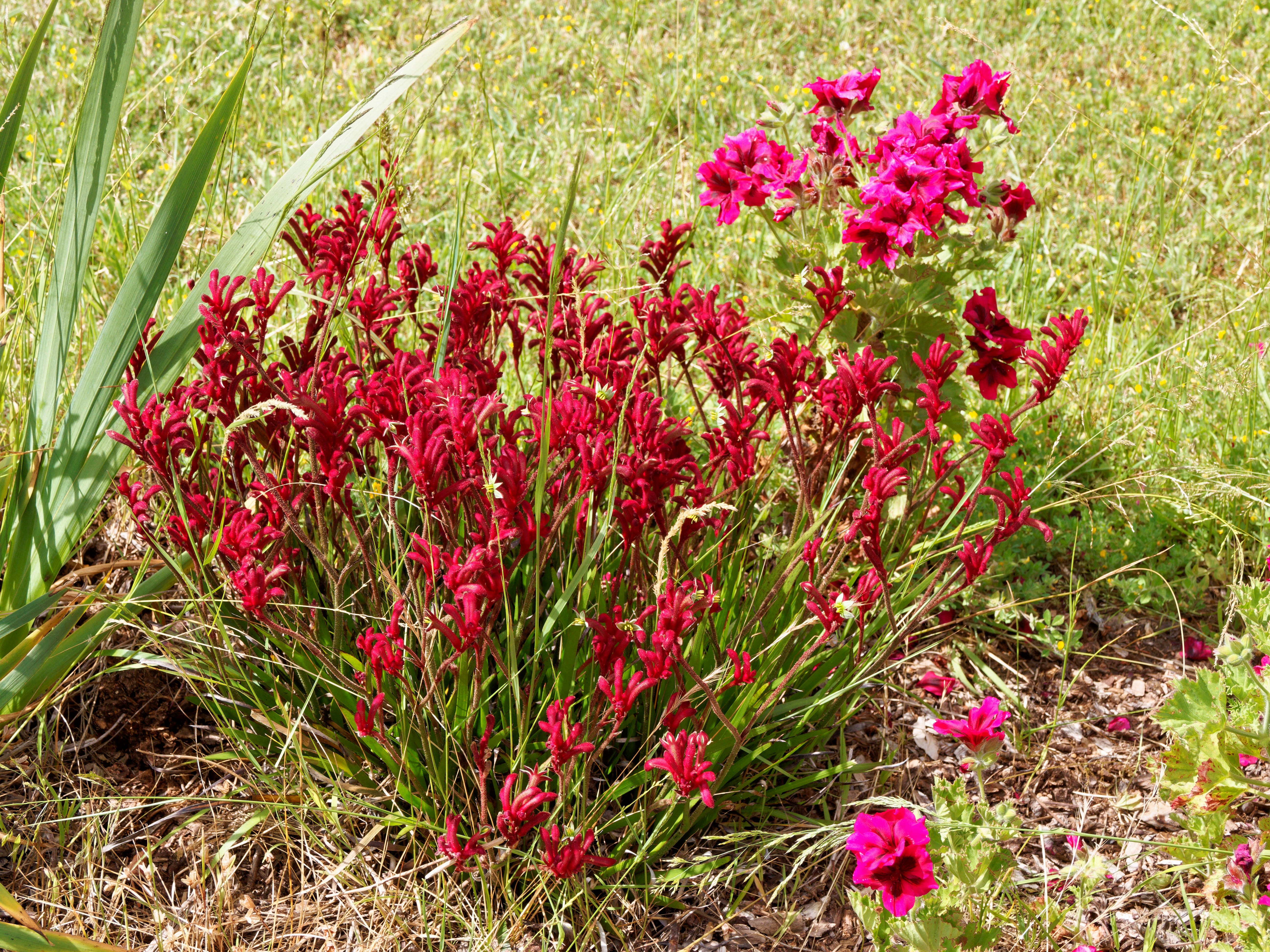
Strangely, some things are looking better than I recall. The Anigozanthos that Diane gave us
over 10 years ago has struggled for a while, but it's now looking as good as I
recall:
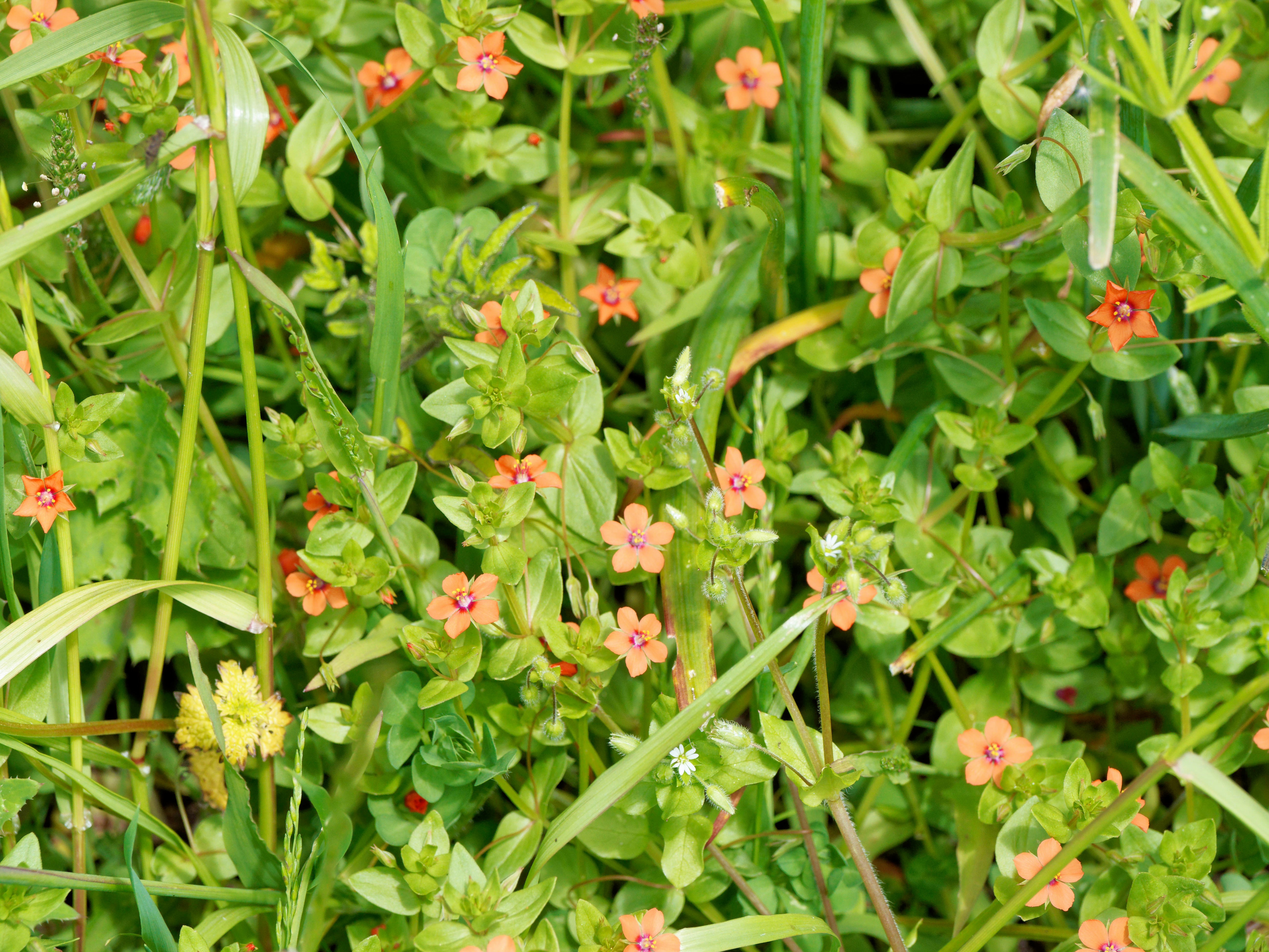
I know that (but not its name). It's a rather pretty weed, with flowers about 1 cm across.
But this is the first time that I have seen so many in one place.
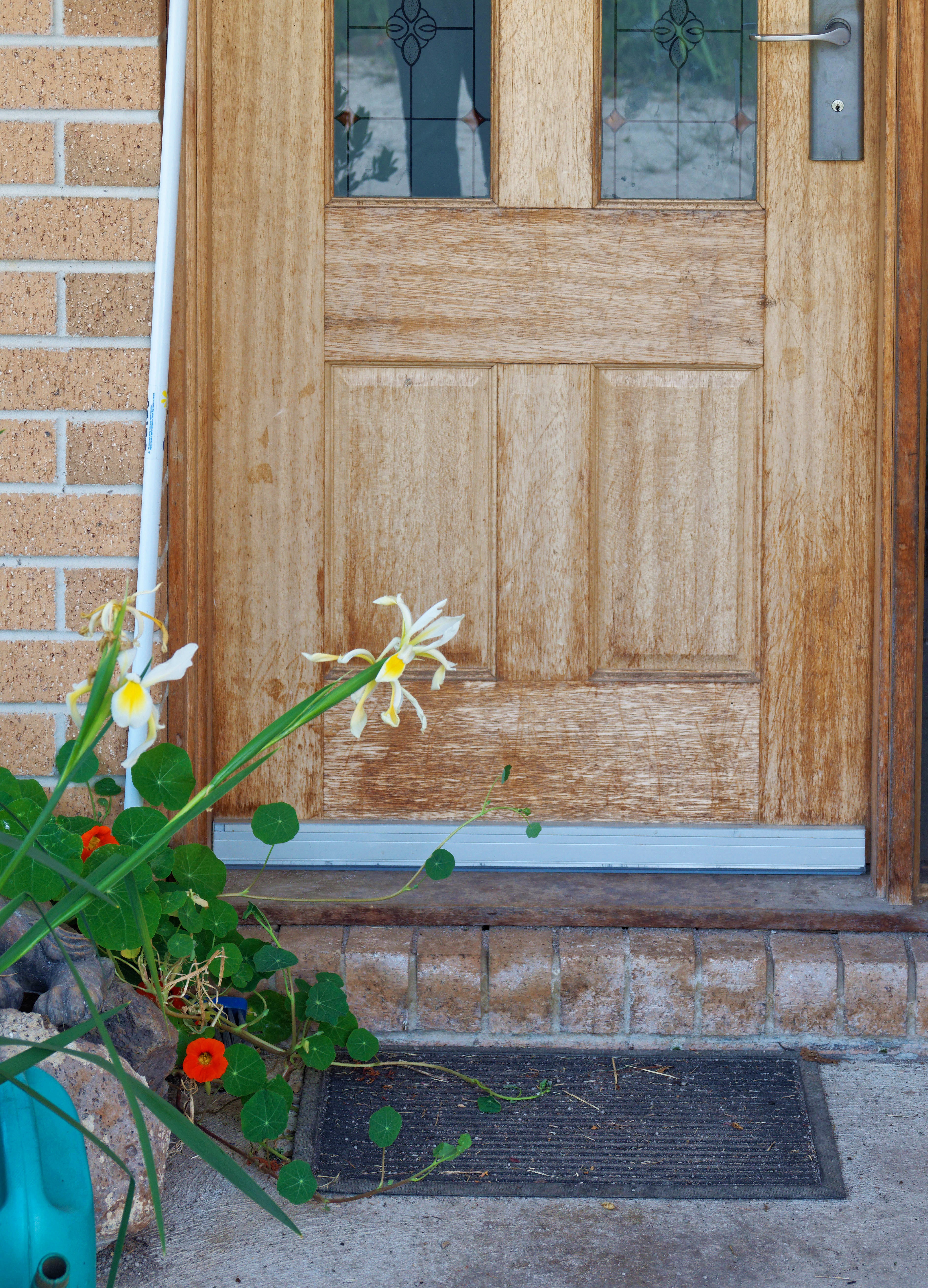
And somehow the white irises are everywhere, even in front of the front door:
The last of the Cyber week special offers expired today, notably PhotoWorks from AMS Software. I've given up on trying to denoise
photos, but what about background removal? But before downloading Yet Another software
package, how about checking my existing packages, notably Gemstone 12. I got it free, but
it's from ACDSee, which I tested
last month without being impressed. Was that Gemstone 15? The product structure is
confusing enough that I can't be sure. I was negatively impressed both by the
performance and the user interface. Surprisingly, though, Gemstone 12 seemed almost normal.
It wanted to put me in the “folder” P:\2-grog, probably because I used it there before. But my current test photos
are in P:\1-Skylum (hysterical raisins, and no longer appropriate). OK, set the
directory and try to load a file. It still tried to load from P:\2-grog! OK,
set the “folder” there too, load the file. What I had from DxO PhotoLab (here original and DxO version)
was:
That's seriously suboptimal, and I started playing around first with the noise in the shadow
area. The results were very different from other software: it crashed, repeatedly. And the
first couple of times it forgot all the settings that I had made. I needed to stop
normally, and then it recalled the settings. Probably there's a way to save them without
stopping, but the program abounds with strange icons, and I didn't want to investigate yet.
A bit more playing round suggested that the recovery of the original image could be better
then DxO, but I didn't have a comparison. And then it occurred to me: before expending too
much time with last year's model, how about Affinity? I have the latest version
there, and they've promised free updates. But that will have to wait for another day.
And PhotoWorks? Not necessarily its forte. They claim “Intelligent photo editor with a
content-aware AI. Batch process multiple photos, boost colors and retouch portraits
automatically, remove unwanted objects, change background, etc.”. Is that enough? Not
today, anyway, so the last special offer is over and done with. I'll look again next year.
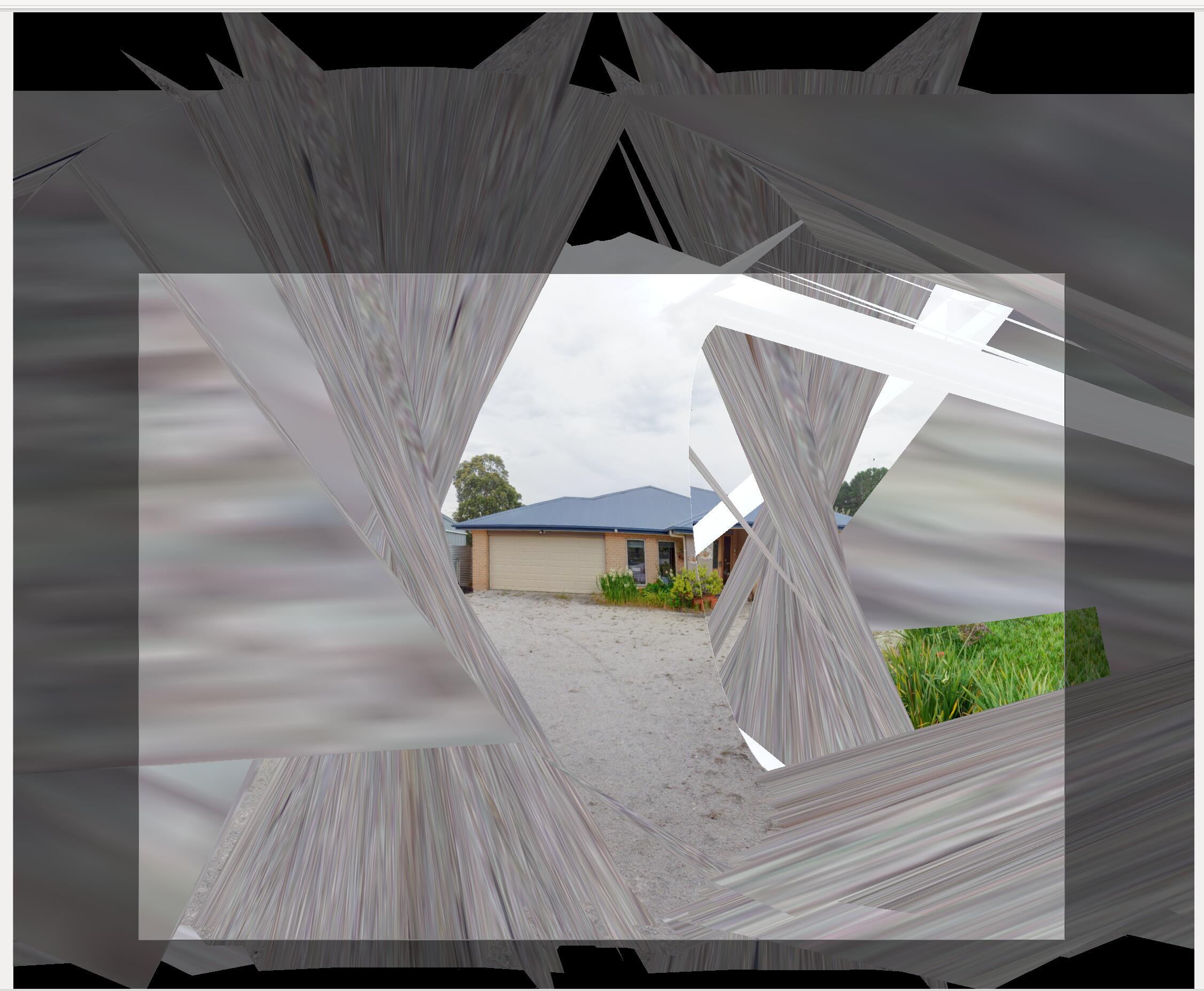
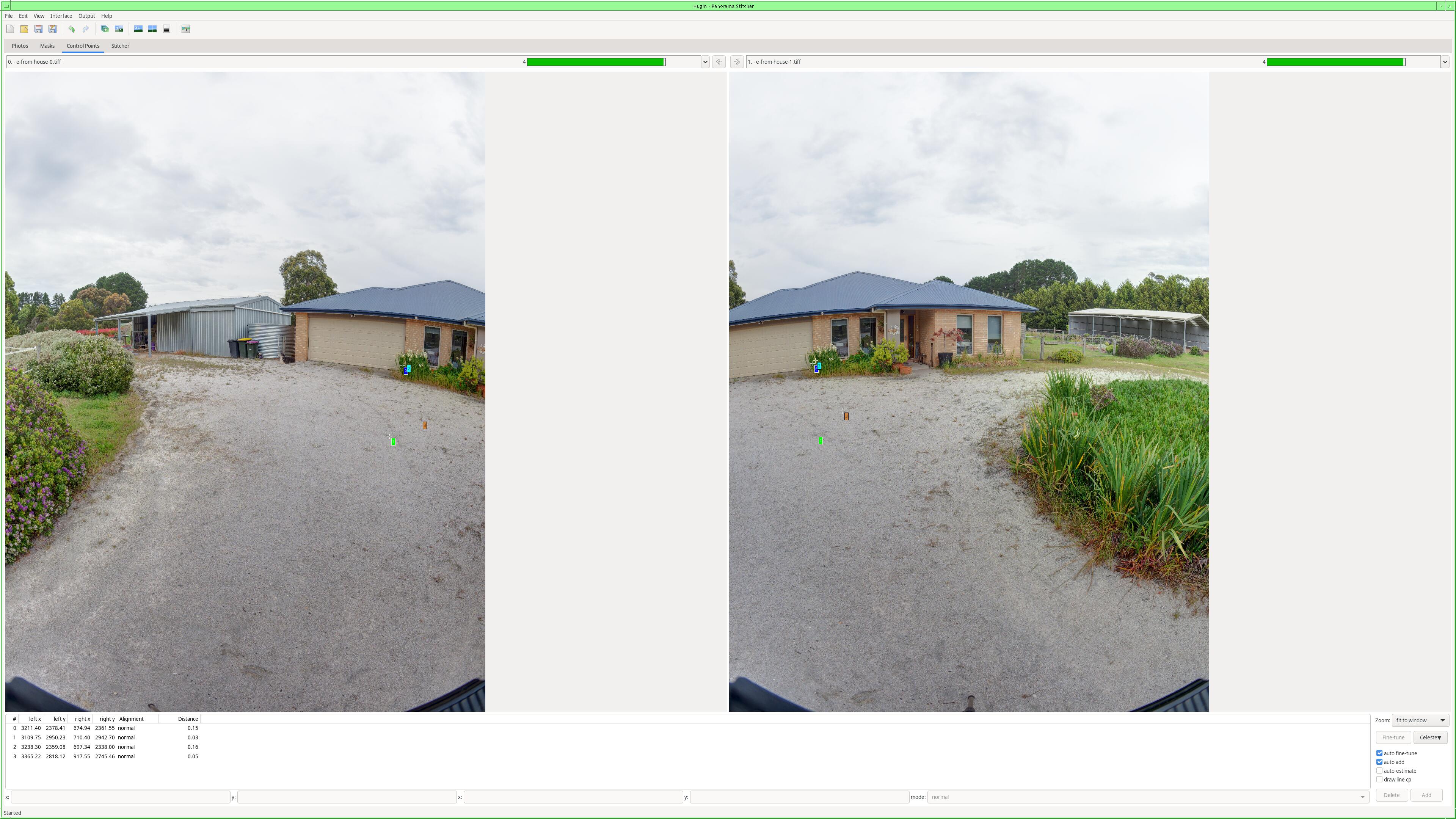
OK, I know what to do: load the images individually and join them one at a time. But it
didn't work! Firstly, it didn't find the images (specified on the command line). So I had
to climb trees to find the files. And when I loaded the first two and aligned them, I ended
up with this display:
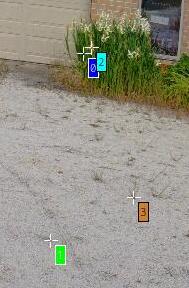
OK, add my own. It didn't work! I couldn't position the cursor where I wanted it. It kept
moving somewhere else. Somehow the whole display is messed up.
OK, what happens with the old version on eureka? Off there and ran my script (which
runs pto_gen to generate the .pto file), and it worked perfectly. What's the
difference in output? I should take a look. The difference between the .pto files
may give me a clue.
And, of course, whose fault is this? Does this only affect the FreeBSD version, or is it a general
problem? My guess is that the not loading the files is general (“passing parameters on the
command line is evil"), but if other people had had so many problems with the fast panorama
preview, I think we
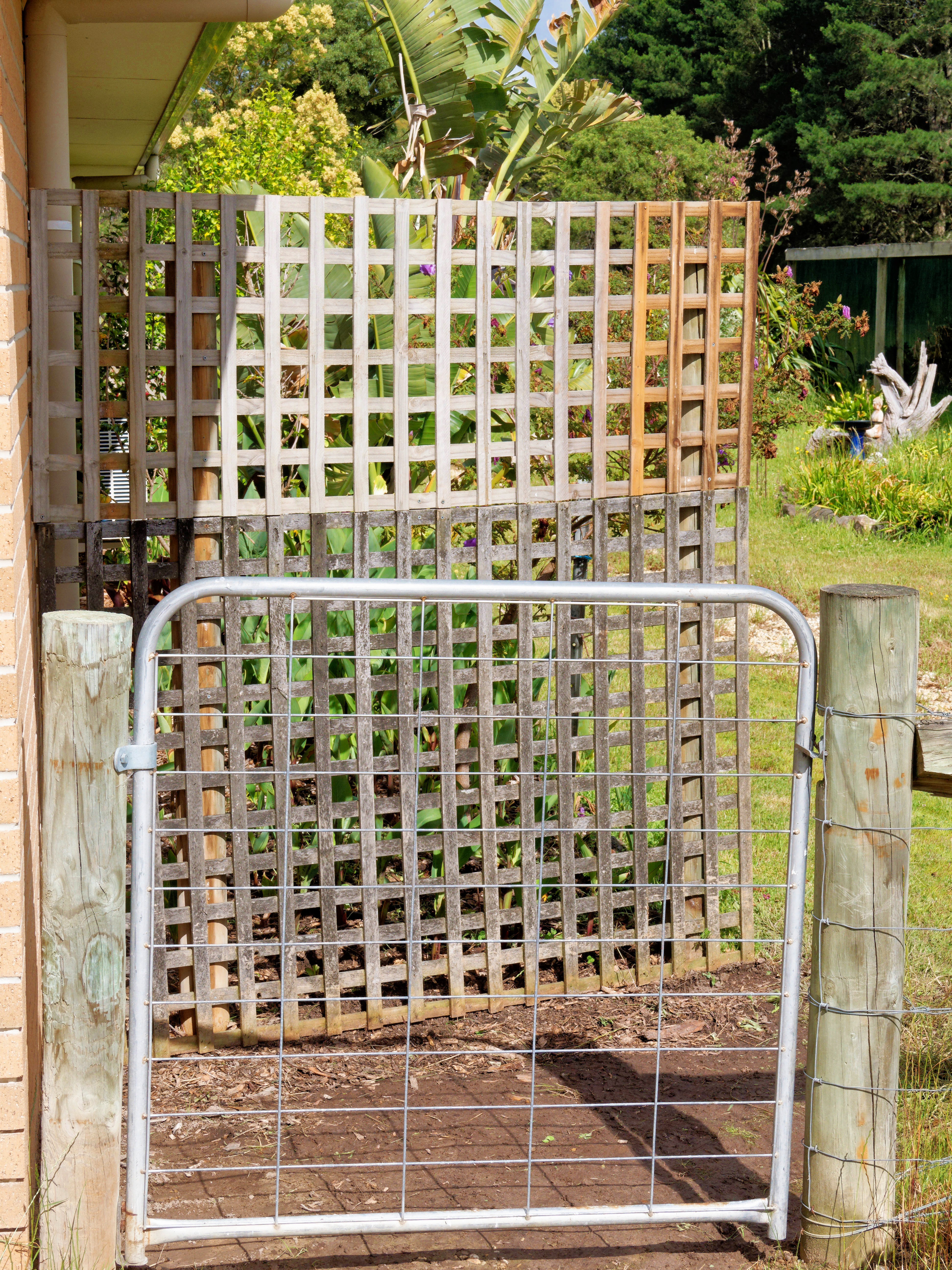
Jesse Walsh along today to do mainly weeding, but he also brought a “new” lattice to replace
the one that was falling apart (and which I forgot to photograph). Here's the new one:
Choucroute garni for dinner this evening.
I've been cooking it occasionally for over
23 years, and I continually find that the recipes have too much meat and too little
Sauerkraut. My first attempt
23 years ago had a ratio of 9 parts meat to 10 parts Sauerkraut. I had reduced
the quantities last year, and today I put in even less (1 part meat, 2 parts Sauerkraut), but
there's still too much meat. 40% maybe?
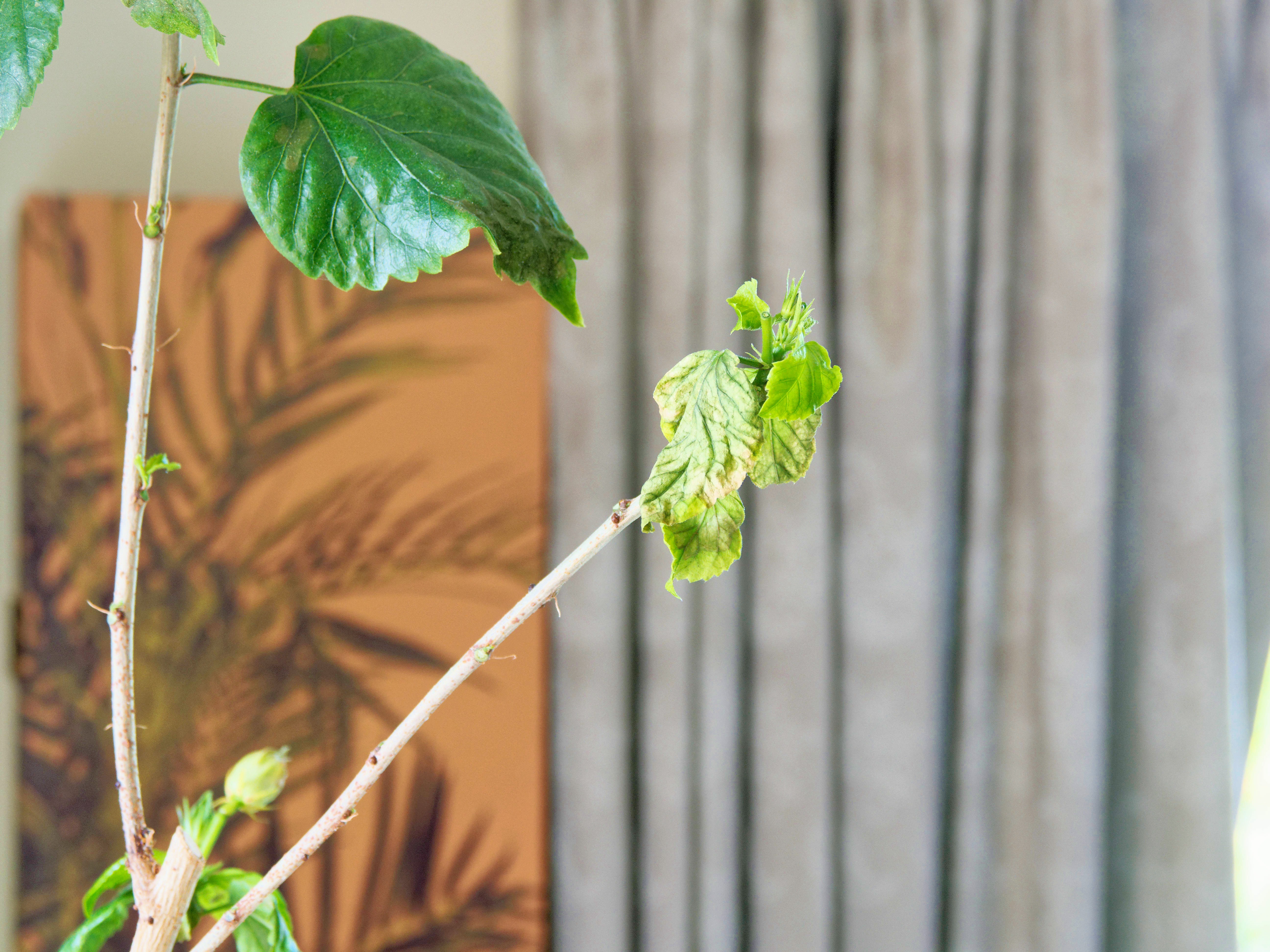
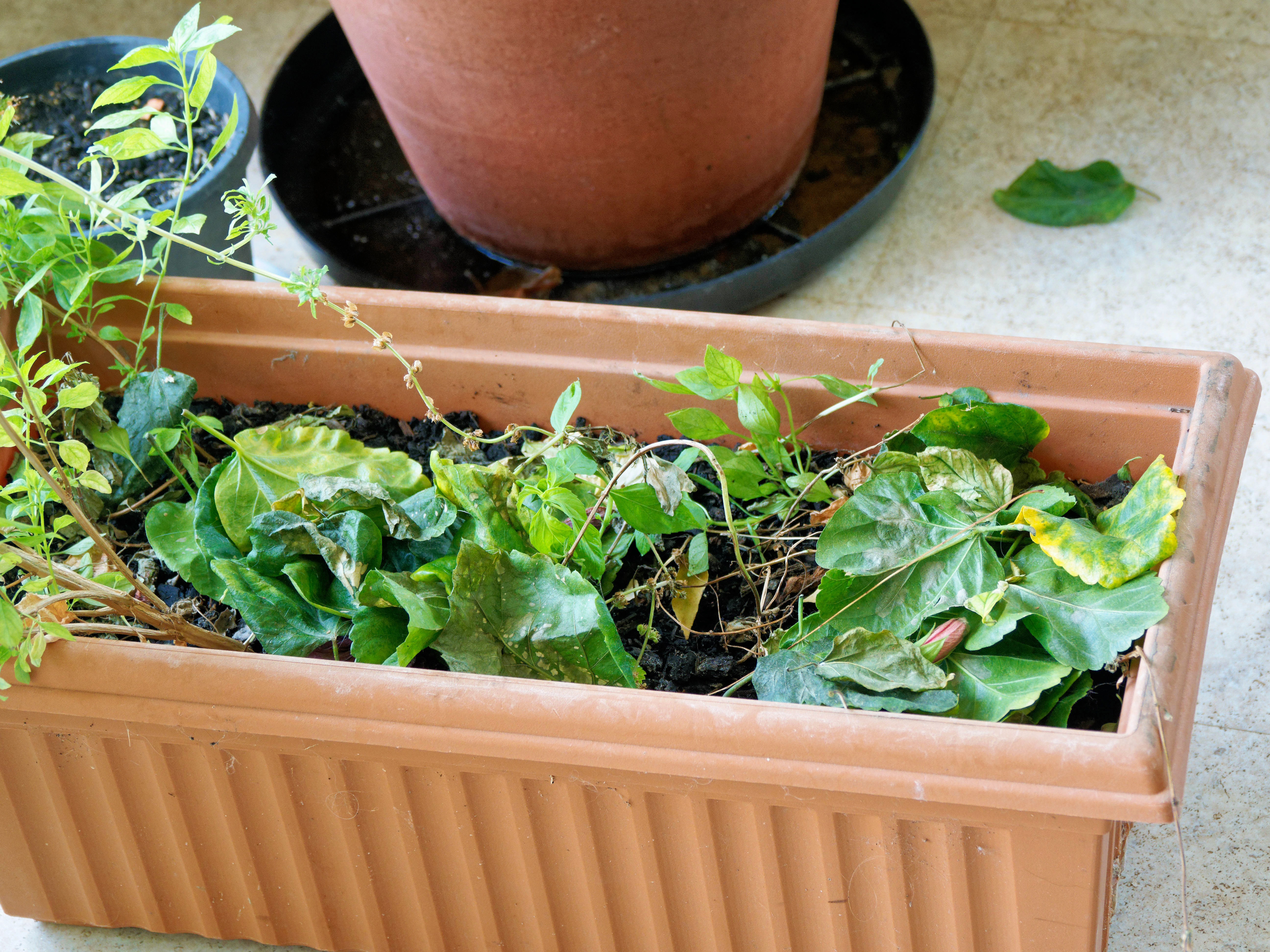
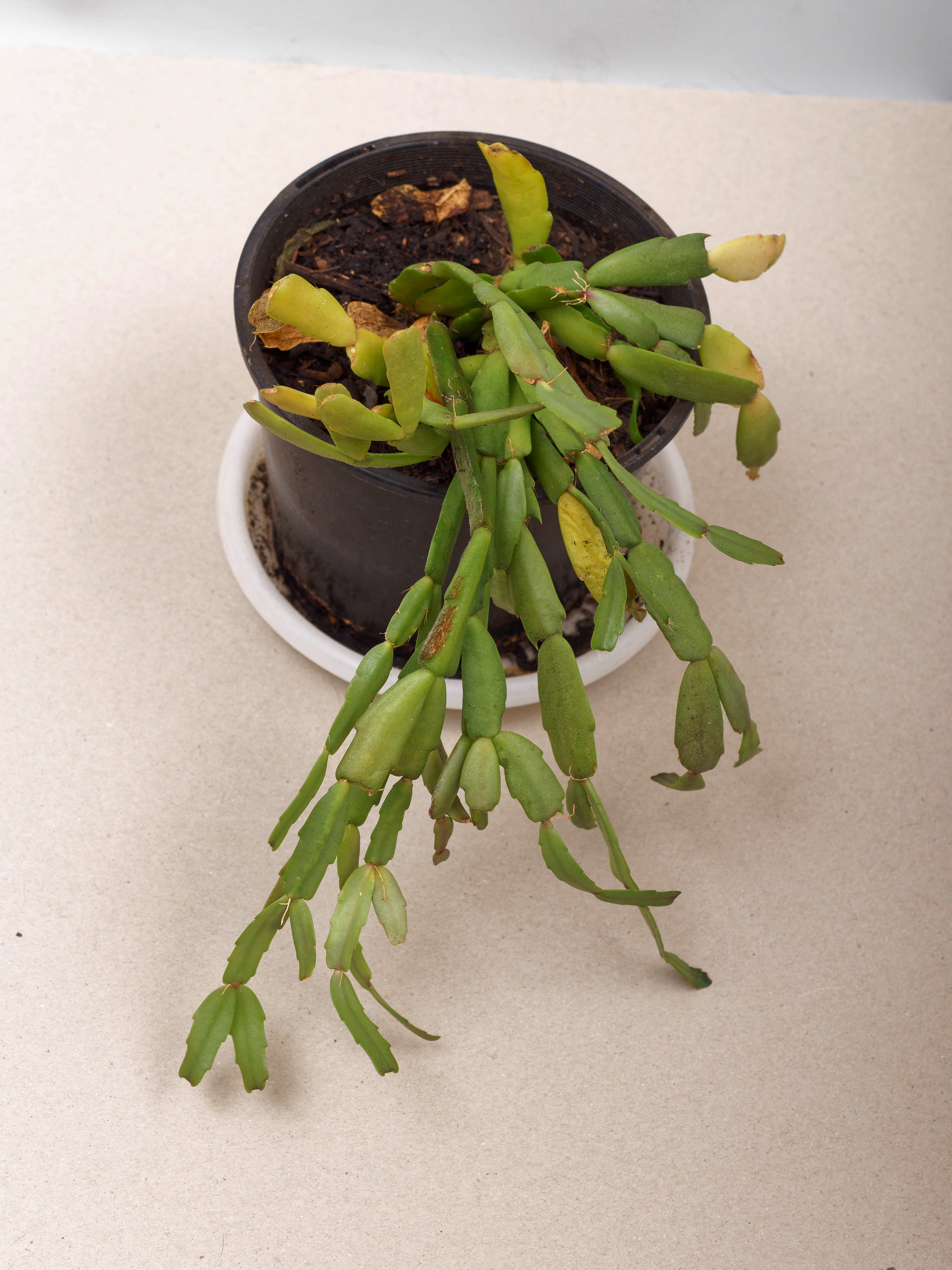
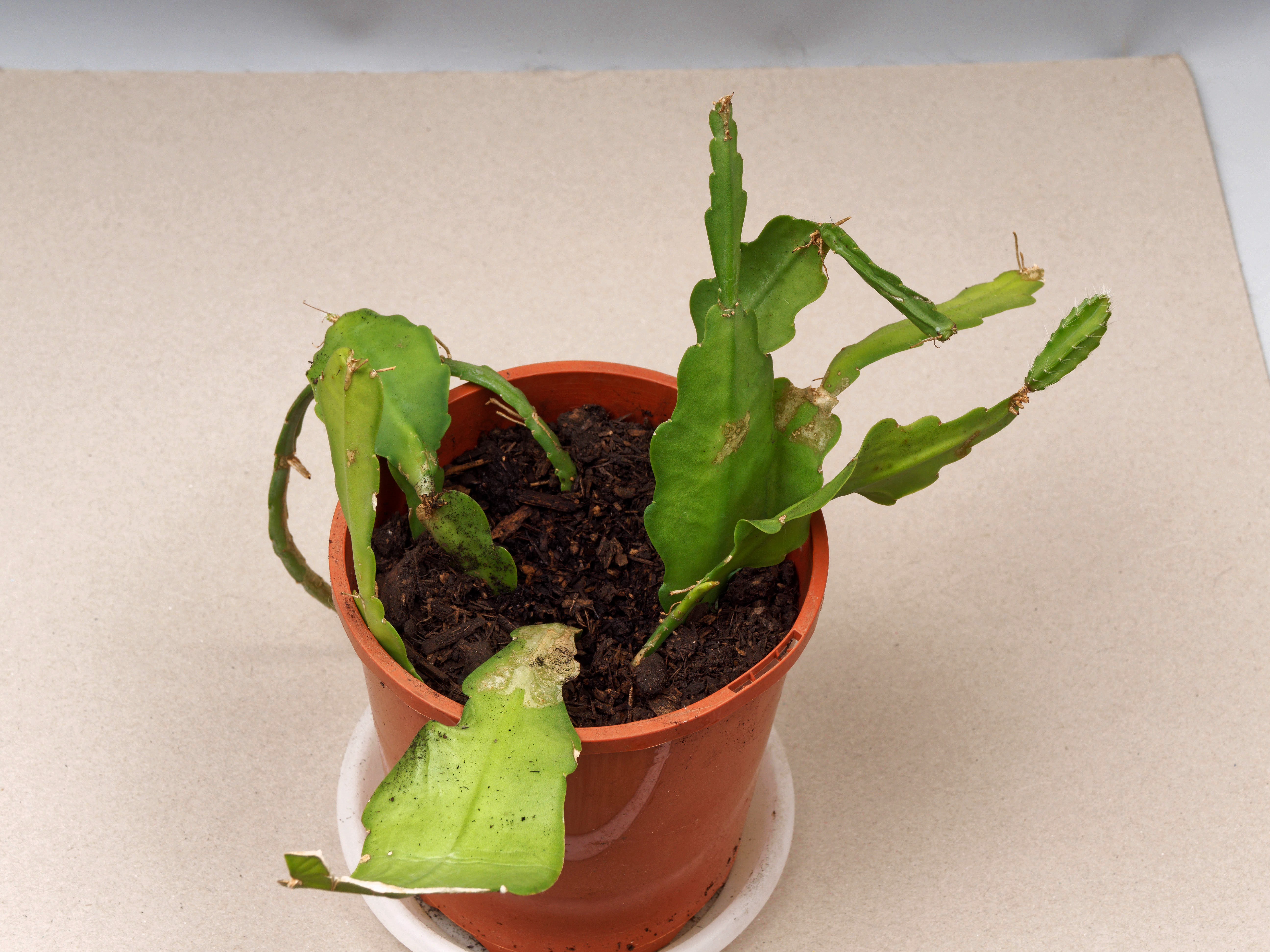
Is that really a result of the fertilizer? At first I thought only old leaves had fallen,
but this image comparison (with Monday) clearly shows that new growth is affected too:
Can an AI bot help? Google Gemini says
“no”, but points to iNaturalist and PictureThis. Well, no, it's too
polite to pointlink. I had to search for myself. And they're both mobile
phone applications! Well, iNaturalist is much more, but I had to install the app, take
the photo and then describe it on a glass keyboard. Not my thing.
And PictureThis? Full of spam when I started it, and when I finally got past that, it
wanted a credit card number. Another non-starter. About the most interesting thing
is part of its home page, which shows:
That's all that is shown. Why a text describing Frangipani (top right) along with a much
larger image of a Hibiscus rosa-sinensis? There may be a good reason, but on their home
page it's just plain misleading.
What about other bots? Claude. I couldn't move the image to its input field. OK, give it the URL of the
publicly accessible version. “Can't access file”. Why?
You're right to question that! Let me try fetching it again - sometimes the initial
attempt fails but a retry works...
I'm getting the same error - "Image content is not supported". This is a limitation of the
web_fetch tool I'm using, which appears to not support directly fetching image files from
URLs, even when they're publicly accessible. The tool is designed primarily for fetching
HTML pages and text content.
However, if you upload the image directly to our conversation using the attachment
feature, I'll be able to view and analyze it for you. That would let me tell you what's in
the photo, identify the plant if it's indeed a weed, and provide any other information
you're looking for.
How do I attach the image? Use the paper clip. No paper clip on my screen. At some point
it divulged that it could also be a + symbol. Aren't these interfaces inutitive? That worked, and I got some useful
information:
This appears to be Scarlet Pimpernel (Anagallis arvensis), also
sometimes called Poor Man's Weatherglass. The key identifying features I can see are:
Small, delicate 5-petaled flowers in a peachy-salmon/orange color
Purple or reddish center in each flower
The flowers appear to be about 1/4 to 1/2 inch across
Growing low to the ground among other vegetation
Small, opposite leaves visible on the stems
Scarlet Pimpernel is actually considered a weed in many areas, though it has quite pretty
flowers. It's called "weatherglass" because the flowers close up in cloudy weather or
before rain.
How about that! I had heard of Scarlet Pimpernel, of course, but
I didn't know that it was the name of a flower. And it's not even scarlet! And I had
thought that this would be some kind of Australian native.
VicRoads have sent me email. Not the
promised email confirming the registration of Yvonne's car,
but the information that they have a new and improved web site.
It certainly looks different. But it's still hard to navigate, and it has managed to forget
my password: I had to reset it. It looks as if passwords will go away soon anyway: now it
would prefer a passkey, which I
really must investigate.
And the site itself? It still doesn't supply information that I need, such as whether my
concession has been applied or not. Doubtless another ridiculously expensive upgrade that
does nothing useful.
Not quite 60 years ago I got my first
camera with electronics, an Asahi
Pentax“Spotmatic”. I
still have it. It looks exactly like the image in Wikipedia, down to the lens serial number:
As I commented at the time, the rearmost lens element protruded. This was what came to be
called the 8 element 50 mm f/1.4
Super-Takumar lens, and somehow the protruding element irritated me. When my father
also bought a Spotmatic 9 months later for the Asia
Trip, I discovered that the lens looked different, so I swapped it. That's the lens
in the image above, here from above:
This lens has seven elements, and the rear one (I think) contains Thorium, making it mildly radioactive.
I've just been watching a video about the various versions of this lens. I had thought that
the way to distinguish the models from outside was because it didn't have a click stop for
f/1.7, and also no marking on the aperture ring for f/2. But not all 7 element lenses have
that peculiarity. A more reliable way is where the infrared correction mark is on the
depth-of-field scale. The 7 element version has it between f/4 and f/5.6 on the scale, like
here, while the 8 element version has it to the right of the f/4 mark. It seems that the
change was made mainly for financial reasons, and the 8 element version was marginally
better. That's potentially borne out by the infrared correction. A pity I changed it.
Off to Cape Clear today for Pene Kirk to examine Larissa and give her an injection. She agrees that her condition is deteriorating, but that we
can keep her feeling well for some time to come, if necessary with more medication.
Also a discussion about what she saw a few days ago, for the first time in her career: a
male tortoiseshell cat. “There's no such thing”. And maybe that's correct: the tortoiseshell pattern comes
from X chromosome
inactivation, and for that the cat needs two X chromosomes—the hallmark of a
female. Pene agrees that it's probably an XXY genome.
I'm sure that I had a second package, and that I've eaten it already, but I don't seem to
have written anything about it. It doesn't help that greps for Pho bring up thousands
of false positives. OK, today's the day. The quantities are irritating, one cube for 500
ml. Normally I take between 300 and 340 ml. I reduced the water to 400 ml, which made the
broth rather too salty, but still not overly tasty. I think that's the last time.
Little technical pains
Topic: general, food and drink, technology, opinion
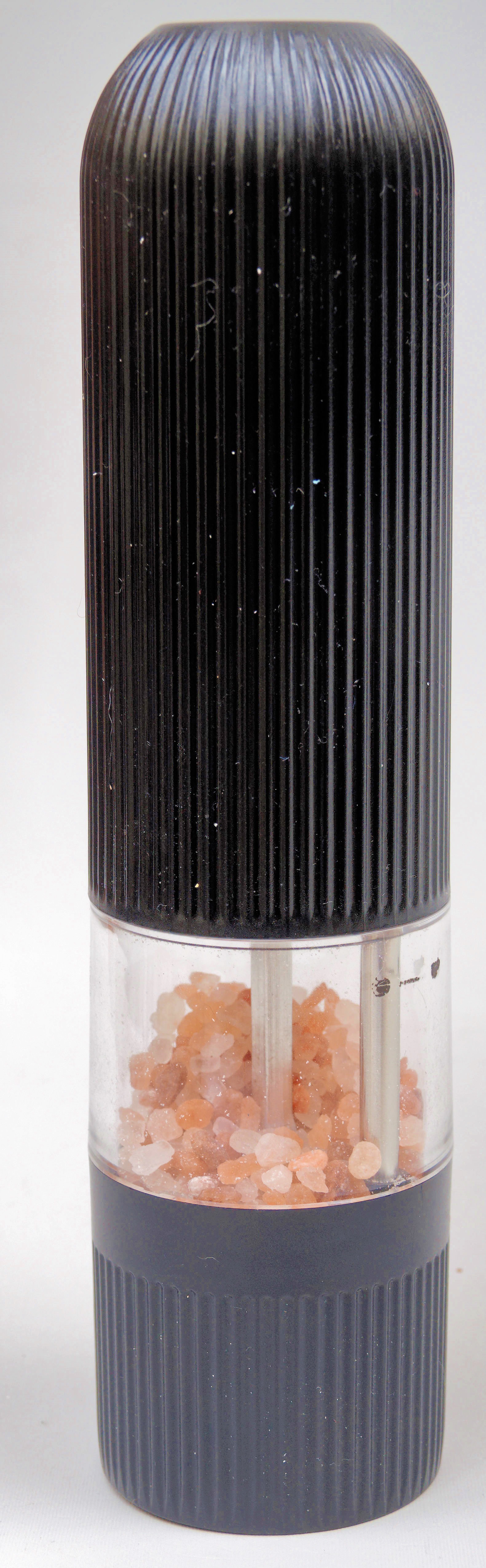
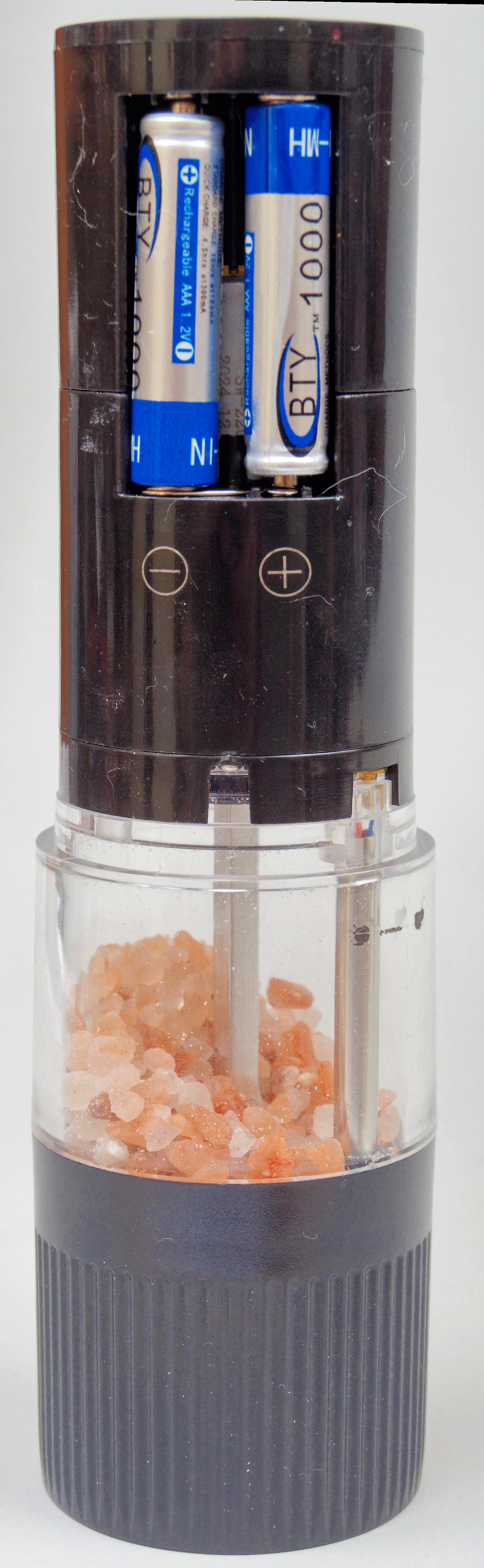
The batteries in Yvonne's salt grinder are weak and need
changing. Not a problem: we have dozens of NiMH batteries.
But getting the batteries out of the compartment proved to be a pain: they were in so tight
that I needed to use a screwdriver to lever them out. But that was nothing compared to
putting them back in: in one case it just didn't work.
Why? Clearly I have done this before. I bought the mills (a matched pair for pepper and
salt) in June, but it seems that I didn't mention it here; presumably I was too preoccupied
with the new dishwasher. They're somehow typical of their kind: one takes four batteries,
the other six. This one was the four battery version:
The compartments are so tight that I just couldn't get the last battery in. Why? I tried
other (non-rechargeable) batteries and couldn't get them in either, so it must be something
to do with the compartment. But it doens't look damaged. In the end I had to get a pipe
wrench to force it in. I wonder how long this device will last, and also what the
tolerances are for these things. They must be considerably less than 1 mm.
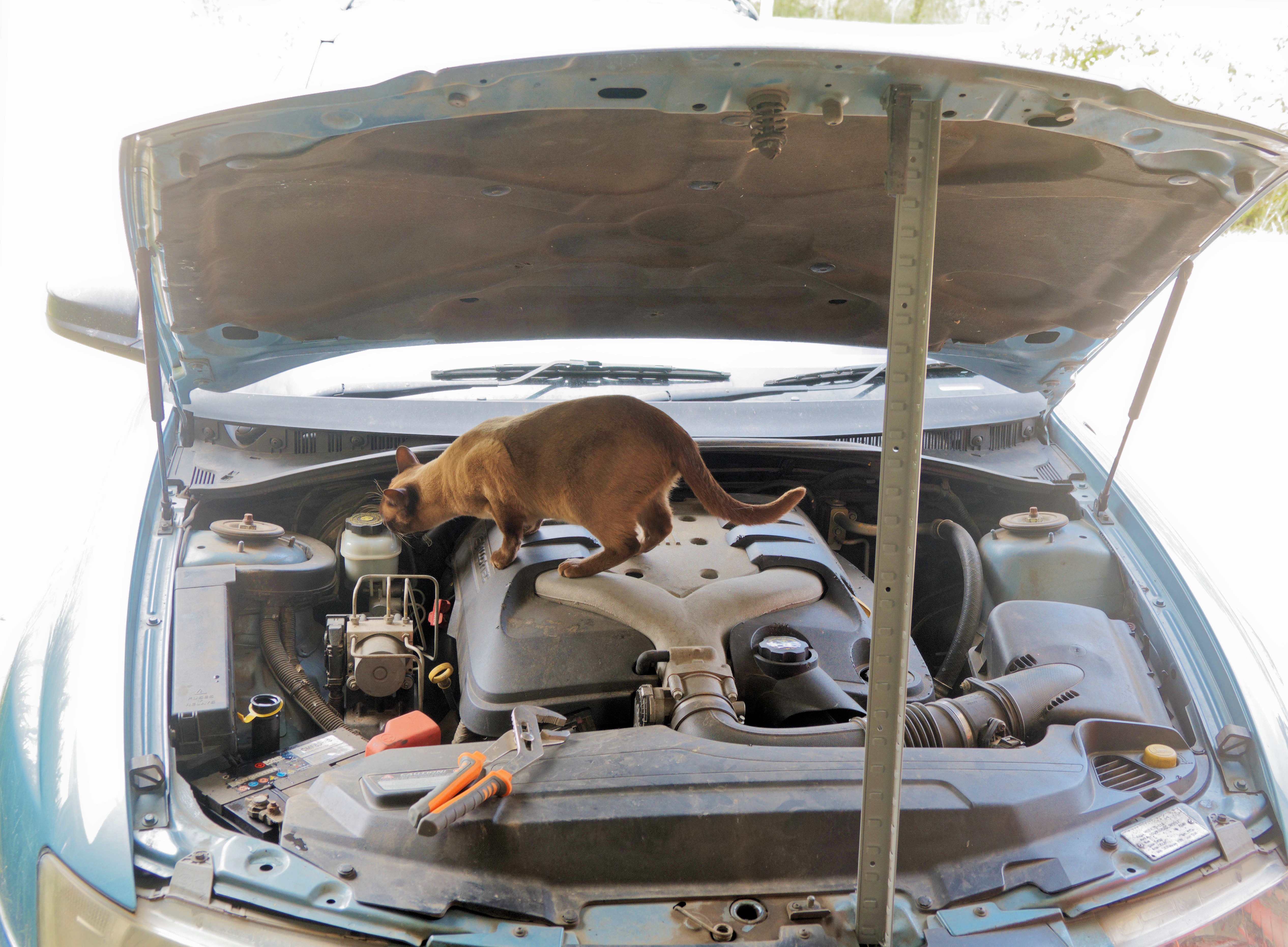
And while I was at it, there were a couple of minor things to do with the car: fill the
windscreen washer reservoir and check the tyre pressures. And they, too, were
a pain! First, the cover of the reservoir was stuck on, and I couldn't pull it off.
And to add injury to insult, the pneumatic bonnet lift support is old and worn out and kept
closing on me. Score one for the old prop rod method, which I simulated with a part for a
shelf. Bruno wanted to know all about
it, of course:
And a good thing I still had the pipe wrench handy.
And then there was the tyre pressure. The air pump is at the end of the garage, and I had
never got round to putting on the wheels. How hard can it be? A wheel, a rod and a nut.
So I tried. The nut is a locking nut, requiring some pressure to insert the threaded rod,
requiring some pressure, and it's in an inconvenient place. In the end I gave up:
And the tyre pressures? Yes, there's something wrong with the front right wheel, which
showed almost no pressure. I'll have to keep an eye on that one.
Yvonne wanted Jennys Lammtopf for dinner today. Problem: my recipe states 200 g of filling for me,
and 120 for Yvonne. And we only had 160 g. OK, give it to
her and I'll eat something else (curries that Yvonne doesn't like).
Problem: the numbers don't add up. The total was 80% of what I had for myself in the
recipe, but the pot was nearly overflowing:
The year is coming to an end, and with it the plans for my yearly annual newsletter. That should include a photo of
Yvonne and myself, along with as many animals as we can keep
still. Here last year's photo:
That was done with Hugin. But we
had decided to repeat the views every 10 years, so the coming photo should look something
like this, taken in December 2015:
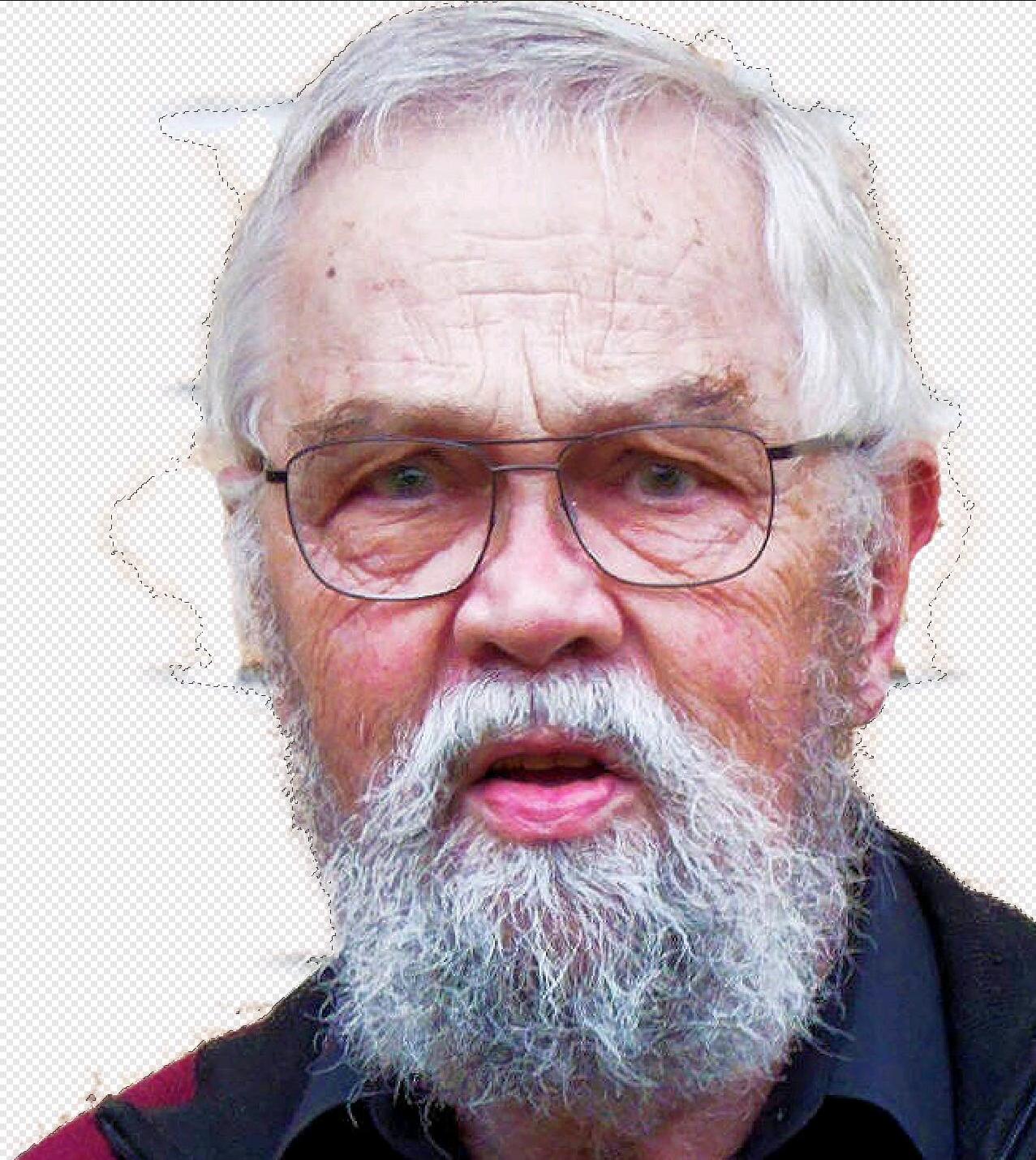
OK, a clear-cut case for backgroung replacement. As planned last week, time to look at Affinity. There's quite an
understandable video on
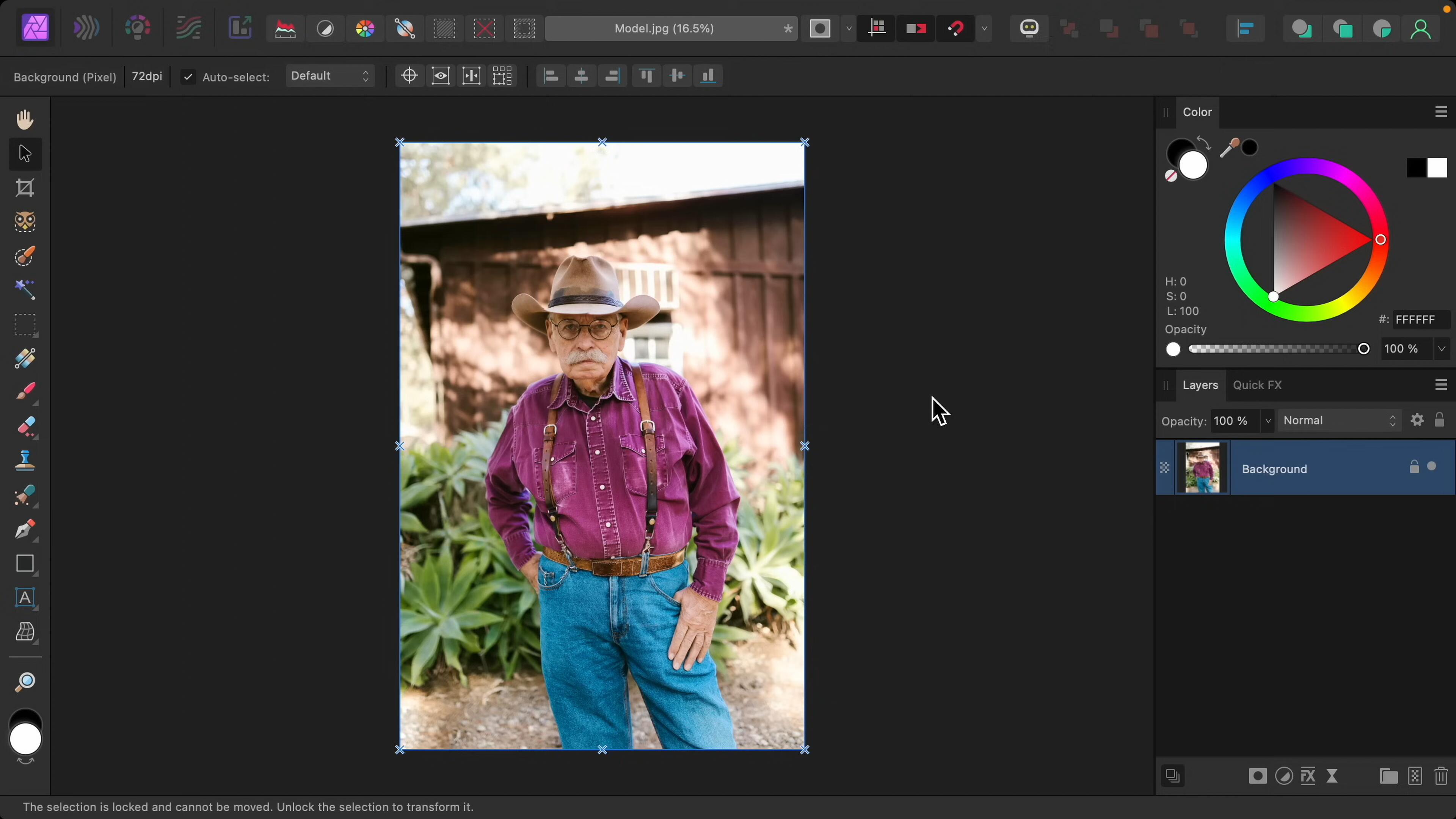
the topic. First step is to load the image and choose the owl icon in the left-hand icon
column:
But my display wasn't like that. It seems to have been completely rearranged. The
left-hand column was only about half as wide, and all the incomprehensible icons had been
replaced by other incomprehensible icons:
And that's on a 1920×1080 display. On my normal 3840×2160 display the icons are only half
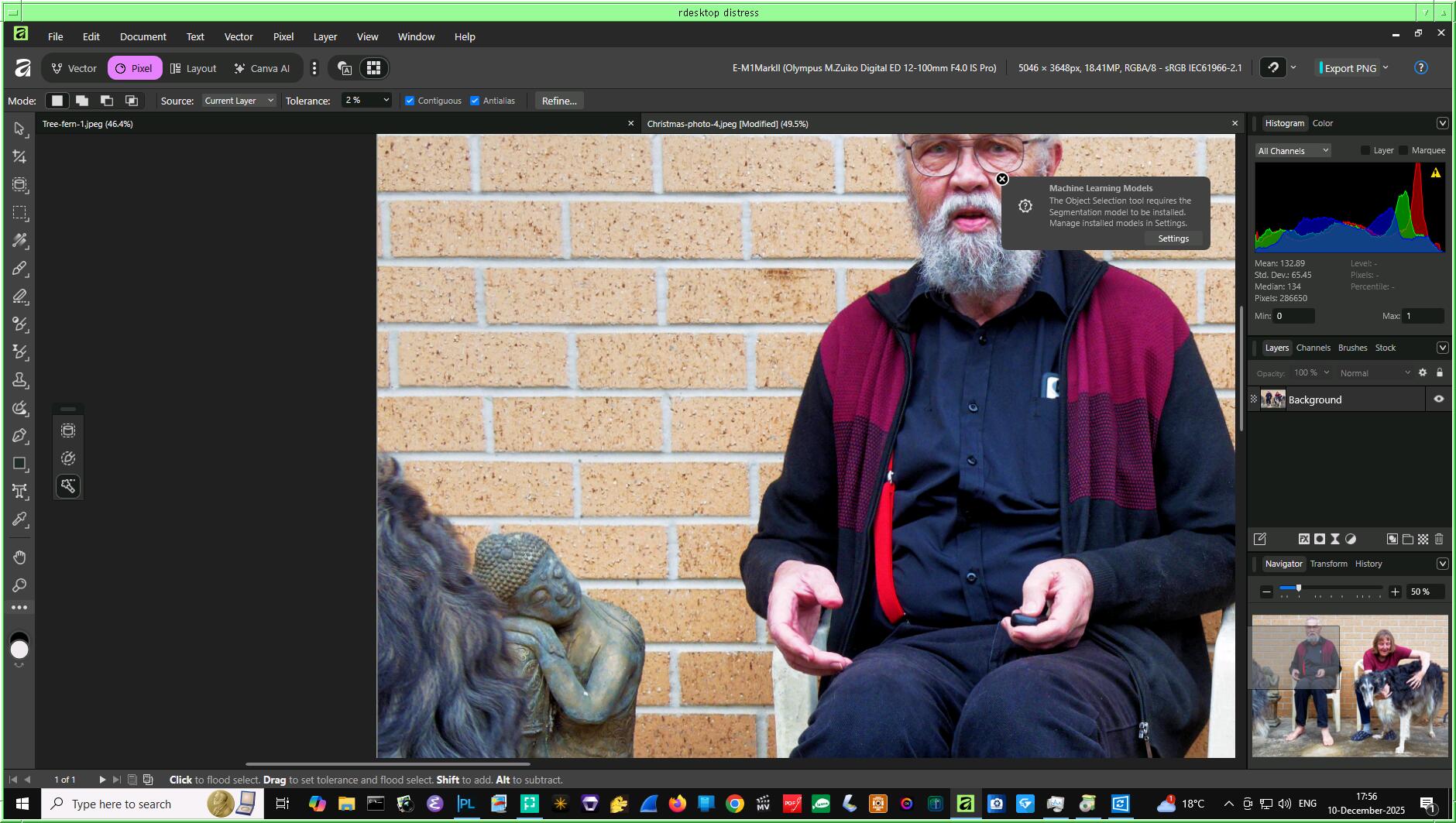
as wide again, about 3 mm. When I click on the third from the top, I get a message telling
me yes, this is the object selection tool:
But that's as far as I got. It told me to click on the object (myself in this case) and it
would be selected. But that didn't happen. Instead a tiny popup appeared elsewhere in the
image, so far from where I was working that I didn't notice it at first:
But then things seemed to start working by themselves. At least the cursor changed shape.
But I still couldn't select the part of the image. Off looking for answers: this is
Affinity 3, and all the videos refer to versions 2 or 1. I should have seen that from the
old video (9 months!) and the different logo. Written documentatation? That's an old,
worn-out magic word. After some time searching, I still couldn't find out how to do things.
In passing, I'm getting more and more fed up with the lack of scalability in “modern”
software, maybe because of my “high resolution” monitors that can display almost 10% of my
high resolution photos at a time. Why can't they scale to the size on the display rather
than to the number of pixels? My main displays have 167 pixels per inch, way more than the
75 or 100 that were once considered normal.
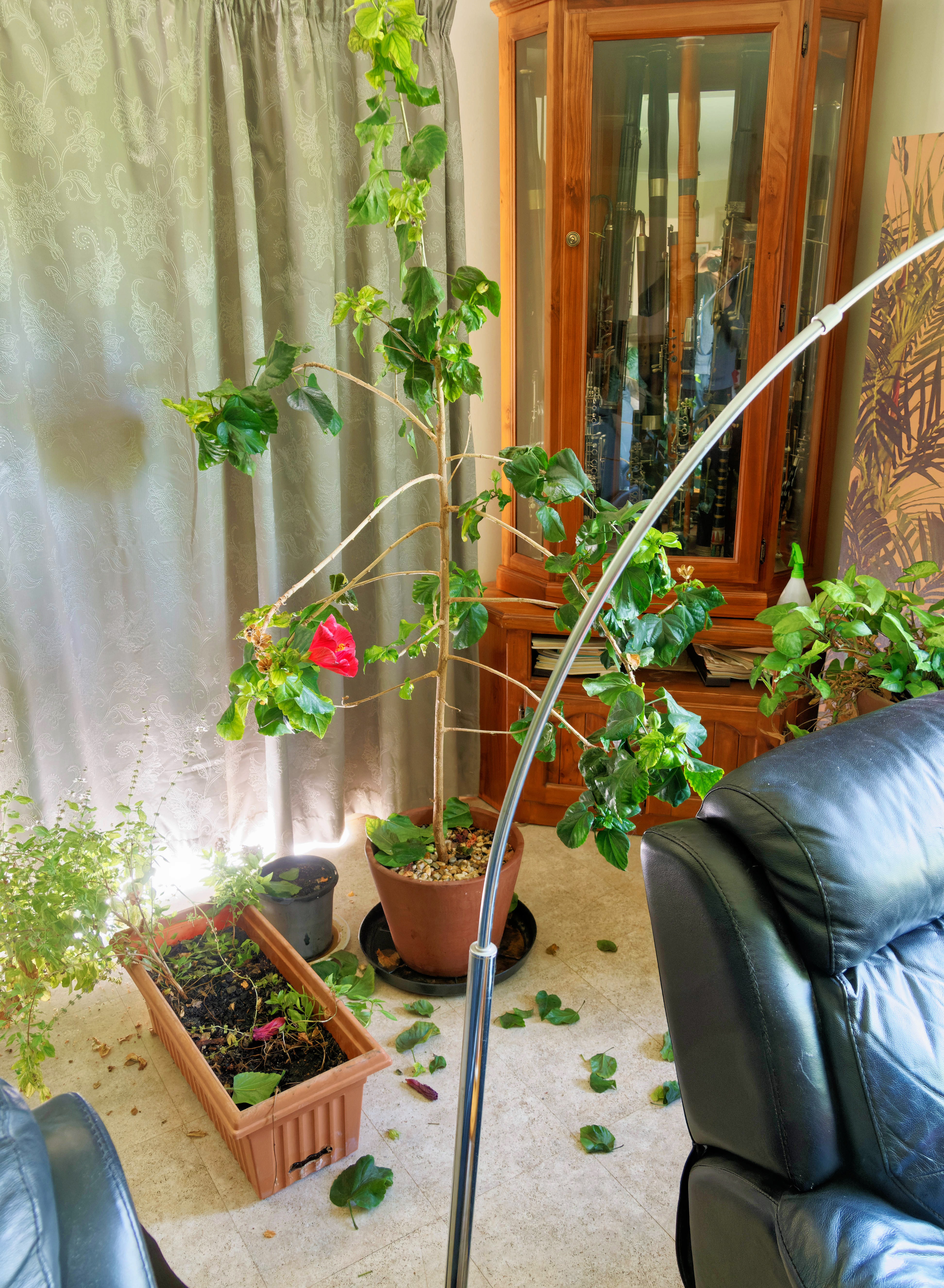
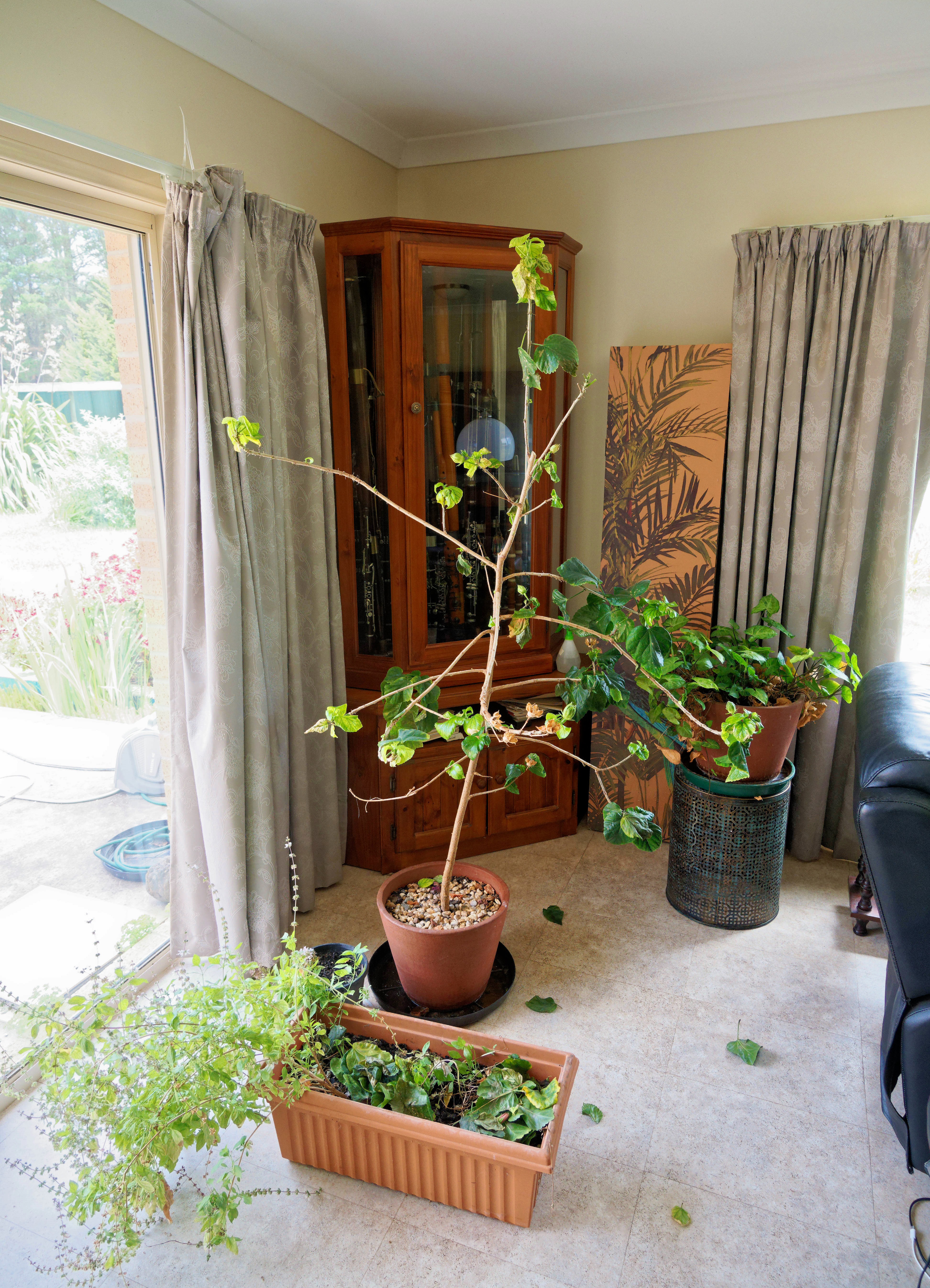
Gemma and Jess, surnames currently unknown, along to do the cleaning today. Yvonne was satisfied, and they cleaned away the dropped leaves from the
dying Hibiscus:
All software seems to do this nowadays, but this is the first that has made it so difficult.
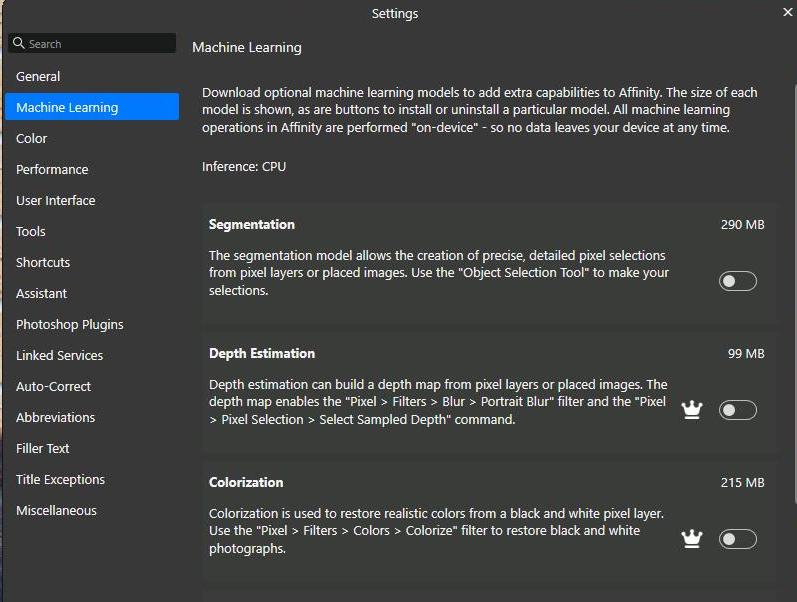
OK, download the module, the only free one in the list, and try again. Success! Or what
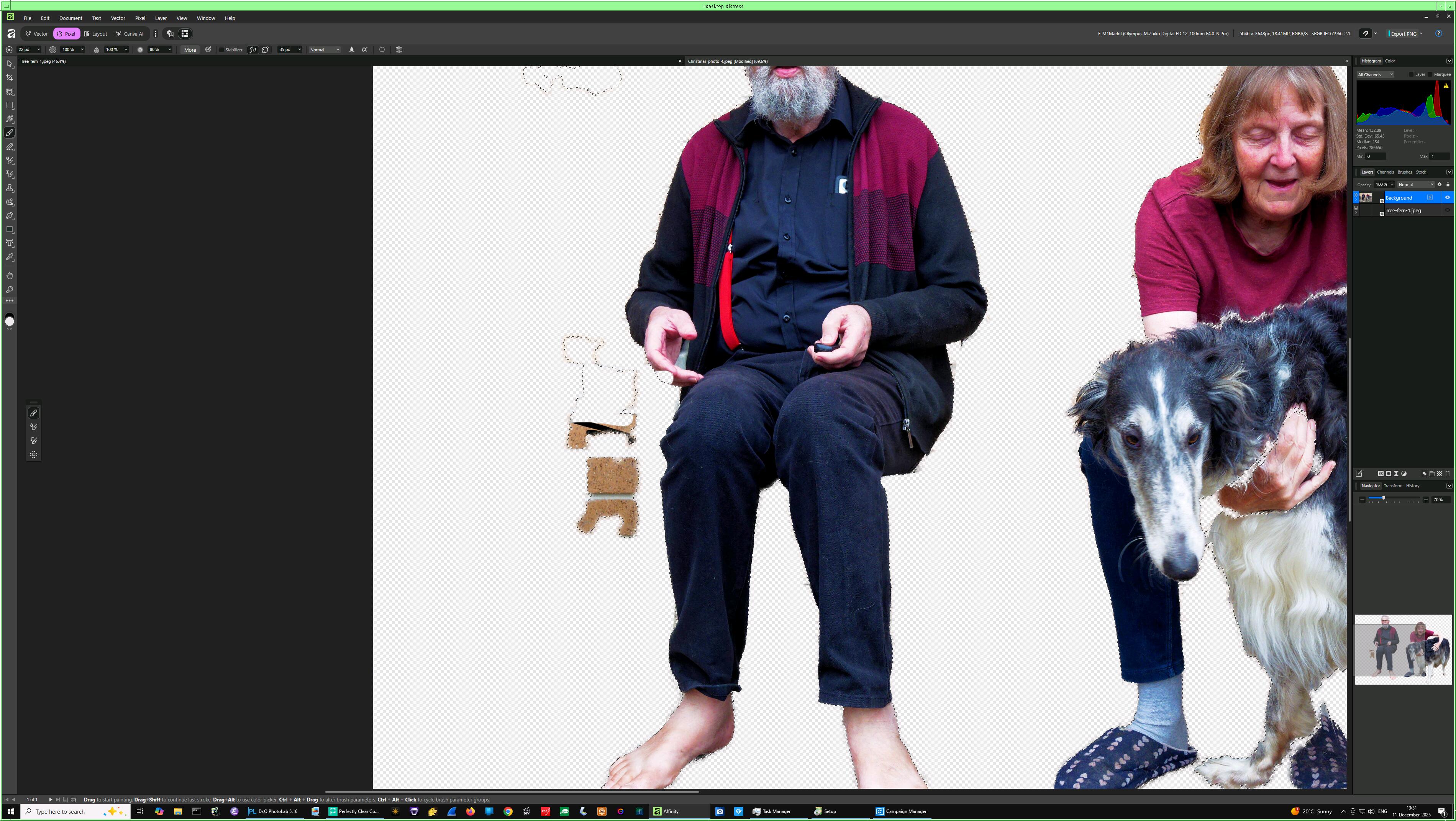
passes for success nowadays: I was able to mark my profile and get a (very) rough mask,
which I could then refine with the “paint” tool—I think, though it left fringes that
wouldn't go away:
But the mask kept jumping around, selecting whatever the cursor was positioned on. Still, I
sort of got it to work. Next to add the background. But when I expanded the image, I
discovered that I had missed some of the misidentified area. OK, paint over it. But this
time I painted black:
And I couldn't find out how to change it. It was somewhere in the video, but I didn't want
to go through it all over again. And this was just a test run, so I left it like that.
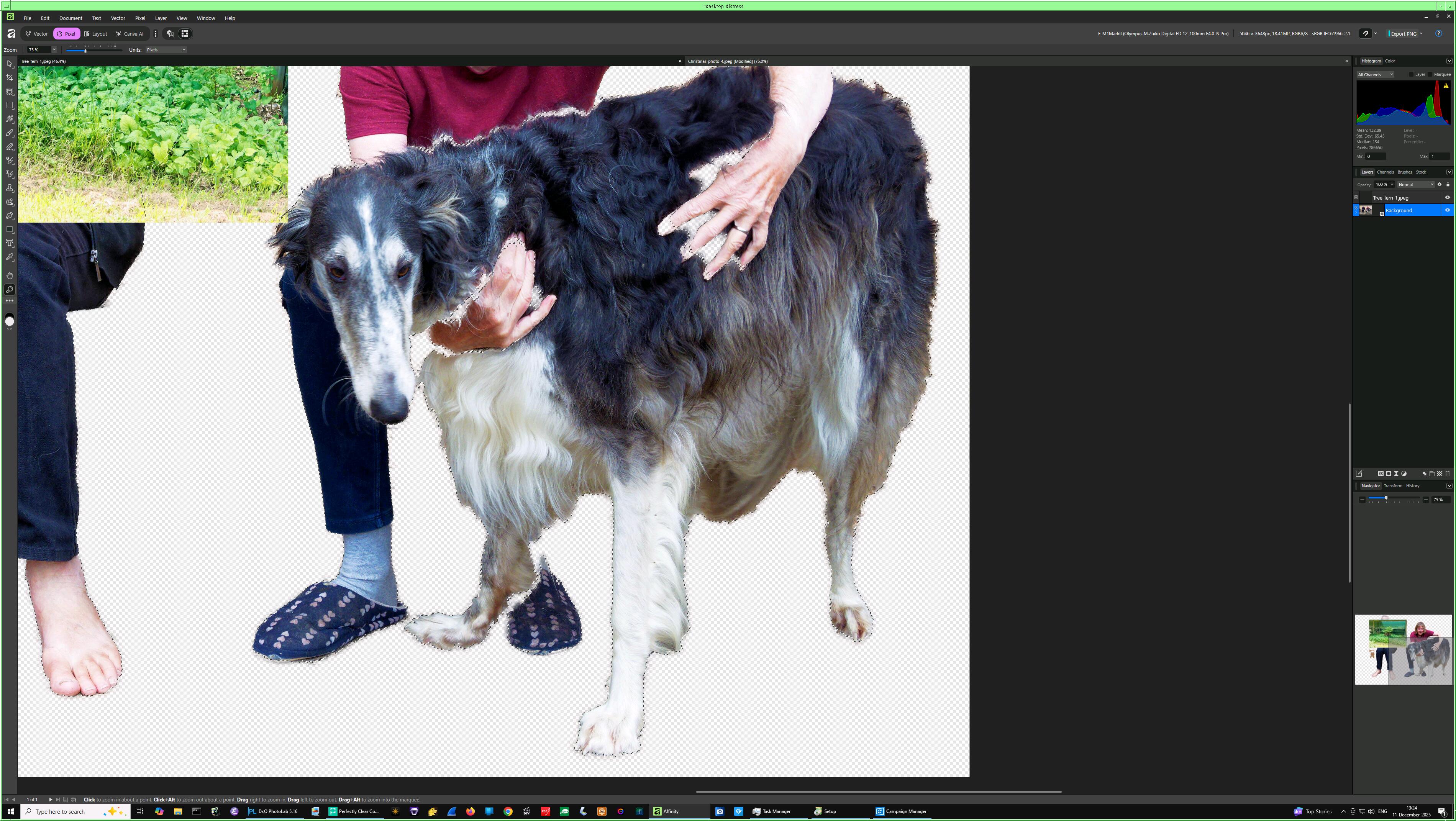
Next in the video was to introduce the background. And I failed completely! The video is
not very clear how it does it, but it appears to involve first opening the image and then
moving the cursor to achieve anything, including adding to the composite image. And I made
the mistake of lifting the button while stretching it, so it ended up too small in the top
left corner:
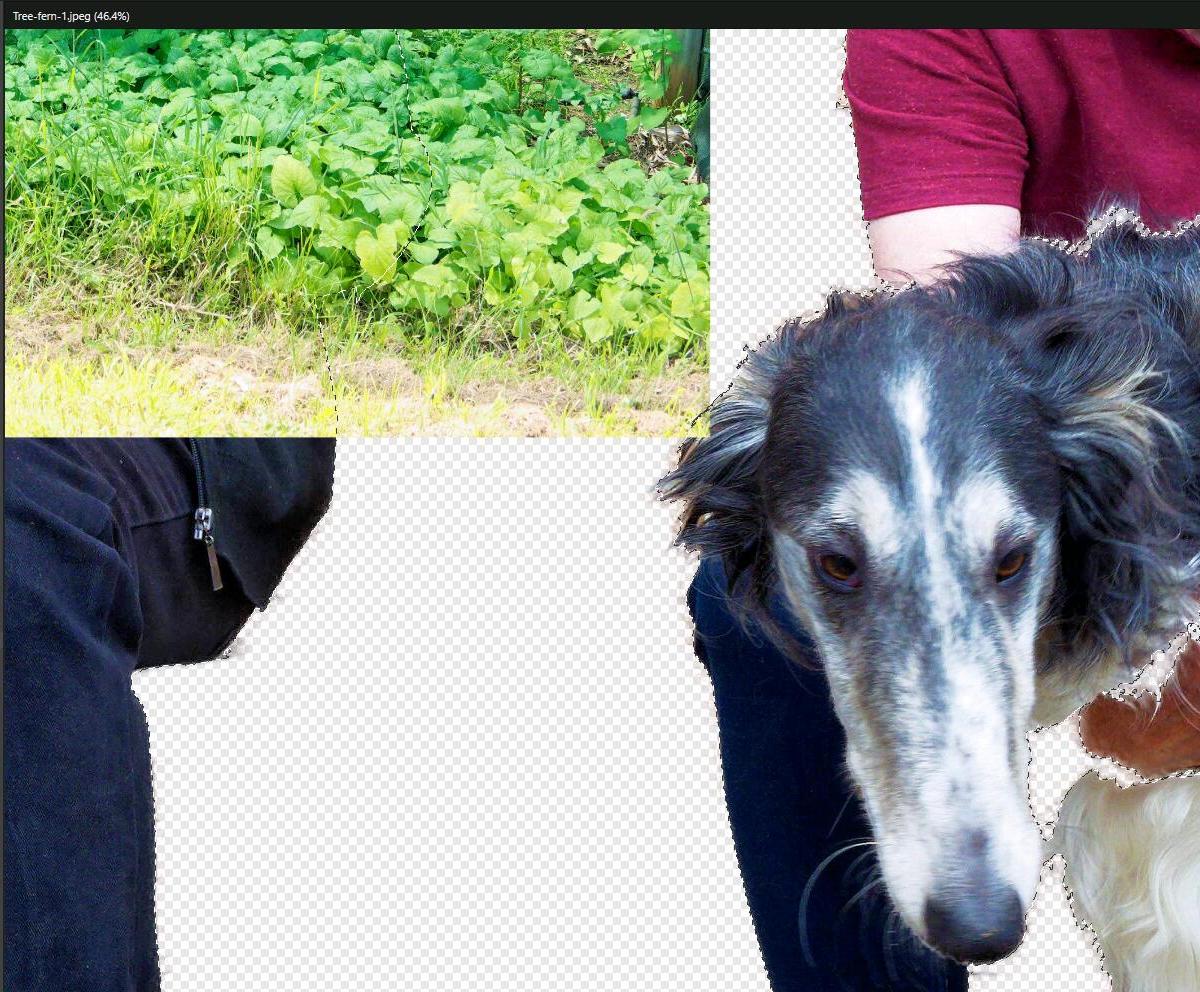
And nothing I could do could change that. Finally found out how to delete it and tried
again. This time something else went wrong, and without any obvious action on my part it
was inverted!
ENOUGH! I tried Affinity because it's still being supported, but there is no documentation
that I can find, and the user interface is both bizarre and very different from previous
versions. There's more aversion than affinity there. Back to ACDSee Gemstone 12, which has the advantage of a number
of videos, all old, and many claiming that Gemstone 12 is in BETA. Interestingly, the
screen display looks surprisingly like the Affinity, though accessing files is less baroque.
But that was all that I had time for today.
Why am I having so much difficulty? I didn't have anything like this much trouble with
basic photo processing 15 years ago. Am I losing my marbles? It's a possibility, but I
don't think it's the case here.
My web sites are still frequently overloaded, with load averages sometimes over 200. And
the servers are issuing frequent ECONNRESETs. Once again I need to think about
what to do.
I already have code to delay and redirect long imagesize strings. Will that
help?
Yes! Though it's very dependent on the delay. At 30 s, the load averages dropped below 1.
With a bit of experimentation I discovered that 10 s was probably a good compromise, with
load averages round 2 to 10. And something that I didn't notice last time: after a
redirect, there was no second attempt. Is that a feature of the web server (automatically
serve a different page), or is it an indication that the crawlers already have the base page
(without imagesizes)?
Another breakfast experiment today. I really can't get my head around Japanese food.
Mainly to use up some ingredients (finally the cabbage is gone; it'll be a while
before I buy any more), I made this:
“China is a mess”. I wonder what it really means. But it seems that the content is more
than just miso.
The result? Edible. I had trouble with the udon, which didn't want to disentangle, and
the tauge (one of the reasons for the dish) was out of place. I really need to
understand Japanese food.
As planned, back to my investigation of ACDSee Gemstone 12 today. I didn't get very far. Once again I'm torn between videos that show you
what happens if everything goes to plan, and the lack of documentation to help when they
don't. Yes, it seems to do what I want. But I've already seen how badly Affinity recognizes shapes. Is there any reason to believe that Gemstone will do any
better, especially when they seem to share a common ancestry? And how do I tidy up
selections? I can't find anything to tell me.
I think we'll do the newletter photo the old way this year. No cats.
I've always had an aversion to codes of conduct. They should be unnecessary: people with
normal upbringing wouldn't offend against any reasonable code of conduct. The requirement
to commit to abiding by one (bound to be subtly different from the next) is tantamount to
being put on probation.
But now I hear that the Bendigo
Writers Festival almost failed this year because of a code of conduct: Bendigo Writers Festival
boycott. Fifty participants boycotted the festival because the code of conduct
included prohibition of criticism of Israel. Good for them.
Yesterday I decided to give up the attempts to perform background replacement with
the software available to me. So what did I do today? Attempt to perform background
replacement with the software available to me. Had I really used all the opportunities
available to me?
First discovery: the version, though claiming to be Gemstone (and not BETA), had significant
differences in the user interface. In particular, one of the items he chose is now (my
version of Gemstone 12) hidden one level further down beneath a different menu selection.
It's things like this, along with the far-too-fast selection of bewildering icons, that made
life difficult. The clip is about 4 minutes long, but it took me nearly an hour to get
through, sometimes frame by frame, and and the end it still didn't work.
Once again the similarity between Gemstone and Affinity Photo became apparent.
Selecting a foreground showed the selected part in red in the video, while my version had a
dotted outline—just what I saw with Affinity. I had to go back and confirm that I was
really using Gemstone. And while this time I was able to add a background, moving it was
exactly like showed in the Affinity tutorial.
Other irritations were setting mask colours. It turned out that I had missed a sub-second
part of the video where the presenter selected not one, but two bewildering icons.
Finally I had something like a mask. It wasn't perfect, though better than Affinity's. But
Yvonne's hand had been left out. Tried to fix it by painting
over it, but that didn't work, though I did find out how to change from black to
white: select the boxes at the bottom on the left
That's not an error on this page. The page contains only two lines (enlage to see anything at all), and the rest is blank. More serious,
though, is that I found nothing about background removal in the entire manual!
In the end, I found a way to save files—sometimes: c-s. But frequently it just
doesn't react. I still haven't found why. The best image I could get was:
Will I ever learn to get something useful? Arguably I should go back and look at Affinity
again; some of what I learnt here also applies there. But what a way to spend an afternoon!
My web site load continues to be very high, and it's clearly mainly crawlers. Does
Google Gemini know anything? “What is the
easiest way to identify a web crawler http request?”
Yes! The honest ones identify
themselves, but there are a whole lot of rogue bots that pose (via the User-Agent
specification) as an old browser. I can do without them:
$REQUESTER = $_SERVER ["HTTP_USER_AGENT"];
if (($REQUESTER == "Mozilla/5.0 (Windows NT 10.0; WOW64) AppleWebKit/537.36 (KHTML, like Gecko) Chrome/48.0.2564.116 Safari/537.36")
|| ($REQUESTER == "Mozilla/5.0 (Windows NT 10.0; Win64; x64) AppleWebKit/537.36 (KHTML, like Gecko) Chrome/109.0.0.0 Safari/537.36 Edg/109.0.1518.61") )
{
http_response_code (403);
exit (0);
}
That works. But to my surprise, instead of lowering the load average, it increased
it significantly. Why? I'm still trying to get my head around it.
Worse, I am still getting so many requests that the network stack can't keep up:
Dec 14 08:03:41 lax kernel: sonewconn: pcb 0xfffff8006a459b70: Listen queue overflow: 193 already in queue awaiting acceptance (704 occurrences)
Dec 14 08:04:43 lax kernel: sonewconn: pcb 0xfffff8006a459b70: Listen queue overflow: 193 already in queue awaiting acceptance (403 occurrences)
Dec 14 08:05:44 lax kernel: sonewconn: pcb 0xfffff8006a459b70: Listen queue overflow: 193 already in queue awaiting acceptance (719 occurrences)
That's up to 12 rejects every second! Clearly I must do something about it. Others,
like Daniel O'Connor, suggest firewalling the sites for a short period of time. That
requires significantly more effort, including potentially a new firewall and identification
software like Fail2ban. Let's
wait and see if the crawlers get tired.
I'm off to Werribee tomorrow,
1½ hours' drive each way. Yes, I can drive via Geelong, but I know that road well. How
about a more scenic route via the Brisbane Ranges?
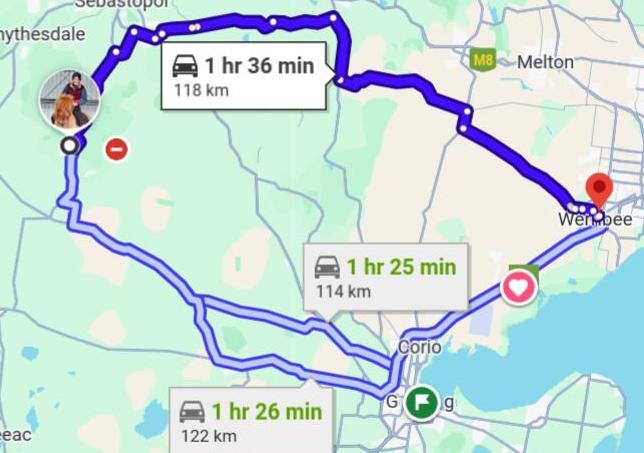
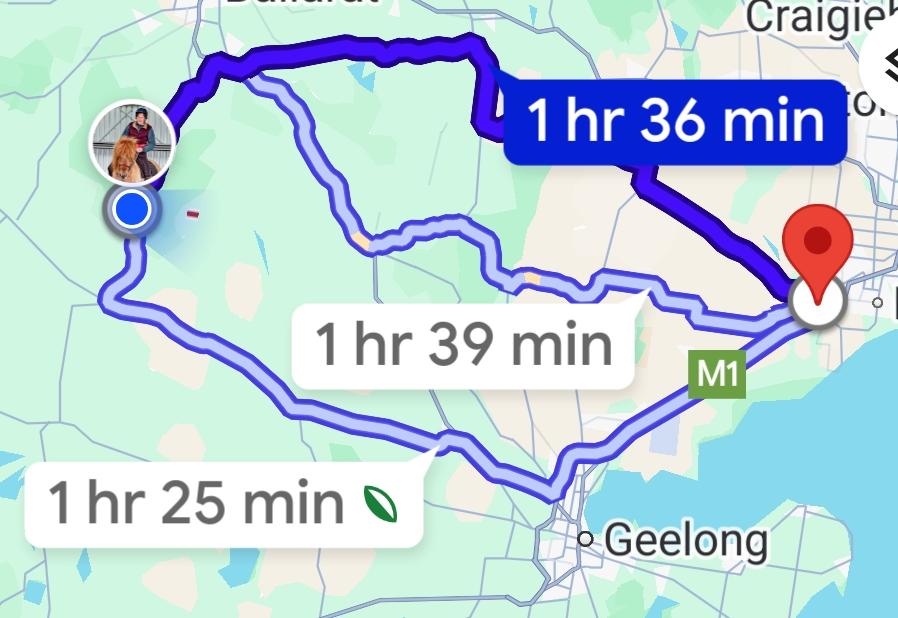
Google, find me a route:
Oh. Different routes! Why did it do that? And none of the routes look “right” to me. The
northern routes go via Sebastopol, which is quite a diversion from the way through Meredith, the one that I wanted
to take.
But then I read the fine print (web browser only; we don't want to worry the pain phone
users): “Avoids road closure on Mt Mercer-Dereel Rd”. Oh. That's right where I would want
to go. So it looks like Geelong after all.
Off to Werribee today for a
periodontic examination. How do I get there? Normally I would have gone via Meredith, Victoria and
Anakie. Meredith is 34
km away, but the road closure on the Dereel—Mount
Mercer road added a full 21 km to the route. But the route via Bannockburn is boring, so I
chose it anyway, running into no fewer than four road works on the way, none of which had an
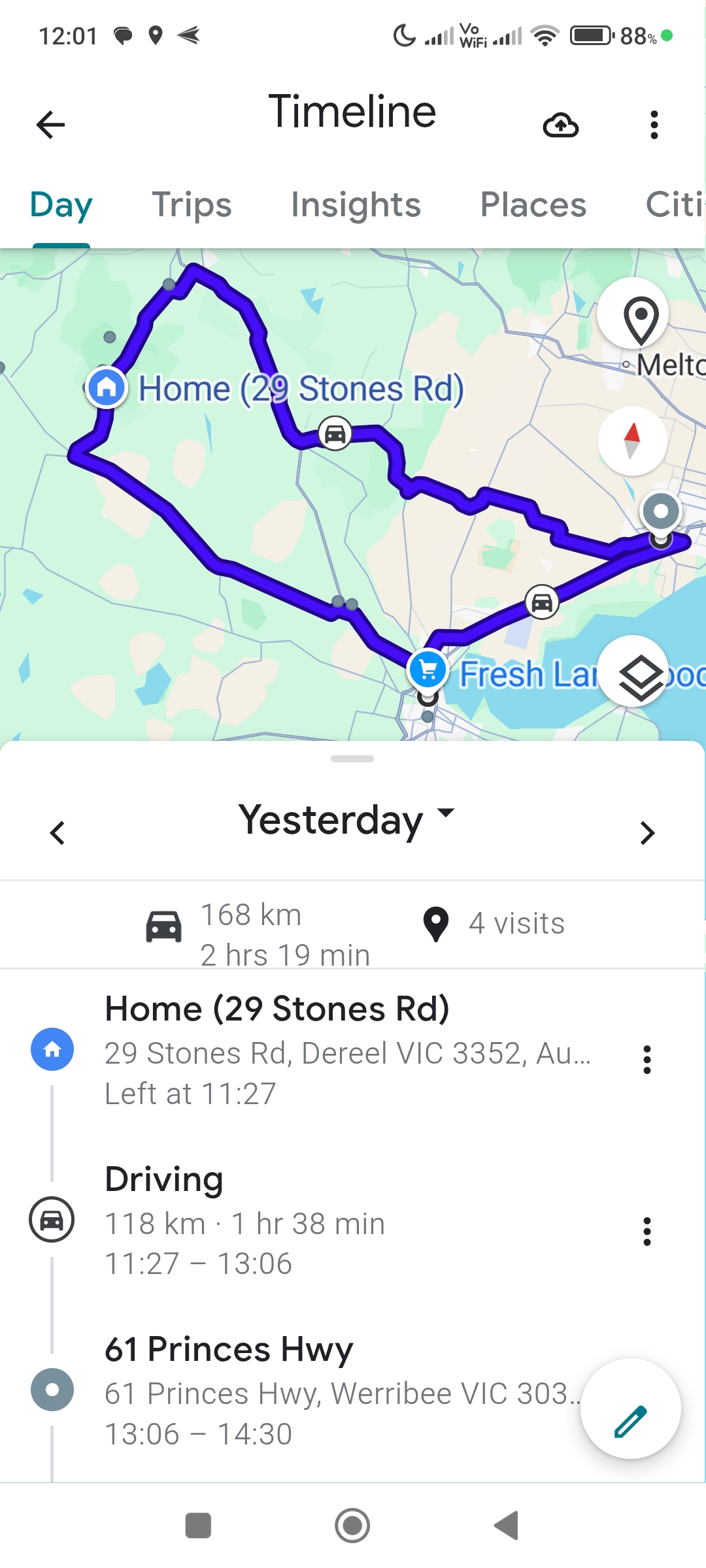
obvious purpose. Still, it was interesting, though I had forgotten to start the GPS Logger
that Android had stopped for me despite my express instructions, so all I got was this toy display from
Google Maps:
How did it compare with Google Maps' estimates? Same distance, two minutes longer. After
deducting the 6 minutes spent waiting for road works, it's actually faster. And presumably
it would have been round 1 hour if I had been able to go via the Mount Mercer Road.
One of the nice things about Google Maps are the images. But to my surprise, things looked
nothing like I expected. I should possibly look more carefully.
My appointment was with Leela Movva,
whom I have not seen for over 3 years. And though he no longer had my records (which remained in
Geelong), he recalled details
about me. A relatively short examination, in which he didn't quite match Mario's gum depth
of 9 mm, but did find multiple depths of 8 mm, still far too much. Dignosis: periodontitis. He has a solution:
laser therapy, which seems to be new in Australia, though practiced (and
hopefully perfected) in California for over 20 years. The costs are eye-watering, over $3000, from which I
discover that my health will refund the princely sum of $739.90. I agreed that I would talk
about it to Mario, but I suppose I will have to do it.
After the periodontics, I had planned to look round Werribee for an East Asian grocery, but I
couldn't be bothered. Off instead to the Fresh Land Asian Food in
Geelong, where I went in July. I had a fairly extensive shopping list, and I wasn't able to find
everything, but to my surprise I couldn't even find tauge. In many ways the Fruit Shack is better.
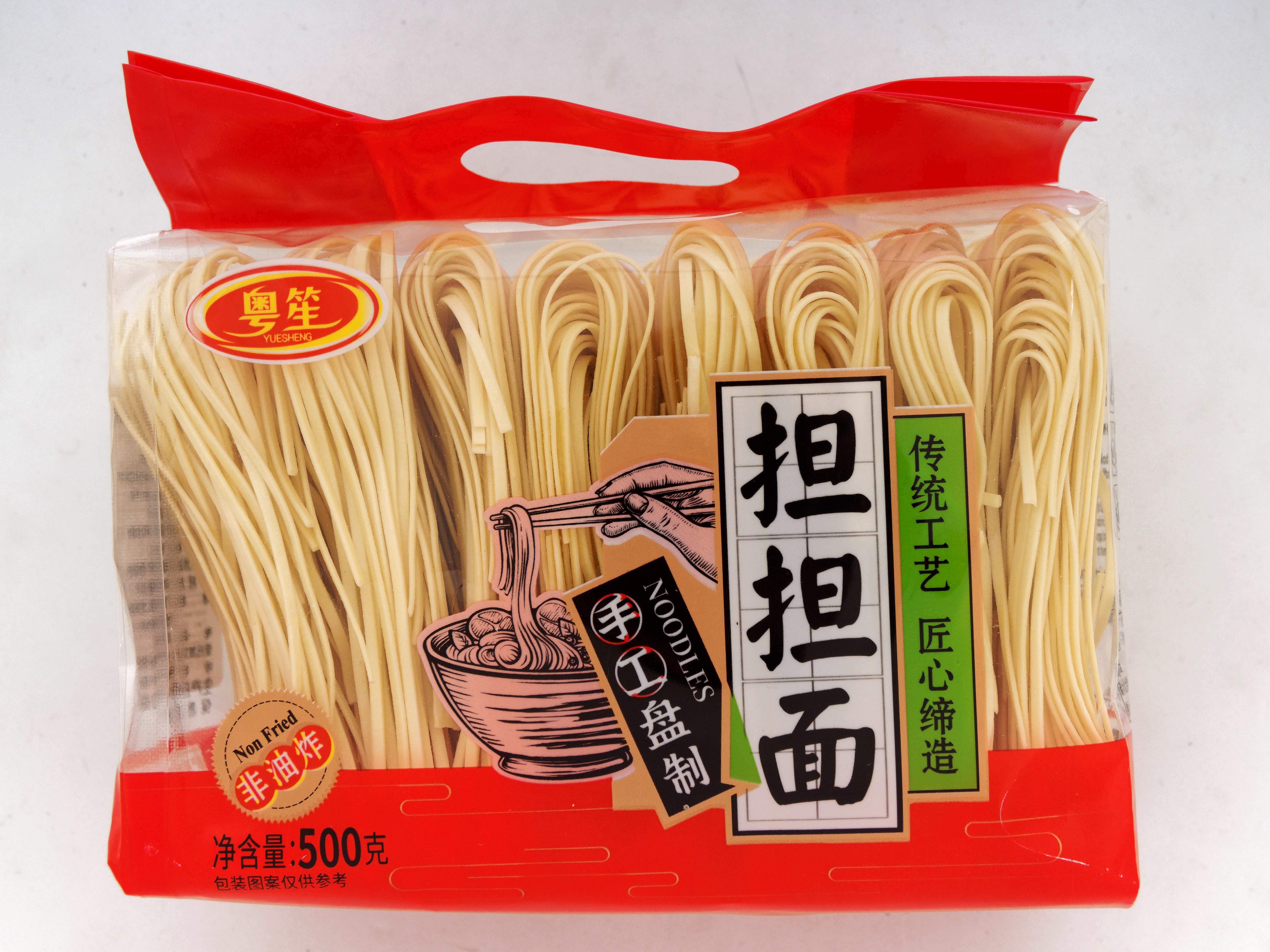
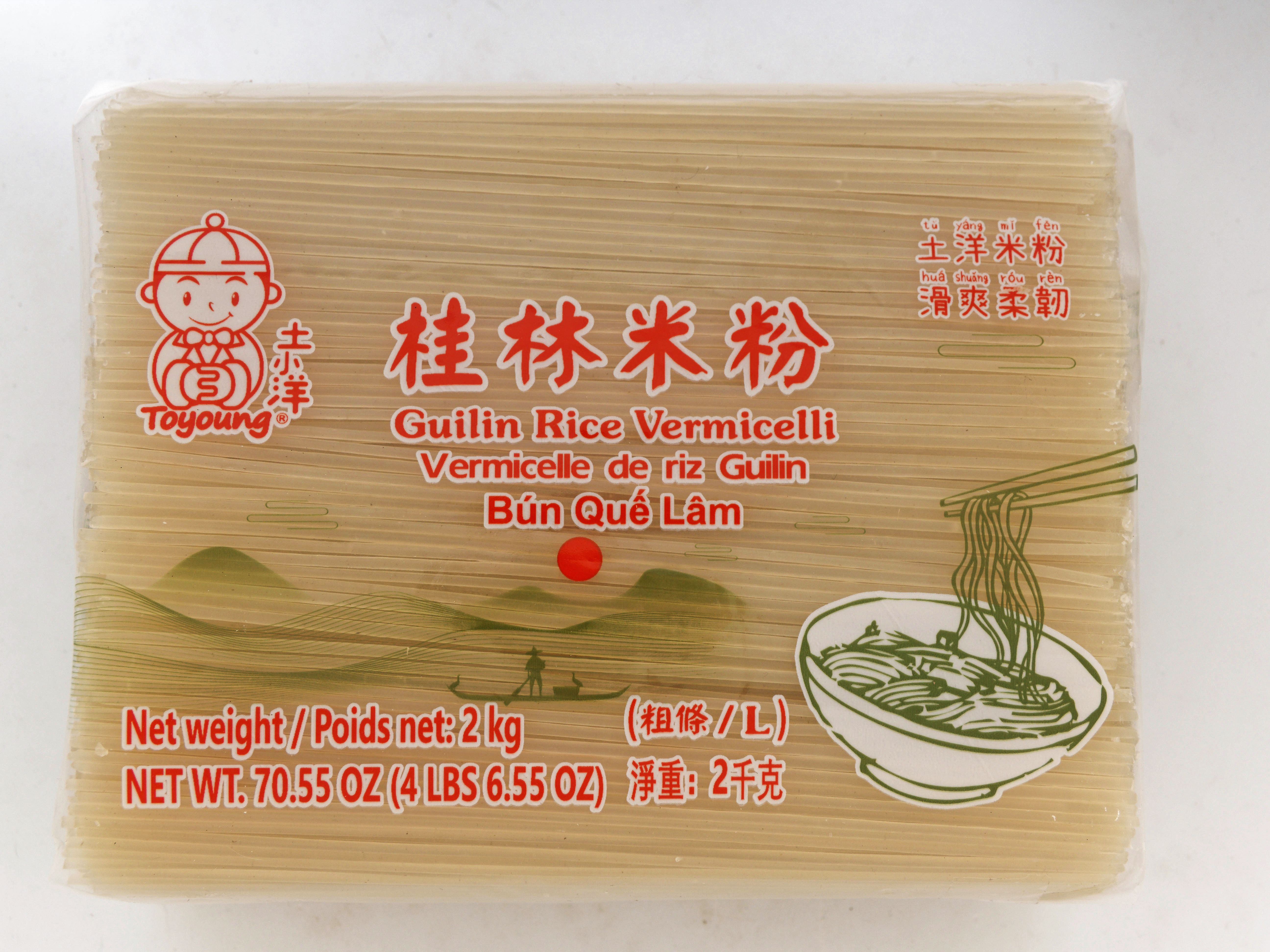
I did, however, find a number of noodles I hadn't seen before:
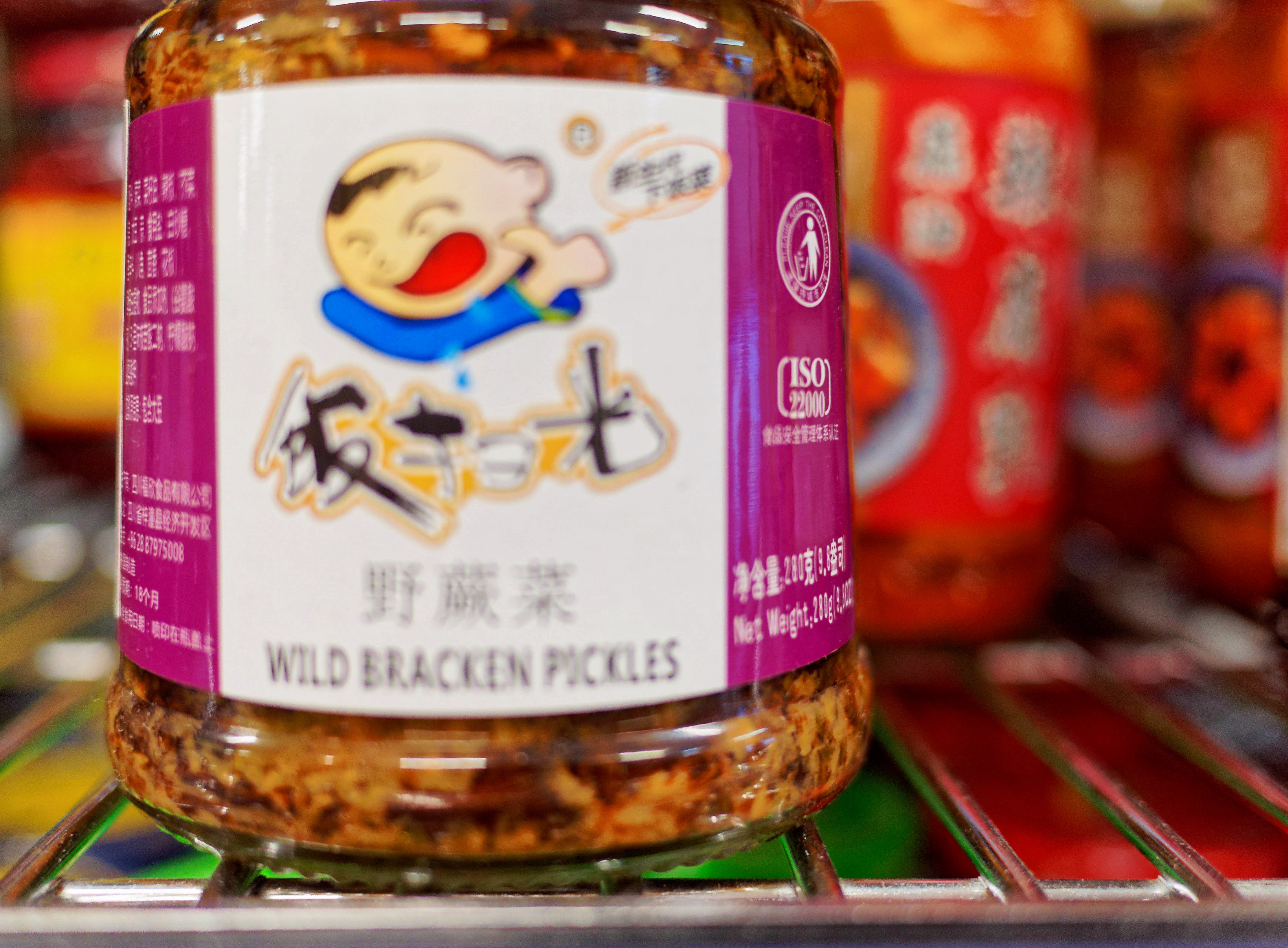
More and more, the inability to read Chinese is becoming a problem. Today I took a couple
of photos of jars that interested me, using my Olympus E-PM2:
The first are something like pickled beans—I bought the right hand two. But what's the one
on the left? To be examined when I can get a legible translator. And I went to a lot of
trouble to confirm that it was in focus. So when I took the second photo, I didn't bother.
The sides are in focus. How did I miss that? Off-centre? With a real viewfinder, I would
have noticed.
There's no question, the grid power reliability has increased considerably in the last few
years. Apart from far too many “planned outages”, there has only been one signifcant outage
in the last 15 months.
Until today. And once again our PV inverter showed itself from its worst side by powering down for about 15 seconds.
Time to see how my new UPS in the office
works.
Wonderful! No interruption. Oh, well distress, my Microsoft computer, was running
at the time, and it's not connected to the UPS, so it rebooted. But all the other machines
were on UPS, and they carried on running.
But then Yvonne came to me and told me that her mouse wasn't
working. Neither was lagune, her machine. Why? I thought it was still running
after the failure, but the last message in /var/log/messages was from 40 minutes
before the failure. That in itself suggests that it's an unreliable source. But why
should lagune have failed? It's behind a UPS like all the others.
Worse: after rebooting she couldn't recover firefox. For some reason she had a different profile, and it was relatively
easy to recover.
But she couldn't access her mail! And here again she had a different configuration: it was
looking for /usr/mail/yvonne instead of /var/mail/yvonne. Why? There was no
obvious change in the configuration. And while searching for the reason, I discovered that
it happened only under X. Why? Put it into the
“later” basket and addressed other issues of the day. A brief look
at ~yvonne/.xinitrc showed some issues, though: for lagune it had
xpat is a graphic card game, and it came up. But xearth didn't, and clearly
the instance for lagoon:0.1 is nonsense. But I was able to start xearth from
a shell. When I have time I'll need to look through the log files in detail.
Oh. /home/local/bin/xearth. That doesn't exist (any more). Another edit.
I still need to look at those log files.
Then later I wanted to watch TV. Problem: teevee still has strange display problems,
so I can't return to the console. Instead I start X over the network. And for some reason Xorg:0 stopped, though Xorg:1
continued running, but accepted no input. So I had to restart it. But why? The connection
goes through no fewer than 3 switches that briefly lost power, but a 15 second outage
shouldn't have caused it to stop. Again something for the “later” basket.
And then, just before going to bed, I got the first of my nightly backup mails. But instead
of the normal 100 kB or so, it was 110 MB! Looking, I saw:
DUMP: Dumping /dev/nvd0p2 (/) to standard output
/home/local/bin/dodump: cannot create /dump/hydra-FreeBSD/2/root.bz2: Input/output error
DUMP: mapping (Pass I) [regular files]
...
DUMP: Broken pipe
DUMP: The ENTIRE dump is aborted.
mkdir: /dump/hydra-FreeBSD/2: Input/output error
/home/local/bin/dodump: cannot create /dump/hydra-FreeBSD/2/tars/dumpdate: Input/output error
cat: /dump/hydra-FreeBSD/1/tars/dumpdate: Input/output error
(thousands of repeats)
What's wrong there? /dump is on eureka. so it's all over NFS. Into the office to
discover that, although eureka itself survived the power outage, the external USB
disk power supplies lost power. Not only did they power cycle, once again they came up with
different device numbers. Tried with moderate success to force unmount and remount the
first disk, but the second umount hung with a strange situation. It wouldn't respond
to kill -9, of course, but top showed me:
PID USERNAME THR PRI NICE SIZE RES STATE C TIME WCPU COMMAND
63712 root 1 20 0 12384K 1972K CPU3 3 0:00 100.00% umount
100% CPU time and no time used? That makes no sense. I had expected it to be waiting on
something. OK, what does ktrace say? Nothing. A completely empty dump file. But a
little later I saw the CPU time suddenly increase to 3:18. My guess is that it was spinning
somewhere deep in the kernel. And gradually other processes ended up waiting on whatever it
was holding, even on hydra.
What to do? For once, the Microsoft solution: reboot. Even that didn't go completely
smoothly: logging in as root on /dev/ttyv2 worked normally, but logging in
as myself on /dev/ttyv3 hung, though it recovered in the course of the night.
Logging in via ssh worked, however.
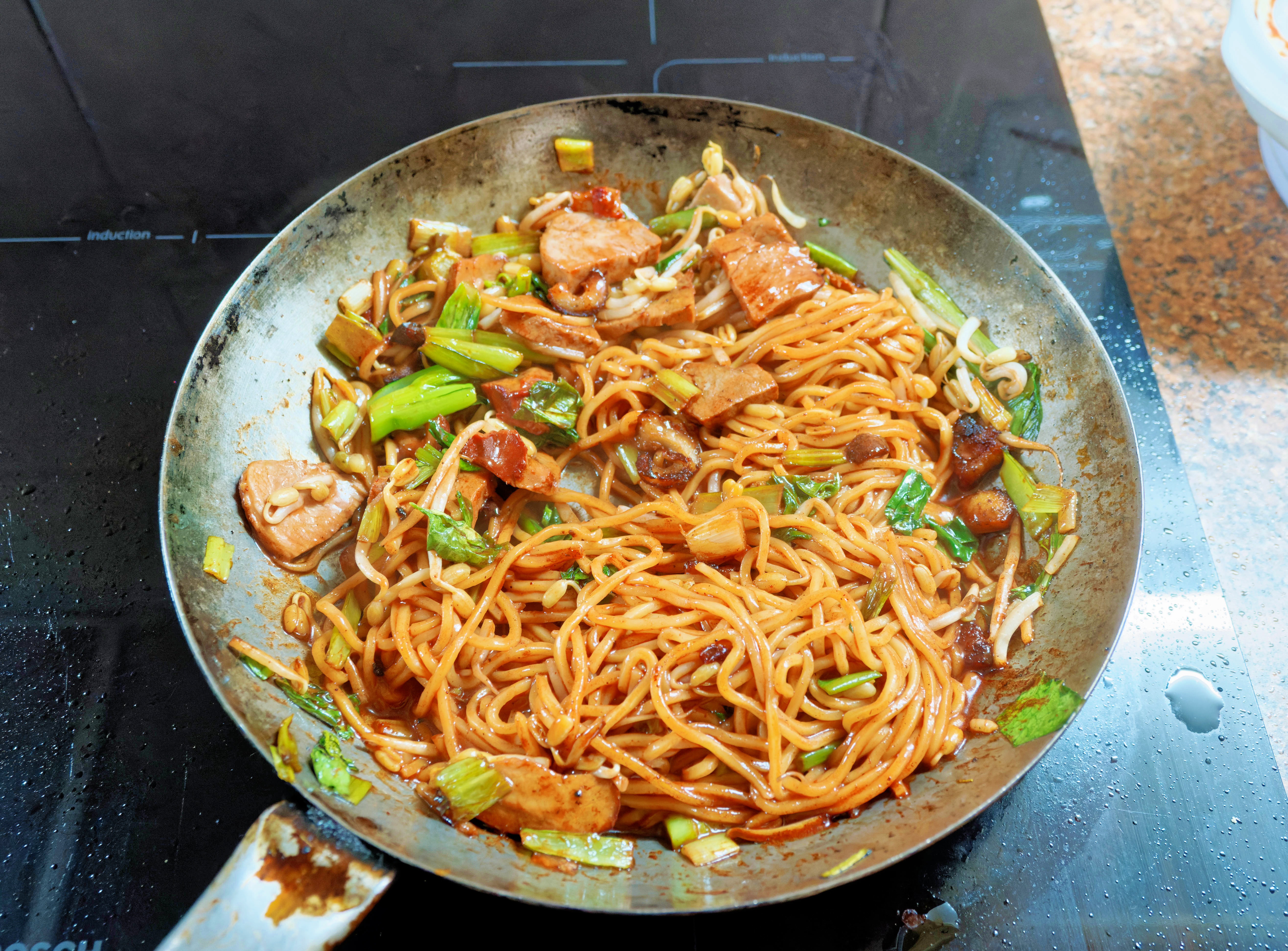
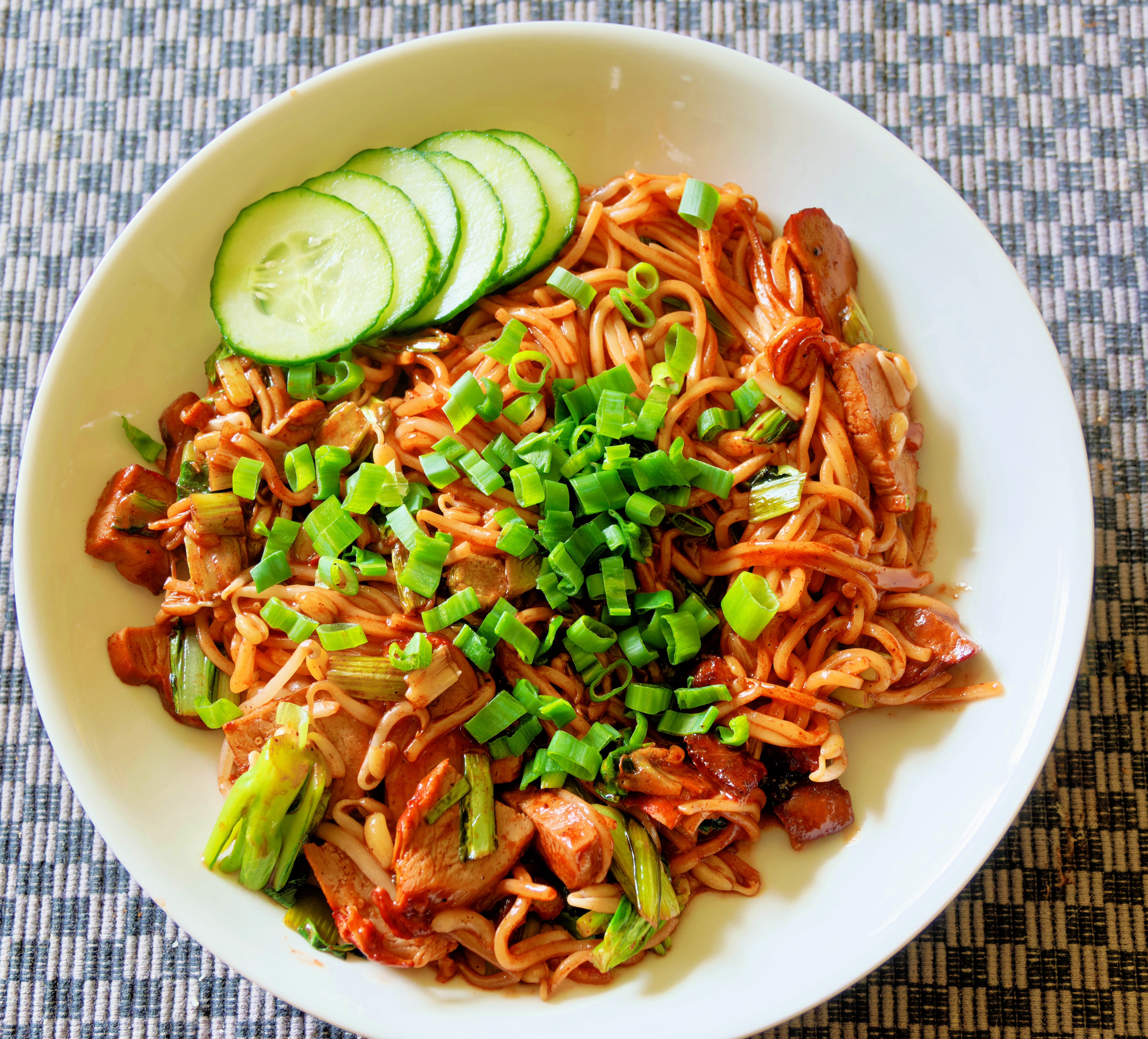
Leftover duck from Saturday today, just what I need for a breakfast of Dereel duck noodles.
Oh. That was 3 years ago, and since then, with the exception of the duck, it has basically
become my generic breakfast noodle dish. OK, this time just use duck and the “marinade” in
which it came, along with choi sam, dòufu and tauge:
Bondi Beach is well known in
Australia as one of Sydney's best
beaches. But now it's known all over the world for the massacre that happened on
Sunday: two terrorists, father and son, attacked a Hanukkah celebration and killed 9, no 11,
no 15 people. Those are the kind of thing that almost only happens in the USA.
Who is to blame? I pointed the finger a year ago: Benjamin
Netanyahu. But instead he blames Anthony Albanese. Bibi, Jews are
dying because of you (not to mention the inhabitants of Gaza). When will this ever stop?
In passing, it seems that the murderers were cowardly. That's a term that the press
is using more and more, like “graphic” to describe not graphics, but distasteful images. I
would have thought that any coward would never even consider mass murder. Where did this
usage come from?
Another Zoom meeting
with Aaron Harivel of OM
Digital Solutions today, on the topic of beginner birding theory. That seems out of
place, since I've been birding with him in person a couple of times, but past experience
shows that he might have something interesting.
Things didn't start off well. For some reason, my video camera (looking at me
on eureso, the laptop) didn't work correctly. I wasn't the only one: a number of
other people showed up on the list without video, and Aaron had an unexpected disconnect
right at the beginning. And I couldn't find a settings link on the laptop (standalone)
version, though the one on hydra had settings but no camera.
Apart from that, he had a number of suggestions, some of which he had told me earlier, but
which I hadn't written down. Today I took lots of screen shots and made some notes:
Use the small square focus on the E-M1.
He mentioned a colleague who used aperture priority on his birding. I still need to get
my head around the reasoning.
Apply the kind of subject detection to a dedicated button. Again, the screen shots
might help. He uses the ± button on top of the camera.
Subject detection disables tracking.
Use the focus limiter.
Mechanical shutter doesn't produce banding
For ProCap, remove the capture counter.
From one of the participants: "Also, suggest looking for Ramsar sites and seeing if
there’s any near you". It seems that Australia has 67 Ramsar sites, covering 83,000 km²
(equivalent to a squre 288 km on a side), and one of the interesting ones for me are the
Western District
Lakes, which I must investigate
Mobile connect, the link between camera and mobile phone that I thought completely
useless: it could good for birding.
He discussed teleconverters and why they only work on certain lenses: they have a nose
that protrudes into the lens, so a lens with an element in the extreme back won't work.
Took a look at my Leica DG Vario-Elmar 100-400 mm f/4.0-6.3 and didn't see anything until nearly 5
cm into the lens. Will it work? No, says Aaron, but Panasonic make their own
teleconverters. It wasn't until later that I discovered that I had not seen the
reflection of the rear element: it's right at the back of the mount. And the Panasonic converter (TC20) costs an arm and a leg.
For that price I could buy a second-hand long lens.
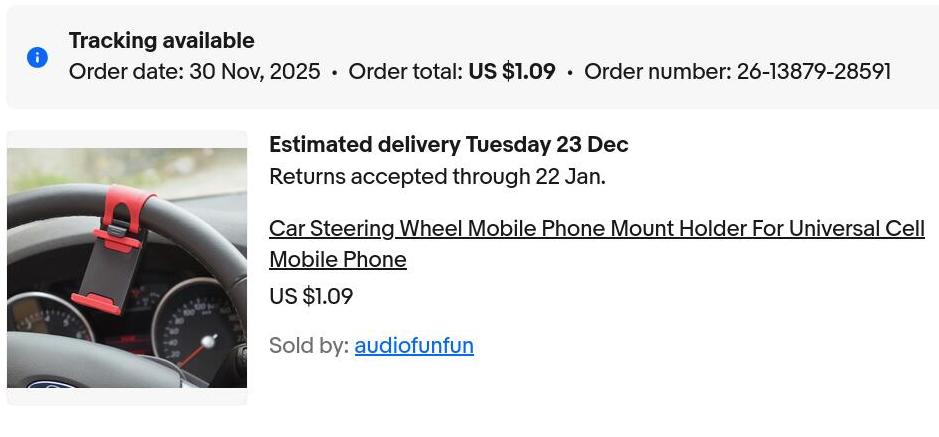
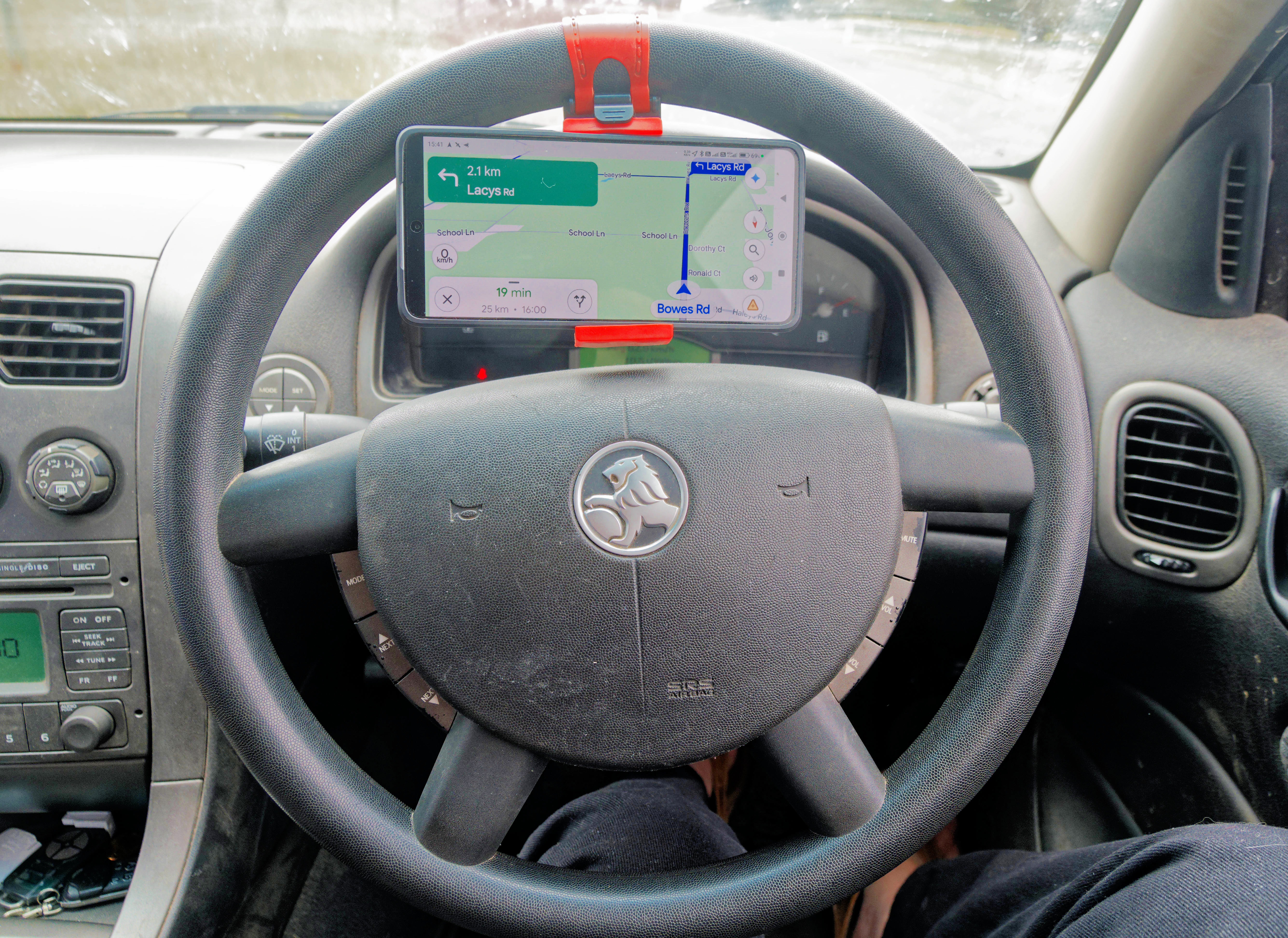
I bought a completely uninteresting mobile phone holder for my car some time ago, and it
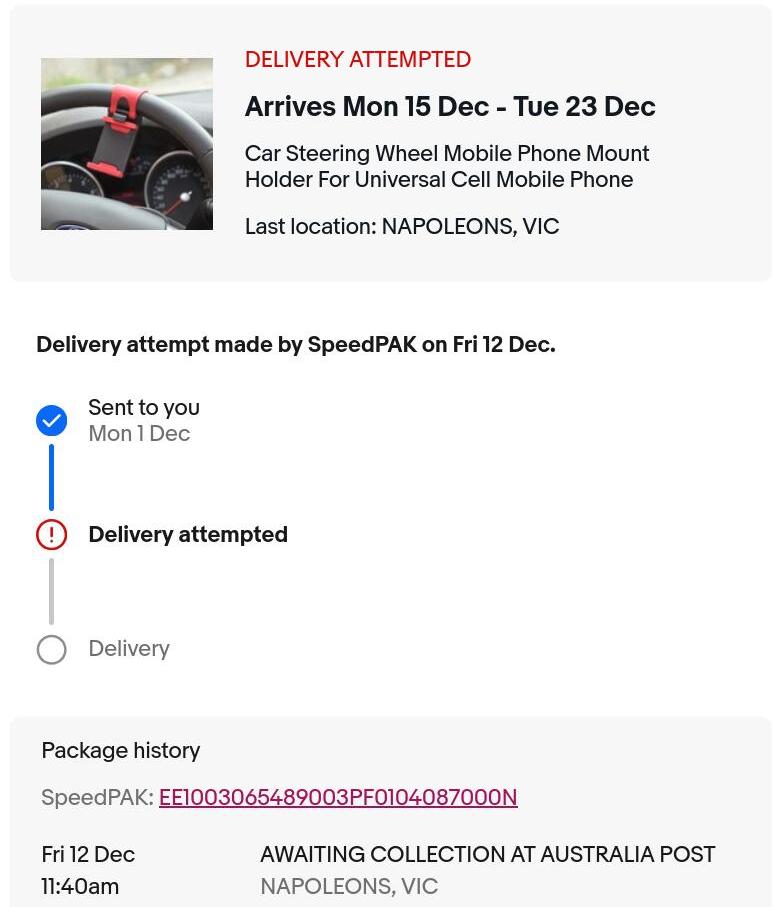
arrived at “NAPOLEON” post office last Friday. No hurry, so Yvonne picked it up today. Notification from Australia Post: at 11:04. What does
eBay have to say? I asked at 11:54 and got
“Delivery attempted” is just plain not correct, but I could almost forgive them for that.
But it seems that it will arrive somewhere between last Monday and next Tuesday, depending
on which view you choose. Why do they even bother? They keep asking me for feedback, and
of course it's extremely negative. Clearly there's a delay there (they did discover
that it had been delivered, some hours later), but why do they claim that it might be
delivered in the past, and why don't they just redirect to the carrier's tracking where
appropriate?
In passing, what a horrible user interface. It seems that Android and Google Maps
have ganged up on me to make it almost unusable. Just taking this shot on my mobile phone
and saving it (Power/Vol Down) took 8 attempts. And the Chromium browser on
FreeBSD didn't want to offer the
claiemd translate. It did on Microsoft, up to a point, but it still didn't give a Chinese
transliteration. About the best I got was a context question “What is sui mi ya cai”? But I still need to
check the writing to be sure, and I'll do that some time in the future—maybe.
Somehow Google Translate is one of many applications hampered by an appalling user
interface.
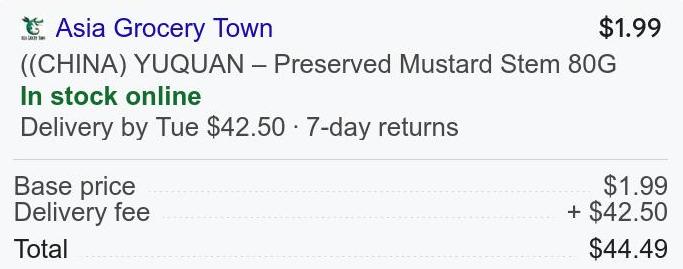
That writing looks surprisingly like the writing on my packet. Three logograms the same, and the first could be
the difference between traditional and simplified Chinese. But what really got me was the
price:
Another stupid eBay postage estimate? No,
this wasn't via eBay, and the company appears to be in Australia, though they seem to try
to hide their location. At that price they won't get many orders from me.
More mild pain in my right foot overnight, near the big toe. But not the joint pain
typical of gout. Took an
indometacin tablet anyway at
breakfast, but by the evening the pain was gone.
Yvonne is having lots of fun with Josy, the standardbred mare, who is proving much
more willing to learn than she had expected. One big difference from her previous horses:
today the farrier came and trimmed their hooves. The result (forehooves):
The noodles that I bought Monday still puzzle me. Why should the Xinjiang noodles need 6 hours' soaking?
What happens if you soak them for only 30 minutes? Or 12 hours? For breakfast, 6 hours'
soaking would been getting up in the middle of the night.
But then I discovered a couple of things. Some years ago I bought some “Heaven Dragon” noodles that were
also called “bún bò Húê”, and which I had cooked for an inordinate amount of time. So maybe
the soaking is a good idea.
And then, only two weeks earlier, I came upon a paste for bún bò Huế. So maybe these noodles are
just what I want for it (the Heaven Dragon are, well, in heaven). But what is the
relationship with Xinjiang?
The other name is clearly Vietnamese.
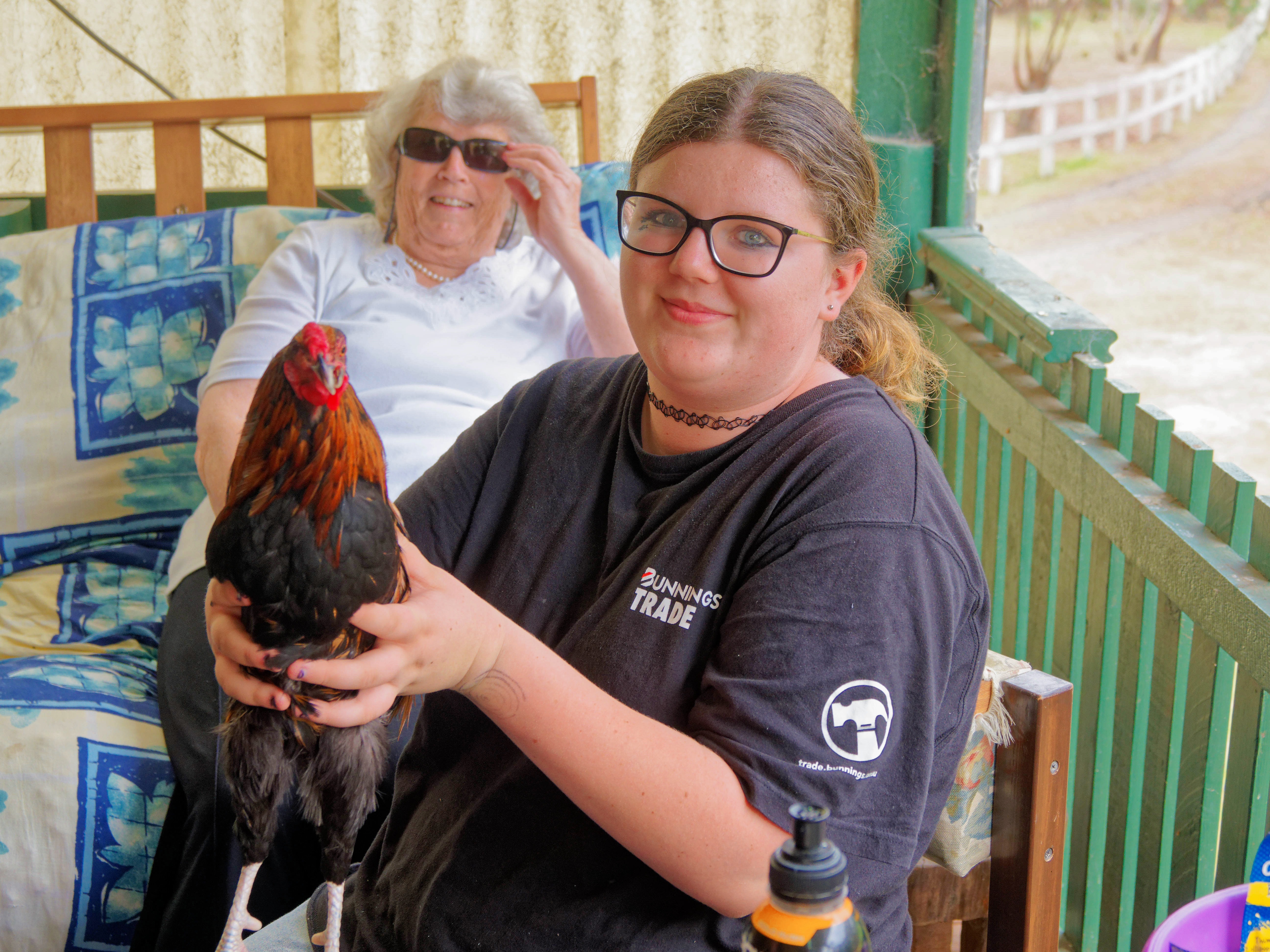
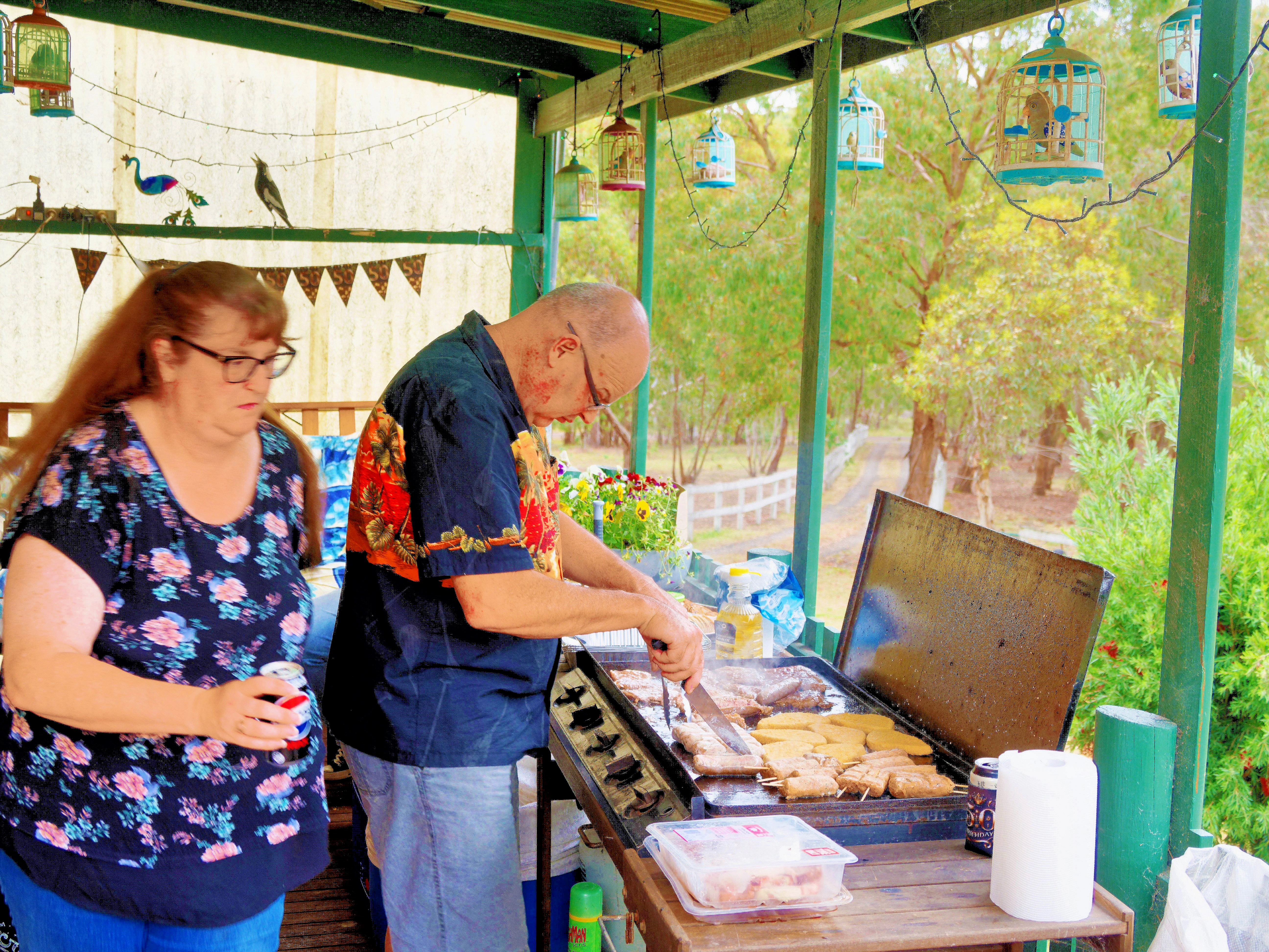
Kerrie Raleigh, a friend of Yvonne's who lives at the extreme
end of Ferrer's Road, turned 50 yesterday, and she invited us to a barbecue. Clearly
chicken wasn't on the menu:
We didn't stay long: Yvonne was not feeling well, and the smell of the cooking
meat—conveniently less than 1 m away—made her feel sick, so we left in less than half an
hour.
Garage sales seem to be going out of fashion, but Yvonne found one just round the corner in Snowgum Road. Why not take a look? Unlike Yvonne I'm
perfectly happy to go there, look around and go again without buying anything.
But this time I found just what I was looking for, and the price was right: a 35 mm film
canister, which I got for free. At least I have something for my Ukrainian film—if I can
find it. Yvonne had to buy something, of course—a neck rest, $1. There was lots of old
stuff from a bygone time, like books and VCR cassettes, and if they had sold everything they
might have made $200. And all that work at time just for that!
1½ years ago I had continual display issues: My oldest monitor kept failing briefly,
and in the end I replaced it.
But today something similar happened: two of my monitors blanked for no apparent
reason. And then they came back again after about 2 seconds. One was my newst monitor, the
replacement for the old Matrix monitor, the other an Acer monitor that I have had for I
don't know how long.
What caused the problem? Since it happened at the same time to two different monitors, it's
unlikely to be the monitor itself. Power problems? I need to check the power circuitry,
but potentially it's a spike from the grid. Or is it a sign of a failing display card? All
four displays are on the same card, two with HDMI and two with DisplayPort. The ones that failed were
one of each, eliminating one potential issue. The fact that both monitors came back at the
same time suggests that it wasn't a grid issue.
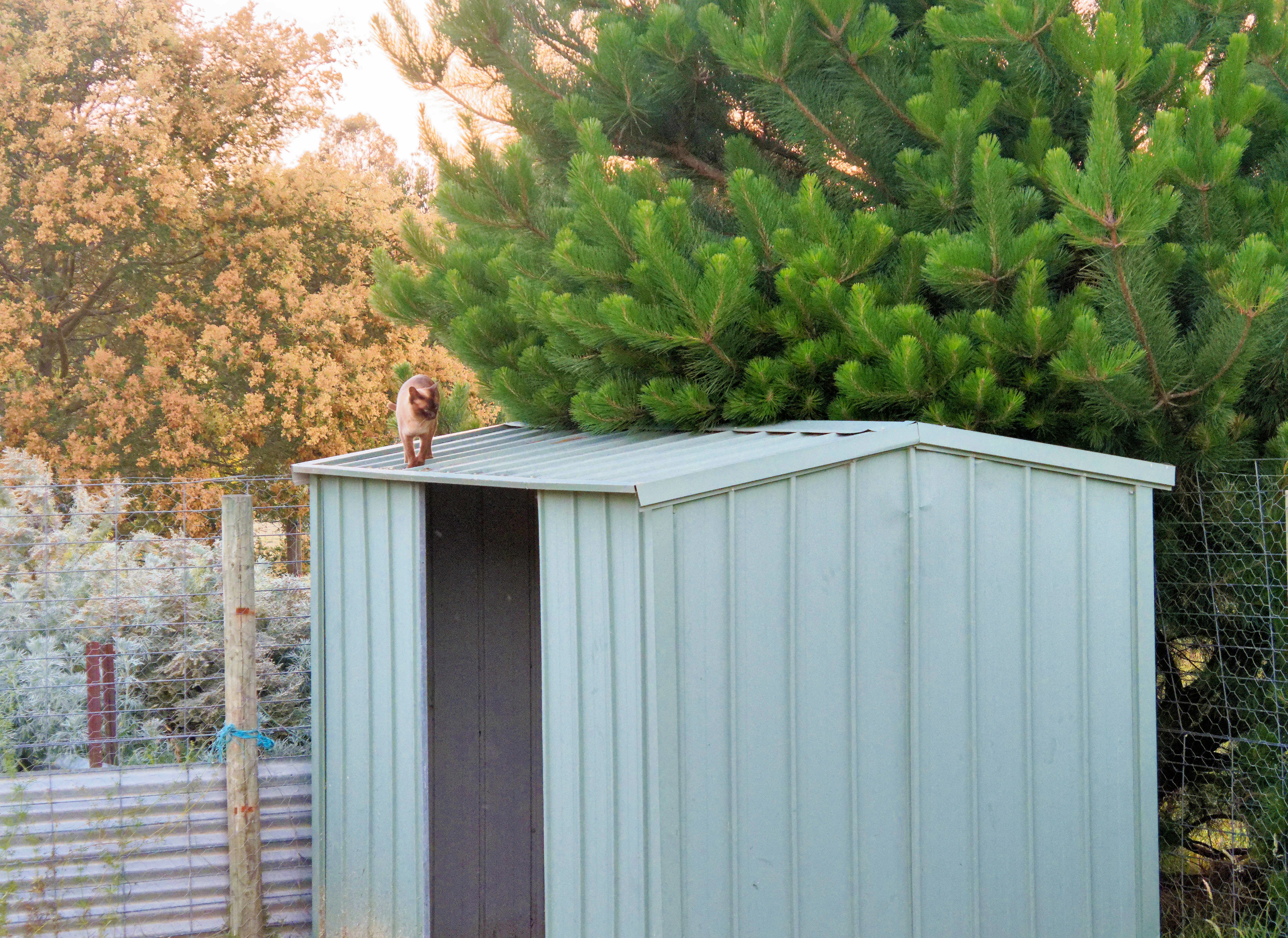
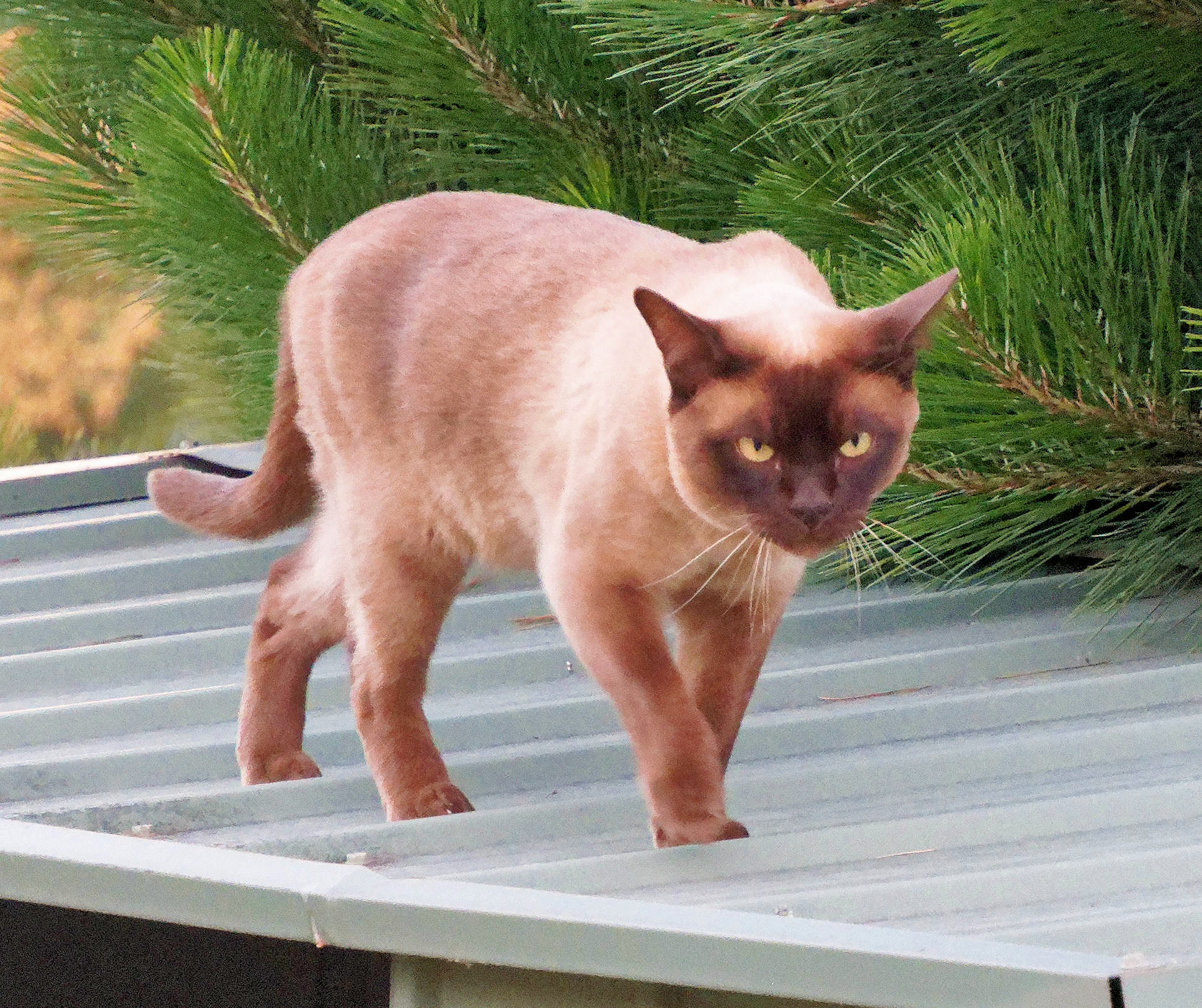
It's been a year since we started letting Bruno outside. It seems to have worked well, and he is much calmer inside as a
result.
We still don't want to let him out at night, and lately when he has wanted to get out after
dark we let him into the fenced-in dog run, which he likes. But lately we've found him
escaping. How? Then we found him on top of the dog kennel:
It's easier to jump onto the compost heap on the other side than back down again, which
seems to be a problem for him. We've found him there frequently, suggesting that the
compost heap isn't that important to him. What is so interesting there, and should we make
it more difficult for him to escape?
Into the office this morning to discover that my shell connection to fra.lemis.com
had terminated:
=== grog@fra (/dev/pts/2) ~ 1 -> Read from remote host fra.lemis.com: Operation timed out Connection to fra.lemis.com closed.
client_loop: send disconnect: Broken pipe
Disconnected at Sun 21 Dec 2025 00:00:05 AEDT
What went wrong there? An attempt to reconnect failed, and ping gave me round 85%
packet loss. Vultr? Waited for a
while for things to come back to normal, but they didn't. OK, try pinging the other
potential hosts on the same /24. Most were either 100% reachable or not at all
(because they didn't exist?), and a couple with 1% or 2% packet loss. But fra
remained round 85%. OK, time to find out how to access it by the “console” that Vultr
provides.
What a horrible thing! Of course it won't remap CapsLock to Ctrl, but for
some reason it's sticky or very slow, so even after accidentally setting CapsLock I
couldn't get rid of it again immediately. I'm still trying to work out if it's slow, or if
there's some other issue. Still, finally I got through and read:
Dec 21 00:00:28 fra kernel: Limiting closed port RST response from 342 to 204 packets/sec
Dec 21 00:03:24 fra kernel: [zone: mbuf_jumbo_page] kern.ipc.nmbjumbop limit reached
Essentially, your server is trying to process network traffic that requires large memory
chunks, but it has hit the "ceiling" (limit) set in the system configuration.
OK, try doubling the size:
# sysctl kern.ipc.nmbjumbop=256000
That worked briefly, but within minutes the system hit the new limit. Nothing for it: I'm
going to have to firewall the system. Much messing around before I came up with this
configuration, which still needs sanitizing:
kldload ipfw
ipfw add 100 allow ip from any to any via lo0
ipfw add 200 allow ip from 192.248.184.42 to any
ipfw add 1000 allow ip from any to 192.109.197.0/24
ipfw add 1000 allow ip from any to 121.200.11.253
ipfw add 1000 allow ip from 121.200.11.253 to any
ipfw add 1100 allow ip from 45.32.70.18 to any
ipfw add 1100 allow ip from any to 45.32.70.18
ipfw add 5000 allow ip from any to any 53
ipfw add 5000 allow udp from any to any 53 in
ipfw add 5000 allow udp from any 53 to any out
ipfw add 5000 allow tcp from any to any 53 setup
ipfw add 8000 allow ip from any to any 80
ipfw add 8000 allow ip from any to any 25
ipfw add 9000 allow ip from 192.109.197.0/24 to any
ipfw add 9000 allow ip from any to 192.109.197.0/24
ipfw add 10100 allow ip from any to any 22
ipfw add 11000 allow ip from 0.0.0.0/24 to any
ipfw add 11000 allow ip from 0.0.0.0/24 to any
ipfw add 65535 deny ip from any to any
In particular, it no longer responds to ping requests from outside lemis.com.
Is that a bad thing?
Strangely, most of the traffic from ipfw show was legitimate. My current guess is
that something was deliberately reserving ridiculous amounts of memory.
And at the end my “console” hung up and wouldn't respond at all. It wasn't that serious,
since I had contact from hydra, but I wanted to fix it. Gemini again, which pointed
me vaguely at that irritating panel in the middle on the left, where it obscures the text I
wanted:
“Open” that and select Ctrl-Alt-Del. And yes, that “solved” the
problem: it rebooted fra! What a horrible thing to do! Still, now I have my jumbo
page limit back to where I want it.
I'm not done yet. I haven't opened the firewall for squid. And I know
that fra still doesn't have email, and discovered that, though it runs named,
it does nothing useful, and this horrible overwriting of /etc/resolv.conf occurred
again. Time for more admin when I have the time.
But somehow the photos are boring. What am I doing wrong? It's clear that this is a case
for focus stacking, getting the foreground sharp and blurring the background. But somehow
the composition is still boring.
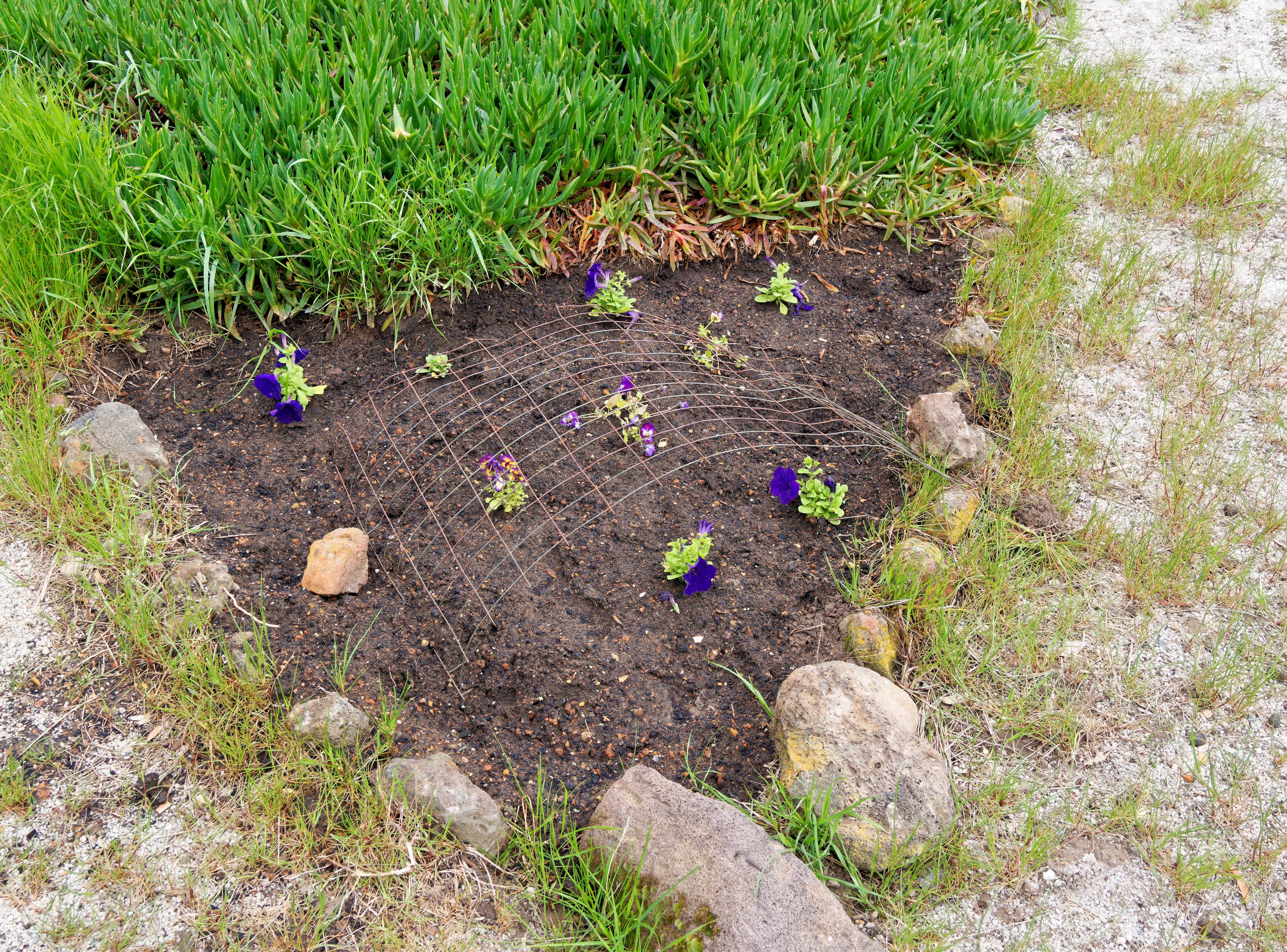
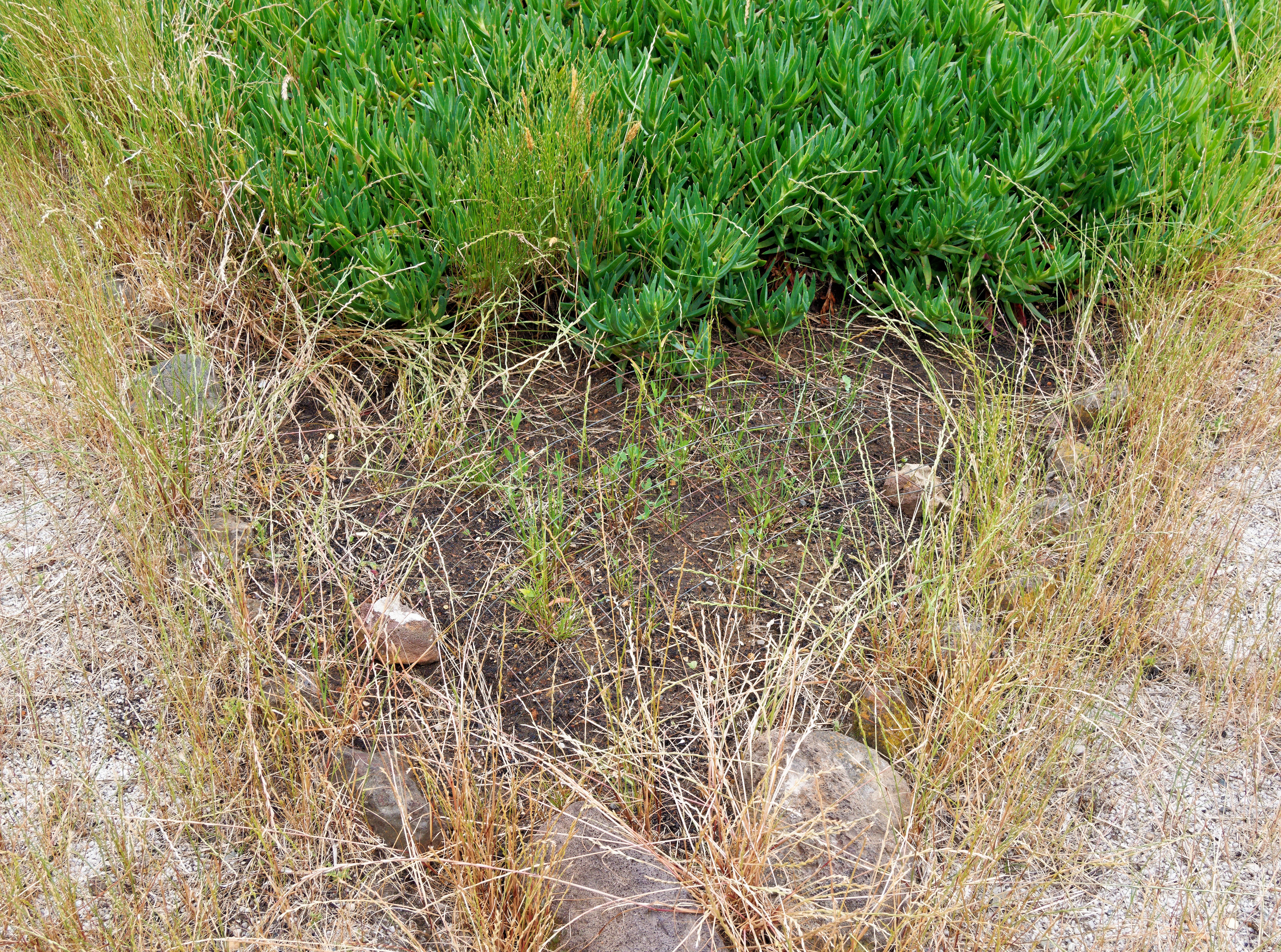
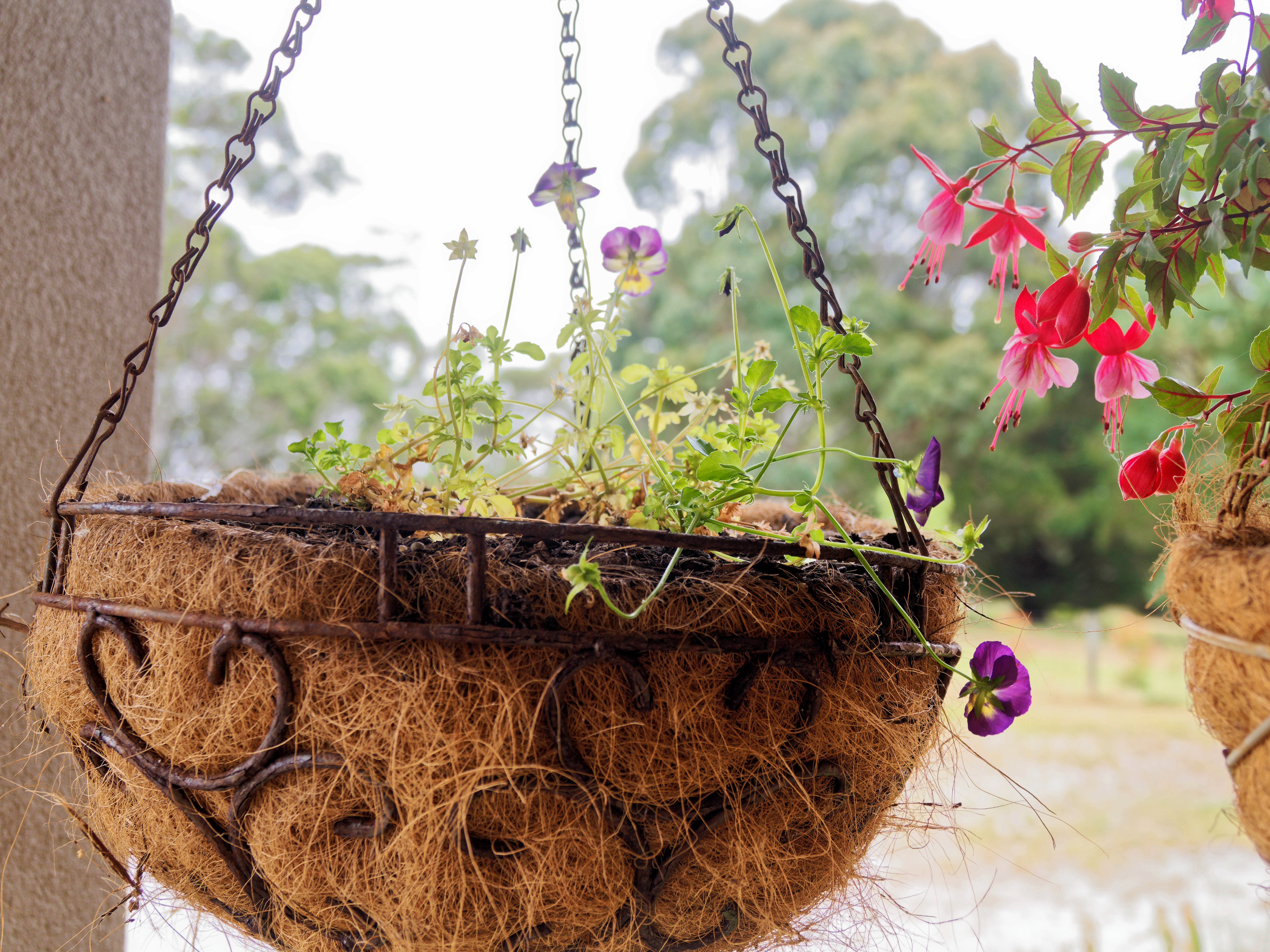
There's not much to report. The cold spring is over, and I fear that we haven't watered
enough. Last month's flowering roses are but a memory. Here last month, then today:
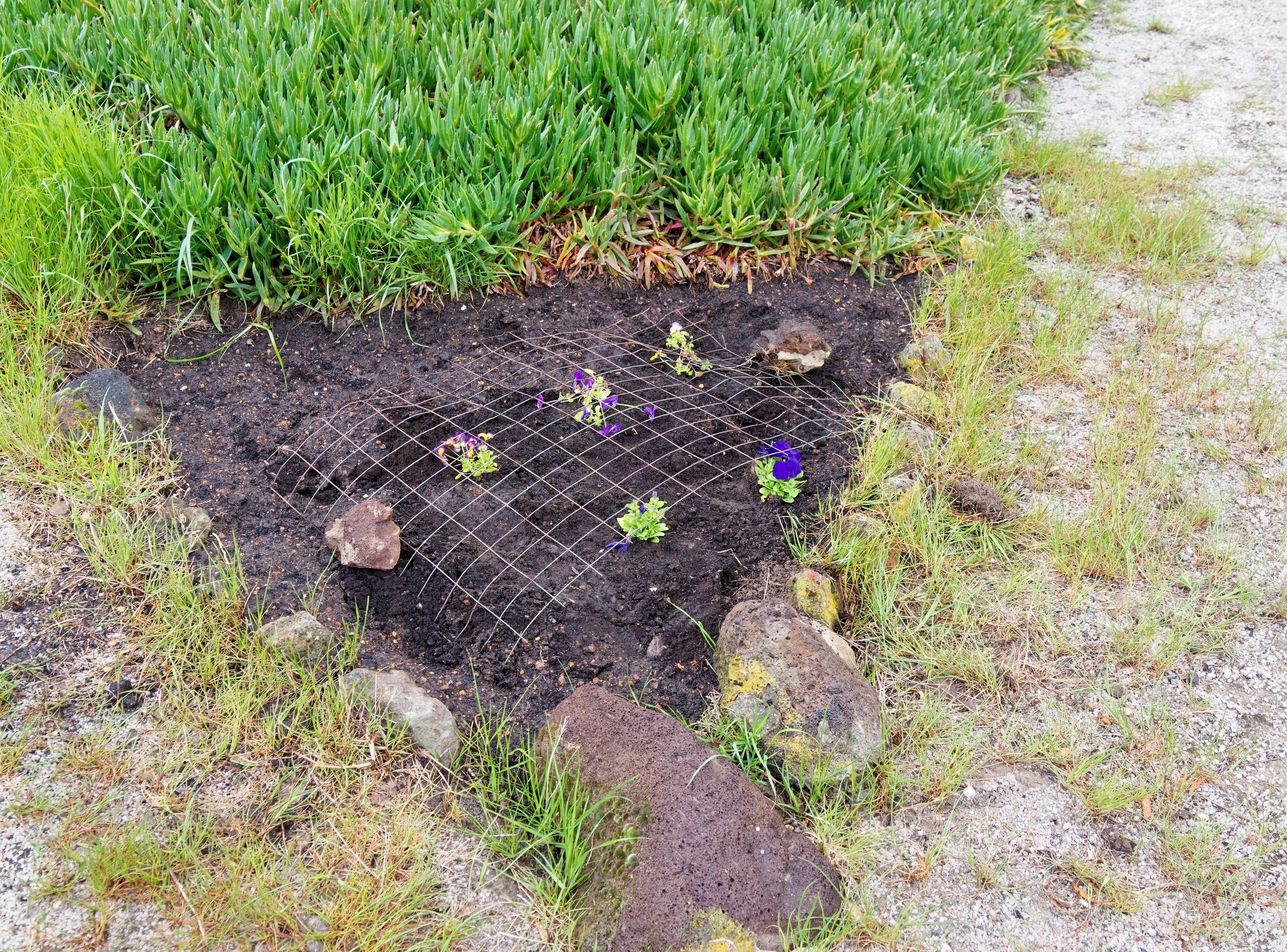
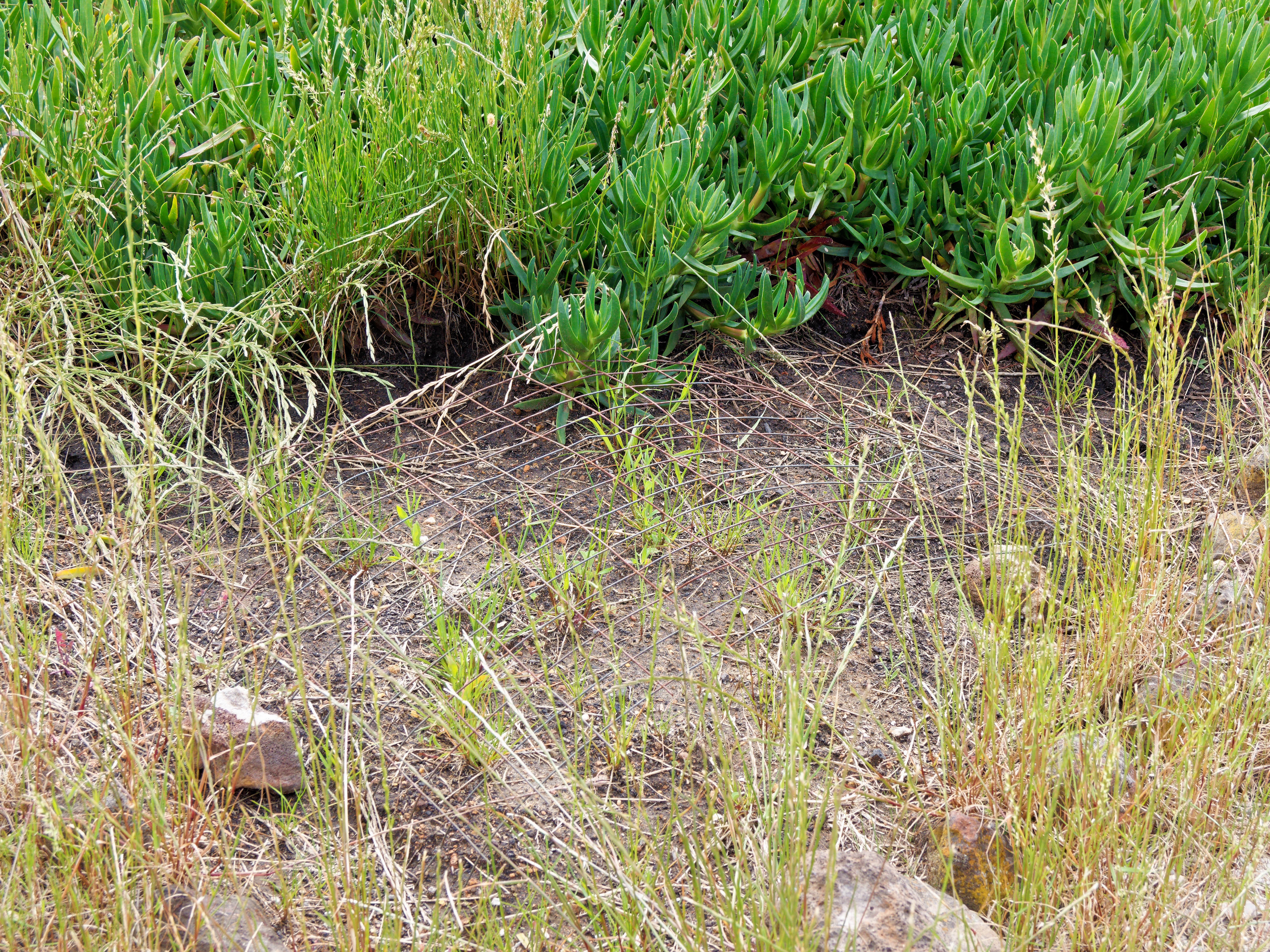
But there's little to be seen of the petunias and violas that I planted in the spring. At least a couple of violas survived. Here in early October (first image) and now:
One of the success stories recently was Josy, Yvonne's new
standardbred mare. Almost
daily she told me of new success stories. And suddenly today she wanted to get rid of her!
She's bossy, breaks through fences, and probably more. I'm amazed. She spoke with Chris
Bahlo, whom I saw today for the first time in months, and it looks like there will be
another swap some time in the not-too-distant future. She has only been here for a month.
My first real camera was a Voß Diaxette, with a 45
mm f/2.8 fixed Steinheil Cassar lens and a Pronto shutter. More out of nostalgia than
anything I bought one on 25 June 2022:
I still have a search on eBay, and today
another one cropped up. It looks pretty much the same except for a groove on the film
advance knob. And the serial number is 806057, mildly interesting: I've already established
that two cameras I knew had almost the same serial number (900139 and 900142). Could this
one be older and an indication that the first two digits were some kind of version number?
Another disconnect overnight (well, yesterday afternoon, but I didnt find out until
this morning) from fra.lemis.com
=== root@fra (/dev/pts/0) /var/log/www 32 -> Read from remote host fra.lemis.com: Connection reset by peer Connection to fra.lemis.com closed.
client_loop: send disconnect: Broken pipe
Disconnected at Mon 22 Dec 2025 16:10:16 AEDT
...
Disconnected at Mon 22 Dec 2025 16:22:16 AEDT
Last login: Mon Dec 22 05:22:24 2025 from 121-200-11-253.79c80b.mel.nbn.aussiebb.net
FreeBSD 14.2-RELEASE-p1 GENERIC
That's round 5:10 UTC. There was
nothing obvious in the system logs, and the system was running normally when I looked. Was
this maybe a real network issue out to annoy me?
A while back I compaioned about how pedas (“hot”) the Tean's Gourmet mi udang was, but gradually it's not so
bad. Is that because they changed the composition, or because I'm getting used to it?
Today I tried one of my “instant” dishes that I bought last week, “Buldak Ramen”, from South Korea:
And indeed it was verypedas, much more than the mi udang or anything similar.
It's also quite a quantity: 500 ml of liquid, and quite a consistent pack of “ramen”, to be cooked in the sauce for 6
minutes:
So: I'm still susceptible to chili, and I think that Tean's must really have changed their
mi udang. And no, 불닭 isn't a corruption of “bulldog”, though the Korean accent could
suggest it: it means “fire chicken”.
Eating the buldak drew tears to
my eyes—I thought. So Yvonne took photos with my camera,
without noticing that it was set to manual mode (1/250 s, f/11 (EV 14.9, appropriate for bright
sunshine)). We caught it in time, where I discovered a better exposure: 1/60 s, f/4,
500/28° ISO. EV 9.9 and 1.3 EV higher ISO, so the first image was underexposed by 5.7 EV.
Not surprisingly, the view on the camera monitor was pitch black. But to my surprise, the
result from postprocessing was quite recognizable:
I took a photo of Kerrie Raleigh and members of her family last week. How about a print? I've been through that before. It was a pain, but once I understood that they could neither accept normal
sized photos nor report their problems correctly, I got things done.
Try again today. First: they had forgotten my customer information, with the interesting
side effect that they offered me 40 free 6"×4" prints when I signed up again with
the same credentials. And yes, the image is still too big: 3.1 MB, 4296x2864 pixels. At
the 8"×12" that's only 358 dpi. It started to load, then the bar jumped back, tried again and stopped.
Reduce in size to 2.3 MB and 3437x2291 and it uploaded. Why do they still have such
low limits, especially since they offer much larger image sizes, at least to
12"×18", where the resolution would only be 239 dpi, barely more than a
high-resolution fax? And why can't they report “errors” correctly?
But that was all. I couldn't find any way to save the image! So I was stuck dead in
the water. I didn't note running into this last time, and the AI bots I asked told me to
just press the SAVE button or look for the three dots (which, of course, weren't
there). Sent off a message to their “help” system—the only way to contact them—and didn't
get a reply.
Why do they do this? It's certainly not in their interest.
Another monitor dropout like the one on Saturday. The same two monitors, both for a second or two. But this time I noted
that one (the LG) came back before the other (the old Acer). So maybe it is a grid
problem. I should investigate getting a surge monitor.
Christmas is with us again. You'd have to look at the calendar to tell. Somehow there's
nothing Christmassy about it at all, not even the eternal Christmas music played on the
radio in Advent. About the only
difference was that Yvonne bought a pre-prepared “Salmon
Wellington” (without mushrooms) during her weekly shopping: just bake and eat.
As planned yesterday, off to look for power quality monitors on eBay. I was amazed. Apart from things like power
consumption devices to plug into a power point, there was nothing under $500! Why? It's
possible that other search terms might help, but I'm discouraged. Now if I could decode the
status from the PV inverter, I might get it for free.
Those are 7 noodles stuck together at bottom left.
It was edible, not more, potentially less of an issue than Tuesday's buldak or the Maggi instant mee. But not as interesting as the ones I make myself, and at the end
I was still hungry.
Why do I buy these things? I want to see if there are other flavours that I haven't thought
of. That's certainly the case with the buldak. But of course the intention is to make it
easy. How much easier is it really? There are basically 4 components to something like
this:
The noodles themselves, of course. There's no advantage here at all. They need
boiling, and I can do that just as easily with my basket noodles. But I also cook
large quantities of noodles and freeze them, thawing out one at a time. Arguably that's
easier than cooking the “instant” noodles.
The meat (dare I say “protein”?). Completely missing in the “instant” version! So I
need to do what I would have done anyway and find something to put in.
Vegetables. Some “instant” noodles have a nod to vegetables, but they're pitifully few,
and of course dried. This is about the only place where they may have an advantage.
Flavouring. This is the reason that I bought these things, but so far there's not very
much difference. Arguably it's easier than mixing real flavouring. It's just a pity
that the flavouring is so uninteresting.
So I'll finish these packages, sometimes with significant modifications, and that will be
that.
In passing, did some web research. This question on Google Search interested me: “Is mie
goreng unhealthy?”. The answer?
AI Overview
Yes, Mi Goreng (Indomie) is generally considered unhealthy due to being high in sodium,
unhealthy fats (palm oil), refined carbs, and low in nutrients, but occasional consumption
is unlikely to harm you; frequent intake is linked to higher risks of metabolic syndrome,
high blood pressure, and poor diet quality, ...
High Sodium:
A single packet can contain a significant portion, or even exceed, the daily recommended
sodium intake, impacting blood pressure.
Oh. Not what I expected. But it pointed at Quora's completely useless “Assistant” question
answerer, about which I have complained in the past. And it seems that the Google answer
took the Quora answer almost unchanged—it just removed most references to “Indomie” from the
answer and claimed that it was a general answer.
That's not uninteresting, though. By coincidence, this wasIndomie (really Indofood), so it's interesting to read on,
even though the answer is generally completely misleading.
Is it correct? No: it says that the dish is tasty. It's boring. And the sodium content?
833 mg, as printed on the packet. What's a normal intake? According to Google Gemini, between 1500 and 2300 mg per day. So it's Just
Plain Wrong to say that it's a lot of sodium. Out of interest I checked: normal soya sauce
contains about 1 g of sodium per 15 ml serve, so if anything the noodles contain less.
But that's not all. One of the issues is that I don't have a dish that I call Mi goreng. Nasi Goreng yes. So what does The Web
have to say? It's an Indian dish! And sure enough, the only references I can find at home
are to mee goreng mamak. But the
recipes I found, even claiming to be for mee goreng mamak, omitted ingredients that I
consider essential, such as karuveppillai and potatoes.
And then I found this question: “what are the three sauces in mi goreng?". OK, that's an
interesting claim, though the source has completely disappeared. The answer:
mi Goreng uses all the good sauces, all the really sticky, sweet ones, like tomato sauce,
cacap, manus, dark soy. it's so yummy. and you can make it at home faster than it. would
take your Uber eats driver to get to your house, I promise you.
Cacap? Manus? I don't know either of those, though it reminds me of kecap manis, which would fit. But then
that's a kind of dark soya sauce, the next item mentioned in the list.
You live and learn. Sometimes I wonder if I haven't lived too much.
It's time for our annual newsletter, to be
released on 1 January. And that requires a photos. We've been here for over 10 years, and we've decided that in the newsletters we would repeat the photos
from 10 years ago. Here's the one we want to replicate:
Things haven't changed that much, but somehow it's still an effort. And in nearly all
photos we managed to cut off part of Larissa. We finally agreed on this one.
While preparing for the newsletter photo, felt a sudden, sharp pain near my heart. Cardiac
problems? Not normally my thing, and it went away almost immediately (less than 3 seconds).
Still, we have these high-tech devices. Off to get Yvonne'sKardiaMobile 6L to
check my heart.
I failed. The thing is so unreliable that I just couldn't get a reading. It claimed that
there was machine interference. Why? Why should that happen with Bluetooth? OK, into the dining room,
where there was nothing to interfere. It still didn't want to communicate. Finally into
Yvonne's office, next to her computer, where it worked with
her phone. The result? Nothing unusual beyond a pulse of 84, which I blame on my annoyance
with this stupid device.
Firing up distress.lemis.com this afternoon for photos, I heard a beep that
could have indicated rebooting. OK, these horrible Microsoft machines reboot without
asking. I just need to reinstall rwhod.
But no, it was sleeping and woke up. Why did it beep?
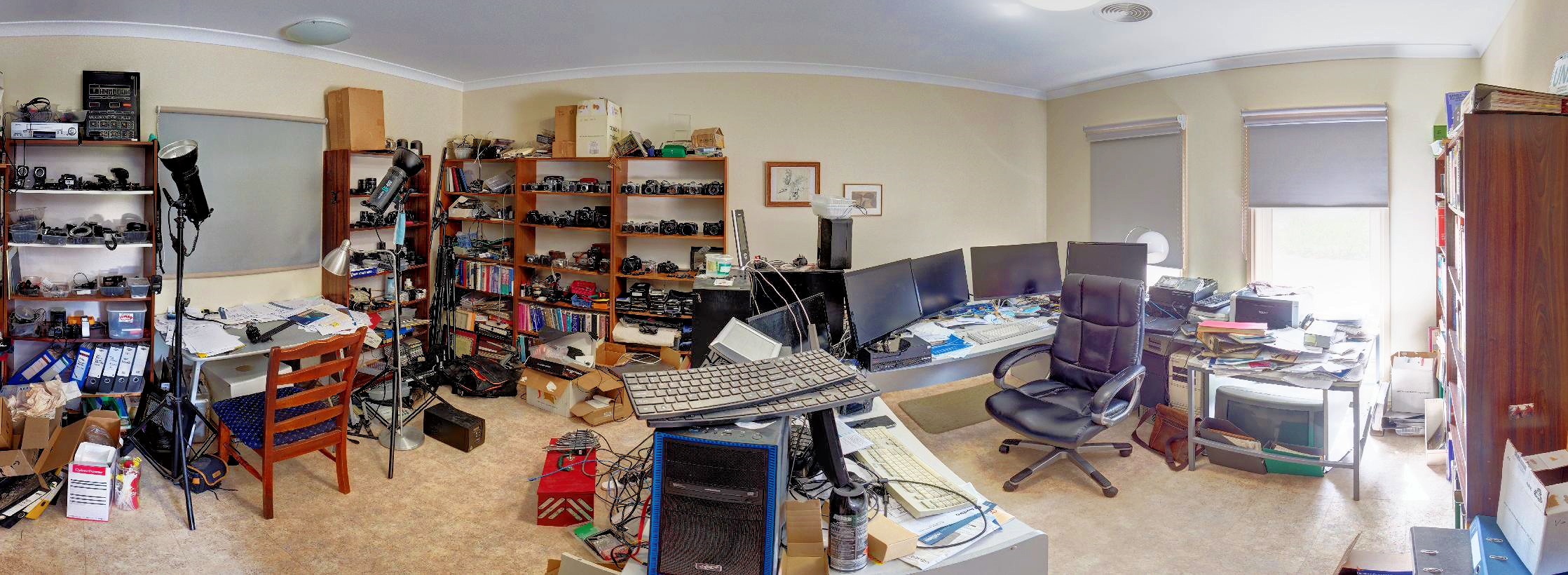
In preparation for our annual newsletter, took a couple of photos comparing the house ten years ago to now. They're depressingly
similar, though it's clear enough that the first of each image pair is ten years old:
In my office, there are even at least three items that haven't moved in ten years: the old
Tandem maintenance panel on top of the cupboard on the left, a file on top of the cupboard
on the right and an old TV under the table in front of the right window.
Bruno has been allowed outside in the
daytime for over a year now, and he definitely enjoys it. But today Yvonne told me that she had seen him approach the road, something that greatly
worries me, since two of our previous (male) cats got run over.
And he didn't come back at a normal time. Out to check if he had been run over or locked in
the shed, but in the meantime Yvonne found him: on top of the cold tin roof in the dog run!
He must have entered from outside. So much for locking him in. I wonder what is so
attractive about the roof. Just the height?
Yana back for Christmas, at least the next few days. She
brought a number of interesting things with her: Matjes, which Google tells me is
unobtainable in Australia, numerous South American peppers, two succulents:
The first is a Hatiora, which I
don't known, but the second is an Epiphyllum oxypetalum, also
known as “Queen of the night”, which I most definitely do know. We had one in Kuala Lumpurover 60 years ago, and
I had been been planning to plant one for some time.
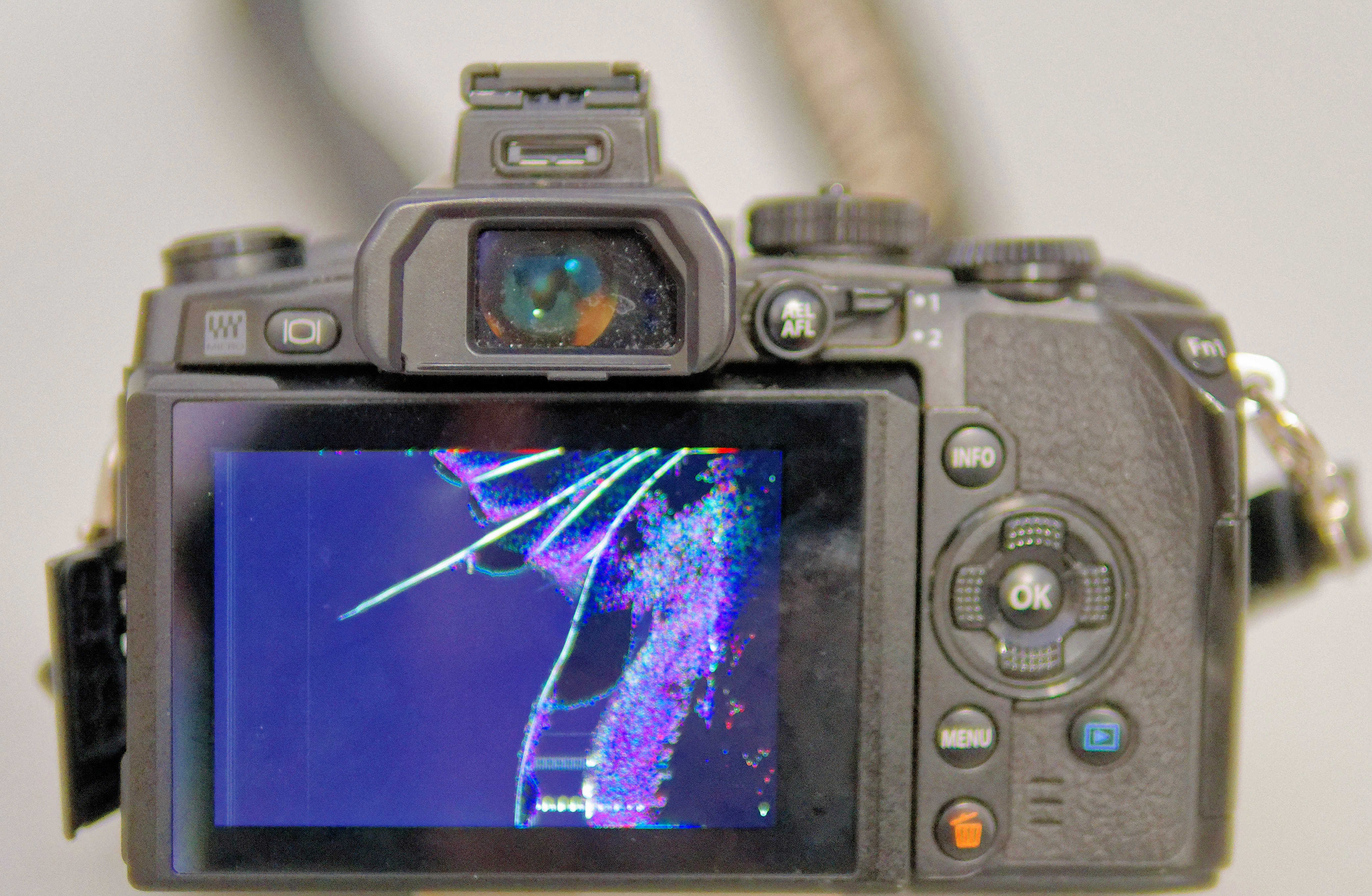
And also her camera, a Olympus OM-D E-M1, slightly the worse for wear:
What happened there? Externally the display is completely undamaged, but it must almost
certainly be a destroyed panel. What can we do? The camera is 12 years old, and a repair
from OM System would probably cost more than it's worth. But it's only the display
(unfortunately meaning that we can't access the menu). It still takes photos, though it's
locked in JPEG mode:
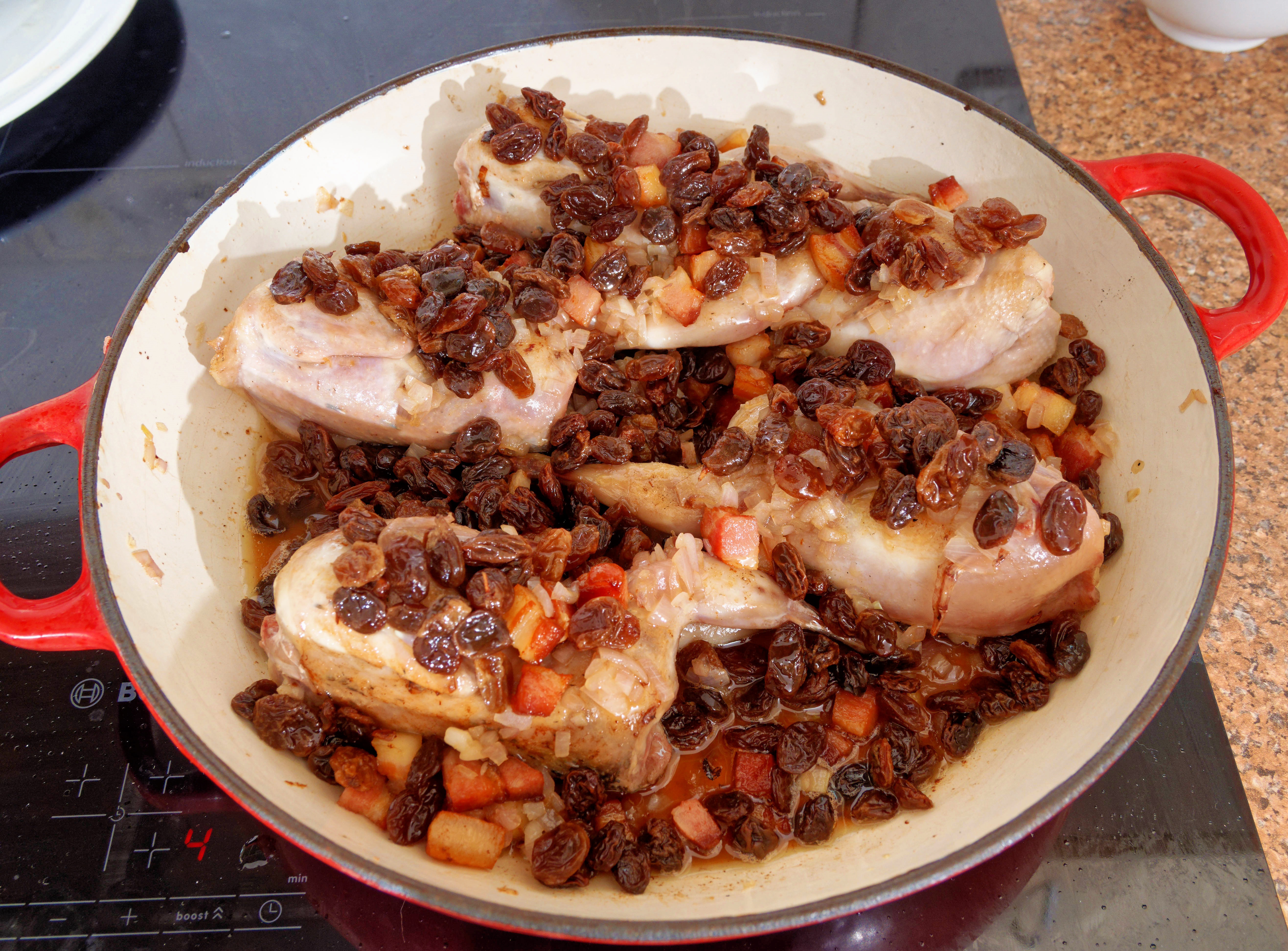
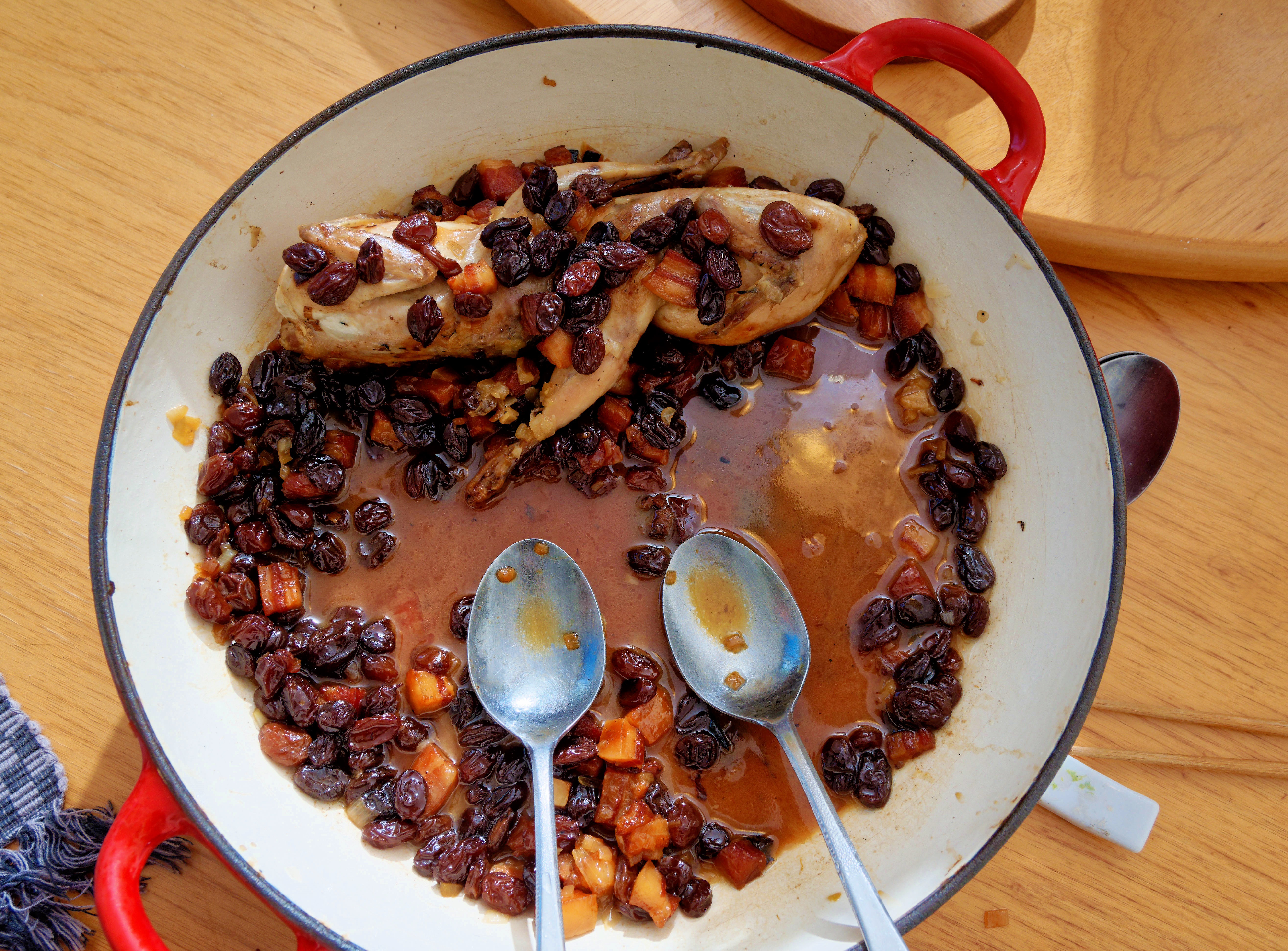
There are three of us, so three hens sounded right. But reading other recipes (all
surprisingly similar), I ended up putting in five birds (two each for Yana and me, one for
Yvonne). And of course they were far too pale:
We were all sated enough not to want any dessert. And of course we now already have
leftovers, although we're just starting with three days of heavy dinners.
So what can we do about Yana's camera? Did a bit of searching
for camera repairers, without coming up with anything spectacular. But what if we don't
need the monitor at all? I tried setting it to display only on the viewfinder, only to
discover that the menu always goes to the monitor. OK, the camera has an HDMI output. What does a cheap HDMI monitor
cost? I paid $225 for my Feelworld FW760 monitor, probably less than the repair would cost. But that's a
7" monitor. There are smaller.
Try it out. Oh. No output. First you need to select HDMI ouput in ... the menu. Classic
chicken and egg problem. It wasn't until later that I read that the camera restricts what you can do with the monitor connected:
You cannot shoot pictures or movies when the HDMI cable is connected.
Still, one failed experimant. But there was more to come: when I pulled out the cable, not
all of it came. Here the camera before and after:
Twelve years ago I bought a Meike MK-300 flash unit. It wasn't spectacular, but it understands Olympus flash
communication. And some time in the last 10 years it stopped working, though I suspected
the camera: it did work on Yvonne'sOlympus OM-D E-M5 Mark III. And how about Yana's camera? It works!
Reading recipes, came across this silly “pinch” measurement, usually the amount of
saffron that somebody wants in a
paella. I know how much saffron
we need: between 1 and 2 g. I suspected much less, but now we have Google Gemini. What does it tell me?
In the culinary world, a "pinch" is both a physical technique and a technical
measurement. While it’s often used informally to mean "just a tiny bit," there is a
standard conversion used by chefs and manufacturers of specialized measuring spoons.
It goes on to say that it's about 1/16 teaspoon, another nebulous quantity. But I
discovered that we have seen this before, as it happened a year ago today, and performed our own (fingertip)
measurements: between 120 and 180 mg, depending on who you are and how generous you are. A
far cry from the 1.4 g that I used on that occasion.
Christmas dinner, four calling birds
Topic: food and drink, general, technology, opinion
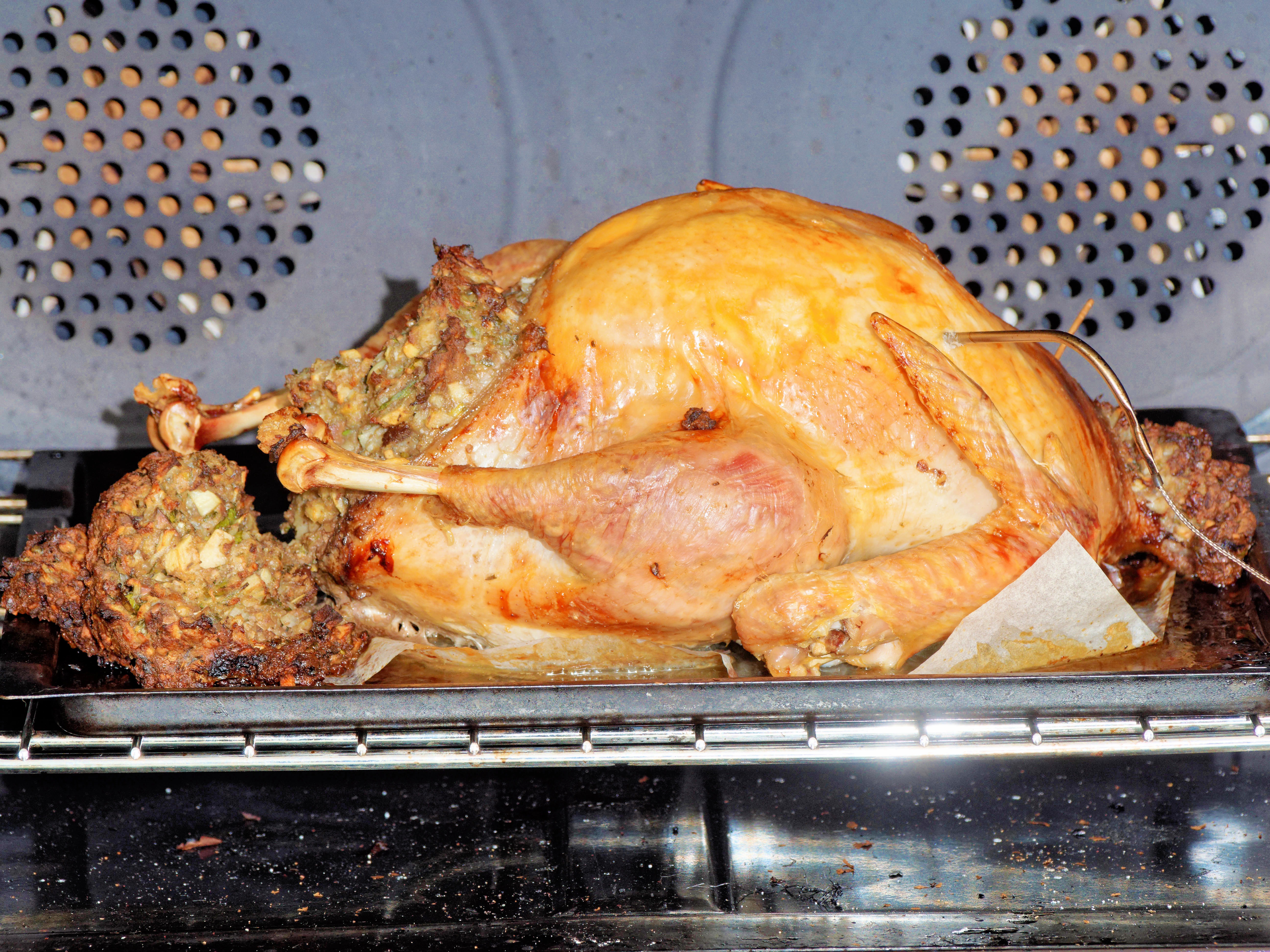
Today was the “real” Christmas dinner, with stuffed turkey, and we had invited Pene Kirk,
making four of us. I had forgotten how much work it is, and spent most of the afternoon
making a too-voluminous stuffing.
And then, after the bird had been in the oven for about an hour, Yvonne got a whole lot of strange noises on her phone, something like an inverted
signature tune for Beethoven 5. No other indication of what it was. In the end I attempted the Microsoft solution and
rebooted the phone. After that, no more noises.
But that was a coincidence. It seems that it was Pene on Facebook, trying to contact Yvonne. She
had had a dog requiring an emergency operation and had to come late!
Fortunately it wasn't that bad; she arrived only a little over 30 minutes late, and for some
reason (probably the electronics of the meat thermostat, which reported that last 10°
increase within seconds) the turkey was also late. And at least the turkey was nicely
browned this time, though it's clear that there was too much stuffing.
At dinner it eventuated that Pene and Yana (who hadn't previously met) got on very well
indeed, leaving Yvonne and me to listen while they discussed such things as autism and
extinctions and cannibalism in precolumbian America.
Autism is the big noise in health
care circles. But what is it? Recently there have been articles establishing four distinct
forms of autism, but I don't understand the articles: to me it looks like different
extremes.
During dinner, both Yana and Pene decided that they were autistic, but nothing like as much
as I was. Apparently I am a prototypical autist, like Sheldon Cooper from The Big Bang Theory. That
doesn't worry me, but is it correct? Yes, I'm not very sociable, but what else is there?
Obsessive-compulsive disorder? Hardly. And autism is something that I had always
associated with youth, which clearly excludes me. I wonder how the definition will change
in the next few decades. And looking at myself, where does this word “disorder” come from?
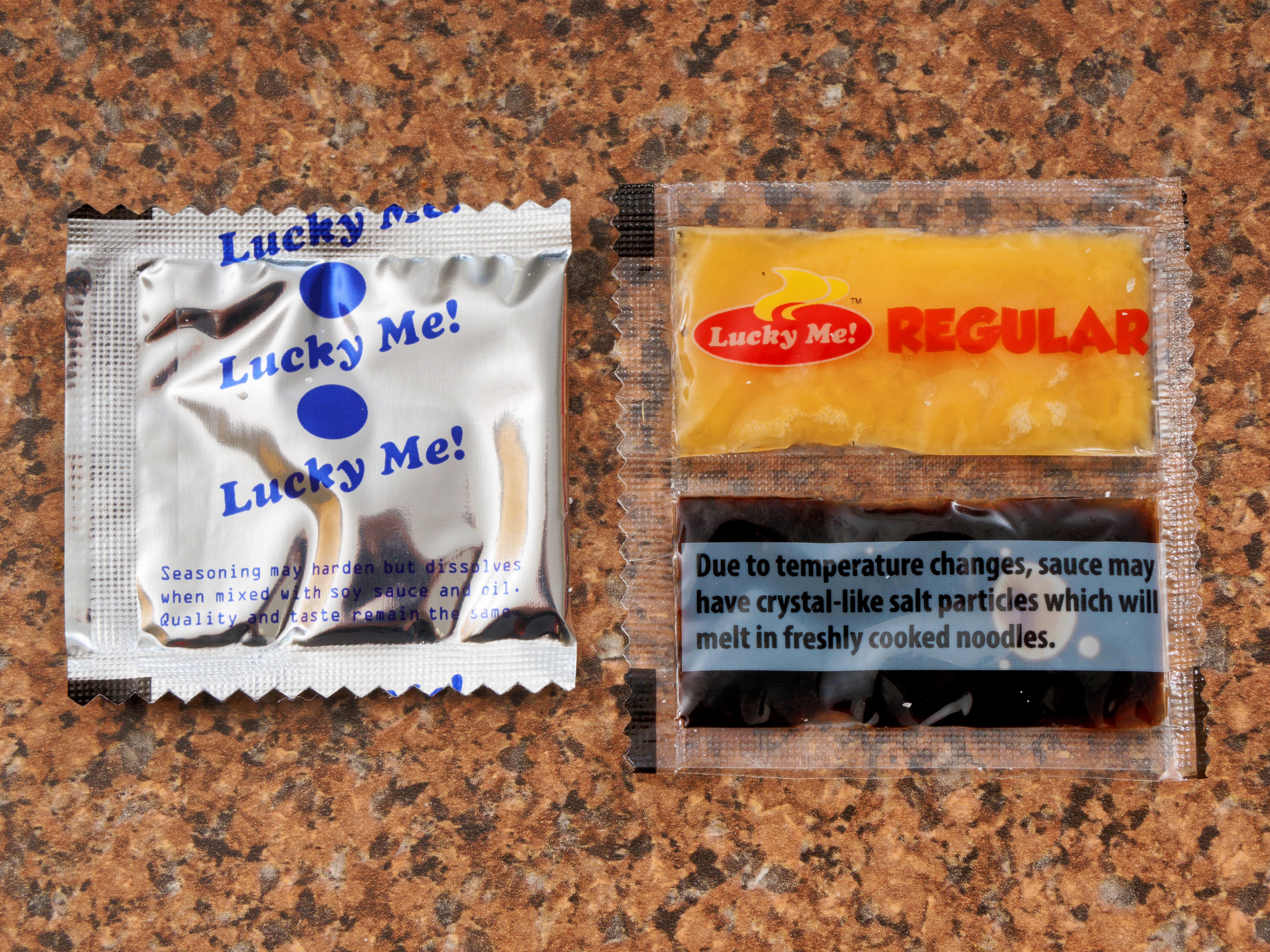
What is it? I had guessed from the name that it was Malay or Indonesian (“Panchit”), but it
proves to be Pilipino (“Pansit”), branded “LuckyMe”, and
strangely made in Thailand.
After my experience with Indomie, I did a bit of
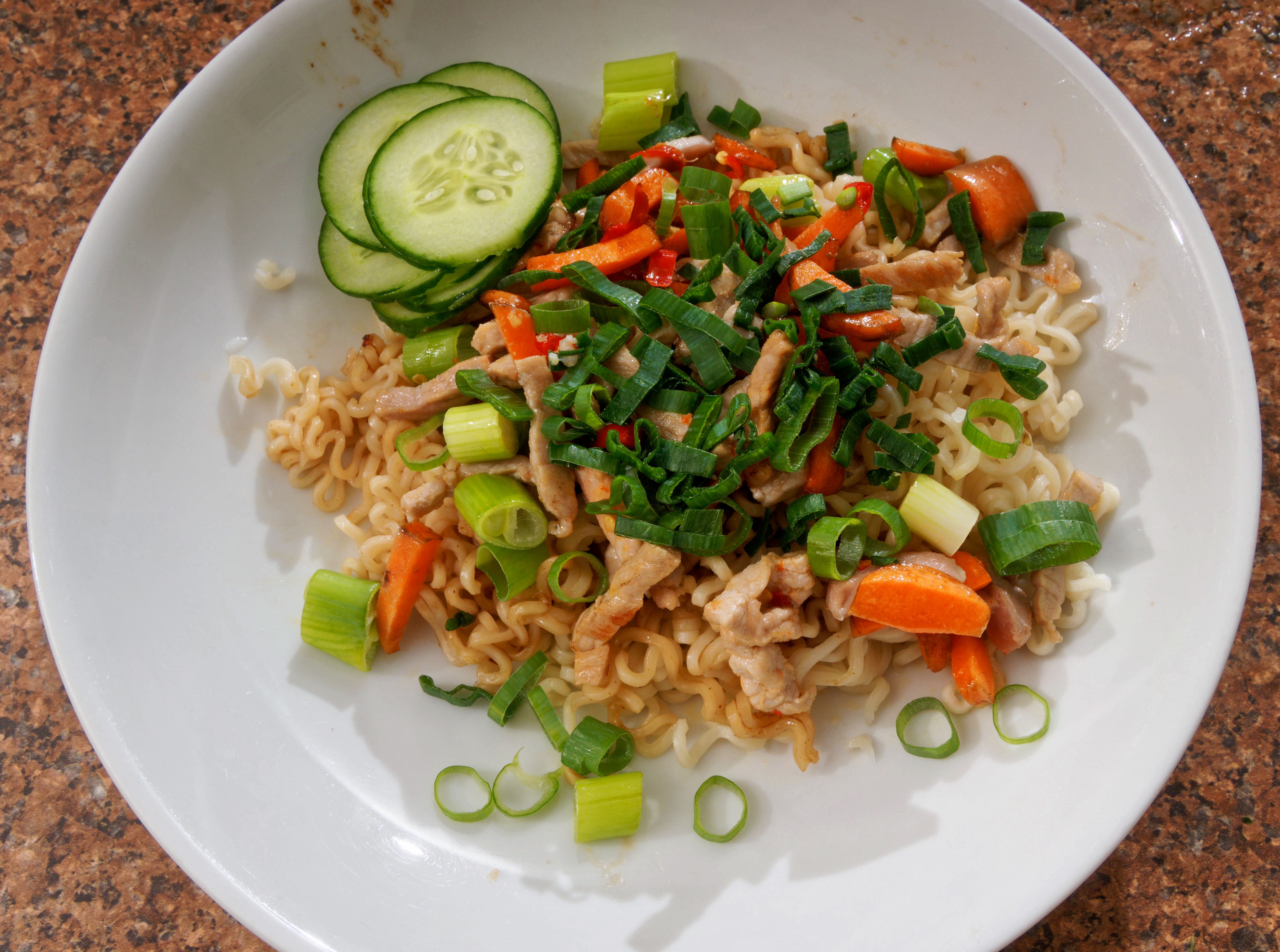
following up on the web. and put in some pork and (surprisingly, but recommended) carrot.
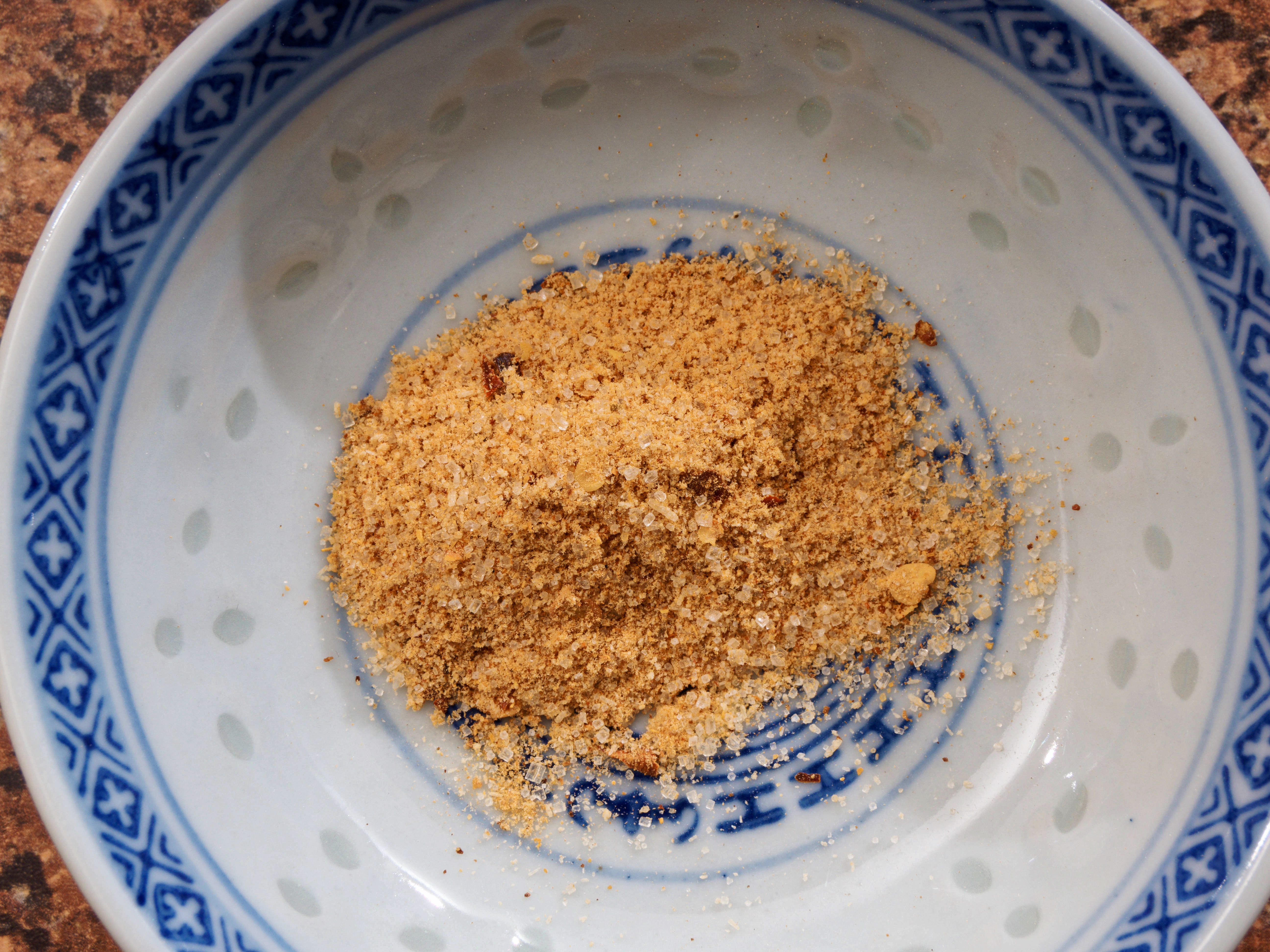
So what's in the pack? You could be forgiven for thinking that it's the same thing. Here
Indomie on the left and LuckyMe on the right:
For the first time, I weighed the noodles before cooking: 63 g, pretty much normal. Not
surprisingly, the instructions were almost interchangeable. The biggest difference was
probably that the noodles didn't stick together as much. And with the carrot, things didn't
taste too bad:
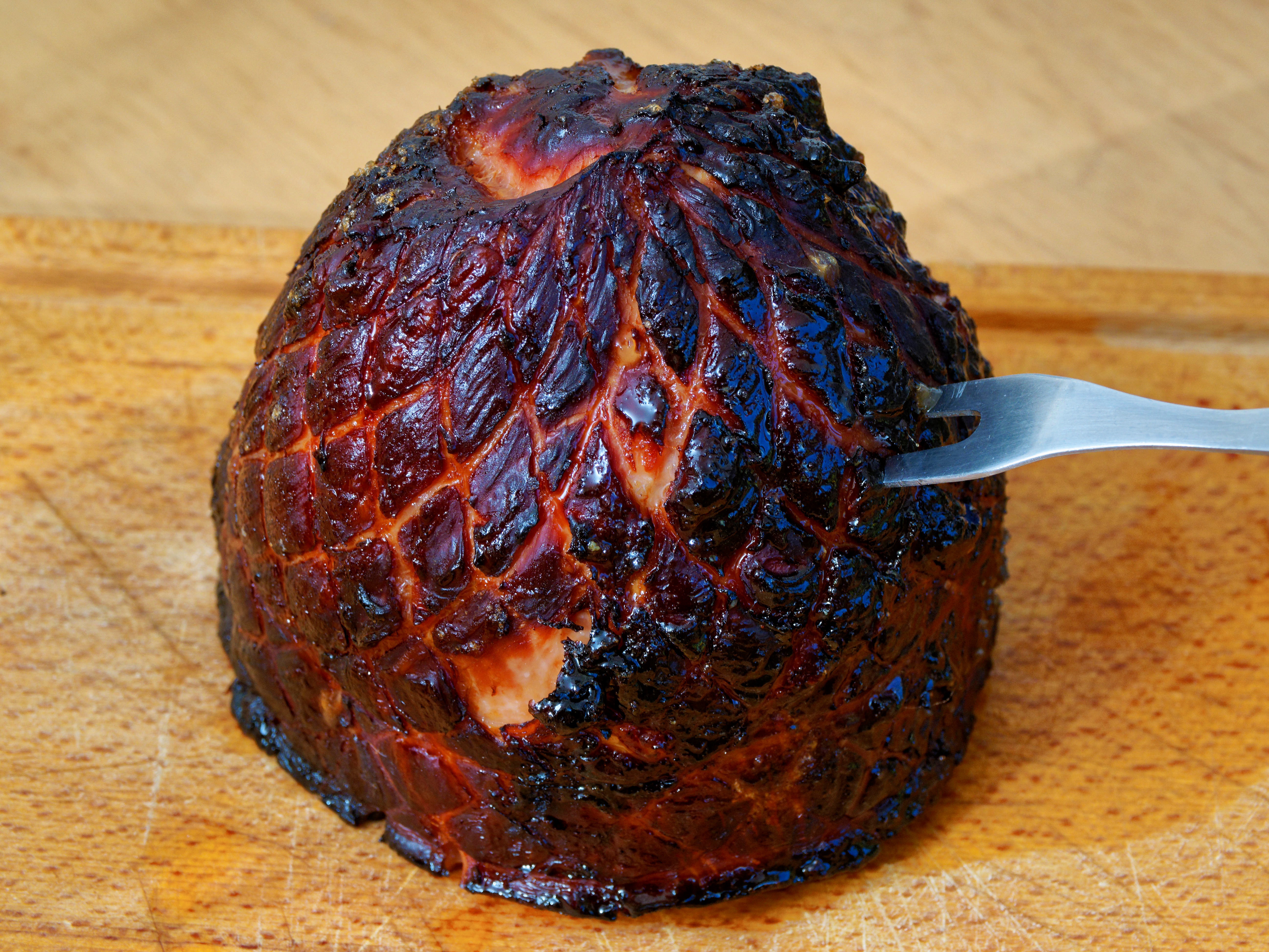
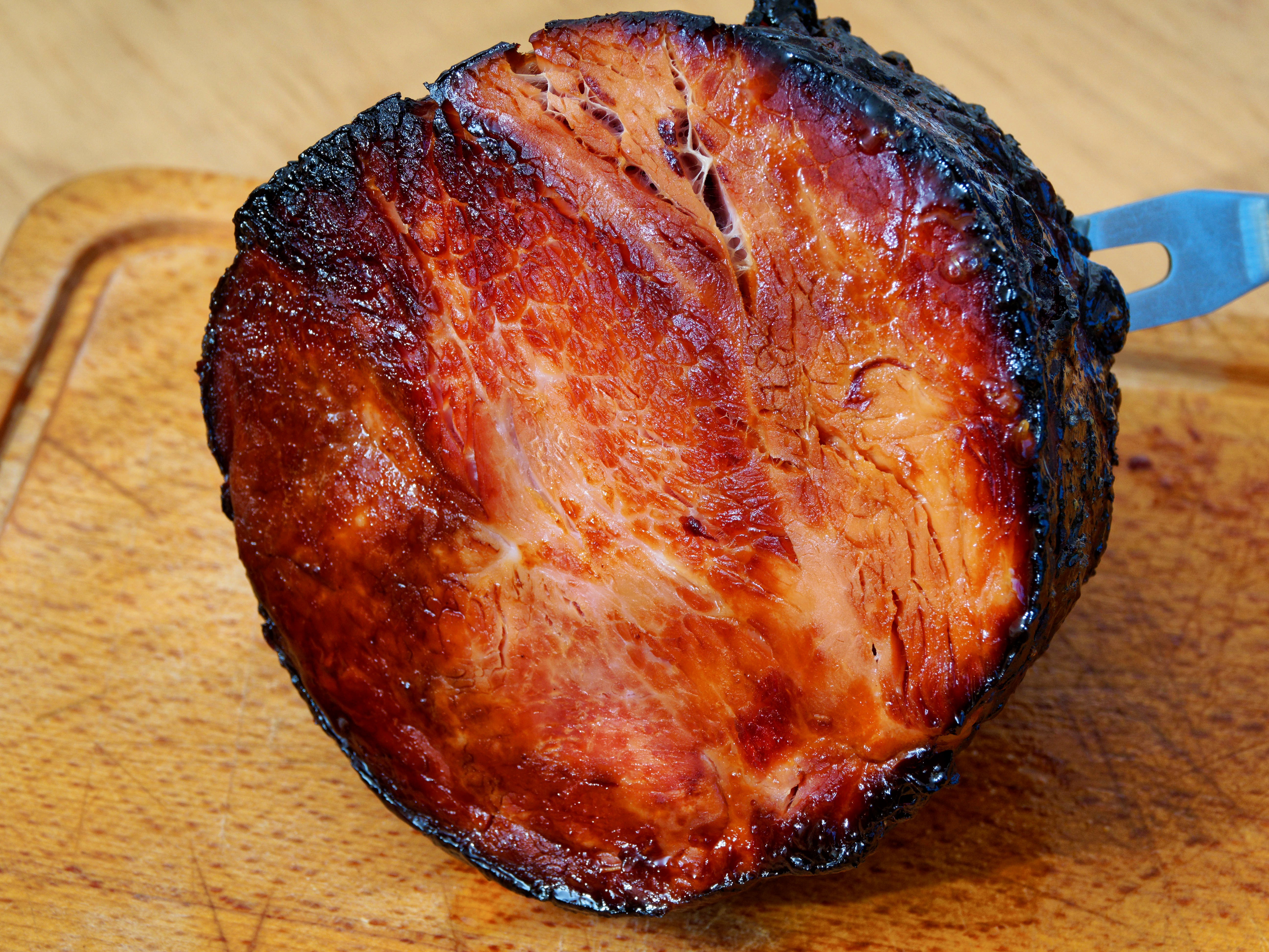
As planned, set to to cook the ham that we had bought for this purpose some time
ago. The way to do that is to glaze it, and I found numerous recipes, some almost
complete, which boiled down to: take equal quantities of brown sugar, maple syrup and honey,
along with a lump of Dijon mustard. Dissolve the sugar in the mixture (how?), cook the ham
at somewhere between 170° and 190°, and paste over the ham at regular intervals.
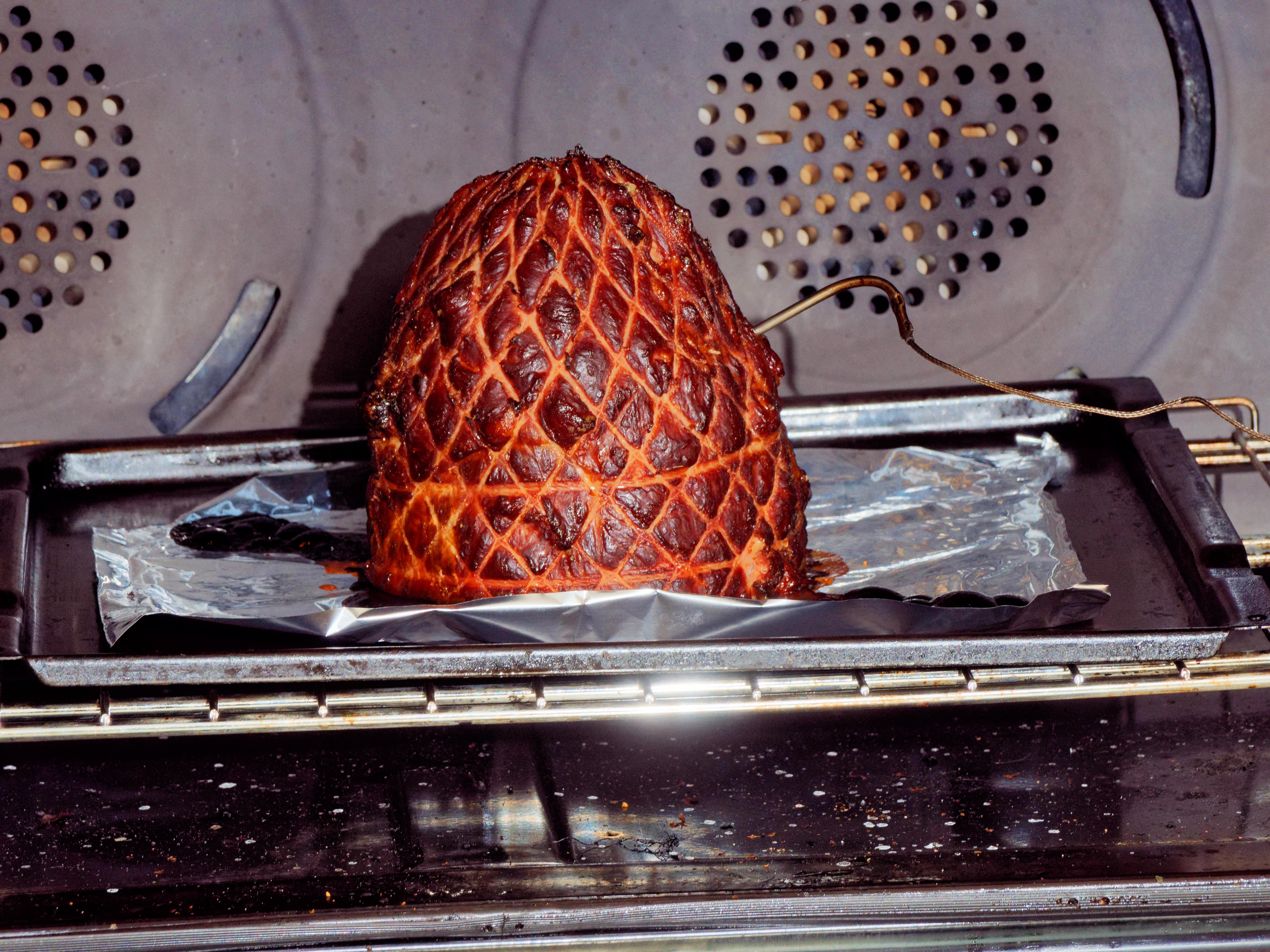
OK, makes sense. I chose an oven temperature of 170°. But the reality looked very
different. After 50 minutes I had:
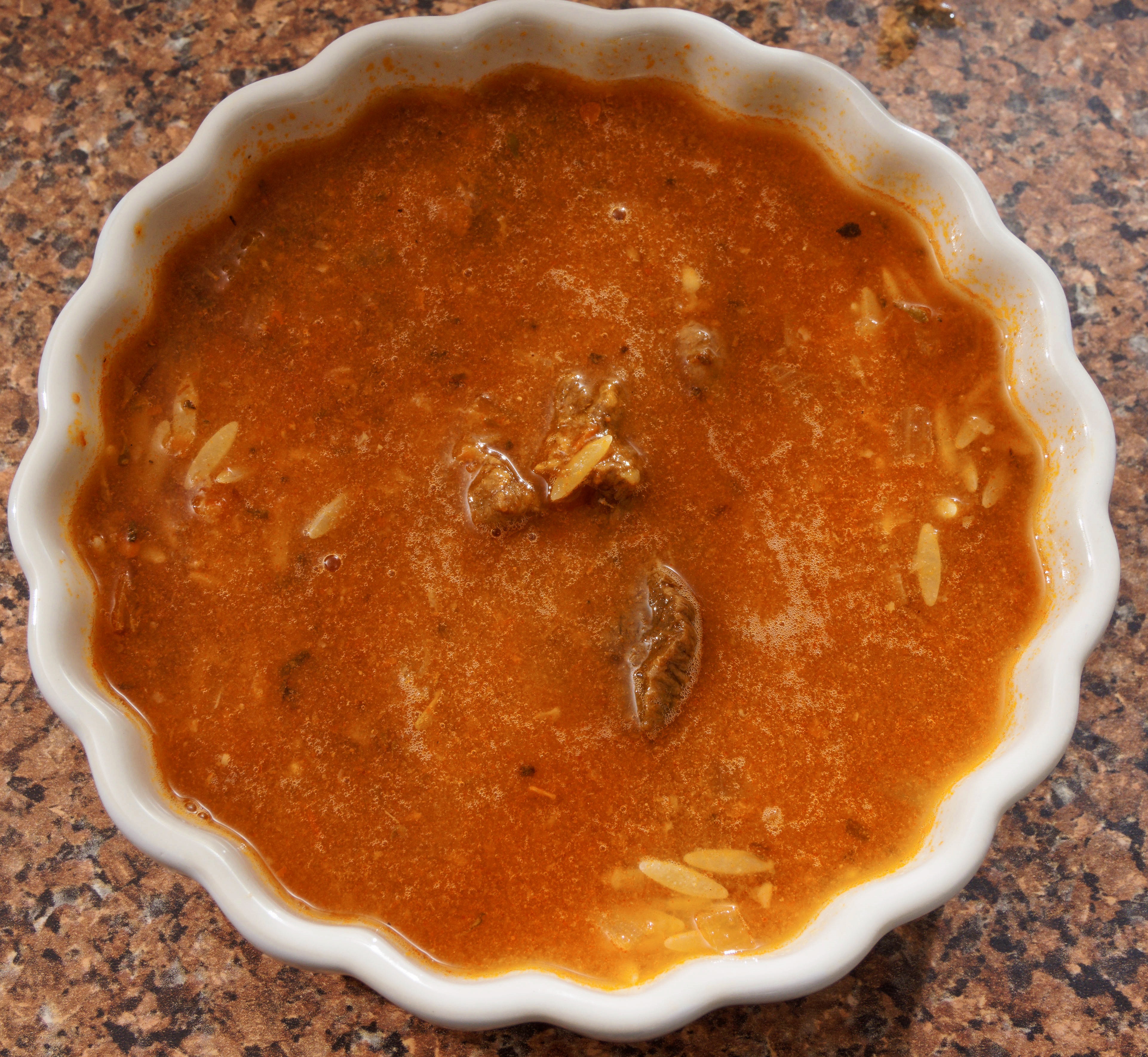
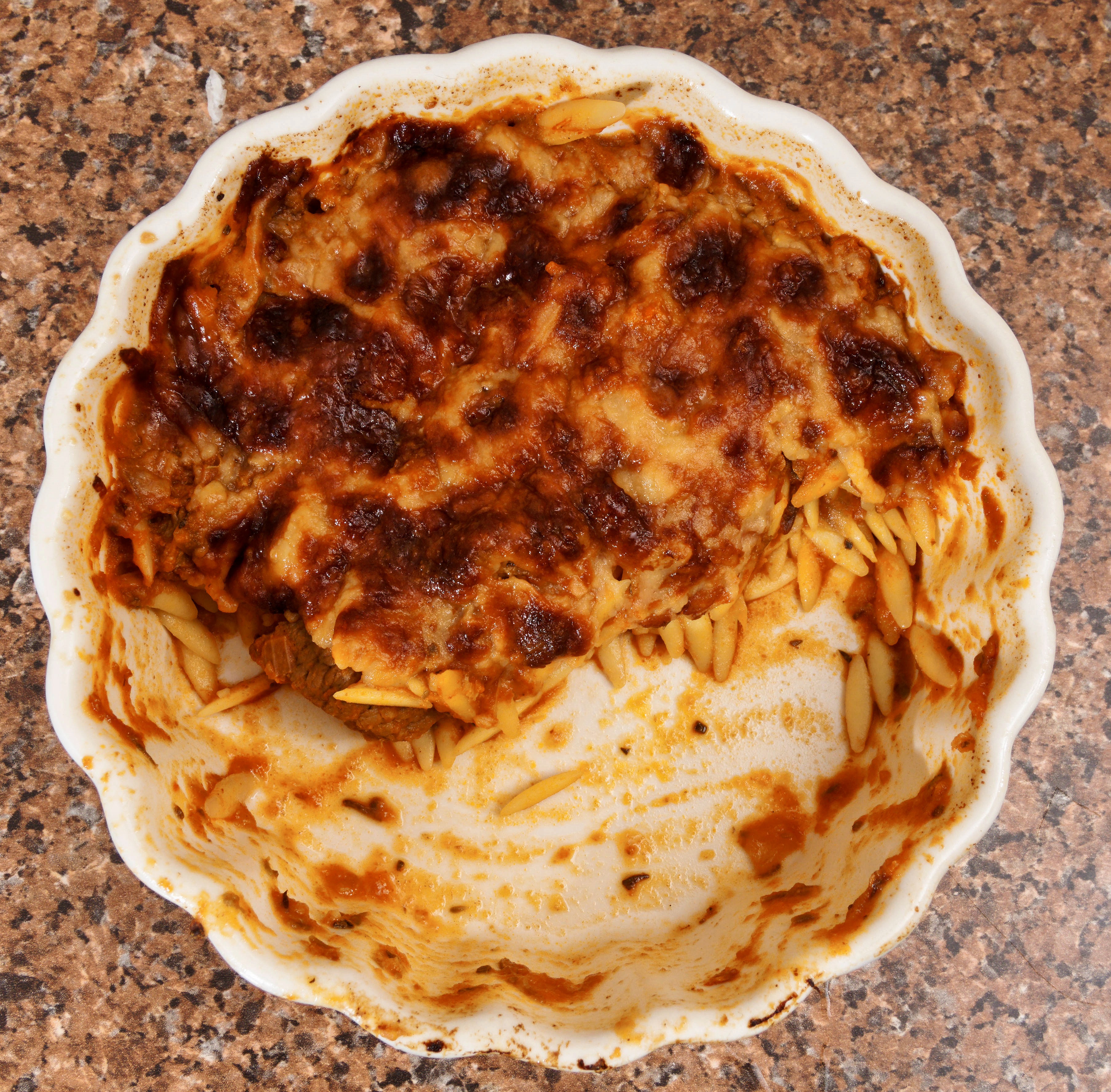
And that with a meat temperature round 22°! The temperature rose so slowly that after my
doubts about the meat thermometer yesterday, I got a second probe, which did show the same
temperature. Under the circumstances, further basting seemed inappropriate. Reading the
instructions on the packaging showed that the meat was already cooked, so it really only
needed to be warm enough to eat. Finally I took it out at 60° meat temperature:
And carving? Another surprise: I could hardly cut through the skin! And the meat was dryer
than I would have liked, though still eminently eatable. Somehow this recipe doesn't match
what I bought.
Chris Bahlo came around to help us eat the ham. For the first time she
noticed fwaggle, the Apple iMac that Jamie Fraser gave me nearly 5 years ago. It really has been a long time since she was a regular guest.
Yana wanted to visit Ballarat today. But she doesn't know her
way around. In the end off with her to show here just a little of the more interesting
things.
First stop was in Sebastopol, since it was on the way. I've already been to IG Store a couple of times, but since then
another shop, Tropical Mart, has cropped up only 125 m away:
It's predominantly Sri
Lankan, which is directly in competition with IG Store. Can they both survive? Took
a look round, and Yana helped his bottom line by buying a coffee. Then on to IG Store,
which I had just wanted to show to Yana, but where I once again bought a number of items.
Yana found a larger variety of last week'sBuldak Ramen;
I was almost tempted to buy a different version, but that way madness lies.
On down Main Road, which is far from the centre of Ballarat, past the Eureka Centre, which I didn't
reacognize, and wanted to go the what's left of the Ballarat Art Gallery, which is
undergoing repairs. They have a small exhibition at the Backspace
Gallery, 43 Mair St. OK, Google, take me to 43 Mair St. “Taking you to 43 Meyer
Street Melbourne”. I tried various alternatives, including spelling out M-a-i-r, but I
couldn't get it to give me directions. A good thing that I knew where Mair Street is,
though to my surprise the house numbers decrease from east to west.
That wasn't the only problem I had with Google Maps. Later I tried to find a
way home, but it wouldn't start the navigation. Rebooted the phone. Still no way to start.
After something like 10 minutes I found out why: somehow it had got itself stuck in a
submenu that even survived rebooting, and to start the navigation I had to press “Cancel”
(×). What a violation of POLA! And what a
success it was in recommending Google Maps to Yana, who is a Google sceptic!
A bit of walking round the historic non-centre of Ballarat, round Lydiard Street and Sturt
Street. I really saw things I hadn't noticed before:
Then on to the Botanical Gardens, where about the only thing that has changed is the price of the
plant pots, now $10 instead of $5. They had a surprising number of Fuchsias on display:
Yana tells me that the trees in Mount Lofty are older, but I'm not convinced. Did anything on Mount Lofty even exist
when these trees were planted? I was guessing betwen 1855 and 1865.
Yana was interested in the sculptures, of course. A couple included what were intended to
lions, clearly done by somebody who didn't know too well what a lion looks like. The teeth
on this one were particularly amusing:
Today was the first time I had to try out my new steering wheel mobile phone holder. Not an
unmitigated success: first, the clamp at bottom kept falling off, and of course turning the
steering wheel turns the phone, which keeps trying to reorient. But the real issue is that
it doesn't do what I want. Previously I had the phone mounted in front of speedometer and
tachometer, which it partially obscured. But now it does a better job of obscuring
them:
Also, mounting and unmounting the phone is difficult enough that I left it there on a couple
of occasions. Not conducive to my availability. A good thing nobody makes phone calls any
more.
On the way home, down Grassy Gully Road, I was stopped by the police. You have to know in
Australia: instead of going in front and displaying a “HALT” sign, like they do in Germany,
they drive up behind you flashing their lights. Why? It would be easy to think that they
are trying to get past, but can't make it.
So: caught “speeding”? No, they wanted to
know why my car (blue metallic) isn't black. And for that, of course, I had to pass a
Breathalyzer test.
VicRoads have once again messed
up and stored in the data about my car that it is black. I had noticed that and marvelled,
but this is the first time in 12 years that I (or Yvonne)
have been stopped for it. They accepted that it was my car, and said that I should go to
present the car to VicRoads. Why? It's their fault. I wonder if I can find a document
proving that it was blue since it was manufactured.
But did they really stop me because of that? As it happened, I had seen the police car
parked in a driveway to the main road about 500 m from the turnoff to Grassy Gully Road.
Just before turning off across traffic, a car came in the other direction, something of a
blind spot (in fact, I mentioned it to Yana), causing me to
brake more forcibly than I might have done. So did the police think that I had seen them
and suddenly decided to leave the main road? I don't know when I turned on the indicator,
but it must have been long before braking for the oncoming traffic. But the first question
(presumably fairly common) was “Is this your car? Where do you live?", though they had my
driver license showing that I live at the end of the road, and if they had checked for the
colour, they would know the registration details. But surely they would have taken a little
while to get them, including the colour, so that can't have been their initial reason. I
suggested that maybe things were a little quiet at this time of year, and got a reaction
from one of them that suggested that I could be right.
We were watching some videos, but we didn't finish a series. Yana wanted the rest. OK, do you have enough storage (round 10 GB)? Yes, on the SD card in her camera, formatted with
FAT32. Her laptop runs Microsoft,
so that seems reasonable. Put in a card reader, put in distress, my Microsoft box.
Nothing! I had expected it to show up as “drive” D:, but there was nothing like
that. What do I do now? Ah, I can access these cards from a Real Computer. Put
into hydra and start copying with mcopy. Noise from the source disk
suggesting that something was transferring, but mdir showed no files and no more
space used.
Is that telling the truth? I wouldn't be surprised if it were lying and would suddenly come
up with a complete 3 GB file, but I didn't have time to wait: Yana is leaving tomorrow
morning, and who knows how long it would take to copy the files?
Dammit, real file system semantics are different. Mount normally on /mnt (the type
isn't fat32, it's msdosfs for hysterical raisins). Start copying.
=== grog@hydra (/dev/pts/42) ~ 3 -> l /mnt total 2663
drwxr-xr-x 1 root wheel 32,768 29 Jun 2025 DCIM
drwxr-xr-x 1 root wheel 32,768 31 Dec 08:23 Sophie
-rwxr-xr-x 1 root wheel 2,791,964,672 30 Dec 21:34 SOPHIE4
drwxr-xr-x 1 root wheel 32,768 26 Sep 04:16 System Volume Information
That looks reasonable. Sopie/ was left over from the first attempt. Let's remove
it:
=== root@hydra (/dev/pts/42) /home/grog 1 -> cd /mnt === root@hydra (/dev/pts/42) /mnt 2 -> rmdir Sophie/ rmdir: Sophie/: Directory not empty
=== root@hydra (/dev/pts/42) /mnt 3 -> l Sophie/ total 0
-rwxr-xr-x 1 root wheel 0 31 Dec 08:28 SOPHIE4
=== root@hydra (/dev/pts/42) /mnt 4 -> rm -rf Sophie/ rm: Sophie/: Read-only file system
^C^C^C^C^C (hang) === root@hydra (/dev/pts/42) /mnt 5 -> mount ...
/dev/da3s1 on /mnt (msdosfs, local)
=== root@hydra (/dev/pts/15) /Photos 41 -> cp -p SOPHIE* /mnt cp: chown: /mnt/SOPHIE4: Invalid argument
cp: SOPHIE5: No such file or directory
cp: utimensat: /mnt/SOPHIE5: Bad file descriptor
cp: chown: /mnt/SOPHIE5: Bad file descriptor
cp: chmod: /mnt/SOPHIE5: Bad file descriptor
cp: chflags: /mnt/SOPHIE5: Bad file descriptor
Oh. Yes, FAT32 doesn't understand a number of permissions. -p makes no sense.
But then I once again got
What went wrong there? The error messages had nothing to do with the truth. It wasn't
until later that occurred to me that FAT32 is not suited to concurrent access, though the
error messages are clearly erroneous. Finally I got the thing umounted and tried again, one
action at a time:
Yana left before breakfast today, leaving us alone to clean up
the mess of the last few days. It was nice having her, but it kept me busy almost the whole
time.
But we weren't done yet. Now we have the whole post-Christmas food left over, and I still
had two full dishwasher loads to process. But gradually it's getting quieter.
I've been keeping my eye on my weight over the last couple of years, and it's too high for
my liking, though still within the “normal” BMI range. What effect did the almost continuous eating overating have? To my
immense surprise, I have lost 1.5 kg or so, and am not almost normal.
Processing yesterday's photos was relatively straightforward, but for once I used geotagging. And the locations
were way out. Yes, I can understand 20 m, maybe even 50 m, but 30 km? Here an
example, now corrected:
The first part specifies latitude (lat) and longitude (lon),
at time 2025-12-30T04:04:58.000Z, the old US military way of writing UTC.
Coincidentally the entry is accurate to the second, placing us, correctly, at
-37.54698333333333, 143.822265 (admire the precision down to 100 nm, that on a device that
can seldom position to 1 m). But when I geotagged the photo, I got:
The time is correct, but the location is miles away. In fact, 30 odd km: I recognize the
location. It's my office at home. That was the first thing I saw, of course, and I
wondered whether—once again—I had phone problems. But the log file was the smoking
gun: the location in the log file was correct, but somehow the location stored in the
Exif data isn't. That must
be (another) bug in exiftool.
What if it forgot that we're on DST,
possibly because of a bug in my script? Where was I an hour later? Having just braved the police, I was at home.
OK, what if I change the time in the log file? That proved to be
unnecessary: exiftool has a parameter to do the same thing:
And that's correct. So something is offsetting the time. What?
That might also explain the problems I noted last winter, where my locations were also messed up. But that was different: the
photo I looked at was taken with my mobile phone, and the out-of-device image inclded GPS
information kilometres from the correct location. There were others, like when out birding,
which I need to investigate. But it's a slow business.
Over a week ago I ran into insurmountable problems with Fujifilm's photo web site in their
Harvey Norman guise, and
sent off a help message, to which I received no reply.
Until today. Despite the time they had, they don't seem to have read my message or looked
at the screen shot. Some of the details, spelling errors original:
The maximum size for photos is 10GB so I'm not sure why you have had to reduce it to a
'too small size'
I had made clear that their system refused a file 3.1 MB in size. So if they only
intended to reduce it to 10 GB, they have messed up.
Please make sure you are using Google Chrome as you web browser and clear your browsing
history on your device to help the website work more smoothly.
Another system that doesn't work correctly, and they expect me to work around it. It's
not clear that any of this would cause the problems I have seen.
Please now go to the home page and select the product you want.
Proceed to checkout.
And how, idiot? That was my question in the first place.
What else can I say? How can I get through to these people?
Do you have a comment about something I have written? This is a diary, not a
“blog”, and there is
deliberately no provision for directly adding comments. It's also not a vehicle
for third-party content. But I welcome feedback and try to
reply to all messages I receive. See the diary overview for more details. If you do
send me a message relating to something I have written, please indicate
whether you'd prefer me not to mention your name. Otherwise
I'll assume that it's OK to do so.