
|
| Greg's diary |
| July 2011 |
|
|
|||||||||||||||||||||||||||||||||||||||||||||||||||||||||||||||||||||||||||||
|
|
|
||||||||||||||||||||||||||||||||||||||||||||||||||||||||||||||||||||||||||||||||||||||||
| Friday, 1 July 2011 | Dereel | Images for 1 July 2011 |
| Top of page | ||
| next day | ||
| last day |
|
More garden restructuring
|
Topic: gardening | Link here |
CJ back again today, and once again we deliberated what to do with the remaining parts of the Cathedral tree. With the tools at our disposal it would be almost impossible to bring it down without considerable damage. In the end, we decided to leave it there, so the cathedral is still there. Nevertheless, by the end of the day things looked considerably different, as the difference between last week's and this week's photos shows:


|
|||||||||||||||||||||||
Also planted the Agapanthus and did more work in the north bed: transplanted the “Lilli Marleen” rose and a Pelargonium that had been almost completely overrun by two welcome volunteer Acacias. Both went into the space left behind by the Aloysia citrodora, which will require more filling. In the meantime, Yvonne planted more of the Pelargonium and the exhumed Aloysia in the southern garden, where we have identified a number of places for planting shrubs.
|
Australia's Urban Broadband Network: not National
|
Topic: technology, opinion | Link here |
One of the projects that the new government brought in when they came to power was the “National Broadband Network”. It was a welcome move: prior to that, a couple of rival companies, first and foremost Telstra, who owns all the copper, had stifled competition and thus progress. By putting the national infrastructure in the hands of a company who did not compete in the retail market, and which would ensure coverage for all of Australia, we could only have advantages.
But that didn't happen. Paradoxically, Australia is one of the most urbanized countries in the world. According to Wikipedia, 89% of the population lives in cities, and over 50% of the population live in the 3 cities Sydney, Melbourne and Brisbane. And it's the urban population, most of whom can already get ADSL or better, who will benefit. The first rollouts of 100 Mb/s fibre have already taken place, mainly to people who don't really care. I can't find the details on the NBN site, but I recall that fibre would be installed to only about 93% of the population—easy when 89% lives in cities. The remainder, making up well over 90% of the land area, don't benefit.
What options are available? In rough (decreasing) order of desirability, they are:
ADSL (or cable). Even in outback communities such as Leigh Creek, you can get good ADSL coverage at the same cost as in the city. It's really, as the government like to call it, “metro-comparable”. All you need is a telephone exchange and an ISP who cares enough to install the hardware.
WiMAX, a dedicated wireless method for accessing the Internet. It's pretty much as fast as ADSL, and only a little more expensive. Unfortunately, the coverage is very limited.
3G networking via the mobile phone network. Available in most areas with mobile phone coverage. Not as reliable as the previous, and considerably more expensive.
Anywhere in Australia you can get satellite, by far the worst option. Satellite communications are bad because of latency, reliability and traffic cost. I've ranted yet again about this issue.
The previous Government introduced a so-called Australian Broadband Guarantee for people who couldn't get ADSL. It recognized the relative quality of WiMAX and satellite, and would only sponsor satellite if WiMAX wasn't available. But that wasn't good enough for the “National” Broadband Network. They have now fixed that by introducing the Interim Satellite Service, which is effectively the old broadband guarantee stripped of everything except satellite. Quoting them, their criteria for “metro comparable” are:
Access to the internet at a peak data speed of at least 512/128 kbps and 3GB per month usage allowance (with no restrictions within these limits on downloads or uploads or usage time);
Costing the consumer, over three years of no more than $2500 including equipment, installation, connection, account establishment, travel costs and ongoing provision of the service; and
The retailer offering the broadband service can install the service within a reasonable period of time.
No mention of traffic. No mention of latency. No mention of reliability. But they've now killed WiMAX stone dead. Or at least, that's the way it looks from that page. Elsewhere they do mention “wireless”, though they don't say what kind. But it seems to me that they're throwing out existing infrastructure to introduce ultra-fast networking in some place and the same old connections for the rest.
One of the reasons I feel so strongly about this, of course, is because I'm directly affected. ADSL or better isn't difficult to install—in the case of Dereel it's a question of installing a local DSLAM, hardly an expensive investment. If the Broadband Network Company wants to earn the term “National”, they should at least introduce something comparable to the Universal Service Obligation for telephones. At the very least, ADSL or better should be available for anybody with a fixed-line telephone. That's not as difficult as some of the things they're doing.
| Saturday, 2 July 2011 | Dereel | Images for 2 July 2011 |
| Top of page | ||
| previous day | ||
| next day | ||
| last day |
|
Another plant identified
|
Topic: gardening | Link here |
A little over a month ago Yvonne brought back some creeper cuttings from her trip to Albury. They were clearly some kind of Solanum, but what? The web has what might be an answer, but it still requires much interpretation. The colour of the flower is important: it seems that few Solanaceae have white flowers, and other vines, such as Solanum crispum, typically have blue or violet flowers. The best sources of information are Wikipedia, which suggests it's Solanum laxum, formerly known as Solanum jasminoides. There's also more information on the Probably the best is on the SA government web site, which links to an image on Wikipedia that I didn't find directly:
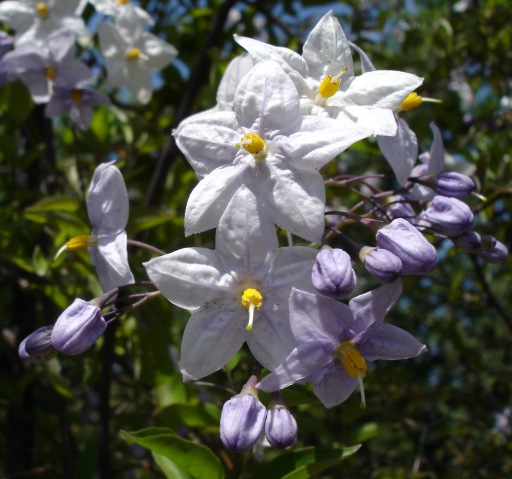
According to the description, it's fragrant (thus the “jasminoides”, it seems). It's growing surprisingly happily, so we'll find out.
|
Dinner with the Yeardleys
|
Topic: general, food and drink | Link here |
David Yeardley is back in town with his fiancée Tuyết and her daughter Minh Chau, and they came over for dinner today:

|
|||||||||||||||||||||||

|
|||||||||||||||||||||||
Minh Chau was not amused, probably overtired, and went off to sleep soon after dinner. David was definitely not overtired. Nor was Nemo:

|
|||||||||||||||||||||||

|
|||||||||||||||||||||||

|
|||||||||||||||||||||||
| Sunday, 3 July 2011 | Dereel | Images for 3 July 2011 |
| Top of page | ||
| previous day | ||
| next day | ||
| last day |
|
Trapping rodents and marsupials
|
Topic: general, animals | Link here |
A couple of days ago I bought a better rat trap—or at least, that's what the (eBay) seller says. It's a cage with a spring-loaded door that catches the rats alive. Put the thing together despite the instructions, and set it up in the garden shed. Yes, the rat went in there, but there are things you have to discover. Make sure it's on a flat surface:

|
|||||||||||||||||||||||
The rod that should have locked the cage shut fouled on the lip of the dustbin and allowed the animal to escape again. Try again.
While I was at it, put together the second trap that I bought at the same time. It's twice the size in each direction, and designed for catching possums. Up onto the roof with it, in the process removing the rat traps I had put there a couple of months ago. We only ever caught one rat with them, though several were set off, but the rats escaped. So it was today. This time they seem to have taken the bait holder with them:

|
|||||||||||||||||||||||
Coincidentally, Peter Dilley called up to say that he had caught two mice in his mouse trap, so he brought them over, to the intense pleasure of Lilac:
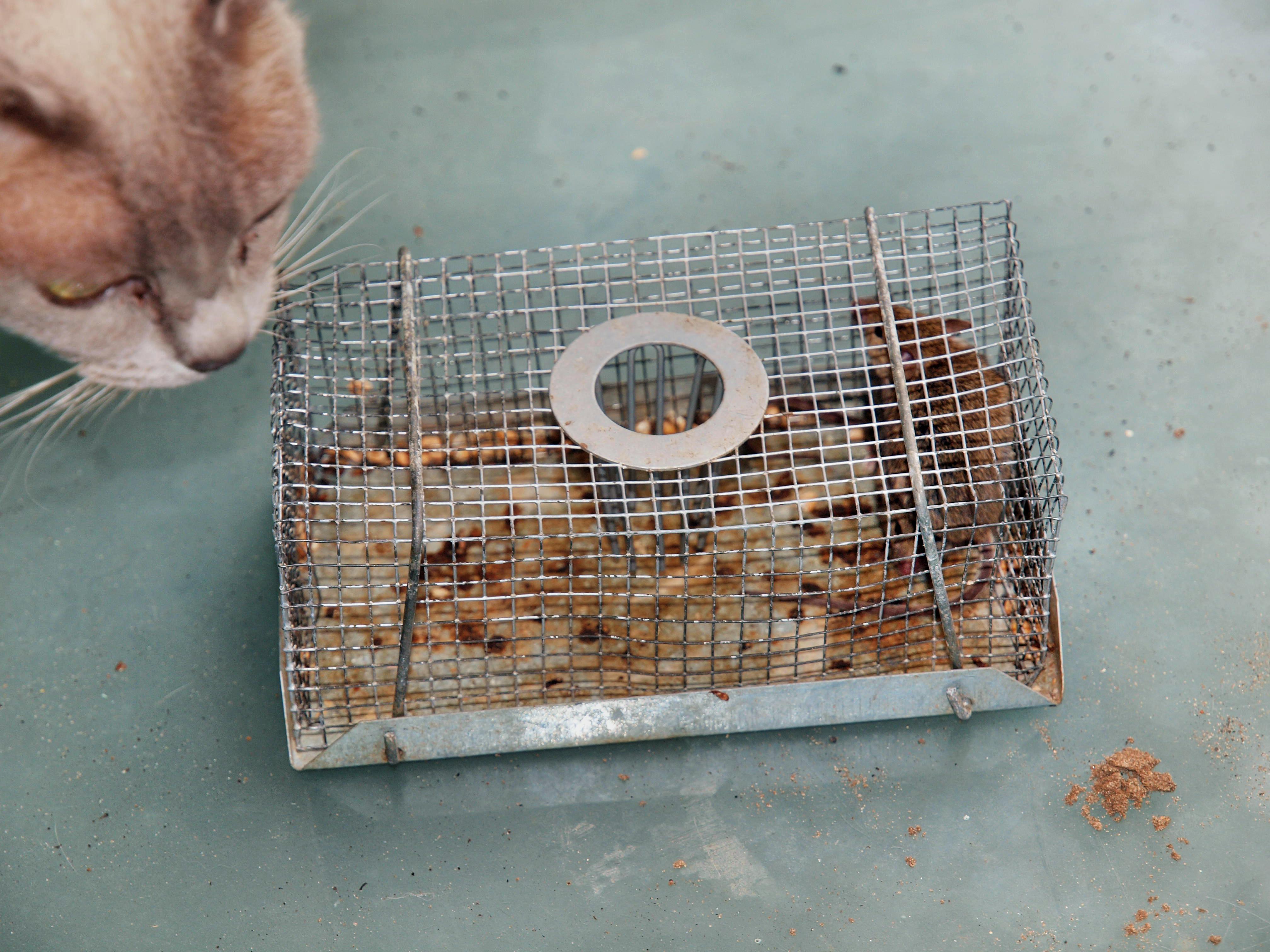
|
|||||||||||||||||||||||

|
|||||||||||||||||||||||
This one looks interesting, so I borrowed it for the night to see if it could help us.
|
More mystery bulbs
|
Topic: gardening | Link here |
While transplanting the plants in the north bed a couple of days ago, found some very large bulbs that had been growing in the shade of the Aloysia citrodora (Lemon Verbena).

|
|||||||||||||||||||||||
As far as I can recall, they have never flowered, maybe because they've been under the Aloysia. Planted two of them back where they came from, now that there's less competition, but I still need to decide what to do with the rest.
|
Importing Trapster to iGO 8 GPS navigators
|
Topic: technology | Link here |
Last week Peter Dilley had found many more speed cameras with his BlackBerry than I had with my GPS navigator, and I've been doing some investigation since then. It seems that the most reliable and up-to-date source of data is Trapster. But that's really for Garmin and TomTom navigators, which use different formats.
I've spent a lot of time trying to find out details of the formats that my navigator uses. It's made by Nav N Go, and for a long time I thought it was called iGO 8, but it seems this is somewhat generic term, and my particular version is called iGO My way. It's not clear how much the difference is—maybe it's all in the eyes of the web site or the marketing department—but it doesn't help when you're looking for details.
What I've established is: the map and associated data are stored in a subdirectory content (also, since this is a Microsoft “Windows” CE device, CONTENT), which has the following subdirectories, most of which appear not to be necessary for normal navigation:
Most of the files in these directories have names relating to the country to which they apply. Most of the files are in a binary format that file(1) doesn't recognize.
building contains images for displaying buildings in 3-D mode. This one is interesting because it contains special information about petrol stations for some countries only:
I have no idea what the difference is between files with the extension .3dc and .3dl.
I haven't worked out what dem is good for. On my navigator, I only have a file for Australia.
lang contains language information, I think for the navigation texts. They're in ZIP format, for some countries there is more than one file, and many of the file names contain spaces:
map contains the map data.
poi contains descriptions of Points of Interest.
scheme contains what looks like data for various display styles, again in ZIP format.
skin presumably contains more display style information, though the file names (only two of them) don't give much away beyond the beta status of one of them:
speedcam is the one I want, the speed camera information. I'll describe it in more detail below.
voice contains the voice information. It seems that the TTS files are just relatively small add-ons for the main voice file. For example, the following two describe voice information without and with TTS:
speedcam is a little different from the rest. On my old navigator, I had:
Those are three different binary file formats, and I couldn't find any reliable description of what they are. Some people on the web claim that they (which?) are sqlite files, but sqlite3 doesn't want to know:
My new navigator has slightly different files:
Despite the older date, Australia.spb has identical content. But what's speedcam.txt? It's about the only file I've found that isn't in binary format:
It's clearly information about additional speed traps, and I'm pretty sure that I've established that it's used in addition to the others. And yes, I can find information about this file on the web. It's clearly CSV, and the fields are:
X is the longitude of the camera location.
Y is the latitude of the camera location.
TYPE describes the type of the camera:
SPEED is the speed limit at the camera.
DIRTYPE is an indication of the directions in which the cameras operate. According to the link, we have:
That's not the whole truth, though. I can add 4-way speed cameras too, though I haven't investigated what value gets put in the file. In the files I've seen, this field is always 0.
DIRECTION is a separate direction indication, in degrees from north. This field also always seems to be 0.
Comparing this to Trapster, it seems that Garmin also has a (different) CSV format. But at least I can convert it—almost. The only values that correspond directly with iGO are the geographical coordinates. Garmin doesn't have any values for the last three fields, and it reports different types of traps, each in its own file. But I was able to download the files and convert them with a pair of scripts: one converts the Garmin format to something the navigator will understand, and the other merges the results with the existing speedcam.txt file and removes duplicates. With a bit of testing, it now works. Interestingly, I still don't find as many traps as Peter did. But there are plenty more on side roads, and I think his BlackBerry was rather generous in its interpretation of the speed camera location.
| Monday, 4 July 2011 | Dereel | Images for 4 July 2011 |
| Top of page | ||
| previous day | ||
| next day | ||
| last day |
|
No rodents, new cuttings
|
Topic: animals, gardening | Link here |
Up this morning to check our mouse, rat and possum traps. All empty, and the cages hadn't been sprung. That doesn't argue against Peter Dilley's trap; only a full trap can be an argument. But we had to take it back, so over to the Dilleys with Yvonne, who hadn't been there before, and took a look around the garden. I'm still amazed how many things are still in flower, including a white rose that could be Iceberg—and all that on the south side of the house.
Inevitably took a few cuttings: a Grevillea that is also in full bloom, and a small, somewhat prickly flowering shrub. The flowers are about 7 mm across:

|
|||||||||||||||||||||||

|
|||||||||||||||||||||||

|
|||||||||||||||||||||||
I wonder if they'll strike.
|
More Internet infections
|
Topic: technology | Link here |
Just before leaving for the Dilleys, got a call from Hazel at “E Protection”, a company in North Sydney (aren't they all?), telling me that my computer had been infected by the Internet. I asked for the phone number, but she said only registered users were allowed to have the phone number. Unfortunately I didn't have time to string her along any further, and just hung up. Somehow I feel guilty.
|
Boat people and the web
|
Topic: general, opinion, technology | Link here |
Australia has been a leading country for immigration since the second world war, and to a certain extent immigrants are welcome and often actively solicited. But the bureaucrats have to make the decision, and as in other countries, one thing that greatly lessens your chance of being accepted is to arrive without a visa. I've been there, done that.
But what if you have no choice? The US aggression in the Middle East has created millions of refugees, and in Africa, without US help, ethnic violence has been just as bad. So lots of people arrive in Australia by boat with the “help” of people smugglers. They've had persecution, torture, rape and death behind them. So what do we do with them? We lock them up, spare no expense to keep them there for years, and then maybe send them back. I'm not the only person who thinks that this is inhuman.
In particular in the case of refugees from Iraq, the Australian government has been a cause of this disaster. The least they could do would be to treat them humanely when they arrive. But both sides of politics continually talk about “stopping the boat people”, as if it were the most important issue in Australian politics, and with no clear idea how they're going to do it or what's going to happen to the boat people. I had assumed that most people in Australia would share my disgust with this approach, but it seems that xenophobia is alive and well.
Recently SBS Television did a three-part film
where 6 volunteers did the boat people trip in reverse, all the way back to Iraq and the
Democratic Republic of Congo. Given that they had volunteered to spend nearly a month of
their lives in the process, it's amazing how little they understood of the issues, and
consequently how surprisedshocked they were to find out the conditions that the
refugees had to bear. Hopefully this series will make a difference to more than the 6
people who were immediately involved.
What does this have to do with computers? Very little indeed. Even the text advertising the web link was wrong:

|
||||||||||||||||||||||

|
|
||||||||
The correct URL is http://sbs.com.au/goback, but they've spelt it in capitals. I thought this might be catering to a bug in Microsoft “Internet Explorer”, so that's what I tried. But no, I just found another bug: the heading “Cannot find server”, when clearly this is a 404 document from the server. And, of course, it's too difficult for the web masters (aren't they all?) at SBS to adapt the 404 document to redirect to the correct page. Clearly the web masters and the programme content masters don't talk to each other.
| Tuesday, 5 July 2011 | Dereel | Images for 5 July 2011 |
| Top of page | ||
| previous day | ||
| next day | ||
| last day |
|
Rat trap: false positive
|
Topic: general, animals | Link here |
This morning the rat trap had finally worked and snapped shut—but empty:

|
|||||||||||||||||||||||
And the possum trap was still open. At the very least I need better bait. But somehow I don't see an improvement over the old style traps.
|
Cool, windy weather
|
Topic: general, gardening | Link here |
It hasn't really been that cold this month—the lowest temperature so far this month was 5.8°, compared to 0.1° last month and 0.7° the month before. But the wind was the strongest I have on record, with reported gust speeds of up to 37.8 km/h. Looking back, it seems that all the wind speeds above about 20 km/h have happened recently. Is that real, or is it the result of some change in the equipment? In any case, even 37.8 km/h isn't very high, and I suspect it's really more.
One result was that the shade cloth for the greenhouse had unrolled completely:

|
|||||||||||||||||||||||
It amazes me that the wind can be strong enough to turn the axle around that many times. Tied the handle down to the frame so that it couldn't turn, and a few hours later it had half unraveled again. Further investigation showed that it had not turned the axle, just blown the cloth around it. Took a piece of hay baling twine and tied one end to the other, but I'll do the other when there's less wind.
|
Transferring the fbbg zone
|
Topic: technology | Link here |
I've been dragging my heels on the fbbg.org.au web site, at least partially because I don't understand the web-based interfaces. Got hold of the registry key and put myself in the whois data as tech contact, but still couldn't find a way to get hold of the zone file (I was sure there was only one). Yes, I can change the name servers, but I'd have to guess at the content. In itself, that's not difficult, since there wasn't much more there than the web site, but it's untidy. Spent a lot of time looking round the TransACT web interface, which showed me nothing, and spoke to people who know their way round TransACT, all to no avail.
Finally found a number (13 30 61) and called up, first having a bet with some friends that they wouldn't know what a zone file is. I was on hold for 10 minutes, during which time I was informed about a dozen times that there was an outage in Mildura, but at least the hold music was bearable (Mozart horn concerto). Finally connected to a very faint-sounding Tim, who did know what a zone file was, and quickly connected me to Max, who apparently knew that Jenny Burrell was the tech contact, even without looking. I wonder how many sites they host. He told me that they don't normally give the zone files to customers (!), but that he would send it to me.
And indeed I did get the zone file about an hour later, sent from Nathan Fletcher, who had gone to the trouble of sending it not just to the email address registered in whois, but also my real email address. I wonder where he got that, and why he bothered. The zone file contained one RR that I didn't expect, and one that looks Just Plain Wrong:
Presumably the second RR has been mutilated by an overly anxious MUA. The mail RR probably doesn't get used, but if it does, it could have been very difficult to debug if I hadn't included it.
|
ALDI cookbooks: too difficult for us
|
Topic: food and drink, opinion | Link here |
Last week ALDI had some “Gourmet” cookbooks on offer, and Yvonne brought a couple back with her. Both seem to have in common that they contain not a single recipe that could be cooked only with ingredients available at ALDI: “At home and in the mood” by Luke Mangan and “The Press Cluβ” by George Calombaris.
The Mangan book is a bit of everything (dedicated to “all the migrants who brought their food, their wind and their rich experiences from their countries...”), and Yvonne found a number of interesting recipes in it. The Calombaris book is a different matter: too complicated. The Press Clu[bβ] is the name of a restaurant in Melbourne, and Yvonne is interested in going there. The dishes are from the restaurant, and just a little too complicated—not so much, it would seem, nouvelle cuisine as cuisine chique.
So the book will go back, not for the usual reasons, but because it's too sophisticated. That's a first. In passing, it's interesting to note that both books are published by the same publisher but I can't find the Calombaris book on it, though they do have other books by him. Possibly this is a rebadged version of one of them.
|
More reception problems
|
Topic: multimedia, technology | Link here |
On the whole TV reception hasn't been bad lately, but last night was an exception which might teach me something. On cardid 2 (the PCI tuner) I recorded a programme on SBS 2 from 19:32 to 20:37, and a programme on 7TWO from 20:37 to 00:30. Concurrently on cardid 1 (the USB tuner) I recorded a programme on SBS 1 from 20:27 to 22:00. The recordings on SBS 1 and SBS 2 recoded without any error messages, though I found massive error reports for the SBS 2 recording in the log file—I guess. The log message format doesn't state the process ID, so in general I can't be 100% sure, though in this case it was the first recording of the day, so it's pretty clear that it must have been that.
But the recording itself looked OK, in crass distinction from the recording on 7TWO, which reported more errors than I have seen in a very long time. Why? I've had a number of hypotheses, but this particular one rules some of them out:
Output of the first tuner interfering with the second tuner. This case clearly disproves that. Although the system numbers the cards 1 and 2, from the point of view of the antenna, the first card is card 2, and the output from card 2 goes into card 1. The bad recording on card 2 happened at the same time as the second recording on card 1, so clearly that can't be the case.
Antenna problems, including wiring. At least in this case, this scenario disproves that too.
Problems with the transmitter. I've seen a surprising number of problems with this particular transport stream, which includes PRIME and 7MATE. We've seen general reception problems lately, so for the time being I'm putting my money on this one.
That doesn't mean that all reception problems are the same, of course. But it does suggest that I might gradually consider replacing the third tuner, since I only removed it because of concerns with hypothesis 2.
Looking at these results, there's a fourth hypothesis I hadn't considered: the immediate change of programme at 20:37:
Could it be that this sudden change has something to do with it? On the face of it, no, but I'll keep my eyes open.
|
Labor saves you money
|
Topic: general, opinion | Link here |
Another brochure in the mail (“Dear Gregory”) from Darren Cheeseman, our local MP, today. That normally only happens before an election, so it begs the question whether the government, currently by no means popular, is planning to call an election.
More interestingly, though, is the content: how much better it is for us. More “kinder” (Kindergarten) places for “kids”, more school stuff, more tax breaks for young families (like his own). Nothing for people like me. At the very best, you'd think that they'd do some kind of demographic analysis and send this kind of brochure only to people to whom it might appeal. Others, like myself, might feel left out.
It's not as if there are no improvements of general interest. I mentioned four of them to him in my last (unanswered) letter last year, but the government has only addressed one: they have made Internet connectivity worse. Time for another letter.
| Wednesday, 6 July 2011 | Dereel | |
| Top of page | ||
| previous day | ||
| next day | ||
| last day |
|
Migrating the friends' web site
|
Topic: technology, gardening | Link here |
So now I have all I need for migrating the web site of the Friends of the Ballarat Botanical Gardens, so did so. Well, at least we now have two web servers running in parallel, though www.fbbg.org.au is still the old site. It's obvious that the friends are not particularly technical, and the last thing I want to do is to have things go wrong somewhere. But—so far—everything works as it should.
About the only issue is going to be migrating from ftp to scp for updating the site. In itself, that's not a problem, of course, especially since Jenny Burrell, the only person who actually does the updates, uses an Apple. But probably there are some funny graphical ftp clients which people can use, and potentially there's no corresponding scp client. But that's down the track.
|
Rat traps: more false positives
|
Topic: general, animals | Link here |
The possum trap was closed this morning. No possum. No rat. It could have been the wind, of course. And the only bait in there was peanut butter, presumably not what possums like. How about carrots? Baited it, the rat cage and two mouse traps with carrot. We'll see.
|
Recode or transcode?
|
Topic: technology, opinion | Link here |
Peter Jeremy had a query about the term “recode”, which I use for describing the transformation of my MPEG transport streams to program streams. He preferred the term transcode.
Which is right? Both terms are in use, but if you believe Wikipedia, transcoding is a repacking of the data into a different format, while recoding maintains the format. But the examples they give are not very convincing. I need to think about this one, but “recode” sounds more logical to me than “transcode”.
|
Wondo Gonseff lives!
|
Topic: technology, general | Link here |
Decades ago I had a colleague called Wondo Gonseff. He was a good bloke, but he was somehow ashamed of his name and preferred to call himself by an anagram, Geoff Snowdon. I was reminded of him by yet another question about why I call myself groggy, and went googling for him.
He's back! He has come out of the closet and is now on LinkedIn. Hopefully I can reestablish contact.
|
More tortilla experiences
|
Topic: food and drink, opinion | Link here |
Enchiladas verdes for dinner this evening, and the first opportunity to try out the normal yellow Masa harina from Minsa. Surprise, surprise, it's different from both their blue masa and the yellow masa from Maseca. Each of the three needs a different amount of water: the blue masa needs about 120 ml water for 100 g, the yellow Maseca masa needs about 145 ml, and the yellow Minsa masa needs about 160 ml. I'll measure it more carefully next time.
And yes, the blue masa doesn't taste as strongly of maize as the yellow ones do. But the Minsa masa is so much easier to handle. It holds together much better, and I can roll it out without any oil, something I could never do with the Maseca. I can't tell any difference in the taste. I wonder why the Mexicans prefer Maseca—maybe because it's from Mexico?
| Thursday, 7 July 2011 | Dereel | Images for 7 July 2011 |
| Top of page | ||
| previous day | ||
| next day | ||
| last day |
|
More rodent trap failures
|
Topic: general, animals | Link here |
Checked the rodent and possum traps today. Nothing. They're all still open. I suppose I should look for an alternative bait, but I'll leave them for another day.
|
Backup disk failure and eSATA
|
Topic: technology | Link here |
Yvonne reported boot problems on lagoon, her machine, today. That proved to be a failed mount of the NFS file system /dump: my backup disk (on dereel) has died.
That's nothing that serious; disks die. But it occurred to me that keeping two backups on the same disk is sub-optimal. I really should find a way to alternate between two different disks, like I do with photos, so that I'll have at least one backup if a single disk fails.
Took the drive out, in the process rejumpering the eSATA adapter that I bought last month for external connections. That showed some difference: lots of disk activity, to judge by the disk lights, but no reaction from the operating system. Discussed with Peter Jeremy, who has the same kind of adapter in the same kind of system: that's not what he sees. More playing around needed. Maybe I should try it in a test machine.
Put the dead disk in a test machine, and it came back to life again, long enough for me to back up some of the files across the network. Then it died again, and the next time I tried it didn't stay alive long enough to finish the boot. Possibly a thermal issue. I should get another disk on the local machine and try backing up there, preferably with something like rsync that will take over where I have left off. Mañana.
|
Bear Grylls: Stupidity for the masses
|
Topic: multimedia, opinion | Link here |
The Nottles left for the Dominican Republic last November, rather to our surprise. We had little knowledge of the country, and, it seems, neither did the Nottles. It seems to have been less than successful. But a couple of days ago there was a documentary film (if that's the word) on the Dominican Republic, featuring a certain Bear Grylls. The programme (Man vs. Wild) description sounded dubious:
Bear Grylls parachutes into the Dominican Republic amidst the region's harsh hurricane season. In an effort to stay hydrated, Bear swims to a deserted island only to find it completely devoid of fresh water. In scorching tropical heat, he makes a raft from storm debris to sail back to the mainland, tackling mosquito-infested swamps and raging white water rapids along the way.
That sounds unbelievably stupid. Started watching it, and yes, it is unbelievably stupid. OK, this Grylls bloke is some kind of “adventurer” (read: somebody who only stays alive because there's a camera team following him). But why should he perform acts of such stupidity? He jumped (not parachuted) 13 metres from a helicopter into allegedly shark-infested waters and had to swim to the island, instead of just being let down there on the ground. And he didn't take any water with him. That's not brave, that's just plain stupid beyond belief. And yet the criticism of the series addresses minor details such as whether the animals in the series are really wild, and avoids the obvious issue that whatever he does has to be filmed, so of course he's not in any real danger.
On the other hand, the response to criticism claims it to be a “but a 'how-to' guide to 'basic survival techniques in extreme environments'”. It is no such thing. Anybody who behaved like that in the wild wouldn't survive. Before we stopped watching the film (after about 10 minutes) we saw him wandering through rain forest and commenting on the arid surroundings, and looking for water (which, I suspect, would have been available) in all the wrong places. We didn't bother to watch how he continued with his raft.
Are TV audiences really so stupid? I was surprised how many people on IRC knew him.
|
GPS navigator as camera monitor
|
Topic: photography | Link here |
My el-cheapo video cable arrived today. Yes, it's cheap. While plugging in the female-female adapter, I bent part of the shield. I don't suppose you can complain about that when it only cost $1.50 including postage. But it works, and so does the GPS receiver as a monitor. The biggest issues, neither of them serious, are a change of aspect ratio and the lack of a stand for the GPS receiver (on the table in the first image):

|
|||||||||||||||||||||||

|
|||||||||||||||||||||||

|
|||||||||||||||||||||||

|
|||||||||||||||||||||||
Wrote a separate page with more details.
|
More reception errors
|
Topic: multimedia | Link here |
Another really bad recording last night, this time on SBS 2. Again there was a second recording which covered part of the time, but this time there didn't seem to be any connection. The recordings were:
One on SBS 1 on card 2 (PCI), from 20:30 to 22:00.
The other (defective one) on SBS 2 with card 1 (USB), from 21:27 to 0:00.
The second recording was good for the first 31% or so, which corresponds to about 22:16, so there's no reason to believe any interference from the first card. And today everything was OK again. It must be some transmission or propagation problem.
| Friday, 8 July 2011 | Dereel | Images for 8 July 2011 |
| Top of page | ||
| previous day | ||
| next day | ||
| last day |
|
Still no rodents
|
Topic: general, animals | Link here |
Checking the mouse, rat and possum traps is becoming a daily ritual. And I'm getting used to not catching anything. Clearly carrots aren't the way to go.
|
eBay: The power of negative feedback
|
Topic: general, technology, opinion | Link here |
It's been two weeks since I picked up the replacement GPS navigator in Melbourne. At the time, Maurice promised to get me new maps “soon”. I wasn't overly surprised that I hadn't heard back from then, but we needed closure, so I sent them a message, including:
Please supply up-to-date maps and file by CoB on Friday, 15 July. Otherwise I will leave the following negative feedback:
Software and maps seriously out of date, missing files, promised updates missing
That worked. I got a call back from a girl with a very faint voice who effectively confirmed the content of a mail message they had just sent: they've found maps dated January this year, and also up-to-date POI information that allegedly won't crash the application the way it did last month. They've put it on a 4 GB micro SD card and it should go out on Monday. We'll see, but it's amazing what the threat of negative feedback will do.
| Saturday, 9 July 2011 | Dereel | Images for 9 July 2011 |
| Top of page | ||
| previous day | ||
| next day | ||
| last day |
|
Caught: a possum
|
Topic: general, animals | Link here |
There's always a lot of noise on the roof at night—that's why I've put the possum trap up there—but tonight there was a difference, the distinct sound of something getting trapped and struggling for a while. Then nothing. Not because it was dead, since these traps just catch the animals and don't hurt them. The morning showed me what I had feared:

|
|||||||||||||||||||||||
The possum had jumped around enough to dislodge the lock and get out. I wonder what I can do there. The corrugations in the roof don't help, but the real issue is that the vertical locking pin for the door doesn't lock into place, and it can be lifted again. This may be a fatal flaw in the design. The other traps didn't catch anything again.
|
Four years in Dereel
|
Topic: general | Link here |
It's been four years since we moved here!
I've since decided that 10 July 2007 is a better date. That's when we spent the first night here.
How time flies! And how little we have done. I bought some boards to make some shelves in cupboards about a month after moving in. I managed the cupboard in Yvonne's office, but the other three cupboards are still waiting. But that's the fun of being retired, not having any pressure any more.
|
More TV reception pain
|
Topic: multimedia, technology | Link here |
My TV reception is going through a bad phase again, but it's clearly related to some stations, notably 7TWO. Last night I had the following recordings:
| Start | End | Daisy chain | Number of | |||||||
| time | time | Channel | Tuner | position | recoding errors | |||||
| 20:27 | 22:00 | 2203 (SBS HD) | 1 | 2 | ||||||
| 21:17 | 22:49 | 2002 (ABC1) | 2 | 1 | ||||||
| 00:57 | 03:20 | 2062 (7TWO) | 1 | 2 | 42 | |||||
The recoding errors aren't the only kind I get; there are plenty of messages in the log files like:
The trouble here is that there's nothing to indicate which programme it is if more than one is being recorded. In addition, they seem to be relatively mild, and streams that have produced lots of these messages may recode perfectly well and show no problems on playback. They clearly indicate some kind of subliminal problem, but it's difficult to correlate, so I won't pay too much attention to them.
I didn't record the number of recoding errors for the first two recordings, but there weren't many. But why so many on the third one? I've decided to keep this kind of record of all recordings for the while, with a little more information.
Today was another problem: three concurrent recordings, which meant putting my third tuner in the machine. Then did some test recordings, which came out less well than I would have liked:
| Programme | Start | End | Daisy chain | File | Number of | |||||||||
| name | time | time | Channel | Tuner | position | size (GB) | recoding errors | |||||||
| Tomato | 15:43 | 16:20 | 2062 (7TWO) | 1 | 3 | 1.2 | 36 | |||||||
| Big Sleep | 15:43 | 16:20 | 2080 (GEM) | 2 | 1 | 2.7 | 1 | |||||||
| Among the ruins | 15:43 | 17:00 | 2203 (SBS HD) | 3 | 2 | 5.3 | 1 | |||||||
| Medicine men | 16:26 | 17:30 | 2002 (ABC1) | 1 | 3 | 2.3 | 1 | |||||||
Clearly there's still more pain to endure. I suppose the next step would be to investigate the tuner configuration again. But why should that help? In the meantime, I'll take out the third tuner and see if that makes any difference.
|
Dinner at the Dilleys
|
Topic: general, food and drink, animals | Link here |
Over to the Dilleys for dinner tonight, roast leg of pork—something that Yvonne professed not to like. But it was very good, and maybe I can now persuade her to eat it from time to time. Spent some time talking about dogs: the Dilleys have a puppy, but they're so far from anywhere that the dog never gets any company.
| Sunday, 10 July 2011 | Dereel | Images for 10 July 2011 |
| Top of page | ||
| previous day | ||
| next day | ||
| last day |
|
How to catch a mouse
|
Topic: animals, general | Link here |
I don't know how long we've been putting out mouse traps in the kitchen. It hasn't worked, and I've been rather lax about doing it every night. Last night, instead, we put the cats in there. Normally they spend the night in the laundry, because they can be noisy, but tonight we left them in the house.
With, it seems, good results. Round midnight we heard some glissando growling from, I suspect, Piccola, which I interpreted as Piccola defending her newly-caught mouse from Lilac. The subsequent quietness suggested that Lilac won and ate the mouse. In any case, they're no longer hanging around the sink and the fridge in the kitchen, so I assume it's gone. Now all we need is a tiger to stay on the roof and catch the rats and possums.
|
Visitors from Canberra
|
Topic: general, animals, photography | Link here |
Claudia Bietz and her daughter Jacqueline are visiting Chris Yeardley with a view to buying a horse. Yvonne and Chris took some horses over to try out, and a while later I saw Yvonne outside my office on horseback. That means only one thing: photos, please. Out to take some not-very-spectacular photos. I must remember to use a very high shutter speed for this kind of photo:

|
|||||||||||||||||||||||
I thought that I was panning well enough, but probably the movement of the horse was enough to make it unsharp. Next time 1/500s. Still, other photos are easy enough at 1/100s:

|
|||||||||||||||||||||||
Finally they rode off into the sunset, or at least the distance. I thought they were too far away when I took this photo, but on looking at it, I think it's quite successful:

|
|||||||||||||||||||||||
|
Another bloody power failure
|
Topic: general, opinion | Link here |
Finally found enough time to watch TV. And what happened? Power failure. Worse, the UPS decided that the projector (Sanyo PLV-Z700, using 187 W), was too much of a load its 800 VA rating, so it did what it was supposed to protect against and switched off. When it came back, only a couple of seconds later, the “Replace lamp” LED was flashing. Before I got a chance to do much, it happened again. And again, and this time it stayed down for ¾ hour.
How I hate these power failures! Today was the day that the Australian Government unveiled its Carbon Tax scheme. Why couldn't they have addressed power generation (which, it seems, will be heavily hit) with a German-style solar power incentive?
|
More reception problems
|
Topic: multimedia, technology | Link here |
As planned, backed up my mythconverg database and re-scanned the channels. There seems to have been no change in the reception parameters, but some of the channel names have changed, in some cases subtly: for example, “7MATE ON PRIME” has become “7mate Ballarat”, and “7TWO ON PRIME” has become “7TWO Ballarat”, enough to confuse MythTV. One of the programmes I had wanted to record was “Electric Dreams” on 7TWO, but for some reason MythTV insisted on trying to record it from 7mate. Trying to record manually only added to the problems. The log file shows it trying to record once only, interrupted by the power failure:
But the list of recorded programmes shows a total of four “Electric dreams”, referring to two files. It seems that this is a database problem, and that I didn't really record from two different tuners to the same files. In particular, the restart at 16:04 was immediately after the power was restored, and it's only there once.
The reception itself is no better. Here the results for today, including the interruptions due to the power failures:
| Programme | Start | End | Daisy chain | File | Number of | |||||||||
| name | time | time | Channel | Tuner | position | size (GB) | recoding errors | |||||||
| Food Safari | 17:30 | 18:05 | 2203 (SBS HD) | 1 | 3 | 2.5 | 0 | |||||||
| Gardening Australia | 18:28 | 19:00 | 2002 (ABC1) | 1 | 3 | 1.1 | 6, failed at 93% | |||||||
| Manhattan | 20:27 | 22:34 | 2022 (ABC2) | 1 | 3 | 3.4 | 26 | |||||||
| Pirates | 20:27 | 23:50 | 2006 (PRIME) | 2 | 1 | 7.7 | 33, failed at 9% | |||||||
| Ferpect Crime | 22:32 | 01:00 | 2032 (SBS 2) | 3 | 2 | 3.2 | 0 | |||||||
| Gabriel | 22:57 | 01:50 | 2088 (GO) | 1 | 3 | 6.4 | 0 | |||||||
| Minder | 23:53 | 01:30 | 2062 (7TWO) | 2 | 1 | 3.3 | 36 | |||||||
| Went the day well? | 06:27 | 09:00 | 2080 (GEM) | 1 | 3 | 12 | 0 | |||||||
| Electric dreams | 13:57 | 15:26 | 2063 (7mate) | 1 | 3 | 5.6 | 28, failed at 40% | |||||||
| Electric dreams (2) | 16:04 | 17:00 | 2063 (7mate) | 1 | 3 | 5.6 | 17, failed at 37% | |||||||
| Clash of the Titans | 14:20 | 15:26 | 2080 (GEM) | 2 | 1 | 5 | 0 | |||||||
| PSA | 19:27 | 21:00 | 2063 (7mate) | 1 | 3 | 6.9 | 13 | |||||||
| Nin's Brother | 21:27 | 22:30 | 2203 (SBS HD) | 1 | 3 | 0.7 | Failed at start | |||||||
So, once again, I'm at a loss. But some of the details are interesting: for example the “Gardening Australia” recording on Saturday evening seemed perfect until shortly before the end. In all probability, the damage is after the end of the programme. And in general, the damage seems to be localized, which suggests interference.
|
Dinner at the Yeardleys
|
Topic: general, food and drink | Link here |
We almost never eat out. Chris Yeardley comes to our place for dinner on Saturdays, and that's about the only time we even eat in company. But yesterdays we ate at the Dilleys, and tonight we had dinner at the Yeardleys, with a lot of company for once.

|
|||||||||||||||||||||||
It was not undercatered, though it would have been easy to get that impression:

|
|||||||||||||||||||||||

|
|||||||||||||||||||||||
| Monday, 11 July 2011 | Dereel | Images for 11 July 2011 |
| Top of page | ||
| previous day | ||
| next day | ||
| last day |
|
Powercor eats computers
|
Topic: technology, general | Link here |
First thing this morning, as I walked past the lounge room, I saw an unusual sight: the disk access light of teevee.lemis.com, the computer that runs the TV projector, was shining brightly: heavy disk access. Never mind that it shouldn't have been on at all—I had not been able to turn it off after yesterday's power failure—why was it accessing disk at all, let alone so heavily?
Some investigation showed a number of depressing things:
It was apparently stuck in an fsck/reboot loop. This is a guess, but it fits the situation.
The onboard NIC was dead. I had to put in an old Ethernet card to get it back on the net.
In the process, ran fsck manually (thus also removing the chance of proving my hypothesis about the reboot loop). But the fsck output seemed to confirm it:

|
|||||||||||||||||||||||
So: yesterday's power failure mortally wounded the motherboard and may have taken a big chunk out of the projector lamp's life. It still works, but we've seen this before. High time to claim all the damages Powercor has done over the years.
It wasn't until some time later that I discovered a whole lot of processor dumps in teevee's /var/crash:
-rw------- 1 root wheel 183701504 Jul 10 18:55 vmcore.10
-rw------- 1 root wheel 183427072 Jul 10 19:16 vmcore.11
-rw------- 1 root wheel 183537664 Jul 10 19:38 vmcore.12
-rw------- 1 root wheel 178221056 Jul 10 19:58 vmcore.13
-rw------- 1 root wheel 183984128 Jul 10 16:21 vmcore.3
-rw------- 1 root wheel 183750656 Jul 10 16:46 vmcore.4
-rw------- 1 root wheel 183603200 Jul 10 17:06 vmcore.5
-rw------- 1 root wheel 181481472 Jul 10 17:29 vmcore.6
-rw------- 1 root wheel 183406592 Jul 10 17:50 vmcore.7
-rw------- 1 root wheel 183844864 Jul 10 18:12 vmcore.8
-rw------- 1 root wheel 183590912 Jul 10 18:33 vmcore.9
Unfortunately this machine doesn't have a kernel with debugging symbols, so I couldn't get much more than this for the first dump (vmcore.3):
(kgdb) bt
#0 0xc07996cc in doadump ()
#1 0xc0799db7 in boot ()
#2 0xc079a089 in panic ()
#3 0xc098be3d in ffs_blkfree ()
#4 0xc099f518 in indir_trunc ()
#5 0xc099f4d7 in indir_trunc ()
#6 0xc099f7e8 in handle_workitem_freeblocks ()
#7 0xc09a08c8 in process_worklist_item ()
#8 0xc09a2372 in softdep_process_worklist ()
#9 0xc09a4d97 in softdep_flush ()
#10 0xc0775929 in fork_exit ()
#11 0xc0a930e0 in fork_trampoline ()
After that, all the remaining dumps failed like this:
(kgdb) bt
#0 0xc07996cc in doadump ()
#1 0x00000000 in ?? ()
#2 0xe4a3aa08 in ?? ()
#3 0xc0805a4c in bread ()
Previous frame inner to this frame (corrupt stack?)
That's consistent with my comments at the time. There was indeed a reboot loop, and it went on for over 12 hours. The dumps stopped at 19:58 not because the system recovered, but because the disk was full:
Jul 23 13:33:31 teevee savecore: reboot after panic: ffs_blkfree: freeing free block
Jul 23 13:33:31 teevee savecore: no dump, not enough free space on device (108108 available, need 179138)
Jul 23 13:33:31 teevee savecore: unsaved dumps found but not saved
That date isn't the date of the dump; the dump was in the swap partition since 10 July.
|
Apple: insecurity through obscurity
|
Topic: technology, opinion, gardening | Link here |
I'm still working on a way to make the upload of files to the Friends of the Ballarat Botanical Gardens web site both secure and easy for non-computer people. Previously it seems that the files got uploaded via a web interface that at least uses https, but I didn't really want to implement that. What's wrong with good old scp? Jenny Burrell, so far the only person who updates the web site, knows more about computers than most gardeners, and fortunately she uses an Apple, so scp should be available.
But it seems that Jenny didn't use this interface after all. As she writes,
The ftp program I use is Fetch 5.6 on Mac OS 10.6.7.
I didn't know that fetch had been ported to Mac OS X—it wasn't on my machine. But it doesn't upload; it only downloads. And what's that “5.6”? Checked and found that there's a commercial product called FETCH that does upload—and it costs $29. And it does some secure versions of ftp that I had barely heard of, including SFTP, which proves to be short for SSH File Transfer Protocol. Clearly that's secure enough, but just requires me to set it up. But looking through the feature list mentions nothing of public key cryptography: maybe it only supports SFTP with password authentication.
But why? Isn't scp on the machine? It is on mine. So I asked Jenny, and knowing the vagaries of Apple's misnamed “Finder”, asked her to try starting it from a shell. But she didn't do that:
I still can't locate scp on this computer with a Spotlight search. Perhaps they took it out or replaced it with something else. I've looked in the system folder in Sharing and Security.
OK, so “Spotlight” isn't Finder, but it belongs to the same problem set. I asked her again to start a shell, and sure enough, it's there.
So how is any Apple user to know that? There's no documentation, and the GUI that floats somewhere above the system doesn't want any contact. Yes, you can go in with “Finder” and select the “folder” /usr/bin, page down through a lot of grey icons, and find it. But who wants to do that? And what's the point of putting software on a machine if nobody can find it? Once again, I'm completely baffled by the way Apple does things.
|
Improving firefox
|
Topic: technology, opinion | Link here |
Anybody who reads this diary could be excused for believing that I'm an old fart, out of touch with reality, who refuses to accept progress. Sometimes I wonder if they're not right. My complaints about firefox are an example: why would anybody want to let the window manager manage firefox's windows when firefox, not a window manager, offers tabs, a less useful substitute?
I've been using tabs for several weeks now, and firefox is much more stable for it. It also uses less memory, which I have suggested is related. It's also a pain, though I'm coming to terms with it. But today Daniel O'Connor posted the URL of an article on one aspect of the new firefox:
... the folks at Mozilla uncovered what was starting to look like a solution for Firefox's Achilles heel, resource usage.
So it is known. It's just that, so far, nobody cared enough. Score one point for the old farts.
|
Aligning time-sequence images, revisited
|
Topic: photography, technology | Link here |
A few months ago I spent some time trying to align multiple images, without success. Since then there has been a lot of activity on the Google hugin-ptx forum about this kind of topic, so posted my own question (why can't I use email? I don't get any error messages, but it never arrives), and got at least one suggestion. It seems that once again Hugin does different things depending on how you ask it. If you use the “Assistant”, you get seriously sub-optimal results, like the ones that I had in March. In all these groups of three photos below, the first will change to the third when the mouse cursor goes over it:

|
|
||||||||

|
|
|||||||||

|
|
|||||||||

|
|
|||||||||
But if you select “Create control points” from the “Images” menu, and you haven't let the “Assistant” mess around, the results from the optimizer are much better:

|
|
||||||||

|
|||||||||||||||||||||||

|
|||||||||||||||||||||||

|
|||||||||||||||||||||||
That gives better results, but the automatic control point generator makes some bad assumptions: for some reason it selects foliage, which can move, over bricks and walls, which don't. This one should be easy enough to do manually, so I tried that. And the results were terrible!

|
|
||||||||
That proved to be the result of allowing the “Assistant” to mess around with the images first. Although I removed all control points, some information must have remained. After starting Hugin again, things looked much better, but still not as good as the second approach. In particular, when adding control points, I get some significant deviations for points which most definitely correspond:

|
||||||||||||||||||||||

|
|
||||||||
The result of this is a somewhat worse correlation than with automatic control point generation:

|
|
||||||||

|
|||||||||||||||||||||||

|
|||||||||||||||||||||||

|
|||||||||||||||||||||||
In particular, try as I might, the second two images are rotated compared to the first, something that also happened with my very first attempts. I've tried this several times, and it happens every time.
One of the loose ends that's been hanging around here is: how does Hugin know that the images were taken at different focal lengths? From the EXIF data, as it reports in the “Camera and Lens” tab:

|
|
||||||||
But I've already established that the Olympus EXIF data is not very accurate. This particular lens (12-60 mm) appears to have only about 32 values for focal length, so the increments are more than 1 mm (there's no 25 mm setting, for example). If Hugin is basing the sizes on the reported focal length, this could be the problem. But what's the solution?
|
TV reception: back to two tuners
|
Topic: multimedia, technology | Link here |
Clearly my current TV reception isn't good enough. It got worse when I put in the third tuner, though the deterioration applied to all tuners. I don't need a third tuner for some time (only about every couple of weeks), so took it out again and tried some recordings on the problem channels, 7TWO and 7mate. And, indeed, the results were better:
| Programme | Start | End | Daisy chain | File | Number of | |||||||||
| name | time | time | Channel | Tuner | position | size (GB) | recoding errors | |||||||
| Murphy Brown | 14:13 | 15:00 | 2062 (7TWO) | 2 | 1 | 1.7 | 1 | |||||||
| Malcolm & Eddie | 14:13 | 15:00 | 2063 (7mate) | 1 | 2 | 3.5 | 2 | |||||||
So why is that? Is it possible that the tuners aren't doing proper impedance matching, but just hard-wired daisy-chaining through? I could believe that. I'll try with one tuner to see what happens there.
| Tuesday, 12 July 2011 | Dereel | Images for 12 July 2011 |
| Top of page | ||
| previous day | ||
| next day | ||
| last day |
|
New navigator data
|
Topic: general, technology | Link here |
As promised, received a 4 GB microSD card today with newer maps:
The serial number seems to be a truncated release date, i.e. 26 January 2011, interesting because it was a public holiday. The data is still pretty inaccurate: Enfield is still a couple of kilometres to the north, and the town centre of Dereel is placed at the junction of the imaginary roads I noted a month ago:

|
|||||||||||||||||||||||

|
|
|||||||||
That was looking south, and the following map is oriented north, but there are still massive errors, as a comparison with the Google map, itself very inaccurate, shows:

|
|||||||||||||||||||||||

|
|||||||||||||||||||||||

|
|
||||||||
In particular, the area shown as Dereel is pretty empty (as my photo above shows), and most of the roads (Elder Street, Russell Street, and the mirrors on the east of the main road) just plain don't exist. Interestingly, “Elder Street” seems to have grown longer since the previous maps. Ferrers Road starts at the east of the main road, and the road on the other side is called Swamp Road. To make up for it, Kleins Road (where I live) and Camms Road (where Peter Dilley lives) are still not on the map. It's clear, though, that the errors are related to those in Google Maps, in particular this egg-shaped area for Dereel.
Still, the map information contains one other hint: studly “WhereiS”. Presumably I could find out whether the maps were up to date there. Went looking there to see what I could find, but of course it's not that simple. Finally found the correct web site, which looked good. But first I had to tell it the model of my GPS receiver—why?—and of course it wasn't there, not even a reference to iGO My way. And without a device, I couldn't find out what the latest maps were. So I guessed some random Uniden device and was told that I had to ask Uniden. Selecting Garmin was not much more help: I could select my country, only one choice: Australia and New Zealand, no choice at all, but the only information I got was that it would cost me money, even before I knew if my maps needed updating or not. What a pain!
The other issue I had was the application crash with certain kinds of POI:

|
|
|||||||||
They sent me new POI data too. But the same old crash. You'd think they'd check this stuff before sending it out. Another message, asking them to fix it and test that it's fixed before sending me another memory card.
|
More image alignment experiments
|
Topic: photography, technology | Link here |
Google Groups has finally agreed to deliver my mail, after somewhat more than 48 hours, and a couple of people have responded on the thread. Some seem contradictory, but there was a bit of a sense there that the focal length could be part of the issue. The focal lengths of the two images were given as 21 mm (44.72°) and 23 mm (41.18°). The EXIF data reports a maximum of one focal length value between these two--maybe. Maybe there's nothing at all between the two values. If Hugin is relying on this information, there's a good chance that it will be wrong. I suppose I could guess at closer focal length or field of view values, but there must be a simpler way.
For the fun of it, I tried changing the focal length spec for the second and third images. I left the first one at 23 mm, but by changing the focal length of the other two. At 22.421 mm, the errors dropped to an average of 0.3 pixel, with a maximum of 0.92 pixel. Wonderful!
Unfortunately, the results didn't look at all wonderful. All three images had a different size—on one occasion. But it wasn't repeatable, and now I have this, which looks pretty much the same as before:

|
|||||||||||||||||||||||

|
|||||||||||||||||||||||

|
|||||||||||||||||||||||
I'm experimenting further, but it's beginning to look as if the Hugin or the control point detectors need to find another way of determining the relationship between the image sizes than relying on the EXIF data.
|
Braised lamb shanks
|
Topic: food and drink | Link here |
Last week I found a plethora of recipes for lamb shanks, something I've never eaten before, so Yvonne bought some—for $4 each, a king's ransom for such a piece of meat. Today went back to look at the recipes, and they had shrunk to a single recipe that didn't look very typical. So out looking for other recipes, of which there are not very many. Found one with Moroccan aspirations in Stephanie Alexander's The Cook's Companion, a book for which I have so far found no use, and another surprisingly similar one in Paul Bocuse's “La cuisine du marché”, though the latter was for veal shanks. Strangely, Bocuse wanted to cook the carrots for 2 hours, by which time they would have been purée.
In the end, made a compromise between the two. While I still think that Bocuse wanted to cook the vegetables too long, I was also concerned that cooking them in a tagine for 30 minutes wouldn't be enough. Ended up doing it for 60 minutes and boiling rather more strongly than I should have, as the second photo shows:

|
|||||||||||||||||||||||

|
|||||||||||||||||||||||
Still, for a first attempt it wasn't too bad.
| Wednesday, 13 July 2011 | Dereel | Images for 13 July 2011 |
| Top of page | ||
| previous day | ||
| next day | ||
| last day |
|
Autumn meets spring
|
Topic: gardening, photography | Link here |
Gradually more and more spring flowers are appearing, and the last of the roses are still around too:

|
|||||||||||||||||||||||
That's the best photo I could get. Clearly I need something with a brighter background, but with a single flash unit, it's almost impossible to get it. Time to play around with multiple flashes. And then I'll run into synchronization problems.
| Thursday, 14 July 2011 | Dereel | Images for 14 July 2011 |
| Top of page | ||
| previous day | ||
| next day | ||
| last day |
|
More insight into reception problems
|
Topic: technology, multimedia | Link here |
More investigation of the recording problems today, for the last few days. It's proving useful to present this data in tabular form; clearly the next thing to do is to store it in a database, so I can do correlations between the file size and the number of errors (an obvious one) or time of day (less obvious). But even without that, it's becoming very clear that I have a problem with the TS that carries the channel 7 programmes (the first three below):
| Programme | Start | End | Daisy chain | File | Number of | |||||||||||
| name | Date | time | time | Channel | Tuner | position | size (GB) | recoding errors | ||||||||
| To Gillian | 11 July 2011 | 0:57 | 3:30 | 2062 (7TWO) | 2 | 1 | 5.5 | 23 | ||||||||
| Dawn Anna | 12 July 2011 | 11:57 | 14:30 | 2006 (PRIME7) | 1 | 2 | 3.9 | Died at beginning | ||||||||
| Once Upon a Mattress | 12 July 2011 | 15:57 | 18:30 | 2062 (7TWO) | 1 | 2 | 5.5 | 10 | ||||||||
| Truth and other lies | 12 July 2011 | 2:37 | 2:35 | 2203 (SBS HD) | 1 | 2 | 8.7 | 0 | ||||||||
| Behind the force | 12 July 2011 | 20:27 | 22:00 | 2203 (SBS HD) | 2 | 1 | 6.5 | 0 | ||||||||
| Köter Rex | 13 July 2011 | 19:27 | 20:30 | 2203 (SBS HD) | 1 | 2 | 3.7 | 1 | ||||||||
| What happens in Vegas | 13 July 2011 | 21:36 | 0:13 | 2088 (GO!) | 1 | 2 | 5.9 | 2 | ||||||||
| Communism | 14 July 2011 | 10:56 | 12:30 | 2002 (ABC1) | 1 | 2 | 3.4 | 0 | ||||||||
| Man about house | 14 July 2011 | 11:57 | 14:30 | 2080 (GEM) | 1 | 2 | 12 | 0 | ||||||||
|
FETCH does key-based authentication
|
Topic: technology | Link here |
Got a reply to my message to FETCH support. Yes, it can do key-based authentication, as a bit of an afterthought: you still need a (dummy) password, which you can store, but you can't store the pass phrase for the key. Or you can start ssh-agent, of course. But how do you do that on an Apple?
|
Working around the last GPS navigator bug
|
Topic: technology, general | Link here |
Finally got the file update that I needed to eliminate this bug on my GPS navigator:
|
|
|
|||||||||
As I had already discovered, the file is stored in an archive branding.zip, and indeed, it's present. So “failed to open” probably refers to a bad language use of the word open, in this case presumably “process”. They sent me a new branding.zip which was considerably smaller than the old one:
Further investigation showed that the file poi_brand.spr was missing. So if it's there, you get the message “can't open”, and the application dies. If it's not there, everything works fine. Now doesn't that make sense?
|
Removing plants
|
Topic: gardening | Link here |
The weather has been pretty terrible lately. Every time I went outside, it started to rain. Finally, today, I got a bit further with my garden work. If only it would dry up and the wind would drop enough for me to spray the weeds that are coming up in defiance of the temperature!
Removed the remaining Salvia microphylla in the north bed—soon we'll plant either another Salvia or a rose there—and also a number of Cannas in the east bed, where I'm planning to plant an Abutilon as soon as I'm done. But it's tiring work.
|
More lighting issues
|
Topic: photography | Link here |
Had another go at taking photos of yesterday's flowers, this time trying to light the background more. Not a success. It seems impossible to trigger the studio flashes from the clip-on flash: no matter what I do, something fires before the main flash, and by the time the main flash fires, the studio flashes are done. I suppose I should connect them by cable and cover over the optical sensors so that they don't fire too early. As it was, took some with only the studio flash, but even on minimal intensity I needed f/22, and the background is both too sharp and not burnt out the way I want it:

|
|||||||||||||||||||||||
| Friday, 15 July 2011 | Dereel | Images for 15 July 2011 |
| Top of page | ||
| previous day | ||
| next day | ||
| last day |
|
Installing Firefox 5
|
Topic: technology, opinion | Link here |
I've been less than happy with firefox release 4—not that I've ever been very happy with firefox—but it seems to be the only game in town. Were the developers also unhappy with it? Given that firefox 4 was the current released version for all of a month or two, you might get the impression. Still, there are issues that came in with release 4 that I might hope would be gone in release 5, so today set out to install it.
The good news: I haven't seen any problems with release 5 yet, and it's possible than one problem I've had (incorrect repositioning after enlarging photos) might have gone away, though it's too early to be sure. But installing it was a pain! That's the fault of the FreeBSD Ports Collection not of firefox.
It started with the dependency checking: it determined that I should install perl version 5.12.4:
OK, so we need a perl upgrade. Why didn't it happen automatically? Ran portmaster against perl, and got:
That's not one error, it's two. First, it's trying to build the current version, and secondly it's failing. So I tried again to install perl version 5.12.4. Same problem:
Round about here I decided to give up trying to build perl and load it from the latest and greatest binary package from ftp://ftp.freebsd.org/. That reinstalled perl 5.10.3, but on IRC I heard:
That was only part of the problem. It seems that the perl port should have updated /etc/make.conf with a line:
But there was nothing there. And why did the default perl port install such an old version if it had been changed 5 years ago? Why is this version still on the ftp site? Looking further, I see:
The build date for firefox is the beginning of this month, but the version is 3.6.18. And the current version in the Ports Collection is version 5. What's wrong here?
In any case, it proved that the real issue was the missing perl version in /etc/make.conf. Installing the package fixed that, and I was able to rebuild firefox without any further problems. But what a pain! I think I was right years ago when I decided that I should reinstall ports rather than upgrade them.
|
Reception problems: further deterioration
|
Topic: multimedia, technology, opinion | Link here |
Somehow investigating my TV reception problems doesn't make them go away. Today was worse than ever. After restarting the new firefox, I discovered that a recording I had started had only recorded about 500 MB in over an hour. Looking at it confirmed: it was broken beyond recognition. Why? Did a number of tests, with little results except to confirm that something was very wrong. Tested the cabling, but in contrast to earlier attempts, wasn't able to provoke any particular change—with one exception: the USB tuner (number 1) stopped working altogether, and I had to reboot to get it to work. But it did disprove my suspicion that the daisy chain was part of the problem: disconnecting the cable out of the physical first tuner made no difference to the problems. I'm still baffled.
| Programme | Date | Start | End | Daisy chain | File | Number of | ||||||||||
| name | time | time | Channel | Tuner | position | size (GB) | recoding errors | |||||||||
| Food Safari | 14 July 2011 | 19:27 | 20:30 | 2203 (SBS HD) | 1 | 2 | 4.4 | 0 | ||||||||
| Crownies | 14 July 2011 | 20:30 | 22:57 | 2002 (ABC1) | 2 | 1 | 5.2 | 3 | ||||||||
| Dangerous Minds | 14 July 2011 | 21:32 | 0:15 | 2062 (7TWO) | 1 | 2 | 5.9 | 0 | ||||||||
| We joined the Navy | 15 July 2011 | 11:57 | 14:30 | 2080 (GEM) | 1 | 2 | 5.4 | failed at start | ||||||||
| The Hills | 15 July 2011 | 13:28 | 14:00 | 2088 (GO!) | 2 | 1 | 1.2 | 9 | ||||||||
| Test recording | 15 July 2011 | 14:00 | 15:00 | 2080 (GEM) | 2 | 1 | 4.6 | 18 | ||||||||
| PBS News | 15 July 2011 | 16:42 | 16:50 | 2203 (SBS HD) | 2 | 1 | 0.6 | 0 | ||||||||
| Kind of Magic | 15 July 2011 | 16:44 | 16:50 | 2002 (ABC1) | 1 | 2 | 0 | file empty | ||||||||
| (reboot) | ||||||||||||||||
| PBS News | 15 July 2011 | 16:54 | 18:00 | 2203 (SBS HD) | 1 | 2 | 4.6 | 8 | ||||||||
| Kind of Magic | 15 July 2011 | 16:54 | 17:08 | 2002 (ABC1) | 2 | 1 | 0.5 | failed at start | ||||||||
|
Dead spray unit
|
Topic: gardening | Link here |
Finally the weather was relatively warm, and there was little wind. Perfect time to spray the weeds. And what happened? After about 20% of the time, the pump handle of the spray unit broke off in my hand:

|
|||||||||||||||||||||||
That's not the first time—the white rod was a reinforcement that I installed two years ago. It looks like some of the screws fell out without me noticing. But this thing is so flimsy that it's hardly worth repairing, and it's also excruciatingly uncomfortable, probably because I never worked out how to attach the harness correctly.
|
House photos on Friday again
|
Topic: photography | Link here |
The weather was better today, and the lack of wind made it a good day for the panorama photos I normally take on Saturdays. So, for the fourth week in a row, I took them on Friday instead.
Somehow some of the photos could do with improvement, notably the panorama I take at the north of the house:

|
|||||||||||||||||||||||
It's hard to think that the gravel in the foreground is almost white. Is that because of the extreme difference in brightness between left and right? Took a few additional photos, notably with wider exposure bracketing (how I wish this Olympus would allow bracketing by more than 1 EV!), but they'll need processing before I know whether it's any better.
|
French Food Safari: missing the point
|
Topic: food and drink, opinion | Link here |
In the past we've watched SBS Food Safari (a page that firefox tells me is dangerous), despite its unbelievably incorrect claims, like that Speck is a French ingredient (the French call it lard), and that the British Empire grew up on Rollmops. Both are German. But OK, you can make mistakes, and now they've brought out a new series, French Food Safari (a page that my new firefox can't display correctly), where they even go to France to see how people do things.
That seemed worth watching, so today we saw one episode (number 4, it seems). Without seeing the others, it's difficult to say how one-sided it is. But the cheeses! There's a picture of somebody taking a large chunk out of a cheese which looked for all the world like Maasdam. But the writing on the cheese very clearly shows the word “Emmental”, so I assume it's a French Emmental. But what French fromager would present Emmental as an example of French cheese? I can only imagine that the choice was made by the film team.
And what cheeses did they mention? Comté, definitely a French cheese (though it too is closely related to Swiss Gruyère), Camembert and Brie, cheeses well-known in Australia. I don't think they even mentioned the name of the goat cheese they showed. Nothing else. They go on and on about the central importance of cheese in the French cuisine, but they don't seem to have absorbed any of it.
| Saturday, 16 July 2011 | Dereel | Images for 16 July 2011 |
| Top of page | ||
| previous day | ||
| next day | ||
| last day |
|
New photo disk
|
Topic: photography | Link here |
Gradually I couldn't wait any more to upgrade my photos disk:
It's not a big deal—just put in the new disk, partition it, create a file system and copy the data. It's just my deep-seated hate of stopping a machine that has made me wait this long. But it had to be done, and clearly it was time for another GPT partitioned disk. Followed the instructions I had written down last month and—it failed:
=== root@dereel (/dev/pts/6) /home/grog 3 -> gpart destroy -F ada1
=== root@dereel (/dev/pts/6) /home/grog 4 -> gpart destroy -F /dev/ada1
=== root@dereel (/dev/pts/6) /home/grog 6 -> l /dev/ada1*
=== root@dereel (/dev/pts/6) /home/grog 7 -> gpart show ada1
=== root@dereel (/dev/pts/6) /home/grog 8 -> gpart show /dev/ada1
With some experimentation I was able to create a partition table, then delete it, and things worked. But what went wrong? Analysing the results, it became clear that this was just a violation of POLA: for some reason, this disk didn't have a BIOS partition table (the other two did, maybe because I had created them first), so there was nothing to destroy. But the messages were so misleading (“Invalid argument” is a catch-all for anything the programmer can't report any other way) that I thought I was doing something wrong. In fact, it probably would have sufficed to carry on after the gpart destroy.
So, for the first time, I needed to copy the best part of a terabyte of data from one disk to another. In the Good Old Days (think IBM 3330 and compatibles, with transfer rates of 860 kB/s), the absolute minimum time would have been almost exactly a million seconds, or 11½ days. Things are much faster now, fortunately. 8¼ hours, or about 28 MB/s, still way below the burst rates I saw of over 90 MB/s:
|
Coldest night on record
|
Topic: gardening | Link here |
Another frost this morning, with ice 3.03 mm thick on the bird bath:

|
|||||||||||||||||||||||

|
|||||||||||||||||||||||
That's no more than we've seen before, but the overnight temperature reading was the lowest since I installed the weather station, -0.5°. In the greenhouse it was even colder, up to -0.9° at the top. Hopefully the plants have not been affected. Took the opportunity to order a thermostat which I'll use for propagating seeds in a polypropylene container.
|
Firefox 5: better?
|
Topic: technology, opinion | Link here |
One of the things that I had to do to live with firefox release 4 was to give up using multiple windows, because firefox crashed frequently if I did. What about version 5? I had a couple of cases where it looped for a considerable period of time (in the order of 10 seconds CPU time, frequently using more than 100% of a processor):
On one occasion it went on so long that I had to shoot it down. But so far no crashes, for what that's worth.
|
Dinner at the Yeardleys
|
Topic: food and drink, general | Link here |
Over to the Yeardleys for dinner tonight—Tuyết cooked some typical Vietnamese food, something that greatly interests me:

|
|||||||||||||||||||||||

|
|||||||||||||||||||||||

|
|||||||||||||||||||||||

|
|||||||||||||||||||||||

|
|||||||||||||||||||||||
Food was good, company enjoyable, and even Yvonne managed to stay awake after 22:00:

|
|||||||||||||||||||||||
| Sunday, 17 July 2011 | Dereel | Images for 17 July 2011 |
| Top of page | ||
| previous day | ||
| next day | ||
| last day |
|
David and Tuyết marry
|
Topic: general | Link here |
Over to the Yeardleys again this morning: today was the big day. David and Tuyết got married:

|
|||||||||||||||||||||||

|
|||||||||||||||||||||||

|
|||||||||||||||||||||||

|
|||||||||||||||||||||||
Of course, not everybody took things that seriously. Chris and Yvonne were celebrating in a different way:

|
|||||||||||||||||||||||

|
|||||||||||||||||||||||
They've been doing that for years. Time for another album
|
More ambiguous measurements
|
Topic: food and drink, opinion | Link here |
The wedding presents showed a clear tendency: a rice cooker from Chris and kitchen scales from Yvonne and me. That's a clear statement of what we think she'll be doing. Took a look at the rice cooker, which has more bells and whistles than I've seen before, and of course the measurements are all in cups. And once again the cup is not the Australian “Metric Cup”, but a Japanese rice cup, 28% less:

|
|||||||||||||||||||||||
|
Oddities and deficiencies
|
Topic: gardening | Link here |
The Yeardleys have a very strange Acacia in front of the house:

|
|||||||||||||||||||||||

|
|||||||||||||||||||||||
It's been there for a long time, but this is the first time I've got round to taking a photo. The recent heavy winds also brought down a Eucalypt in a horse paddock nearby:

|
|||||||||||||||||||||||
Fortunately no horses were injured.
Closer to home, Peter Jeremy asked about the wellbeing of our Murraya koenigii (Curry Tree). Despite the cool weather, it's looking quite happy. Here a photo taken in February and again today. It's not immediately obvious that it now has a couple more rows of branchlets:

|
|||||||||||||||||||||||

|
|||||||||||||||||||||||
The same can't be said for the Hibiscus rosa-sinensis, which looks as if it is suffering from some deficiency:

|
|||||||||||||||||||||||
What is it? Spent an inordinate amount of time reading gardening books, most of which were quite vague. Magnesium? Iron? Manganese? The effects are all similar. Manganese is in just about any fertilizer, probably in quantities way beyond the traces that are needed, so that seems unlikely. Put some Mg₂SO₄ there to be on the safe side, but according to one book magnesium deficiency hits older leaves, and iron deficiency hits younger leaves, like here. But the water I use is full of iron, so possibly the pH is wrong. More investigation needed, but not on the full stomach I brought back from the wedding reception.
|
Still more reception problems
|
Topic: multimedia, technology | Link here |
The reception problems aren't going away. Here's the latest collection of problems:
| Programme | Date | Start | End | Daisy chain | File | Number of | ||||||||||
| name | time | time | Channel | Tuner | position | size (GB) | recoding errors | |||||||||
| Hustle | 15 July 2011 | 21:30 | 23:03 | 2002 (ABC 1) | 1 | 2 | 3.5 | 0 | ||||||||
| Light Brigade | 16 July 2011 | 1:12 | 4:30 | 2062 (7TWO) | 1 | 2 | 7.2 | 0 | ||||||||
| Food Safari | 16 July 2011 | 17:30 | 18:04 | 2203 (SBS HD) | 1 | 2 | 2.5 | 0 | ||||||||
| Nim's Island | 16 July 2011 | 18:27 | 21:50 | 2006 (Prime 7) | 1 | 2 | 8 | 2 | ||||||||
| Gardening Austraya | 16 July 2011 | 18:29 | 19:00 | 2002 (ABC 1) | 2 | 1 | 1.3 | 0 | ||||||||
| New York | 16 July 2011 | 20:27 | 23:38 | 2022 (ABC 2) | 2 | 1 | 5.4 | 6 | ||||||||
| Alfie | 16 July 2011 | 23:57 | 2:35 | 2005 (SC 10) | 1 | 2 | 5.6 | 32, died after 3.8% | ||||||||
| Britannia Hospital | 17 July 2011 | 1:47 | 4:30 | 2080 (GEM) | 2 | 1 | 12 | 0 | ||||||||
| Miracles | 17 July 2011 | 12:42 | 16:10 | 2062 (7TWO) | 1 | 2 | 7.6 | 0 | ||||||||
| Typeface | 17 July 2011 | 14:56 | 16:31 | 2002 (ABC 1) | 2 | 1 | 3.7 | 5 | ||||||||
Even the ones without recoding errors are now showing problems, like the “Gardening Australia” recording. On the whole, though, it's not too bad, with the exception of “Alfie”, which was unrecognizable. But that was with SC 10, a Transport stream I've had problems with in the past, and which I haven't recorded for a long time. But I wish I could find out what it is. Maybe it's really just marginal signal.
| Monday, 18 July 2011 | Dereel | |
| Top of page | ||
| previous day | ||
| next day | ||
| last day |
|
Wedding photos
|
Topic: photography | Link here |
Over to the Yeardleys today and picked up Chris' and Tuyết's cameras, then back to process the stuff. What a lot of photos! A total of 162 photos, only 7 of which weren't wedding-related. Still, it's less than the photos of the last hacker's barbecue on 17 April (164 photos) and 18 April 2010 (175 photos), where again we had several photographers working. But somehow correlating them takes up an inordinate amount of time. What was the time difference between the cameras? Who took each photo? In addition, my scripts don't handle the Nikon orientation information correctly, so there were plenty that required rotation.
|
More GPT pain
|
Topic: technology, photography | Link here |
So now I have all three 2 TB disks set up: one as my /Photos file system, and two for backups. Only one problem: the first of the backup disks was still partitioned with MBR. That's a problem not just for consistency, but also because the partition name is different, so I can't mount them from entries in /etc/fstab. That's OK: I still have two other backups (the other one is the old /Photos disk, which still barely has enough space, and which is still online), so I wiped the MBR disk and partitioned with GPT instead.
This time it had other surprises in store for me. Because of the USB problems I have on dereel, I did it on teevee, the TV computer. And it's running an old version of FreeBSD that requires explicit offset and length for the add command. Instead of the first variant below, I needed the second:
That's not difficult, but I'm superstitious, and there's always the potential to get offset or length wrong, so I moved the drive to dereel. And though dereel generally handles other USB disks OK, it didn't want to know about this one. OK, we have more computers. Put it on lagoon, Yvonne's computer, and created the GPT partition and file system. Then I moved it to teevee.
And teevee didn't want to know! It claimed that there was no GEOM on the disk. Repeat, same thing. Finally I gave up and partitioned it on teevee, offset, length and all, and finally got things moving. Over 100 Mb/s Ethernet, that'll take about 24 hours. Hopefully it will still be readable on other machines when we're done.
|
Old panoramas
|
Topic: photography | Link here |
While looking through old photos for evidence of alcohol abuse, came across some photos I took of our house on 19 June 2007, a few weeks before moving in. In the past I've done some comparative photos every year since moving in, but now it's getting a bit uninteresting. But I had almost completely forgotten these photos. They were taken with my Nikon “Coolpix” L1, hand-held and certainly with no consideration for stitching panoramas. But some were taken from (roughly)( the same standpoint, so for the fun of it, tried stitching them together. The results are surprisingly good:

|
|||||||||||||||||||||||

|
|||||||||||||||||||||||

|
|||||||||||||||||||||||

|
|||||||||||||||||||||||

|
|||||||||||||||||||||||
They could be better, of course, but given that I didn't even try to take them from exactly the same position, it's not bad at all. In particular, it's one of the oldest panoramas I have of the east side of the house, which now looks completely different. Now to get a modern version.
| Tuesday, 19 July 2011 | Dereel | Images for 19 July 2011 |
| Top of page | ||
| previous day | ||
| next day | ||
| last day |
|
Administering the Friends' computers
|
Topic: gardening, technology | Link here |
Somehow spent all day today with the Friends of the Ballarat Botanical Gardens. In the morning, various preparations, mainly writing and trying to get Jenny Burrell's public key. That was yet another case of working around “user-friendly” software.
Basically, all I wanted was for her to generate a pair of RSA keys and send me the public key. Completely straightforward:
And indeed, that worked. Almost. I never got the key. It's presumably sitting around on Jenny's machine waiting for her to configure the MTA. Normally she uses Apple Mail, which apparently doesn't use local MTAs. So I asked her to send it to me using Apple Mail. First tried it out on my own Apple machine. Not simple. Firstly it took me 10 minutes trying to work out how to create a new mail message. About the only thing that looked likely was the button “New” on the main window, but when I tried that I got some message about the certificate from dereel.lemis.com, and no create window. Then I searched all the menus and found nothing.
Tried Apple's non-help. The article on “Create a new message” has all sorts of detailed information, but it doesn't tell you how to start. There was certainly no “Create” button. Finally asked on IRC. Yes, it is the “New” button, since renamed to “New Message”. Why didn't I get a compose window? Maybe it got placed below another window, which Apple seems to like to do. I later checked the menus again, and there was definitely a “New message” selection in File menu (the others are in the “Message” menu, as you might expect). But I could have sworn that it wasn't the first time I looked, and they were definitely the mail menus, and not the “Finder” menus. Either I'm losing my mind, or it's a case of “Now you see me, now you don't”.
But my problems weren't over. In principle, you click on the “Attach” button. And it brought up one of these silly graphic directory displays—without the dot files. So I couldn't select .ssh/id_rsa.pub. Discussed various methods on IRC, in the process discovering that you can open a “dialog” [sic] box by pressing ~ where it asks for a file. That's definitely a great workaround from the GUI, but it wasn't the choice I had already made; instead I got Jenny to copy the file to her home directory with the good old tools that always work:
Then she was able to attach it and send it to me. Isn't Apple nice? I note that they no longer advertise with “The computer you can learn to use in a day”.
Also checked the pH of the potting mix of the Hibiscus rosa-sinensis with the yellow leaves. I had been suspecting it was too alkaline, a typical cause of iron deficiency despite the presence of iron. But it was very acid, round pH 4.5. Could that still be the case? Took a leaf to show to people at the Friends.
In the afternoon to the Gardens, mainly to try out a laser printer in replacement of an ink-jet printer that was reportedly too slow. Also took some left-over Cannas with me for sale there.
The weather wasn't the best, and not many people were there. Found Lorraine Powell on the machine I was supposed to be looking at, and she gave me a very different perspective: the problem with the thing wasn't that it's slow, but that it just frequently prints badly. That proved to be typical ink-jet smudge. The printer doesn't get used much, so we'll probably replace it with a laser printer some time.
The big surprise, though: I had been told that we can't get ADSL here, in the middle of Ballarat, so I had been planning for wireless, though I first wanted to confirm that we can't get ADSL. But what did I find? We have an ADSL connection already! I don't know yet how fast or how expensive, but that's a great advantage.
Also a lot of talking about other details. Nothing's difficult, but it's a new situation for me to cater to people who really don't know much about computers and just want to get the job done.
Also showed the leaf of the Hibiscus rosa-sinensis to Yvonne, who confirmed that it's iron deficiency. Dropped in to Bunnings on the way home and picked up some iron chelate. They're horrendously expensive; hopefully they'll do the job. Also some orchid fertilizer and a new spray unit.
| Wednesday, 20 July 2011 | Dereel | Images for 20 July 2011 |
| Top of page | ||
| previous day | ||
| next day | ||
| last day |
|
Garden four years later
|
Topic: photography, general, gardening | Link here |
In the past I've taken photos of the garden on the day we moved in and every year since, with the exception of this year: the photos weren't very representative, and the results were getting more and more boring. Then I rediscovered the photos I took on 19 June 2007, which show some very different perspectives. In addition, I was able to stitch many together as panoramas. Today took photos as comparable as possible of what things look like now. The differences are amazing. In particular, there's so much more vegetation now:
|
|||||||||||||||||||||||

|
|||||||||||||||||||||||
This is the driveway. It seems that the tree on the left has both grown and dropped its branches. But the Acacia baileyana on the right was there when we moved in, just very much smaller. As a result, the comparison is of only limited interest.
|
|||||||||||||||||||||||

|
|||||||||||||||||||||||
This used to be a dog run. We've extended the shed behind, and it's now a hay shed. And the whole area is ugly enough that we've planted a couple of Grevilleas in front of it, which are moderately successful in hiding the area.
|
|||||||||||||||||||||||

|
|||||||||||||||||||||||
|
|||||||||||||||||||||||

|
|||||||||||||||||||||||
This is the east side of the garden, looking first to the south-east and then back to the north-east, approximately from where the tracks fork. There's really little comparison here.
|
|||||||||||||||||||||||

|
|||||||||||||||||||||||
And finally a view from the south-east of the garden.
|
Redirecting web pages, the right way
|
Topic: technology | Link here |
Yesterday at the Friends Mike Sorrell asked me how I got the nickname Groggy. I went to a computer, brought up my home page, and followed the link to the page. But I got:

|
|
||||||||
Brought it up manually—strangely, that worked—and left the investigation until I got home. Here, everything worked correctly. So I tried with Microsoft “Internet Explorer”. Failure.
Where's the bug? After a bit of investigation, I found that the link was incorrect: grog.html instead of grog.php. In the course of time, I have changed the structure of my web site, and also many pages have changed from a .html to a .php suffix. But of course many of the older URLs have been indexed, so I have a 404 document which tries to redirect to the correct page, and it seems to work. Except for “Internet Explorer”.
Further investigation, with the help of people on IRC who know more about HTTP than I do, showed that the redirect page I was returning was correct, but I was still returning an error code 404. According to the specification, my method should work (here quoted from Wikipedia):
At the HTTP level, a 404 response code is followed by a human-readable "reason phrase". The HTTP specification suggests the phrase "Not Found" and many web servers by default issue an HTML page that includes both the 404 code and the "Not Found" phrase.
A bit of searching came up with this page, showing that, though my page should have worked, there's a better way, and “Internet Explorer” even understands that one: just return an HTTP redirect reply. Once again I have learnt something.
|
Food Safari 13, Groggy 1
|
Topic: food and drink, opinion, technology | Link here |
After commenting on the French Food Safari last week, I followed up with a somewhat milder comment on the web site:
Looking at the big firm cheese with the big holes in it at the beginning of the episode, I thought it was (Dutch) Maasdam. But looking more carefully, it appears to be a French copy of Swiss Emmental. Why did you show that? I'm sure it wasn't because the French hosts wanted you to. And I see you still talk about "Speck" as if it were a French word (it's German). The French word is "lard". I find it disappointing that these extreme inaccuracies mar an otherwise interesting series. Greg Lehey
The text was all in one line, despite the empty lines that I had left in the hope of having something like proper text layout, but they were removed. More interestingly, though: the site has “Agreee” and “Disagree” buttons for people to press. And I got only one agreement and 13 disagreements. These were the only disagreements on the page.
OK, I don't write my opinions to solicit public support, but why? Nobody came up with a follow-up (far too difficult, let's just press a button), and it's difficult to see what there is to disagree about. Or was it the production team? I almost hope so: that would mean that they have taken notice, and that can only mean that they'll do more research next time.
In passing, it's interesting to note that http://www.sbs.com.au/shows/frenchfoodsafari has significant rendering problems, not only on FreeBSD, but also under Microsoft:

|
||||||||||||||||||||||
The big orange area should be an image offering to play the video, but it fails here both on firefox and “Internet Explorer”.
| Thursday, 21 July 2011 | Dereel | Images for 21 July 2011 |
| Top of page | ||
| previous day | ||
| next day | ||
| last day |
|
Copying DVDs
|
Topic: multimedia, technology | Link here |
Two weeks ago I borrowed a DVD from the Geelong Regional Libraries. teevee.lemis.com, my TV computer, doesn't have a DVD drive, and the machine is located where a DVD drive wouldn't make any sense. So to watch the DVD, I first need to copy it to disk, one of the most primitive operations you can perform with a computer. We've been copying data since computing began. But both the media industry and “clever” programmers have made copying DVDs a minefield.
You can mount a DVD on the computer and access the files with no difficulty. By definition, they're in the subdirectory video_ts:
=== grog@dereel (/dev/pts/6) ~ 66 -> l /cdrom/video_ts/
The files vts_01_?.vob are a total of 5.5 GB long, and clearly the payload of this DVD. They're split into chunks of 1 GB to avoid signed 32 bit overflows. Theoretically you could create a copy like this:
This works as long as the DVD isn't encrypted. But frequently it is, as in this case, and you need libdvdcss to decrypt it. There's a program called vobcopy that performs the copy. It's a little strange in its interface, it goes for the biggest file on the DVD, and it has this remnant of the last century where it won't create a file more than 2 GB in size unless you ask it very nicely. But normally it works.
Not so today:
=== grog@dereel (/dev/pts/23) /src/ISOs 20 -> vobcopy
The “8” in the final message is the numeric value for SIGFPE. What went wrong there? Hard to say. I can view it with mplayer, but that doesn't copy. Instead I need the companion program mencoder. And there the fun starts. What options?
=== grog@dereel (/dev/pts/23) /src/ISOs 24 -> mencoder dvd://1 -o mydvd
So, I need to work out at least one command option. Time to RTFM. But:
=== grog@dereel (/dev/pts/23) /src/ISOs 27 -> man mencoder | wc
At 60 lines per page, the man “page” is 153 pages long! Yes, you read this sort of thing with less, but it's really difficult to read, and it's not always particularly helpful:
lavc (-lavcopts)
Many libavcodec (lavc for short) options are tersely documented. Read the source for full details.
So I went off to the web, where I found a number of pages describing what to do. The most promising seemed to be this tutorial. But what a pain! First you need to run mplayer to find the crop values, then run mencoder twice with lots of coding options. Here the examples without the convenient scrolling boxes which hide half the text:
And that's a copy operation? Things weren't that bad in the bad old days of the 1960s!
Of course, that's only part of the explanation. It's not really a copy, it's transcoding, not what I want. More to the point, though, it doesn't work for me. First, I need to change some of the parameters, and when I do, the combination doesn't seem to be correct. But it's far too slow anyway: each pass runs only slightly faster than playing the DVD in the first place.
Next I found a reference in the mplayer manual, something that I had forgotten about, but which I should have read first. But it, too, talked about transcoding. And I had difficulty deciding what kind of audio I needed, so tried the “copy” option. Here the payload of the script I wrote to automate it:
It worked—but it reduced the size of the image by 80%, and the quality was distinctly worse. Also, it changed the aspect ratio. Tried various other options, and gradually it became clear that if I could copy the audio, I could copy the video:
That worked, and mplayer displayed it in the correct aspect ratio. But the audio was in Italian, probably because that was the last language in the list. OK, I was getting the hang of it:
It's still not perfect: there's some difference between the output file and the contents of a DVD that confuses my play script and causes it to select 4:3 aspect ratio. That's my problem, not mplayer's, since it displays fine with raw mplayer.
But what a pain! Yes, there are hundreds of variables, but it shouldn't be that difficult. In principle, vobcopy should have done the job, but it looks as if the DVD is scratched, and that returned invalid data to vobcopy, which didn't check carefully enough and crashed. I'm sure I'll have to refine things further before I'm happy.
|
Preparing for spring
|
Topic: gardening | Link here |
Finally got around to some work in the garden. The weather has been unpleasant lately, and I didn't get much done, but some of the plants desperately need fertilizing. Put the iron chelate on the Hibiscus rosa-sinensis, which really needed it, and also the Meyer lemon, which might do so, and the Camellia japonica, mainly because the packet said it could do with it. The stuff's very expensive, but fortunately I don't need much.
Also the orchids. The Cymbidium has started a flower spike, so it's none too early.
|
New Friends' web site
|
Topic: gardening, technology | Link here |
I haven't got much feedback from the Friends of the Ballarat Botanical Gardens about the web site, so decided that today was the day. The new site is online, and the transition was completely smooth. Now we just need to get round to closing down the old one, which is no longer accessible.
| Friday, 22 July 2011 | Dereel | Images for 22 July 2011 |
| Top of page | ||
| previous day | ||
| next day | ||
| last day |
|
ALDI specials
|
Topic: food and drink, general, opinion | Link here |
Yesterday Yvonne brought home some electric pepper and salt grinders from ALDI. I had lots of fun putting the pepper grinder together, and this morning we tried it out. This is the finest setting:

|
|||||||||||||||||||||||
The salt grinder wasn't much better. The results were finer, but the output was minimal. The best thing about ALDI is that you can return things within two months, no questions asked.
Of course, things aren't always that bad, or we wouldn't bother. She also brought back a “lazy Susan”, and earlier she bought some insulated Indian serving dishes which they call Handi, but they appear to be double-walled, which doesn't suit the style (you certainly can't cook in them). Still, we bought them as serving dishes, and they look good:

|
|||||||||||||||||||||||
|
Hunting down the reception problems
|
Topic: multimedia, technology | Link here |
There were three things to record concurrently tonight, so put the third tuner back in ceeveear. I've been concerned that this might be part of my ongoing reception problems, so after putting it in I started recording the same programme on SC 10 (the channel with the worst reception, and fortunately also the worst content) on all three tuners at the same time. Playing them back showed clearly that the problems were not confined to one tuner. In this image, the left side of the announcer's forehead has been torn out on all three recordings:

|
||||||||||||||||||||||

|
|
||||||||
That was typical of nearly every such artefact, but it's difficult to keep the players in sync to get better photos. It's almost certainly not the only problem—I've seen issues with SBS in the past where the cause was clearly different, but the effect was the same—but it's fairly convincing in this particular case.
|
Copying DVDs: the simpler way
|
Topic: multimedia, technology | Link here |
Discussing yesterday's efforts to copy DVDs on IRC today. There should be a simpler solution. To quote H. L. Mencken:
For every complex problem, there is a solution that is simple, neat, and wrong.
In this case, Callum Gibson asked why I couldn't just copy the DVD with dd and use mplayer to play the image. I've known for a long time why not: the DVD decryption takes place when reading the data from the DVD, so the data that dd reads is not the data that libdvdcss reads. But of course, there's a simple way to prove or disprove that: try it out. So I did. And it worked.
Why? Is it because I had already used libdvdcss to set the decryption keys, or am I just plain wrong? On the face of it, it's the latter, but I've been bitten in the behind too many times to just accept that. More experimentation required, but not now.
The other suggestion, from Edwin Groothuis, was that if I can play the DVD with mplayer without any complicated options, why not just use mplayer -dumpstream to extract the VOB? Tried that, and that works too. That's so much simpler than the “solutions” I found yesterday:
The only thing to beware of is the message at the end:
That's a clever kiddie showing off. Normal completion, no core dump.
(Comment added 26 March 2018) This is puzzling. This silly message comes from vobcopy, not mplayer. Did I try that as well? Did it work better?
|
New spray unit
|
Topic: gardening | Link here |
The weather's not really up to it, but it's good enough for weeds to grow, so put together the new spray unit and did a little bit of spraying. The wand is a little silly—it has two nozzles, which doesn't make for accurate spraying near other plants—but the connection is the same as for the old unit, so I used the old wand. And the good news: it's more comfortable, it sprays well, and the construction of the pump lever means that it's unlikely to break. It just feels a bit funny operating the pump, but I suppose I'll get used to that.
| Saturday, 23 July 2011 | Dereel | Images for 23 July 2011 |
| Top of page | ||
| previous day | ||
| next day | ||
| last day |
|
The rose arch—finally
|
Topic: gardening | Link here |
It's been nearly three months since we bought the rose arch, and it's been lying around in various places for that time. At first we spent some time wondering where to put it, and I finally agreed with Yvonne's initial suggestion to put it in the middle of the north bed. So we put it there, a big wind came up and blew it down again. Clearly it's a wind load and needs to be concreted in.
A few days ago Yvonne bought some ready-mix concrete. The bags came with convenient information about the volume of concrete to expect from them:

|
|||||||||||||||||||||||

|
|||||||||||||||||||||||
Isn't that useful? Converted to useful measures, it means that one bag of mix is enough for 8.4375 litres of concrete (and yes, I think they would probably write it to 5 places). Why do people do this sort of thing? And why the multiples of 3 in their example?
The concreting work itself wasn't much problem. In a day or two it'll be solid enough to plant some roses against:

|
|||||||||||||||||||||||
|
The McClellands branch out
|
Topic: general, opinion | Link here |
Mail from somebody calling himself “Roly” today, with a JPEG image of a flyer he had received:

|
|
|||||||||
It seems that the McClellands have got bored with just railing against mobile phones. Now the power companies are using technology to blow up our domestic electricity supply. There's also an online version, thoughtfully written in Microsoft “Word” format so as not to upset thinking people. With some difficulty I was able to convert it to HTML with Apple's TextEdit.app.
In passing, I noticed that their “Save Dereel” web site still contains the same lies they wrote about me some months ago. I don't know if the link to “Groogle” is new, but it's certainly amusing. Possibly the cleverest thing they've done so far. Which kind am I? Clearly number 1: I immediately googled for “Groogle” to see what they came up with. And yes, the link is there. The Urban Dictionary seems to have multiple definitions for just about every nonsense nickname I have (re?)invented.
|
Caille aux gousses d'ail et aux cèpes
|
Topic: food and drink, photography | Link here |
Quails for dinner tonight, and Yvonne decided to cook a recipe from the Haeberlin family, Caille aux gousses d'ail et aux cèpes, literally “Quail with cloves of garlic and with cèpes”. I thought this was something like the chicken with 40 cloves of garlic, where the garlic goes inside the chicken while it's being cooked, but in this case they're cooked separately and served with the dish:

|
|||||||||||||||||||||||
Quite nice. Now to get Yvonne to write up her version.
Now that we have the “lazy Susan”, there are photos that I can take that weren't possible before, and by taking two revolutions, I can even mix and match:
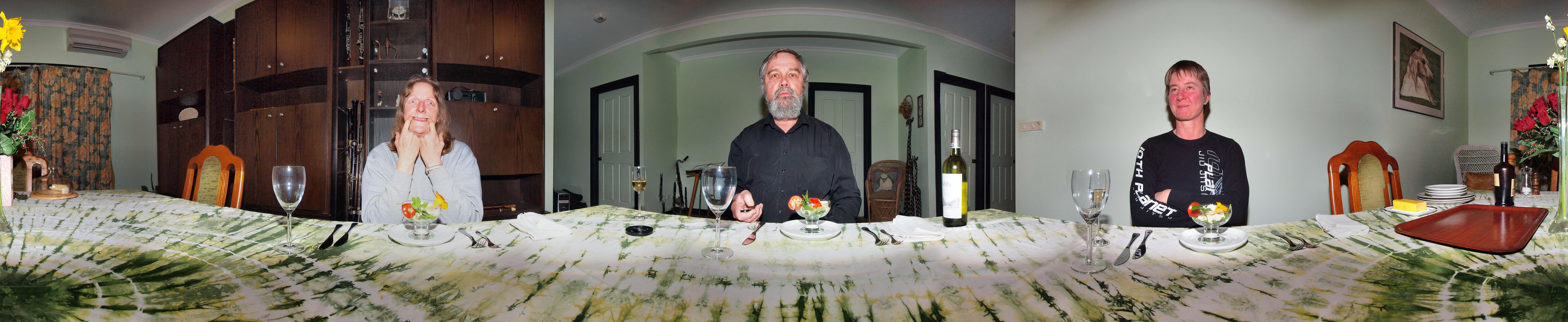
|
|||||||||||||||||||||||

|
|||||||||||||||||||||||
That's the good news. In fact, things didn't go at all according to plan. I forgot to set the flash unit to the “18 mm”. Normally it tracks from “24 mm“ to “105 mm”, values given as full-frame equivalents although the unit is for Four thirds cameras only. To set it to “18 mm” you need to pull out a flap, and I forgot that. And for one of the photos it overexposed completely—I think it emitted full power, so I missed my second photo of Yvonne. Even apart from all that, the lighting looks less even than I would expect.
As if that weren't enough, I had planned a second series with us taking up all the chairs at the table, but I forgot to reset the focal length after taking the photos of the dish, so all I got were a few individual photos:

|
|||||||||||||||||||||||

|
|||||||||||||||||||||||

|
|||||||||||||||||||||||

|
|||||||||||||||||||||||

|
|||||||||||||||||||||||

|
|||||||||||||||||||||||

|
|||||||||||||||||||||||
Next week. Maybe this'll become another weekly ritual, like the house photos.
| Sunday, 24 July 2011 | Dereel | Images for 24 July 2011 |
| Top of page | ||
| previous day | ||
| next day | ||
| last day |
|
Coming up roses
|
Topic: gardening | Link here |
When should I plant roses? Some say that I should wait until after the last frost, but that could be in a couple of months' time, far too late. In any case, there's not much likelihood of a serious frost where the arch is—I don't think I've ever seen it freeze in that area. And the concrete round the arch is solid enough that touching it isn't going to move anything. And I had two rose plants waiting in the greenhouse, an Iceberg and a Rosa banksiae, both of which looked like they needed to be planted.
It wasn't just a matter of planting them. There was also a big rose bush to remove, so big that I didn't want to remove it last year. It has now (just) stopped flowering, a month earlier than last year, so set to to remove it. As expected, it wasn't easy. Cut the lateral roots and tried to pull it out with the car, not helped by the arch in the way—I should have taken it out first. In the end I had to cut the tap roots as well. Took it over to Chris, who planted it immediately. It's a big thing, and hopefully it'll survive.
Putting in the new plants (on the west side of the arch) was straightforward, but of course the concrete round the base meant that I had to plant them a little further away. They were well on their way to becoming root-bound, so it was a good thing I decided to do it today.
| Monday, 25 July 2011 | Dereel | Images for 25 July 2011 |
| Top of page | ||
| previous day | ||
| next day | ||
| last day |
|
More reception problems
|
Topic: multimedia | Link here |
Recorded two TV programmes last night. The earlier one was more or less normal until exactly 21:48:0, and then it went to hell. The second started later and was completely unrecognizable. This looks very much like some kind of interference or transmitter problems to me. But how do I track it down?
|
Olympus “Viewer” 2
|
Topic: photography, technology | Link here |
Olympus have brought out a new version of “Viewer”, their program for image processing. I hadn't installed the previous version on smart, my Microsoft-in-a-VM, so did that today. But they wanted a machine with between 1 GB and 2 GB of memory, and I've had trouble getting even 1 GB in the past. Today was no different: the maximum memory I could set was a little over 800 MB. Made a copy of the disk to be on the safe side, created a new VM to use it, but wasn't able to start it: the copy had the same UUID as the one from which it was copied, of course, and VirtualBox refused to accept it. Somewhere there's a correct way to do it, but I couldn't be bothered looking.
Running “Viewer” was much the same as before, with the same quirks. But I persevered and managed to get it to convert all the images for last Saturday into TIFF, correcting lens distortion as it went. The whole thing took 2½ hours. Is that a lot or little for 309 photos? And of course, the bug is still there that I can't scroll to the bottom of my photo directories. In general I don't see much difference from the previous version.
|
Hugin development version
|
Topic: photography, technology | Link here |
I've been subscribed to the Hugin development mailing list for a while now. Quite a bit is happening: Yuval Levy, the chief developer, has spent the summer adding lots of new features and at least one bug, and since he's going back to university in the Swiss autumn, it's liable to stay like that for a while. But how to find the bug? On some machines, notably Microsoft, but also some Linux, opening the fast preview window causes the process to loop, and they're still looking for the reason.
Decided to jump in and see if I could see anything. That involved minimal work with Mercurial, not as bad as I had feared. But the configuration failed, and after a bit of work discovered that they had removed some of the files, apparently to fix a Ubuntu build failure, but in the process they broke the FreeBSD build.
Finally got it built by reverting changeset 5090. It runs, and I don't have any problems with the fast preview window. So I might as well stick with it.
|
Stopping fondue from getting fatty
|
Topic: food and drink | Link here |
One problem we sometimes have with fondue de fromage is that the fat separates from the cheese. We had a fondue again tonight, and it started to happen. Suddenly it occurred to me: it's exactly the same as frying onion purée for curries and such. There the oil separates out, and that's the sign that it's done: there's too little moisture left to keep the emulsion together. So the fat separates from the fondue when it has been boiled too long and too strongly. Turned the heat down low, and it didn't progress. I'll keep my eye on that in future.
| Tuesday, 26 July 2011 | Dereel | Images for 26 July 2011 |
| Top of page | ||
| previous day | ||
| next day | ||
| last day |
|
Panoramas with distortion correction
|
Topic: photography, technology | Link here |
After converting my photos with Olympus “Viewer” yesterday, I had 32 GB of images to process. The converted images were TIFF format, which required some changes to my scripts—fewer than I had expected. Spent most of the day playing around with them, in the process noting the good fit of most of the images. Went back and compared with the old ones, and discovered that, although the fit was different, there wasn't a really clear advantage of the new ones. Here a comparison:
| Raw | images | JPEG | images | |||||
| Image | Average | Maximum | Average | Maximum | ||||
| verandah-centre | 2.1 | 15.4 | 1.8 | 5.3 | ||||
| garden-centre | 0.8 | 2.6 | 1.0 | 3.4 | ||||
| garden-path-ne | 0.7 | 2.1 | 0.7 | 2.2 | ||||
| garden-se | 1.0 | 3.9 | 1.1 | 3.2 | ||||
| house-nw | 0.8 | 1.9 | 1.0 | 3.2 | ||||
| garden-n | 0.7 | 2.1 | 0.7 | 2.0 | ||||
| north-view-panorama | 0.8 | 2.8 | 0.8 | 2.6 | ||||
| garden-path-se | 0.8 | 2.4 | 0.8 | 2.2 | ||||
| w-to-house | 0.9 | 2.7 | 0.9 | 3.3 | ||||
| dam-panorama | 1.2 | 3.0 | 1.1 | 3.3 | ||||
| house-ne | 1.0 | 3.6 | 1.3 | 2.7 | ||||
That by itself doesn't say very much, though. In particular, it looks as if the first image, verandah-centre, fitted better the old way, but in fact the new one was noticeably better. Here both of them, first the old one, then the new. Running the cursor over the new one will replace it with the old for a better comparison:

|
|||||||||||||||||||||||

|
|||||||||||||||||||||||
In particular, there's a noticeable discontinuity in the beam at top centre:

|
|
|||||||||

|
|
|||||||||
The match is much better, but the colour fringes remain. In this crop it looks as if the old one has fewer colour fringes, but that is probably due to the choice of image at this point. Clearly “Viewer” doesn't do much correction of chromatic aberration with the lens corrections. About the only advantage of the old one is a somewhat more pleasant overall colour. But that can be improved.
The results of the other images vary. Put them on a separate page for later examination.
|
Caught a rat
|
Topic: animals, general | Link here |
Finally I have caught a rat with the new rat cage:

|
|||||||||||||||||||||||

|
|||||||||||||||||||||||
What to do with it? They're dangerous enough that I wouldn't want to give it to the cats, and I didn't feel like killing it. In the end took it down the road, about a kilometre away, and let it out. And it ran straight for my feet! Jumped out of the way and saw it hide under the car. Hopefully it didn't get inside.
Got back home and discovered that I had lost the trigger bar of the cage, the one that locks the door. I must have dropped it when the rat came towards me. Back to where I let the rat out and spent quarter of an hour looking for it. I was just about to give up when I finally found it. But sometimes I'm left with the feeling that this is more work than it should be.
|
The captcha to end all captchas
|
Topic: technology | Link here |
I hate captchas, especially the fuzzy ones. But today I found one that completely blew my mind: who can write Φ²?

|
|
||||||||
At first I thought it was a joke, but I filled it out (with some difficulty) and sure enough, it was accepted. Maybe the hk should have been subscripted, but it accepted it without that. But how can they expect people to enter that kind of text?
|
Slow weeding
|
Topic: gardening | Link here |
It's becoming imperative that I do something about the weeds round the bird bath. Spent about an hour doing only 1 m². There must be an easier way.
| Wednesday, 27 July 2011 | Dereel | Images for 27 July 2011 |
| Top of page | ||
| previous day | ||
| next day | ||
| last day |
|
Frost, transplanting, weeding
|
Topic: general, gardening | Link here |
Just as I had thought that we probably wouldn't have any more frost this winter, another one came—very mild indeed. The bird bath didn't freeze at all—well, not the one I usually measure. We have another one in the Japanese Garden, and it had 0.45 mm of ice on it:

|
|||||||||||||||||||||||

|
|||||||||||||||||||||||
That also gave me a chance to see where the frost hits first: in the east bed, south bed, and round the Tropaeolums to the east of the bunker. Strangely, there was also some suggestion of frost directly in front (to the east) of the verandah.
In the afternoon, finally transplanted the “Gruß an Aachen” rose to the north bed, to the east of the rose arch. I'm still trying to decide what to put on that side of the arch. Mandevilla laxa seems a good choice.
And another square metre of weeding. What a pain!
|
Inconclusive image processing
|
Topic: photography, technology | Link here |
Spent a lot more time today trying to process images in different ways and compare them. It took all day and was inconclusive. I suspect that somewhere I have confused the output of two different processes, but it's difficult to tell. Still, I'm spending too much time on this. If I have to sit in front of a computer, I could at least finish my weather station software.
| Thursday, 28 July 2011 | Dereel | Images for 28 July 2011 |
| Top of page | ||
| previous day | ||
| next day | ||
| last day |
|
Broken door latch
|
Topic: general | Link here |
Getting dressed this morning, found Piccola in the bedroom. The door was open. Put her out, shut the door, and a minute later she was in again. Further investigation showed that the door wasn't shutting properly, and after taking it apart, it's clear that the spring in the latch mechanism has broken.
What a nuisance! It's difficult to get good latch mechanisms in Australia, and I will have difficulty replacing the mechanism with something that matches the others in the house. So the pain is out of all proportion with the damage done. For the time being, took the mechanism out of the door across the hall, the “guest room” that currently has standing room only.
|
Reception problems narrowed down
|
Topic: multimedia, technology | Link here |
Yvonne back with a tiny “set-top box” (in other words, a TV tuner) from ALDI today. I bought it in the hope that it might shed some light on my continuing TV reception problems, and indeed it did. First I connected it at the end of the antenna daisy chain, behind the two PCI tuners, and checked the reception. Pretty much identical to the problems that I've been having lately: in particular, ABC1 was very poor. Played around with the contacts at the antenna amplifier power connector and it got marginally better, barely enough to suggest that it was an improvement. Connected it directly to the connector, without the computer in between: no difference.
So, there's one thing clear, at least for the time being. The problem isn't the computer. So what remains? Connectors, cables (rats?), the antenna, its mounting or the transmitters. The antenna location is really suboptimal:
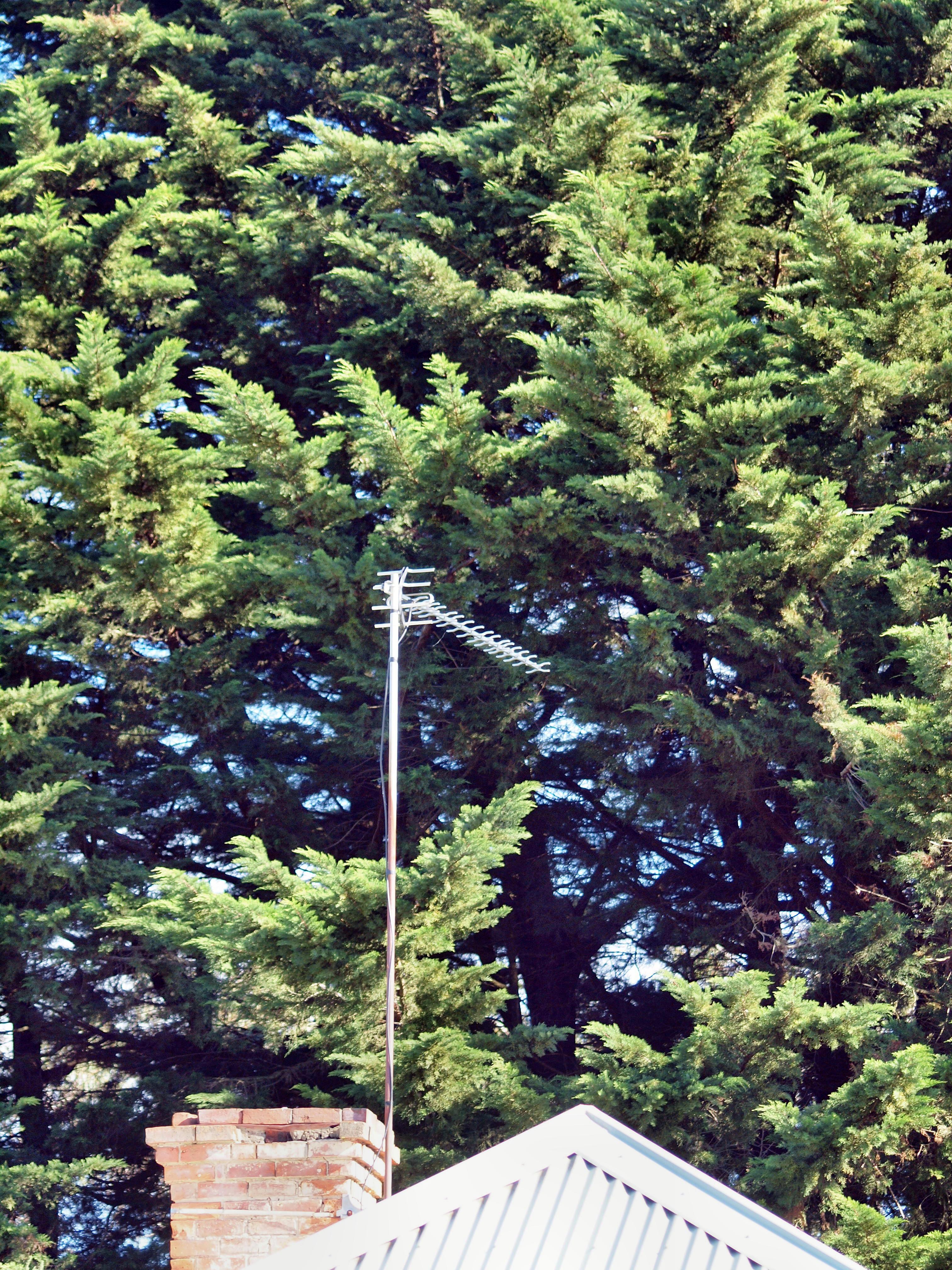
|
|||||||||||||||||||||||
There are other alternatives, such as south by the garage:

|
|||||||||||||||||||||||
But would that make such a big difference? Anyway, at the very least I can now refine my search.
| Friday, 29 July 2011 | Dereel | Images for 29 July 2011 |
| Top of page | ||
| previous day | ||
| next day | ||
| last day |
|
Reception problems: antenna system
|
Topic: multimedia | Link here |
More thinking about the reception problems today. It's abundantly clear that it's a signal strength issue not related to the hardware or software I use for receiving it. But where? Connectors? Cables? The antenna? Its mounting? Or the transmitters?
Walked around and investigated things more carefully. It seems that our antenna is pointing in a different direction from the neighbours', and on further investigation it seems to be pointing differently from both where the old one pointed, and where it was pointing itself 4 years ago. Here two photos from 15 August 2007, showing the old and the new antenna, and one taken today:

|
|||||||||||||||||||||||

|
|||||||||||||||||||||||

|
|||||||||||||||||||||||
It's really difficult to get exactly the same perspective. For the orientation: the antenna is pointing roughly north-west. The first photo was taken from further north than the other two. The third was taken from the same direction, but apparently from closer to the house. Still, it seems relatively clear that in each case the antenna is pointing further to the west than before. It's difficult to compare directly, but it also looks as if the neighbours' antenna is pointing further to the north than my antenna. So it looks as if a bit of antenna alignment might go a long way. But to do that correctly you need some feedback, and it's not clear to me how to do that correctly.
|
60 years of commercial computing
|
Topic: technology, history, opinion | Link here |
Last year I noted that it had been 64 years
since ENIAC was first demonstrated. But it
wasn't for another 5 years that computers came out of the closetlaboratory
and UNIVAC (later called UNIVAC I),
confusingly called a “commercial computer” (something later reserved for
non-scientific computers) was “delivered” to the United States Census Bureau. That was just over 60 years ago, and closer examination shows that it wasn't actually
shipped to the Bureau until the following year.
Looking at the intervening time, a couple of other important milestones occurred in a year ending in 1: in 1971, after a third of the intervening time, the first microprocessor was delivered, and in 1981, after half the time, the IBM 5150 was announced. None of these had the decency to happen on the same day, of course, but the average is close enough to today that it seems like a good time to stand back and look at the historical perspective. It's easy to divide it in to 3 periods of 20 years. In this article I'll concentrate on the middle period.
The first 20 years of commercial computing were characterized by extremely fast changes in architecture. UNIVAC had thermionic valves, the equivalent of 9 kB of delay line memory, and an instruction execution time of about 500 µs. Only 3 years later the IBM 704 had up to 36 kB of 12 µs core storage and an instruction execution time of about 24 µs. And while UNIVAC had a “repeat” instruction, the 704 had index registers. The manual of operation looks almost modern.
In the 1960s transistors gradually came to replace valves, core storage (much more of it) became the standard, and computers developed more and more of the features which we now consider modern: in 1961 the Burroughs B5000 had a hardware stack, the Burroughs D825 of 1962 was a 4 CPU SMP machine, and also in 1962 the Atlas introduced virtual memory. By the end of this period, computer architecture was relatively well-defined. But computers were still big and expensive—even “minicomputers” were too expensive for individuals to buy. That changed with the introduction of the microprocessor.
When was the first microprocessor introduced? It depends so much on what you mean. What does “microprocessor” mean? What does “introduce” mean?
My definition of microprocessor is a CPU on a single chip, not the only definition that was in use in the 1970s. My understanding was that the first real microprocessor was the Intel 4004, and it was introduced in 1971. But what does “introduce” mean? I'd consider it to mean that the first systems were built with it. The Wikipedia article went by the first advertisement, which in my book is wrong, though there's a clear date for that: 15 November 1971. But elsewhere there's mention of production quantities being shipped in March 1971. The truth is probably pretty close to 40 years ago today.
This 20 year period was also full of architectural development, and it's convenient to split it into 4 5-year periods:
1971 to 1975: There was amazing development. The 4004 was followed by the Intel 4040 and the Intel 8008 within a year. Unlike the 4 bit processors, the 8008 was almost a real computer. I wrote a program for one in 1975. And in 1974 the Intel 8080 was introduced. Some of the design compromises made for that processor are still with us today.
With the 8080 it became possible to build real computers. That wasn't what the industry had expected: they were all designed for embedded use, and it took the industry a while to reorient themselves. But CP/M changed all that. Microcomputers were built based on the Intel chips, but also the Motorola 6800 and Mostek 6502.
1976 to 1980: Things continued to improve, but the pace dropped. The next obvious step was to 16 bit processors, and Intel introduced the 8086 in 1978. And nobody paid much attention: the 8 bit processors had the software, and the 8086 wasn't compatible enough. Motorola went one better and introduced the 32 bit Motorola 68000 in 1979. I had predicted an IBM/360 on a chip by 1980. That didn't happen, but the complexity of the 68000 was similar, so I felt vindicated.
Still, 16 bit processors were interesting. The big problem was the operating system: the de facto standard was CP/M, and it only ran on the 8080, 8085 and Z-80. They had a 16 bit version under way, but it took forever to appear. Finally I ended up buying a system in late 1980, from a company called Seattle Computer Products. They had not just the CPU and support boards (S-100 bus) but also an operating system, 86-DOS.
The price was right, but who had ever heard of Seattle Computer Products? I called them up, and the phone was answered by their President, whose name I recall as George Paterson (another indication that this wasn't the biggest company in the world), though I note that other reliable documentation refers to Tim Paterson. I asked him what he thought would happen when Digital Research brought out CP/M 86, and he said “We're feeling confident. Big companies have bought in to the system. If I told you how big, you'd know who they are”. It wasn't until mid-1981 (and the next section of this overview) that the IBM 5150 was announced, with PC-DOS, son of 86-DOS, that I understood what he meant.
1981 to 1986 was clearly the time when computers first became accepted by non-geeks. As the documentary makers would say, it changed the face of computing forever. At work, I discovered that when I found that our admin people were using the same kinds of computers that we had thought the preserve of us techies. Technically, though, 16 bits were here to stay, and Unix was being run on various new 32 bit designs. It seemed that every man and his dog was bringing out new processor designs. And they were developed with that hallmark of big computers, virtual memory.
1986 to 1991 showed further refinement and a bit of a shakeup in the microprocessor market. A new architecture came out: RISC, which would solve the problems of the old CISC machines. Consolidation began, and a number of previously successful designs faded away, such as the Motorola 68000 series. But that wasn't a matter of just replacing CISC with RISC: market factors began to play an increasing factor, and the replacement Motorola 88000 machine was never a commercial success.
And round this time microprocessors escaped from microcomputers and started being used in larger machines. The era of discrete CPUs was as good as over. Even big machines like the IBM 360 series got microprocessor-based CPUs. The small computer became the norm, and many large computer companies switched or went out of business.
Looking back 20 years later, it's difficult to see any fundamental change. RISC computing turned out not to be the silver bullet that everybody thought it was, and CISC is still alive and well, even growing. The change from assembler to higher-level languages meant that the only people who had to put up with emetic instruction sets were the compiler writers. Increasingly, users were isolated from the computers, so the biggest factor in the success of a platform was marketing.
On the software side, a serious split has developed: toy operating systems for the illiterate masses, where the mouse replaces the keyboard, and “hobbyist” operating systems like FreeBSD and Linux for enthusiasts—and a growing proportion of the illiterate masses. Despite the significant increase in the number of people in software development, it seems that important technical issues are not solved as well as they once were: the incredible increase in computing power makes it unnecessary. That's why firefox wouldn't run on a Control Data 7600 supercomputer: it doesn't need to.
That doesn't mean that there hasn't been technical progress, of course, but it's mainly just details. Neither hardware architecture nor operating systems have really changed. Recently Apple brought out a new version of Mac OS X. I read an article about it in c't, a magazine I respect. Most of it was a description of how the appearance had changed, and some minor details have been improved. But is the integration between the operating system and the GUI any better? It wasn't mentioned, but I wouldn't have very high hopes. On the other hand, my interface to my computer is not significantly different from the one I had in 1991. I have multiple monitors and a different window manager, and that's about it. Even the monitor resolution peaked about 10 years ago and has been dropping since then.
Processor complexity and performance have increased markedly, of course. The fastest Intel 80386 of 1991 managed about 10 MIPS. The fastest modern processors now are probably 1000 times faster, achieved not just by jacking up the processor clock, but by increased parallelism. They have integrated cache, multiple processors and—the same basic instruction set. And they run in machines that still bear a strong resemblance to the original IBM 5150. Until recently I ran an Intel 80486-based machine, made in 1992, for my brewing system. I stopped only because it failed, and who needs old computers? People give them away on every street corner.
That's not to say that nothing has happened in the last 20 years, of course. But in my book it's no longer a technical revolution. There are a few new developments, but most of them—even the ever-increasing prevalence of embedded devices—based on technology that was in place decades ago. It's the decrease in size, power and price that makes it possible to market things that would have been impossible 20 years ago. That's technical evolution.
| Saturday, 30 July 2011 | Dereel | Images for 30 July 2011 |
| Top of page | ||
| previous day | ||
| next day | ||
| last day |
|
Garden flowers
|
Topic: gardening, photography | Link here |
Normally I take photos of the garden every Saturday and of the garden flowers on the last Sunday of the month, but today the weather was so windy that I had to put off the garden itself until tomorrow. So did the flower photos today.
There are a number of plants which weren't there a year aog. The Abutilon is flowering happily and is now planted, so presumably it will continue. The same goes for the volunteer Acacia pycnantha in front of the entrance to the house, and the Alyogyne huegelii:

|
|||||||||||||||||||||||

|
|||||||||||||||||||||||

|
|||||||||||||||||||||||
Other new plants are the Banksia (“Honeypot”) a lone Crocus that has already fallen flat on its face, and a succulent of some kind with a flower spike just preparing to bloom:

|
|||||||||||||||||||||||

|
|||||||||||||||||||||||

|
|||||||||||||||||||||||
And the Daphne that my uncle Max gave me nearly 3 years ago has finally flowered:

|
|||||||||||||||||||||||
In contrast to last year we have neither roses nor gingers in bloom, and the Arums are less in evidence than last year. All that suggests a cooler winter, though I can't see any evidence of that in my weather records. Maybe it was wind or some other factor that makes the difference.
|
Dinner panorama
|
Topic: general, photography | Link here |
Last week's attempts at a panorama round the dinner table were less than successful, so did some preparation today with various lighting. It proved that bounce flash (second photo) was better than direct flash, and that even so it made sense to have the diffuser in front of the flash (third photo):

|
|||||||||||||||||||||||

|
|||||||||||||||||||||||

|
|||||||||||||||||||||||
Armed with that, finally got a reasonable panorama. Now we need to work on the motives:

|
|||||||||||||||||||||||
| Sunday, 31 July 2011 | Dereel | Images for 31 July 2011 |
| Top of page | ||
| previous day |
|
More panorama experiments
|
Topic: photography, technology | Link here |
As promised, the weather was better today, and I was able to take my weekly “house photos”, a term that I need to improve: they're mainly of the garden. Did a number of experiments today:
During some of my tests last week, I discovered that I could get almost acceptable panoramas with only half the images. The test was on the verandah, which is stitched together from 24 images: two rows at 30° intervals. The trouble with going to 60° is that the height is lessened, and in practice I've found that 45° is just about enough for panoramas taken in landscape mode. Today I tried the only intermediate step, 36°, which gave me a total of 20 images instead of 24. And in the process, discovered that my rotator doesn't seem to start at 0°. With rotations of 30° or 45°, I can start at 0°. With 36° I can't. I wonder if the previous owner took it apart and replaced the components out of alignment.
My current way of making panoramas involves two processing steps: first I merge two or three images taken with different exposures in the same direction to make a tone-mapped image. Then I stitch the tone-mapped images together. The problem there is that on days like today, when there's a lot of wind, the merged images don't match exactly, and leaves and things are clearly duplicated or triplicated.
So: what happens when I give Hugin the task of merging the images? Put in all 60 images and let it work it out? Tried that: yes, Hugin lines them up correctly, but when it comes to stitching them, it runs into some obscure exposure problem. Possibly that's my choice of processing parameters, but for the time being it's back to the old method.
Carried on from the experiments with Olympus “Viewer” that I did last week. Discovered one of the reasons why the images didn't look that much different: yes, “Viewer” can compensate for lens distortions, but you need to tell it twice, both “automatic” and “enable”. I had only had “automatic” set. Also experimented with chromatic aberration, which, strangely, Olympus does manually even with its own lenses. The results certainly looked better.
“Viewer” takes about 30 seconds per image to convert an image, at least with the VM I'm using for the task; others tell me that on a real machine it's much faster. I took 328 images today, which would have taken about 2¾ hours to convert. But I only planned to use 248 of them. I create a list in a file called makejpeg, which I already use to convert only the ones I want.
Added a Makefile target foroly to pick out the same files and store them in a directory 00-Oly (so that I can find the thing at all in the toy directory tree display), which made things a lot easier. Once again I converted to TIFF, probably a bad idea: try as I may I can't get any useful EXIF information in them. “Viewer” offers the choice “Exif-TIFF”, but it lies.
And exiftool has its problems too. It copies the data, but not all of it, at least the way I invoke it. That's even more of a problem than it seems: I use the EXIF data to set the timestamps on the resultant files, and I order them by time. Without correct timestamps they were out of order, which makes panorama stitching more difficult. In addition, the EXIF data didn't include focal length or focal plane diagonal, so I had to type it in every time. I think I should go back to JPEG.
By evening I had stitched two panoramas, made no easier by the fact that there was sunshine again in the photos, and despite the tricks I used, I managed to get a lot of flare. I wonder if there's some issue with Hugin.
|
Little work in the garden
|
Topic: gardening | Link here |
It's getting warmer again—today we had over 20°—and I should really be doing something in the garden. But photography kept me going all day, and I only had time to do some vine pruning on the verandah.
|
Goodby Carlos
|
Topic: animals | Link here |
Claudia Bietz, who was here a few weeks ago, has bought Carlos, and he'll be leaving soon, probably this week. Yvonne and Chris took the opportunity for a last ride. Carlos is the grey on the left:

|
|||||||||||||||||||||||
|
More reception problems
|
Topic: multimedia, technology | Link here |
So, I had finally decided that my reception problems lie in the antenna system, and I'm wondering whether to approach it myself or get somebody in to do it for me. What speaks against the latter is the suspicion that they won't necessarily do it well enough. It looks as if Barry Robinson positioned the antenna incorrectly when he installed it.
But that doesn't seem to be the only problem. Came in this morning and found one “recording” completely empty, and a second one still “recording”, having stored nothing. Both were on GEM, so it looked like a smoking gun. Tried recording the same programme on another tuner and—it worked. After a lot of further investigation discovered that tuner 1 (the USB stick) had hung itself up. Reboot didn't help. Power cycling didn't help. I had to physically remove the device and replace it, and now it works again. Somehow there's too much flaky hardware out there, and much of it seems to be USB-related.
Do you have a comment about something I have written? This is a diary, not a “blog”, and there is deliberately no provision for directly adding comments. It's also not a vehicle for third-party content. But I welcome feedback and try to reply to all messages I receive. See the diary overview for more details. If you do send me a message relating to something I have written, please indicate whether you'd prefer me not to mention your name. Otherwise I'll assume that it's OK to do so.
| Top of page | Previous month | Greg's home page | Today's diary entry | Next month | Greg's photos | Copyright information |


