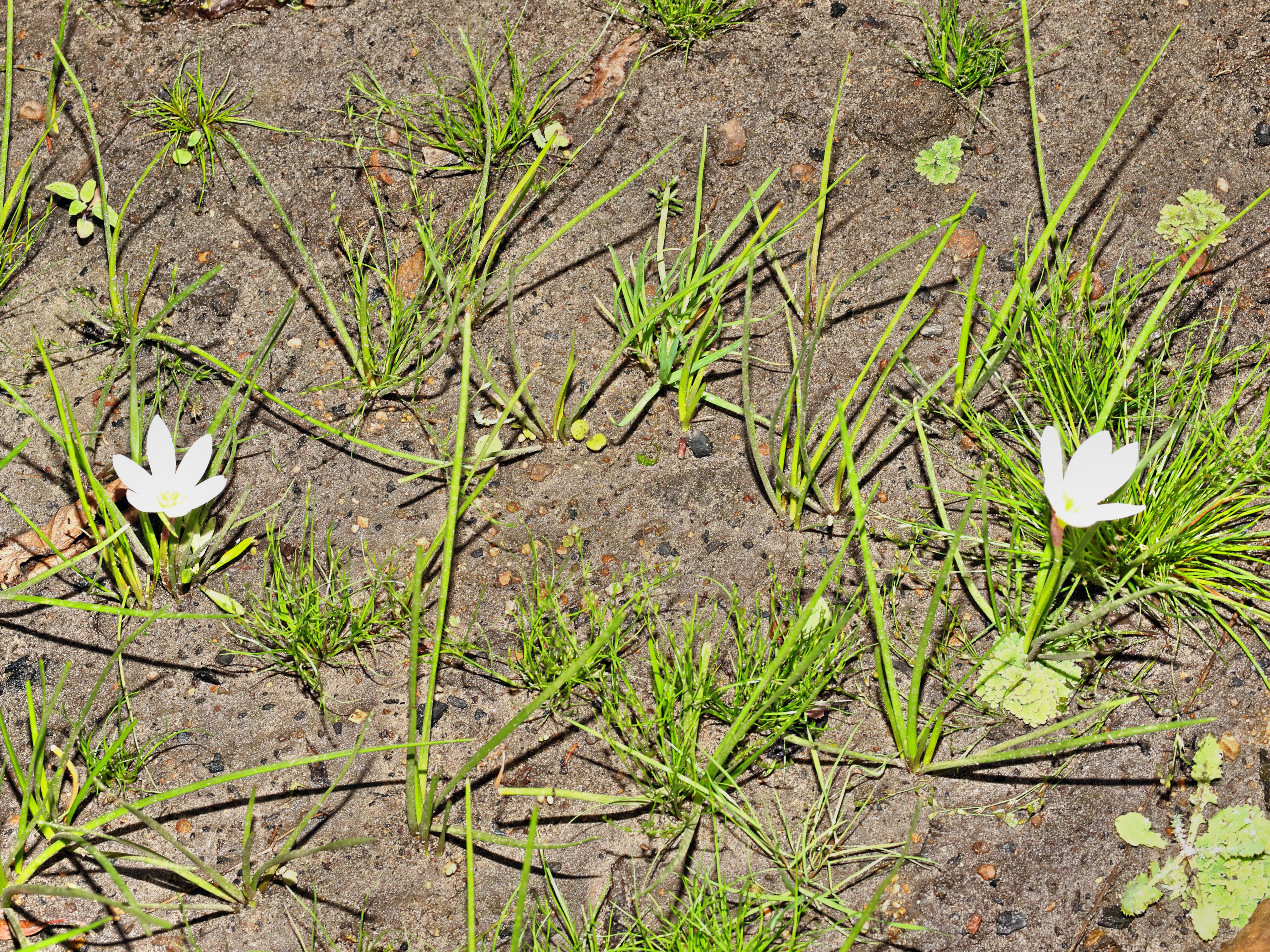
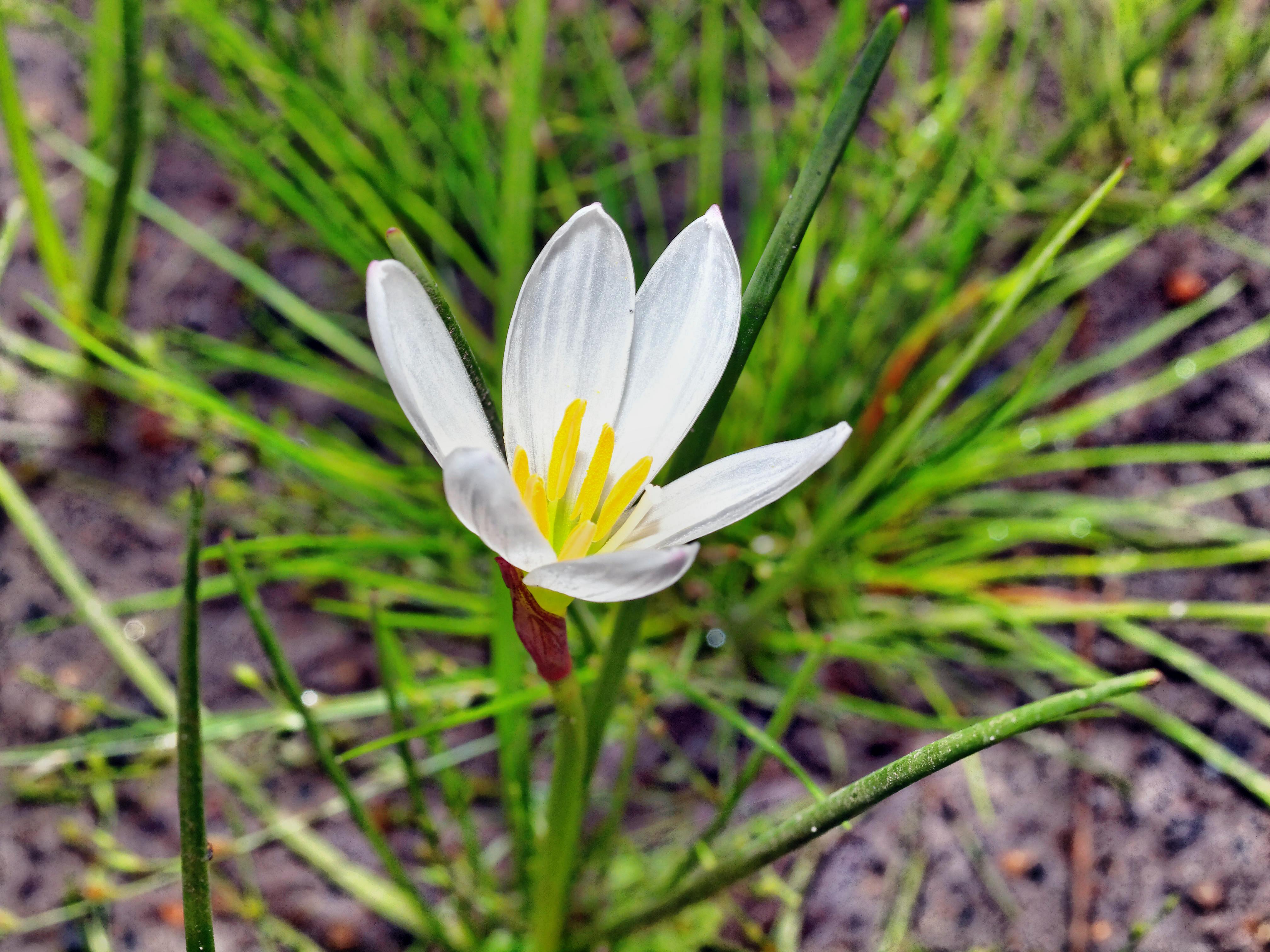
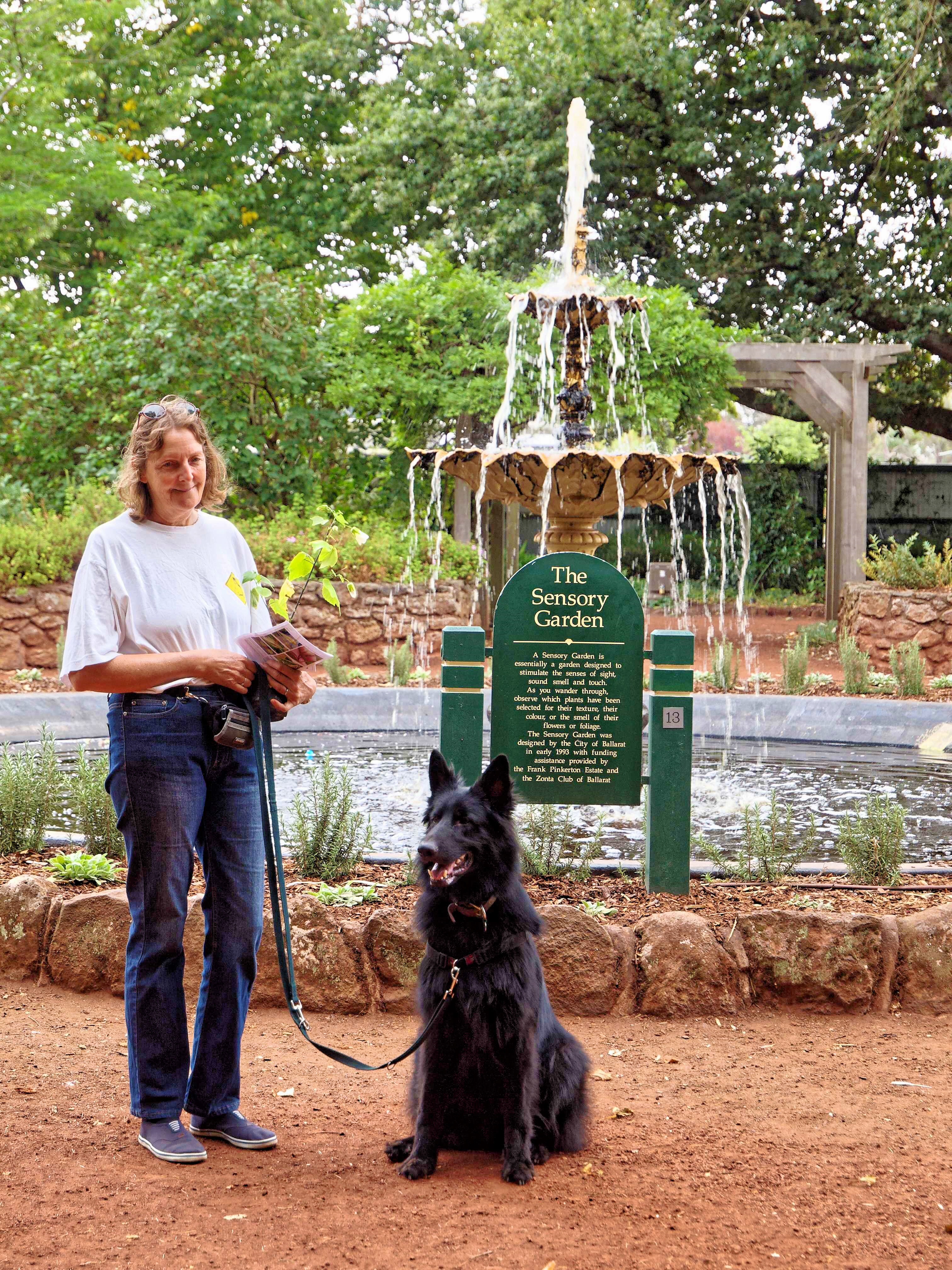
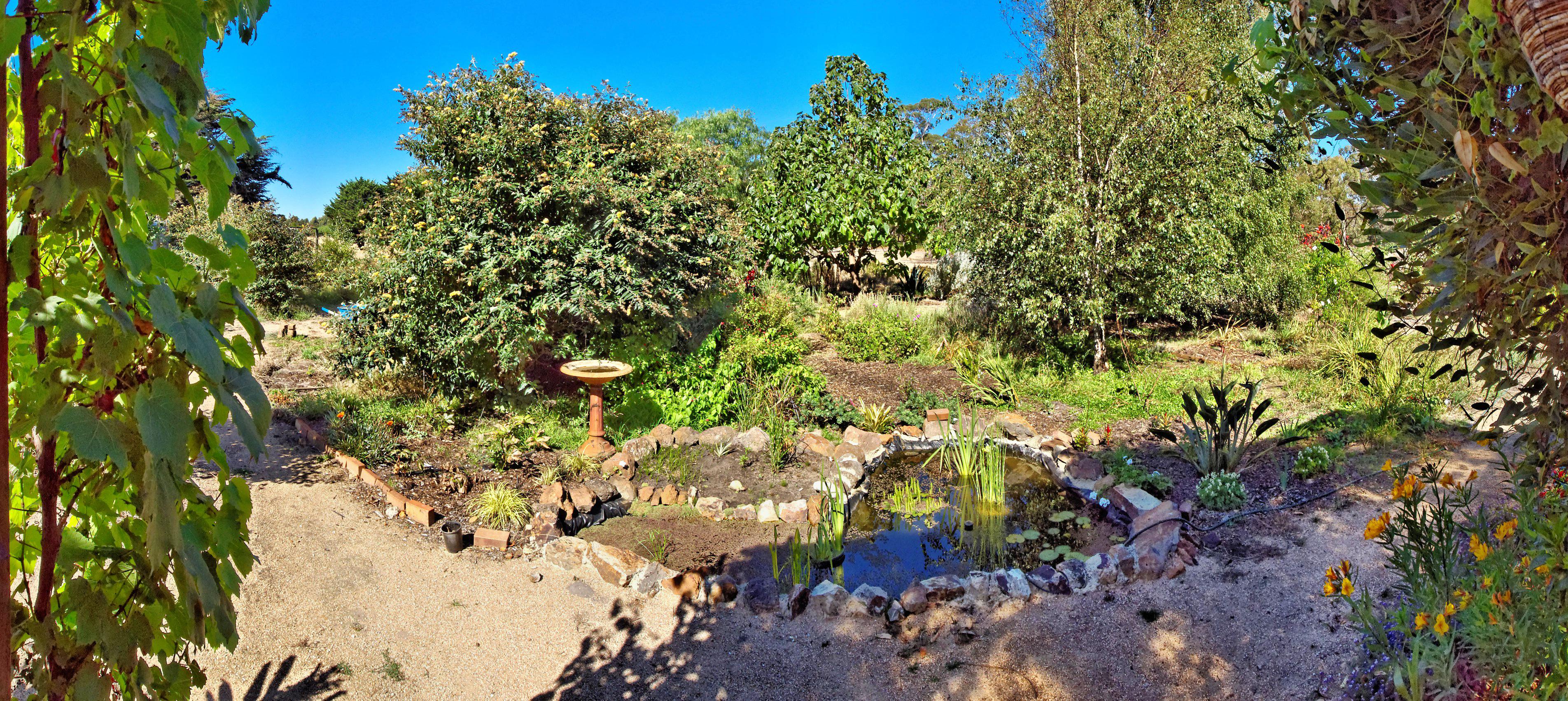
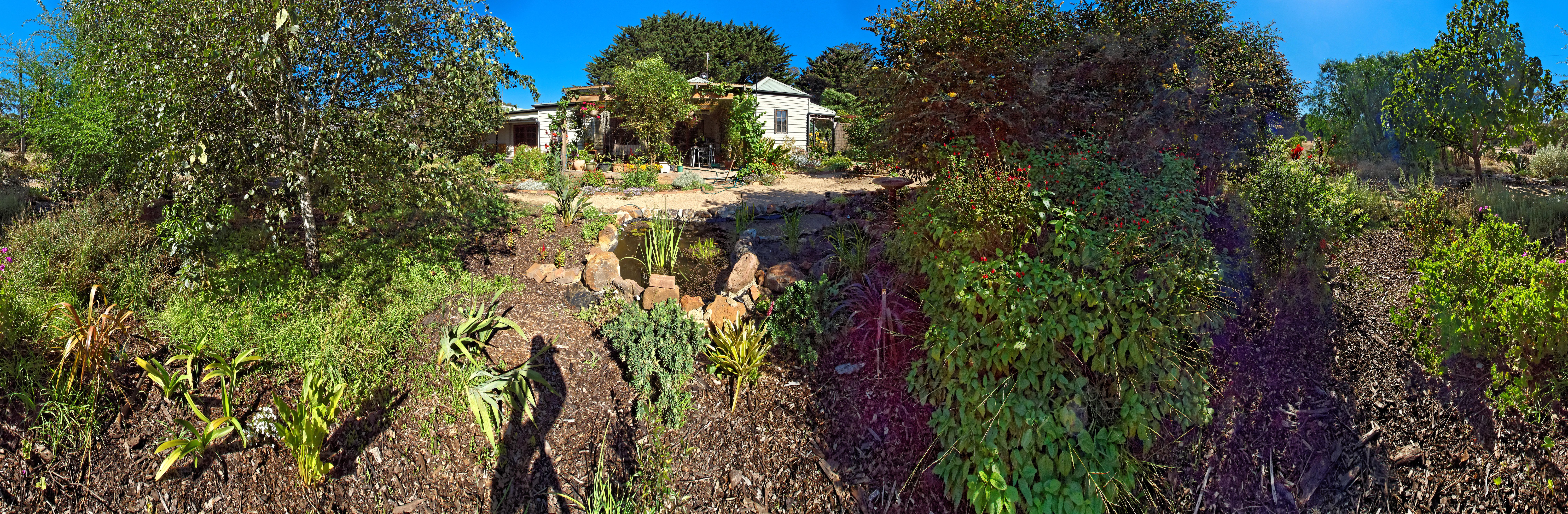
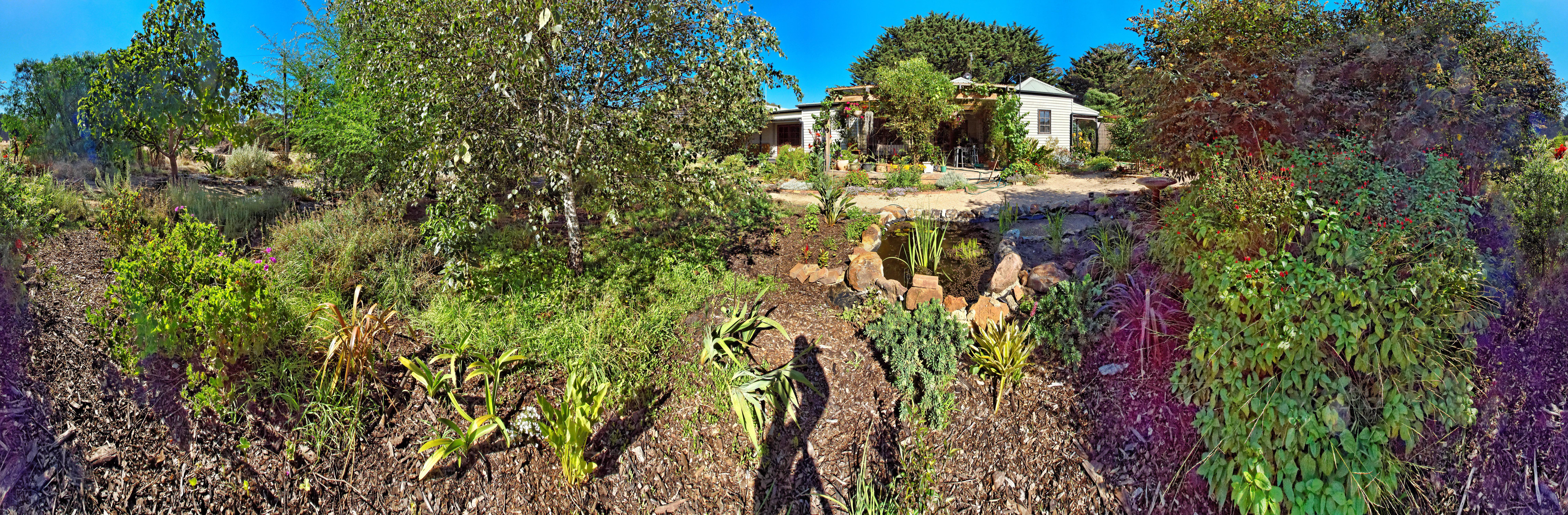
After yesterday's return to garden work, I should have continued today. I didn't, or only
barely. Why? No idea. But despite the fact that I don't seem to be doing very much, I
don't seem to have time for anything. I suppose I could claim that it's “planning”: one of
the reasons that I didn't do much in the garden is that I keep reconsidering where to plant
things. Some day, maybe soon...
I've been quite happy with
the Nickel-Zinc batteries I
bought a few months back, and so I bought some
more. They arrived yesterday: 8 AA size and 4 AAA size. It took me a couple of days to
charge them: that's 4 loads (for some reason the charger handles only 2 AAA batteries at a
time), and each takes 5 hours.
And one AAA battery didn't charge properly. After the charge cycle was complete, one
battery had 1.836 V, which is about normal, and the other only 1.699 V, which is definitely
too low. In the course of time that dropped to 1.368 V. A second time round it didn't
charge at all, but later I got it to go as high as 1.7 V, but after a few hours it fell back
to 1.62 V. Clearly it's defective.
It's always possible that a battery is defective, of course, and as long as it's only one,
it's not even statistically relevant. But it begs the question: how reliable are NiZn
batteries? And more generally, how reliable are other kinds of battery? I've already spent
some time monitoring the charge of my Lithium-Ion
batteries for my camera. Time to do something more general.
Into town today to talk to Peter O'Connell about my finances. Things are looking pretty bad
around the world, but we agreed that, at least for the moment, things in Australia aren't
looking too bad.
Had some time to spare after that, so wandered around the shopping areas. Some things have
changed: there used to be five different bookshops in the central area, and I've noticed
that at least 3 have closed down, including big names like Dymocks and Angus & Robertson. Why? Is it the
economy? Or is it the competition from online sales? I suspect the latter, but I can't
make up my mind whether it's a good or a bad thing. It's good to be able to browse books
before you buy, but there's so much more choice online, and the prices are so much lower (I
think) that I can't really see a future for walk-in bookshops, at least not in smaller
cities.
I've also received my new focussing rail for my panoramas. The previous one was too short,
and I couldn't quite position the lens with the horizontal axis of rotation through
the entrance pupil. This one is
nearly double the length, and there's no issue there. But it's from the same manufacturer,
and it has the same mounting plate as the other—completely smooth:
As a result, the plate doesn't grip properly, and this is the reason for the sag that I have
noticed in a couple of panoramas. What to do? The obvious thing is to stick a layer of
rubber on them, like they do elsewhere. But where to get the rubber? Off to Spotlight, where a helpful assistant helped me look
for things, but at the end I decided that they didn't have what I needed. But they did come
up with the idea of going to Clark Rubber, back in town. Didn't have time for that today, though.
There are other issues with the rail: it has a scale centred round the middle screw (⅜",
conveniently fitted with a ¼" adapter), but the marker is offset by 2.2 cm. Here it's
centred over the hole:
Then there's the issue that you can't position the camera everywhere on the rail: as the
photo above shows, there are two slots and the hole in the middle, separated by about 2.6
cm. And of course, the correct position for my camera with the Zuiko Digital ED
9-18mm F4.0-5.6 lens is in that area. If I put it in the middle, I have the same
problem as with the shorter rail. If I put it at the closest end of one of the slots (it's
symmetrical), the lens is so far back that it potentially enters into the field of view of
the lens:
It doesn't quite, fortunately, at least not with the standard crop, but it's only barely out
of the field of view. ufraw doesn't crop, and there's a slight shadow visible at the bottom of the image:
And then there's the issue of the sheer length of the thing. It makes it almost impossible
to look through the viewfinder.
Maybe I should have bought a shorter rail. But why are these things so difficult?
I've been making my bread according to the same
recipe for years now—since I started
with sourdough I have baked an
estimated 45 loaves. I used 800 g of rye flour and 500 g of “Manhattan Light Rye” bread
mix, really 87.5% wheat and only 12.5% rye—really light. Now the flours have both run out
at the same time, so closely that I finished them both off in the same loaf. And we've
bought new flour, this time plain wheat flour and rye. That's clear enough: I can get the
same proportions with 438 g of wheat and 862 g of rye.
I didn't quite do it that way, though. In the end I used 900 g of rye and 400 g of wheat,
but I partitioned them differently across the fermentation steps:
Step
Old
New
1
150 g MLR
200 g rye
2
350 g MLR
400 g wheat
3
800 g rye
700 g rye
The results were surprising. The first step hardly seemed to ferment at all, but after
being left overnight (the normal procedure) the second step looked fine. But the third step
was close to a catastrophe: first it required a good 50 ml less water, and it turned into
something like glue. I was able to handle it in the end, and the bread looked OK after
baking, but it was amazingly different from previous loaves.
What's the difference? The Manhattan Light Rye had unspecified additives, which I thought
were for flavour and consistency reasons, probably related to the use of yeast and high
proportions of wheat. But that wouldn't explain why the rye was so slimy, nor why I needed
so much less water. My best guess is that the rye flour is different, at least because it
was moister (that would at least partially explain the difference in the use of water,
though 50 ml is still a big difference), or maybe it's just a different kind of rye. We'll
see in the coming months.
Our lawn mower has been out of commission for some weeks now. I didn't mention it at the
time, but it would start, run for about 20 seconds, then stop again, not to be restarted for
a while. It had all the indications of a blocked float valve in the carburettor. I didn't
feel like looking at it myself, so asked CJ Ellis to come and take a look.
That he did today. The maintenance manual didn't give any help (“take the mower to an
authorized retailer”—in itself a problem with this kind of vehicle), but we got the thing
removed, with more involvement on my part than I had wanted. It started when I tried to
demonstrate the behaviour to him. The battery was dead. Not just discharged, but
completely dead, as we discovered over a period of time. It had always been a little weak,
but it seems that last time I left the ignition turned on, and that killed it completely.
The (digital) battery charger showed 0.3 V and refused to even try to charge it
(“Err”). Put some jumpers on it from
the Commodore, in itself a
problem making contact, but even after bringing the voltage up to about 12 V, the charger
couldn't even maintain that voltage. So it looks like we (finally) need a new battery.
I had thought that we just needed to remove the air filter and take the lid of the
carburettor. It wasn't anywhere near that simple: we had to completely remove it and
dismantle it:
And then we found no evidence of dirt. I'm beginning to wonder if my diagnosis is correct.
But we won't find out until we get a new battery.
Now that I have an air compressor, we used that to blow out the channels in the carburettor.
As if we hadn't had enough frustration already, the compressor stopped working. Further
investigation showed that the power switch wasn't working. The external switch is just a
plunger, and it seems that internally it should be spring-loaded to the “on” position—a
strange design in itself—and that this spring loading was no longer working. Put it
manually to “on”, and now we'll have to turn it on at a different switch: if I turn it off
again, it'll stay off until I dismantle the switch again.
45 years ago my father opened an office
in Kuching, the capital of the Malaysian
state of Sarawak, to build Kenyalang Park, a large
housing development. I did some surveying work on it myself in the time I was in Kuching.
Today I got a call from John Ting, an architect in Melbourne, who is writing a book on the
architecture of Sarawak, and wanted more information about it and my father's activity in
Sarawak in general. It seems that he's from the Ting family who ran the local supermarket at the time I was there (and not to Ting Pek Khing, the
rags-to-riches story of the boy selling oranges in the Open Market in Kuching who became one
of the richest builders in Malaysia, with the help of my father). Clearly John was looking
for more details, but all I could find were two very poor quality scans from my father's CV,
showing the place in construction 40 years ago:
This USB tuner I have (Winfast
DTV Dongle Gold, bought only a year and a half
ago) has been pretty flaky: it seems that it will hang up for no apparent reason. To
add insult to injury, MythTV insists on using
it in preference to the other two tuners. So I've taken to removing it from the computer
and only replacing it when I need three tuners.
That was the case yesterday. But now the thing doesn't seem to work at all. I suppose 18
months is a normal life for USB toys—the web page has moved and lost all its images too—but
it gets on my nerves. And I have a third PCI tuner, but no PCI slot to put it in. What a
pain all these things are!
The red rose that I transplanted far too late this spring lost all its leaves and looked very unhappy for a while. But then it
recovered, and now it's in bloom—at a time when less badly treated roses around it are not
doing very little. But it's pink:
I should be attending to the weeds in the north garden (where the rose is growing), but it's
becoming apparent that I've neglected the vine on the verandah too much, so spent some time
attending to that. Putting up wires to train the vines along is a surprisingly strenuous
task, and I'm still not finished. But I need to do something soon: there are shoots all
over the place that require training. Two more wires and I'm done.
From webmaster@vamrad.by Thu Feb 2 06:00:06 2012
Delivered-To: groggyhimself@freebsd.org
Received: from mac.mir.by (ns.mir.by [93.125.59.1])
by mx1.freebsd.org (Postfix) with ESMTP id 7AFAB8FC18
for <groggyhimself@freebsd.org>; Wed, 1 Feb 2012 18:47:11 +0000 (UTC)
Received: by mac.mir.by (Postfix, from userid 2077)
id 4429CAD823B; Wed, 1 Feb 2012 21:37:34 +0300 (FET)
To: groggyhimself@freebsd.org
Subject: <? print $subject; ?>
X-PHP-Originating-Script: 2077:helpus.php
From: Frank Lincoln <flincoln777@gmail.com>
Saturday again, and more house photos. Today was the first day with the new, longer
focusing rail. It's useless! Or at least it is for the crucial verandah photo. The zenith
shot requires the camera to be pointing directly upwards. That works with the short rail:
In fact, just about any rail longer than the short one is too long, since it would foul the
base of the panorama bracket otherwise.
That doesn't make the bracket useless—most panoramas don't have a zenith shot, and if I use
other lenses I'll need the extra length. But it just goes to show how difficult the minor
things about panorama hardware are. I can probably fix this specific issue by drilling a
hole further back than the slots, which would also have the advantage of more consistent
positioning of the scales.
The main verandah images are gradually getting there. Today I took two zenith images,
offset by about 10° (which, coincidentally, would have allowed me to use the long rail).
The control point detection was better, but still not perfect.
From an exposure point of view, I tried filling in the dark areas of a couple of the photos,
with reasonable success. Here the shade area with the washed out colours, with and without
flash fill-in, once again with mouseover alternation:
Clearly here the first photo shows much better gradation at the right of the tree fern and
shade area.
Also tried the same thing in the centre of the garden, where I've had problems in the past.
I did today too, not helped by the wind, but it was marginally easier with flash, and again
the results are better, though it's not as obvious as with the previous photo:
The difference in the details between the photos is also surprising. That was the wind, and
it makes it clear why stitching this image is such an issue.
Then there's the view from the verandah to the pond. That's an issue because there's only a
small area round the bird bath that needs illumination. How do I do it? A little flash
just isn't enough, because the overall exposure doesn't need it, and it illuminates evenly:
The biggest difference there is the vines on the left. So I tried manual flash with a
longer focal length of 85 mm (also manually). That illuminated the area round the bird bath
better, but completely overexposed the vines
and Hardenbergia in the edges:
In the end I took photos from different series and masked them. Most of the images here
come from the series taken without flash, including the left-hand side of the left-hand
image, and only the area round the birdbath gets the full-power flash.
It's still not perfect, but it's getting better. One of the issues was the illumination
round the bird bath. It looks as if the focus of the flash gun went to the right of the
bath, but looking at the original component image, that doesn't seem to be the case:
Andy S (I should know the surname, but he hides it) has been following my experiments with
panorama photography, and suggests I should get the right stuff—in fact, the Really Right Stuff. For example, I could get a
rail and clamp set for the special price of only $200. The web page doesn't give
useful details like length, and neither does the manual (yes, a manual for a rail!),
but reading the scale and comparing with the product number suggests that the length is 192
mm. Is it better? It too has two slots and a hole in the middle. It's more solid, and
requires Allen keys to screw things together. And it has a bullseye spirit level.
The length is intermediate between the two rails I have. The price is over 10 times as
much. What do I get for that? It still has similar disadvantages. It, too, would not fit
on my panorama bracket. It might not block the viewfinder as much, but only because it's
shorter. And it's not clear that the one wouldn't also intrude into the field of view. If
I waste $15 on a rail, I can live with it. If I spent $230.43 (including postage) on the
same thing, only to discover it wasn't what I needed, I'd really be pissed off.
Then there are things like NodalNinja.
They offer rotators and brackets too. The rotator looks pretty much like
what I have, and (without postage) costs about 50% more than the Sunway. The panorama
bracket doesn't look that bad. For $239.95 (+ guessed $35 postage) I could get effectively the same thing as I bought for $90 (including postage) in
November—except that I can't mount the camera in horizontal orientation. In summary,
though, “get the right stuff” is what I'm trying to do. I can spend more money and still
end up with the same issues, or even worse.
Last year we had really good rainfall, and the two halves of the dam stayed joined from
September 2010 until December 2011. Things have gone downhill since then, though. Here's what it looked
like a year ago and what it looks like now:
The effects are showing elsewhere, too. A number of areas in the garden that looked as if
they were adequately watered last year are now showing signs of dryness, notably south of
the verandah. Even
the Watsonias are looking
unhappy. Put in some more drip line and a sprayer. With any luck that will reinvigorate
the roses and Clematis on that side of
the verandah too.
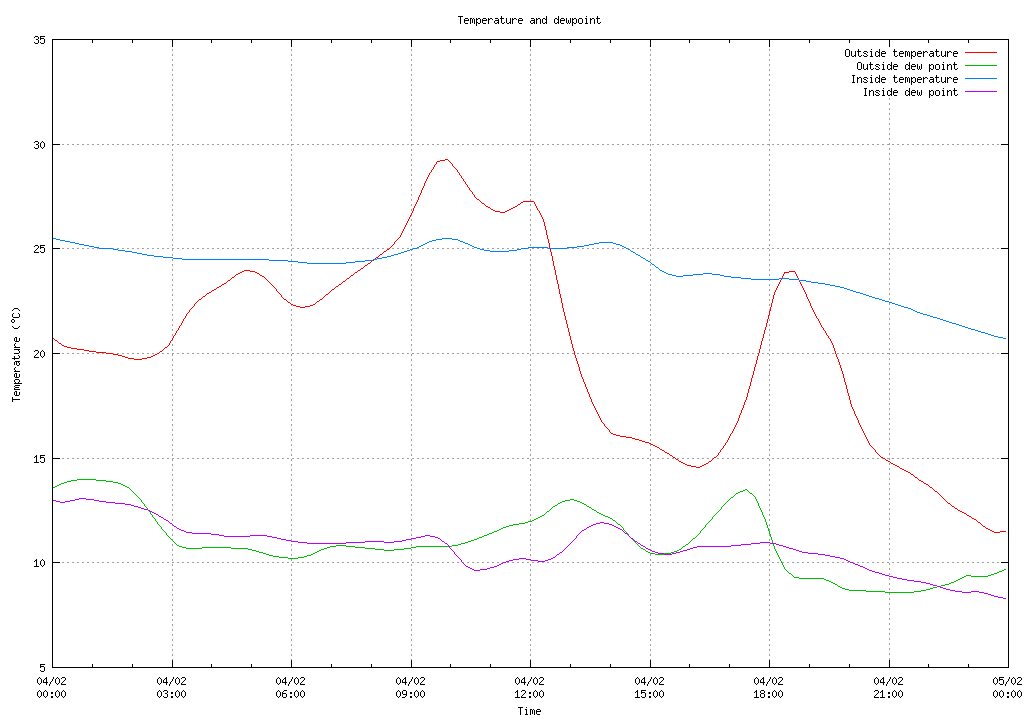
Another day when I didn't do anything in the garden. The normally dry summer is making
itself evident again. Woke up with temperatures in the high 20s and winds of up to 40 km/h,
hurling up dust all over the place. But it didn't stay that way. By mid-afternoon the
temperature dropped below 15°, and it started to rain.
In the morning it was too windy, and in the afternoon the rain kept me away. I could have
attended to the vines on the verandah, of course—in fact, I should have—but I found
some excuse.
Things are happening in the greenhouse, too.
The Murraya koenigii (curry
tree) that Peter Jeremy brought nearly two years ago was
the only survivor of a number of shoots, and it didn't do much until January last year:
It grew quite happily for a while, and then stagnated. About a month or two ago
a Silver birch seedling
established itself in the pot and rapidly outgrew the Murraya, which had hardly changed.
But now it's growing again, and has almost doubled in size in the last month:
It's no longer the only one, though—three other seedlings germinated, and I have been able
to keep the other plants free of aphids, though I don't like the look of that ant on a
flower:
Lately we've had a lot of cockatoos around here, screeching their heads off. Today I tried
to take some photos, not helped by the light. But I saw something surprising:
Message from Michael in South Australia today about my “right stuff” article. He agrees with Andy S. He points me at this
video, showing how easy it is to put a Really Right Stuff panorama bracket together:
I really hate watching Youtube, but I looked at this one. It serves to confirm my
dislike. It's badly produced, and he didn't stress the important information. In
particular, he didn't explain how to adjust the position of the entrance pupil in line with
the upper rotator. But it works, and it works well. The result looks pretty much like what
I discuss in much more detail last
month.
There are differences, of course:
The Really Right Stuff solution
has much better workmanship than my bracket.
Using the L plate, he can move the camera from vertical to horizontal without
readjustment. My solution has an L bracket too, but it requires readjustment.
His solution doesn't use a detented rotor, something that I consider important. Mine
does.
His side clamp has a degree scale. Mine doesn't. This is a distinct advantage, and
would have helped solve the stitching problems I had with my verandah panoramas
a couple of weeks ago.
The Really Right Stuff solution is more modular, a great advantage.
The accuracy of the alignment of the vertical and horizontal rails is “flush”: in other
words, it's up to you. It's also possible to assemble it with the rails offset,
introducing an error. Other brackets are fixed, so this particular mistake couldn't
happen.
And what does it cost? It's difficult to say, because this arrangement doesn't correspond
to their bundled offerings. Searching through the myriad pages, I think that I could get an
alternative from these components, starting from the bottom:
At the very bottom comes the detented rotor. Unfortunately, Really Right Stuff doesn't
seem to offer one. This greatly detracts from the potential “all from one supplier”
approach.
MPR-192: 192mm Multi-purpose rail for the bottom horizontal rail, only $75. This
is the device that I looked at yesterday, without the clamp.
An L plate. This is difficult: there's a different L plate for each camera, and they
don't make one for the Olympus E-30, though there's evidence that they once did. But that's not
important for pricing: they all cost $140, such as the B20DL: LPlate for Canon 20D without grip.
It's possible to attach the camera without the L plate, just a B20D: Conventional Plate for Canon 20D—again there's nothing for Olympus—which
saves $85. But that also limits you to portrait-only orientation. I haven't bothered
to look for a solution to that problem.
All this comes to a total of $773.54, including $43.54 postage. Of course, there's an
easier way if we don't want exactly the configuration in the video: their Panorama Packages.
There are two possibilities:
The PG-02 Omni-Pivot Package, which costs $535 and requires a nodal slide (MPR-CL II: MPR with integral clamp for another $140). They also don't mention
it, but it's also missing the L Plate, which is necessary for this configuration. That's another $140. With
$52.42 shipping, that comes to a total of $867.42. The components are different from
the ones in the video, and they don't look as good. In particular, the upper rotator
looks less robust. Still, it appears that they will do the trick.
I could also take the PG-02 Pro Omni-Pivot Package (savour that “Pro”) for $895, which includes not
only the nodal slide, but a panning clamp without detents at the bottom. It still
requires the L plate, so with $58.07 shipping, that's $1,093.07. And yes, the L plate
is necessary, as the 360° rotation shows. For that I get the nodal slide and a
PCL-1: Panning Clamp without detents at the bottom. This doesn't really buy me
anything that the previous package doesn't.
So we have four possibilities, all of which offer roughly equivalent functionality. The
solutions above still require a leveller and a detenting rotator. I'm still looking for a
leveller, so I leave it out of this discussion. If I took the Sunway DDP 64M rotator in each case (another $170.92), the prices
would look more comparable:
The custom setup I selected above, for $944.46. This looks so much cheaper than the
other two that I'm left with the worry that I might have missed some component. And
that's a general issue buying this stuff.
What I have now, for $288.37.
Clearly my solution is less than a third of the price of the cheapest Really Right Stuff
solution. What do I lose? There's no degree scale on the upper rotor. The L plate isn't
adjusted to my camera (a moot point, since Really Right Stuff doesn't have one for my camera
anyway). The workmanship is not as good. And that's about all.
Probably Andy and Michael (and potentially many others) are missing something: I already have
a functional solution. The issues I describe in my diary are just that, details, and they
have solutions. If I spend up to $1,000 more, I will still run into many of these issues.
I'm not too worried about the Canna (first
photo), since they only last a week or so each, but I was quite unhappy about
the Alyogyne. I had already
given it a post to steady it, but it snapped off at ground level. The roots on the one side
of the Alyogyne were torn out, but the rest looks OK, so I rammed in
a Star dropper and tied it to
that. I hope it survives: it's one of the longest flowering trees we have.
In the afternoon, went past the garden pond and heard a particularly noisy fish. On further
investigation, it popped out of the water and showed its head briefly before submerging
again and popping up somewhere else:
a Little Cormorant. It finally
flew off, leaving at least one very agitated looking fish there. What do we do about that?
Wire netting?
That wasn't the only problem. Every time we have stronger winds, the water irises tip over,
and I have to get in the pond to put them back in place again. Clearly not a thing to do
once a week, especially when the weather gets cooler. Today decided that an outer pot
resting on the ground might help things.
And that caused a chain of events. We didn't have a spare pot, but had an ornamental grass
in a suitable pot that we had planned to plant anyway, once it had finished flowering.
That's the case now, so tried to get the grass out of the pot, not helped by the silly ridge
inside, and used that. So far it looks more stable.
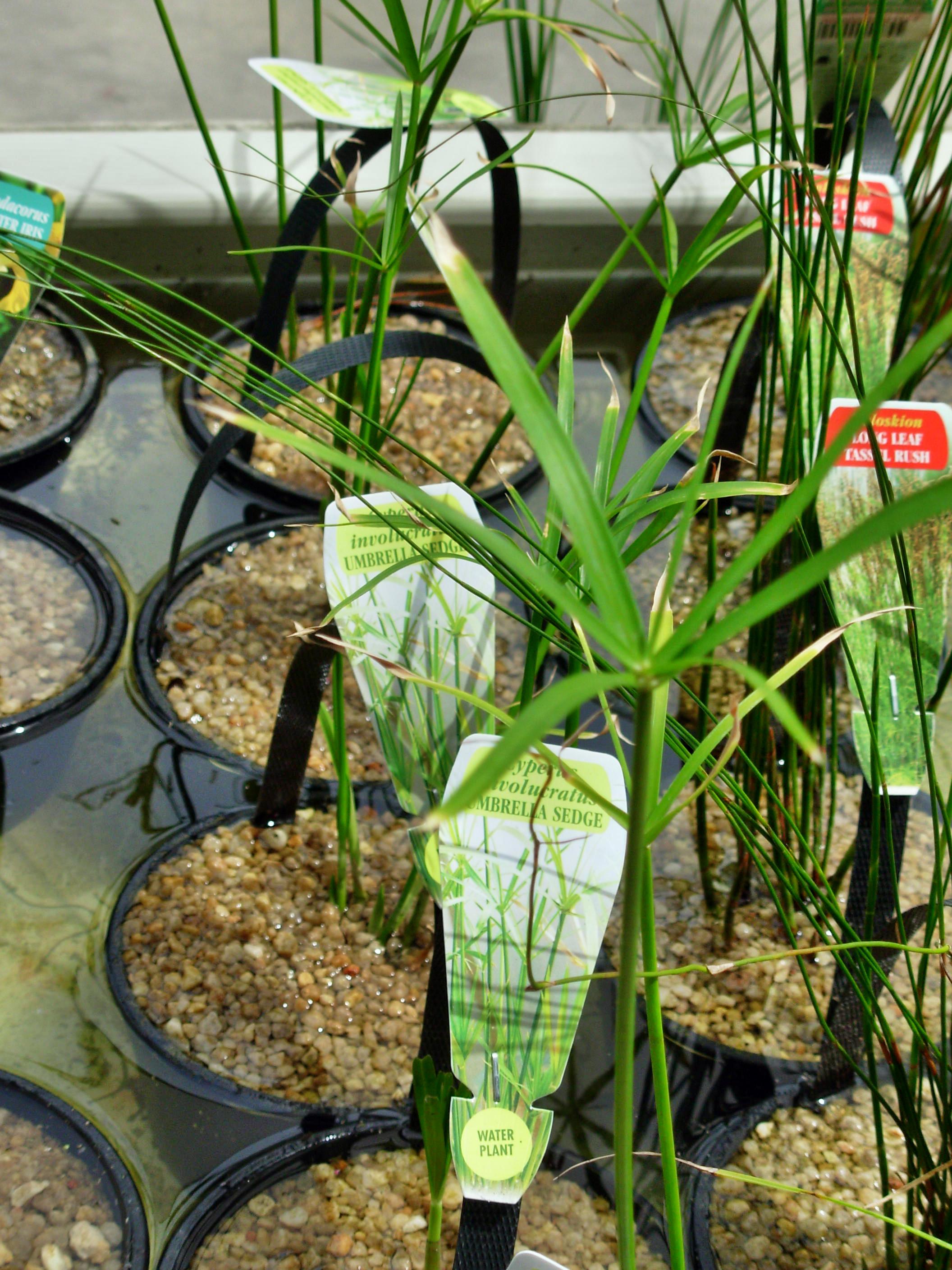
That left us with the grass, of course. Where should we put it? Somewhere near the pond,
but there are a lot of plants that we intended to plant round there. So we ended up
clearing the weeds and planting a number of plants:
The grass to the right of the bird bath, in front of
the Salvia microphylla.
The Limonium perezii bought
at the same time, to the left of the orange flower, requiring the removal of the first
of many Watsonias. We'll
see if it survives the winter.
So now, gradually, we're getting most of our plants planted. Hopefully I'll get the rest
done soon. We still have a few trees in small pots that we brought with us from Wantadilla nearly 5 years ago. High time to plant them as a wind
break to the north-east.
Peter Jeremy came out with an obvious alternative solution to the “verandah east” exposure
issues that I discussed on Saturday:
take the photos in the afternoon, when the sun is coming from the north-west. Tried that
today, and the sun promptly disappeared. But of course it worked better, and without flash.
Here Saturday and then today, once again with mouseover
alternation:
That in itself isn't a solution, though. Firstly it won't be as good with sunlight, and
secondly my real intention here is to find a good way to expose these problem images.
Yesterday was a bit of an exception in gardening: we did something significant. I tried
again today, but didn't get beyond a few barrowloads of mulch and a bit of work on the vines
over the verandah. It's so tiring, not helped by having to move lots of heavy pots, and I'm
still not done. The last two wires still need to be completed, and after that I'll have to
prune back lots of shoots that went off in the wrong direction.
I really need to look at this at least once a week. Still, one way or another it should be
complete next year.
Also a bit of attention to the area south of the verandah. Things are growing there again,
but there's still evidence of lack of water. On investigation, discovered that the whole
irrigation circuit in the area was set to run for only 20 minutes per day, as opposed to 30
(and in one case 40) minutes for the others. That explains a number of things. Also spread
some fertilizer in the area to be on the safe side.
What is it? A baby dragon? Until I looked at the photos, I wasn't even sure that it was a
spider. But it is,
an Austracantha minax or Jewel
Spider (or, for the Americans, “Australian Jewel Spider”—it seems that there's a similar
looking animal elsewhere). What a strange looking animal!
My current keyboard is a Northgate OmniKey keyboard manufactured in August 1989, 22½ years
ago. It's no longer in the best of condition, but in all that time I haven't found anything
that I would like to replace it with. Things are getting desperate, though. The r
key, in particular, is bouncing badly.
But it's not the only keyboard of that kind that I have, and in the past I've found that if
I rotate between them, the bounce tends to recover. So today I went to see what I could
find: two Avant
Stellar keyboards, both with defective keys, and three other OmniKeys (I thought I had
five, but I can't find the fifth), all with their own problems. Tried them in turn and
found: one had a defective Control key and a couple of flaky keys; another had really
severe bounce in the Space key; the third had a broken clip on the Enter key.
With a bit of chopping and changing (moving parts from one keyboard to another) I can
probably get a few more years' life out of them. But as I've commented before, this is stupid. Why can't I find a modern
keyboard that will satisfy me? There's also the issue that PS/2 keyboards are obsolete, and
the modern replacement is (shudder) USB.
So what do I need from a keyboard? The keys should feel “right”, of course, but most modern
keyboards, even the cheapest, aren't too bad in that respect. But they're clearly designed
by people who can't touch-type. In particular, about 25 years ago the function keys were
moved to where you can no longer find them without looking at the keyboard. For some
reason, they've also done it with the Esc key. That's the biggest issue I have.
Others, such as the location of specific keys (`/~ and the Ctrl and Alt
keys) depend on the use of the keyboard, and they can be relatively easily remapped (except
for those brain-dead keyboards that hard-wire the completely
useless CapsLock key). And though the “Inverted T” arrow keypad layout
makes no sense at all, it's not really that painful, though like any keypad it requires
moving the hand from the main keyboard.
So: the big issue is to find a keyboard with function keys on the left, where I can access
them without taking my eyes off whatever else I'm looking at. They must be available. Time
to start looking.
More work on the verandah today, and finally got the wires up for the vines. I
should have done it long ago, as some of the unwanted shoots showed. The one that grew out
of the Hardenbergia in the first
photo came, as I feared, from the other side. It was 3.5 metres long, almost the depth of
the verandah:
Removing all the shoots is counterproductive. They shouldn't stay, but at the moment
they're providing shade, so I decided to just cut off the tips in the hope that that will
allow other shoots to grow. The extraneous ones will come off in the winter, when it will
also be easier to trim them.
Also looking for a place to plant the Iris-like plants that we bought on Australia Day. Once again looked at the area south of the verandah,
but the soil there is really pretty terrible. Managed to drive my pick through some tulips
that somehow had not only survived but thrived there, cutting one of the bulbs in two. I
suppose I should plant it separately and see if it (they) survives.
Another day with little to report. Spent lots of time messing round at the computer,
finally spread a bit of mulch on the north bed, and that was about that.
Spent some more time looking for replacement keyboards today. The one must is
a function key block on the left—as I discovered in Wikipedia, others agree with me:
Early models of Enhanced keyboard (notably those manufactured by Northgate Ltd.)
maintained the layout with function keys on the left side, arranged in two columns of six
pairs. This layout was more efficient for touch typists but was superseded in the
marketplace by that with F-keys along the top.
But where can I find one? I recall having found a number of links a while back, but I can't
find them any more. Looking on eBay and similar
didn't help much. And it's not as if I can buy just any keyboard with F keys on the left,
either: I already have a very dubious one which I refuse to use.
But then I have at least two other keyboards which almost fit the bill: Sun Type 5c and Sun
Type 6. The main problem is that they're electrically incompatible. Did more investigation
and came up with a number of pages describing how to build USB adapters: http://kentie.net/article/sunkbd/ describes what appears to be a prototype to
adapt a Type 6 keyboard, but it requires a lot of work, including programming
microcontrollers. http://gis.sakura.ne.jp/sunkey/sunkey_e.html describes a similar one for a Type 5 keyboard, but it doesn't even have a circuit.
http://www.buzzard.me.uk/jonathan/sunkbd.html, also for a Type 5 (is
there any difference?) gives much more detail, even a PCB mask.
But again it requires a microcontroller. As a kernel hacker, I'd rather minimalist hardware
and a kernel driver. The first link above provides some Sun documentation for the keyboard
protocols, which show it to be 1200 bps at TTL levels. It should be relatively trivial to
connect it to a serial port, or a serial/USB adapter. But I'd much rather find something
that doesn't need any custom hardware at all. More searching needed.
Of course, even that may be overkill. The Type 7 keyboard has a USB interface, and they're
available. But I've found various reports on the web suggesting that people have had
trouble with them, I don't have one, and though they're relatively cheap second-hand (from
$29), they're all in the USA, and they want more than double that price for shipping. And
what happens then if I find that I don't like it? So for the time being I'll investigate
the option of a TTL to RS-232 level adapter.
It looks like rain tomorrow, so I pulled my house panorama photos forward to today, which
coincidentally allowed me to try taking them in the afternoon instead of the morning. And
once again I had trouble with the base plate for one of the sliders. The standard base
plates used to attach cameras to tripods have a separate locating pin which fits into the
indentation under the camera. Or do they? I had a recollection that all cameras had that
kind of indentation, but on examination, the only camera with such an indentation was my
Olympus E-30. I
have 5 other SLRs here: an Asahi Pentax SV, an Asahi
Pentax “Spotmatic”, a Pentax Z1, a Canon 20D and (on loan) Chris Yeardley's
Nikon D70. None of them have the indentation. The only other camera I found was a Samsung
video camera:
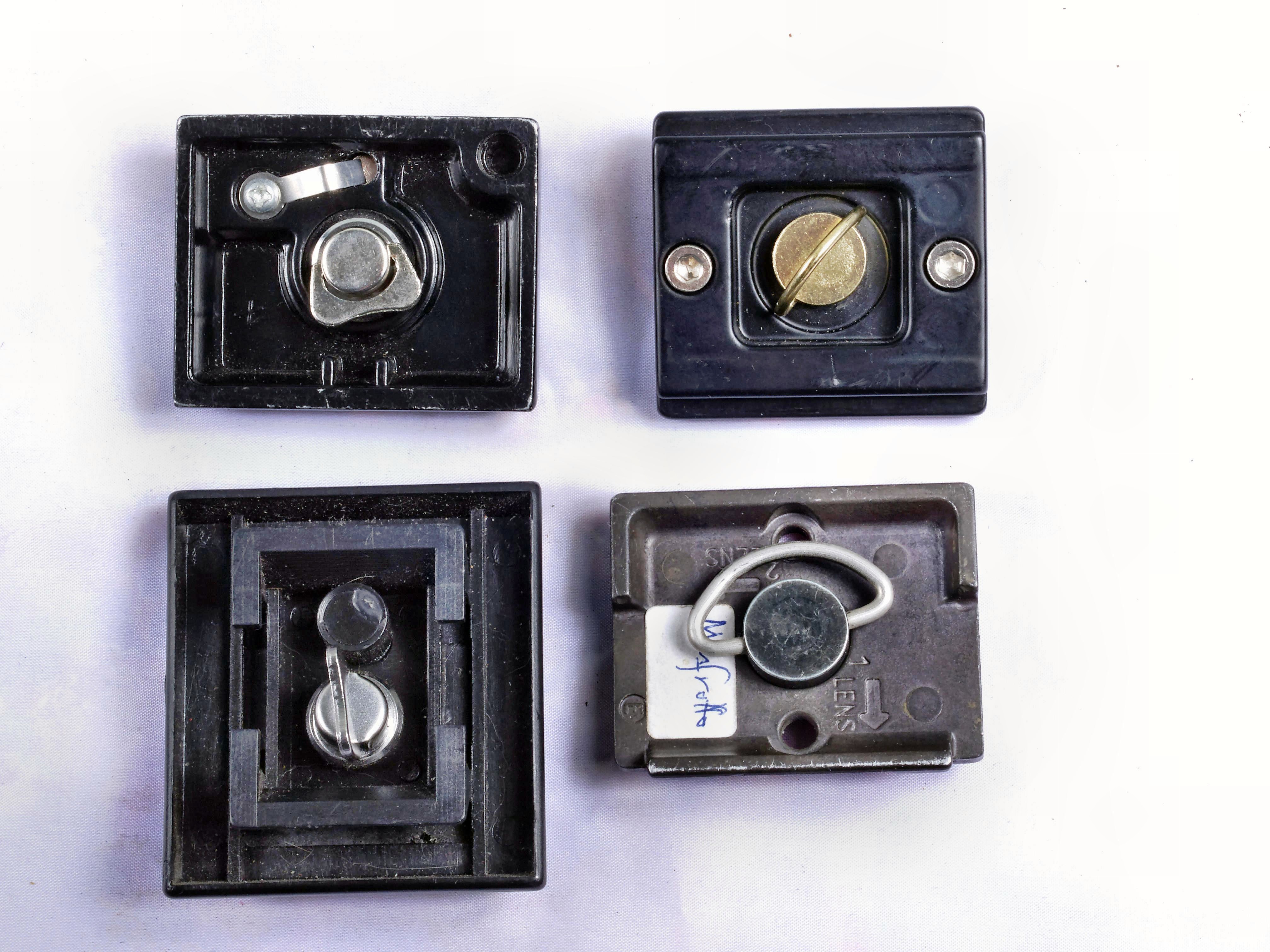
The ones on the left with the pins are the cheap Chinese plates. The expensive Manfrotto
one (bottom right) has holes, but no pin. Neither does the plate that came with the
panorama bracket (top right), though the underside has some rather useless screws with Allen
keys that may be removable:
And the recess in the Samsung is so large that it only roughly holds the thing in place.
There seems to be little standardization of these things. In any case, it seems reasonable
that I should drill a recess into the base of the rail, remove one of these silly Allen key
screws and replace it with something longer to fit into the recess. More investigation
required.
Somehow didn't find much time for the garden, but I really want to get the mulch in the
north beds done, and did put some in, by hand. Hopefully it will help significantly in
keeping the weeds down.
We ate “tacos” yesterday evening, and we
were left with lots of Pico de Gallo and Guacamole, so it was clear that we
had to eat huevos rancheros today. In
the process, both yesterday and today, continued trying to refine my tortilla recipe, and today tried a mixture of 50%
blue, 50% yellow masa. The results weren't too bad. The blue masa tastes stronger, but it
doesn't stick together well, and it's difficult to roll out thin enough. This mixture is
easier to process, and the results look interesting:
Into town for various minor reasons today, picking up some pea straw mulch I had found on
Freecycle, and coincidentally also some some
dumpling sauce that she had also promised me, with the unlikely name “Wun Hung Low”. Also
to ALDI, and bought a table-top vise with a
ball joint which might come in handy for taking macro photos, and Yet Another GPS
navigator—will this one have better maps? And looked at some plants at Formosa Gardens, in the process
discovering the identity of the Iris-like plants that we bought on Australia Day.
They're Dietes iridioides, or
maybe Dietes grandiflora.
Here our flower and two labels:
Mail from Ian Donaldson about my keyboard problems, suggesting I look at the Northgate
“Ultra Plus”. I suppose the combination of the length of this thread and the description
have obfuscated things. He found the information at http://www.northgate-keyboard-repair.com/, where the keyboard is really called
“Ultra Plus”. But of course it's an OmniKey Plus, and it's identical to what I'm trying to
replace:
But he has a point. He suggested buying a new (i.e. different, reconditioned) one, but I
don't need that. I can repair the existing ones. It seems ridiculous, but I have all the
equipment I need, and it's less fiddly than building PCBs with microcontrollers. I might
have a go at it.
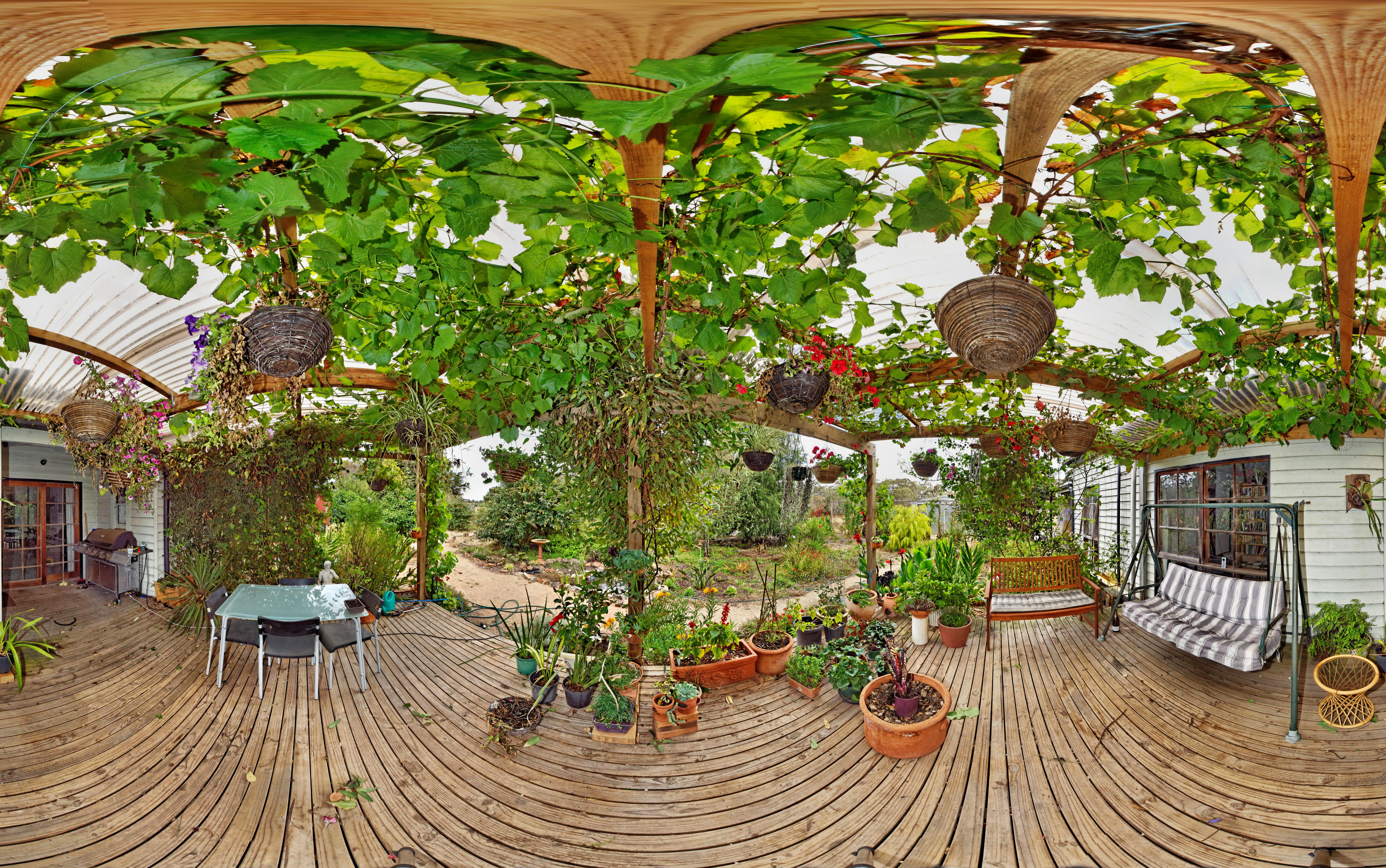
That caused unexpected problems stitching the images: there weren't enough obvious places
for the control point detectors to find communalities, and I had to manually complete at
least half of the panoramas. But the results weren't too bad, and finally I have a panorama
of the verandah with almost no detectable discontinuities:
Chris Yeardley has been on holiday in Việt
Nam, and I'm helping her bring her photos on line. One of the (many) reasons I don't do
this with commercially available software is that I want to give titles to my photos, not
names like 100_4984.JPG or even (shudder) 36836231@N00/2423055893. Yes, you can do that. I've tried it with various products, and you'd think that they
deliberately make it as complicated as possible.
My current method works much faster: a little script that displays image name and details
and prompts for a name. It uses GNU
readline, so I can copy the name I apply to one image and apply it to the next with a
different extension. Typically I'll have names like Pelargonium-1,
Pelargonium-2 and Pelargonium-3, so I can copy the text Pelargonium-
and just add a digit. Independently of this, I
use xv to display the
images.
Still, it's not easy to remember what you've done, in particular the sequence numbers. This
is most evident in my monthly flower photos,
where names such as the example above may be spread around through a list of 130 odd photos. And Chris ran into
this problem today as well, exacerbated by the fact that she only had a single screen, so
the xv image display overlaps the xterm window with the script. It was
interesting to watch Chris use it—she's the first person apart from myself ever to do so—and
it became clear that something better was necessary.
But what? I already have a script that builds web pages with “contact prints”, which simply
shows all the images reduced on one page. But it should be possible to write code that
accepts text input, sets default names, automatically completes the pelargoniums and checks
for duplicates.
But how? I suppose the correct answer
is “JavaScript”, but I don't know that
well enough. Straight HTML with PHP should also
do the trick—but how do I get a page to submit the contents of all forms? My first approach
looks like this:
Each input field is associated with a photo, so it can't be in a single form. How do you do
that? Can you do that? None of the documentation I found, either on paper or on the
web, tells me that. So, once again, it's a lot of guesswork and experimentation.
I spent most of the day looking at my photo software issues, but I did find enough time to
get out and finish mulching part of the north garden bed. Much more needs to be done.
Took a first look at the GPS receiver I bought from ALDI yesterday. It uses different software, and so far I'm unimpressed. The maps
are as bad as ever. The street where I live is still not there (it's only been here for
about 100 years), and the fantasy streets that have been added to the east in the last
couple of years are still there:
My house is in Kleins Road, roughly on the l of the “Please tear off” foil. It's
shown as less important than the (non-existent) road going off to the bottom through the
arrow of the More tab. Finding addresses is now an order of magnitude worse.
Previous versions allowed you to select “City Centre” or “Street middlepoint”, but now it
seems that you must select one of the streets it knows and a street number that it
knows in that street.
Admittedly, I haven't checked the manual—in my experience, that wouldn't help—but the fact
alone that the maps are still broken means that it will go back. The rest just makes
it even worse.
Got various feedback from people reading this diary about how to make a single form to
include all my <input> tags. The one I looked at, from
Peter Jeremy, included <span> tags inside the form. That
appears to work, but according to the definitions at http://www.w3schools.com/html5/tag_form.asp it shouldn't:
The <form> element can contain one or more of the following form elements:
This is for HTML 5, being the latest and greatest, but things aren't significantly different
for other versions. You
can't put general content inside a form. This appears to be Yet Another Example of where
the HTML syntax is unnecessarily restrictive. What I'm trying to do is pretty much what
almost any Tandem Pathway program would have done 30 years ago. Why do I have to break the
rules to do it?
Spent some time playing around with that, iteratively improving things, and doing other
things in between. It's getting there, but it's a long way from finished, and it grates
that I'm breaking the rules.
An HTML form is a section of a document containing normal content, markup, special
elements called controls ...
That's not quite the same as what the w3schools document, but on re-reading that document, it doesn't make it clear that the listed
elements are the only ones allowed. Still, that's HTML 4, and one day we'll have HTML5 (and
save spaces in the process) What does that say?
A form is a component of a Web page that has form controls, such as text fields,
buttons, checkboxes, range controls, or color pickers. A user can interact with such a
form, providing data that can then be sent to the server for further processing
(e.g. returning the results of a search or calculation). No client-side scripting is
needed in many cases, though an API is available so that scripts can augment the user
experience or use forms for purposes other than submitting data to a server.
That's about as vague as the w3schools document, and it introduces more bad language: abuse of the word “experience” to
mean “impression”. I suppose language has to evolve, but why entrust it to buzzword
marketeers? Does it have to eclipse existing usage? Or are we to suppose that there are no
experienced people left? There's also a term “non-normative” whose meaning is not
immediately evident.
The rest of the HTML5 document shows that yes, indeed, I can do exactly what I want with the
<form>, so I did. With a bit of work, it did what I told
it. Now I need to think about how to make it easy to use. One clue might be in that “user
experience” comment: do it
in JavaScript. But that requires more
experience than I have.
Into town today mainly to for a checkup with a podiatrist, who told me what I expected, that
there was nothing wrong with my feet, scraped off the soles, and warned of dire problems
with my feet if my diabetes got worse. Good to have confirmation of my expectations.
Also got a new battery for the lawn mower. A few months
back I bought a car battery from Sebastopol Auto Parts for $87, but today they wanted
$75 for a lawn mower battery, or preferably $80 for a much better one. How little
difference there is in price! On, on CJ's prior recommendation, to R & J Batteries in La Trobe St., where they also
wanted $75, but ended up giving it to me for $70. They also have UPS batteries there—I must
take a look at what I could use.
While in town, to the Ballarat Library,
which had just informed me that the DVD that I had returned on Saturday was available for
pickup. So was “South Pacific”, so I picked up that, and then discovered it was a BBC
Documentary, not
the musical I was looking
for. This web site is really impossible! Last time I had spoken to them about it, they
sang the praises of how good it was, so this time I asked to be shown how to do it and was
helped by a Senior Librarian. First question: “What is the PIN number of your
library card?”. It wasn't necessary, and I didn't give it. But I don't suppose it'll stop
her asking somebody else next time. She showed me a couple of non-obvious tricks, but she
still wasn't able to perform some normal searches. “Java? Is that a computer language?”
At least I made my point, and she told me they're considering a replacement web site.
Hopefully I was able to give her some useful input.
To Bunnings to buy some odds and ends, and
looked through the outside garden area. I get the impression that they deliberately place
obstacles to shopping trolleys in the aisles:
At Bunnings picked up a water lettuce
(Pistia) of unspecified species, and
Yvonne (shopping separately) bought
a Salvia uliginosa (“bog sage”)
(and yes, yet another Salvia), which grows
in the marginal areas:
For some reason, most aquatic plants are very expensive, and this one was no exception. But
there's an easier way: we have something very similar growing in the north garden, and there
had been a number of self-seeded plants that I put in pots only a couple of days ago. But
at the time I didn't know that they tolerated aquatic conditions. Maybe they don't, but
it's worth risking one of the plants to find out:
Today was the first day I used my new photo processing web page in earnest. It's still
pretty bare-bones, but it includes one feature that makes life easier: a single ,
(comma) in a field tells the page to take the previous name (less trailing number) and
append the next sequential number: after the image Bunnings-blockade-1, a comma will
generate the name Bunnings-blockade-2. I can already see the use of a ! to
say “continue doing this until you find another specification”. And I can see myself
playing with this for some time to come. PHP is
much more malleable than shell scripts.
I've been trying to identify various plants for some time, with only limited success.
Today, while looking through the PlantNET of the Sydney Royal Botanic
Gardens, I found a page for identifying some kinds of Salvia. It doesn't help with the ones I
have, but it's the first time I've found this kind of information on line, and it's not
limited to Salvia. Maybe there's wording in there that will help me search for more
extensive identification pages.
Just before Christmas, Yvonne got caught doing 122 km/h on
the open road. You'd think that that wouldn't be a problem, but
in Victoria the speed limit
is 100 km/h, and speeds are policed much more stringently than petty issues like drug
trafficking or burglary. So the policeman stopped her, wasted
a breath test tube on her, and said she would receive a penalty notice.
But none came. Could the policeman have lost the details? In any case, we weren't too
upset. But yesterday a reminder arrived, by some stroke of bad luck. Based on the address,
it should never have got here:
I suppose it's typical of the attitude of these people that they've turned the name around
without indication. What if it were for my friend Olufemi Adekola? Or is that Adekola
Olufemi? Of course, it doesn't have to be a non-European name to be confusing. In Germany
30 years ago I had neighbours called Peter Phillip and Otto Adolf.
But Enfield? We live
in Dereel. Yes, there's a hamlet called
Enfield 10 km away, but what does that have to
do with us?
How can that happen? Apart from a really draconian fine, they want to put 3 demerit points
in her driver license. And for that they need (and have) details of her driver license,
where the address is almost correct:
And there, again, the address is wrong! The house number is 47. These details are
important. How can the authorities make this kind of mistake not once, but twice? This
kind of incompetence stands out from minor lapses keeping to an imposed speed limit
inappropriate to the road conditions. In this case, though, Yvonne reported the error long
ago, and they put a sticker with the correct address on the other side.
Things wouldn't be so bad, except that they wanted $20 more to pay for the delay caused by
their incompetence. Yvonne called them up and was told to write a letter explaining the
problem. They had all the evidence in front of them (address to which the summons was sent,
address on the driver license). But no, Yvonne had to write a letter. She did so,
handwritten, with the request that they drop the excess charges (which still seems to be a
matter that they can decline), and asked for an explanation about how this could happen in
the first place. I don't have much expectation that she'll get that—but why shouldn't she?
The authorities are supposed to be for the public good, so they should be accountable.
We've largely given up putting kangaroo protection around our plants: they don't seem to be
nearly as bad any more. But the problem isn't gone, and this morning I saw a rabbit
wandering round the garden—and a few minutes later, Piccola looking rather active, and no more rabbit.
But there has been some damage, of a nature that I'm not sure I can explain. It's not
rabbits. The climbing roses in the south of the garden must be particularly tasty:
I've already had to put protection around the Japanese maple that has barely grown since we
got it 3½ years ago—the leaves had all been eaten off—but the Japanese ornamental cherry is
now nearly 4 metres high and beyond the reach of any animals we've seen round here. The
lower limbs, though, are a different matter:
The leaves are eaten off up to about a height of 2 metres, far larger than a kangaroo. I
suppose they pull them down to their heads with their forepaws. They've also been at
the Alstroemerias in front of the
verandah, not in itself such a problem, since they die off anyway:
From time to time lately we've had increased problems finding Piccola in the evening. Normally she comes at 18:00 for food,
but sometimes, like today, she didn't.
But earlier on I had been messing around in back right hand side of the garage, when
suddenly something above my head said “Meow!”. There was Piccola on top of some side
cupboards, about 2.2 m off the ground. When she lay down flat, she was almost invisible.
So when she didn't come, I went to check. Yes, still there, and very annoyed that I
was able to catch her and bring her inside. Hopefully she won't abandon that place now.
I've found that when processing garden photos with DxO Optics "Pro", they
generally come out best with the “HDR Artistic” “preset”. There are limits, though,
apparently when the contrast is very low. Here a comparison of one of yesterday's photos
done with the “Artistic” and “Realistic” presets (run the cursor over
an image to compare it with its neighbour):
dereel crashed today, out of the blue. There used to be a time when computer crashes
seem to happen like this all the time, for no particular reason. But while that may still
be the case for Microsoft-based machines (I really don't know), it's now very seldom on any
of my BSD machines. I wonder if it's an
indication of hardware problems (something that people love to blame software issues on).
The thing that did get me was the time it took to fsck my photo disk. OK, it's 2
“TB”, of which 60% are in use, and it has over 400,000 files on it:
Filesystem 1048576-blocks Used Avail Capacity iused ifree %iused Mounted on
/dev/ada1p1 1907196 1137008 751115 60% 401226 688948 37% /Photos
It took 2 hours, 40 minutes, mainly in phases 1 (2 hours) and 5 (30 minutes). Phase 5 stuck
at 92% for 27 minutes of that time. I wonder why. One thing that did hit me was the slow
I/O transfer rate, only about 40 to 50 transfers a second in phase 5. Is that because of
extreme seek distances? I suppose it's time to read the source.
So now I have a new battery in the lawn mower. I charged it overnight and tried to start
it. No joy, just some scraping noises. Took a look at the carburettor and discovered that
we had not attached one of the linkages, possibly the choke. And try as I might, I couldn't
get it through the guide slit. What a pain these things are! And how well it demonstrates
how out of touch I have become with this kind of work. Another one for CJ if I don't
succeed next try.
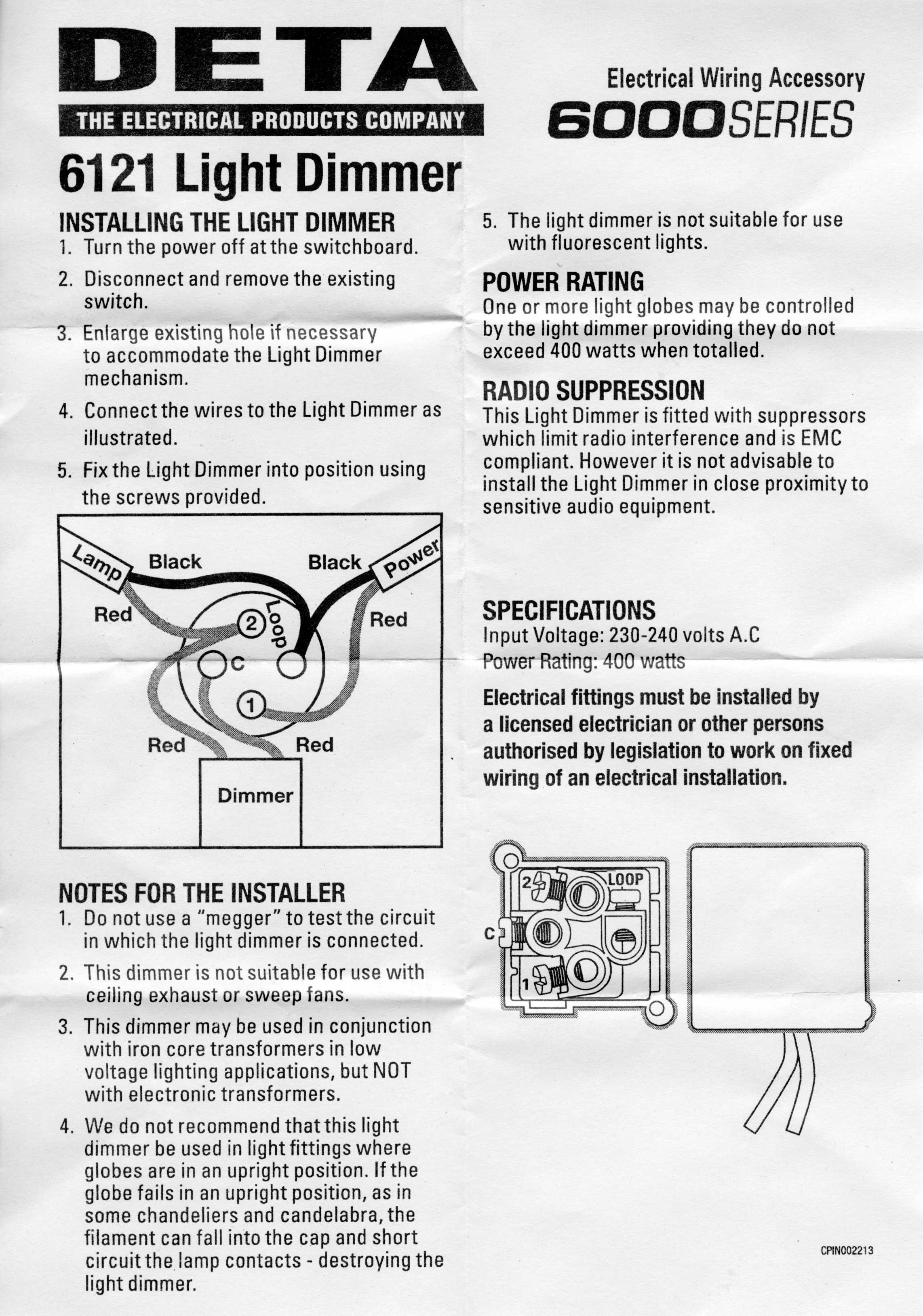
The dimmer on the light in the lounge room has been flaky for some time. There must have
been some intermittent internal connection, and from time to time the lamp would just go
out. So a couple of days ago I picked up a new one, a DETA6121B, a
combination of dimmer and light switch. Conveniently the wires to the dimmer unit weren't
connected to the switch, but it looked pretty much like the old one, and so I shouldn't have
had any trouble just connecting the wires the same way.
But it comes with a wiring diagram which disagrees:
That's straightforward enough, apart from the incorrect colours. According
to IEC 60446, the colours should be
brown and blue. Red is obsolete, and black is now one of the phase colours, not neutral as
was implied here.
That doesn't make any difference in my house, which uses its own version of incorrect
colours: red and white. But it's not very important: they correspond to the red wires in
and out. The circuit is symmetrical, so either way round is OK. Just forget the black
wires to the right-hand contact in the diagram.
Tried that, greatly hampered by the short length of the cables, which barely reached contact
2. Powered on. Nothing. Much cursing. Strangely, still nothing. Removed the thing again
and checked the resistance of the switch contacts. It's
a SPDT switch with
common at the top of the diagram (contact numbered 2), and L1 and L2 (the switched contacts)
are left (marked C) and right (marked Loop). The connector at the bottom (numbered 1 on the
diagram) is not connected internally. But that's the power input on the circuit diagram.
So this circuit is Just Plain Wrong. It can't possibly work.
Checked back with the old switch. Yes, it was shown correctly. In particular, the dimmer
is connected between contacts 1 and C, and the (single) power cable is connected between 1
and 2. Connected up the new dimmer like that, and surprise! it worked. So not only is this
circuit incorrect, they can't even blame it on some new rearrangement of the switch. It's
Just Plain Wrong. Looking at the identification symbols on the diagram, it's clear that C
is Common, and 1 and 2 are L1 and L2: the switch is shown rotated 270° from the actual
position. But even then it doesn't make sense. With the switch in one position, it works.
With the switch in the other position, the dimmer contacts are shorted together. Why that?
It took a while for me to realise something far more sinister: in principle, this circuit is
symmetrical. From the functionality viewpoint the input cable and the output cable are
interchangeable. Change the text “Lamp” and “Power”, fix the errors, and it will work just
as well. In fact, I don't even know which way round mine is, and I'd guess that applies to
most domestic situations. But what happens if the neutral line is there, connected to the
right-hand contact (“Loop”)? If the power is turned on, it will work as before. When you
turn the power off, however, you short-circuit phase to neutral. Sure, that will blow a
circuit breaker—hopefully. But what manufacturer supplies components with such dangerously
inaccurate documentation? It was after closing time when this occurred to me, but I'll call
them up on Monday. This should require a recall of all these components.
House photos again today. For the time being I'm using the old macro rail, which clips
directly into the dovetail clamp on the panorama bracket, so it didn't slip the way the new
one has been doing. That gives me a bit of time to decide how best to stop the slippage.
Started early because of the low wind, and this proved to be a good idea: things were much
easier than last week, and by early afternoon I was pretty much done.
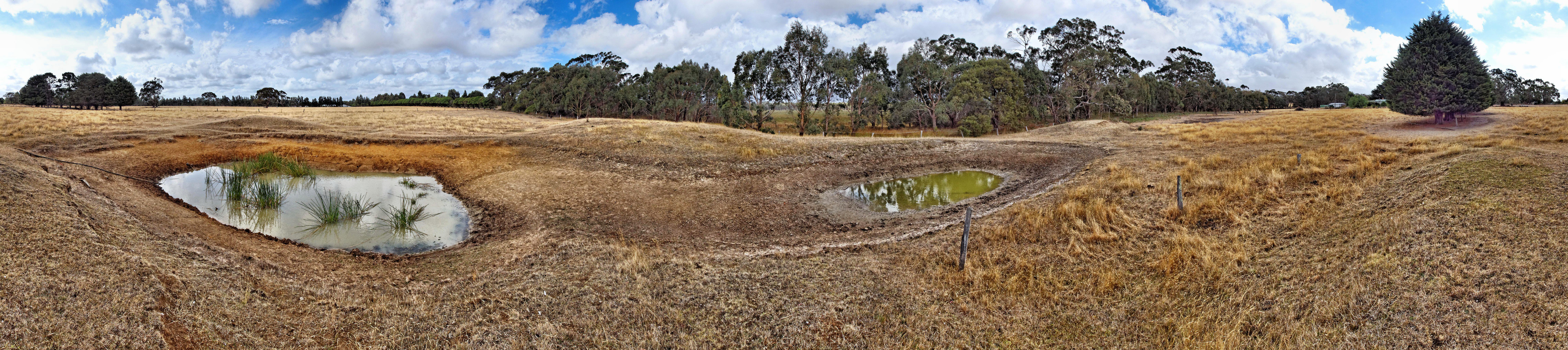
About the only thing of interest was the dam photo. It's really low now, and the
horses were walking all over it. Took a total of 20 images and stitched the best together
later on. Here a year ago and today:
Changed the NiZn batteries in my flash gun
today, and recharged them. Nothing unusual in that—almost. I had forgotten to turn the
flash gun off last week, and though it shuts down automatically after a while, it's a soft
shutdown (it has a real mechanical power switch). But the voltages were interesting: before
recharge, 3 of them were in a normal range, and the fourth was so low that the standards say
it's defective. But they all recharged happily:
Battery
Charge date
Before
After
9
20120218
1.695
1.866
10
20120218
0.789
1.845
11
20120218
1.682
1.884
13
20120218
1.659
1.875
Yes, battery 10 had the lowest voltage after charging, but only barely. It'll be
interesting to keep my eyes on it.
Mail from Mal White about yesterday's article on the
dimmer. I suspect he has misunderstood a couple of things. But he raises a couple of
interesting points:
In Australia, only a licensed electrician can work on fixed wiring.
That's doubtful. Yes, you see this again and again, and it's repeated on the instructions.
But it's clearly a case of CYA:
there's no restriction on the sale of these devices—Bunnings isn't a trade outlet, and most people who
buy electrical fittings there aren't licensed electricians, nor do they intend to get a
licensed electrician to install them. That's not Bunnings' fault: if the government were
interested in enforcing this legislation, they would ensure that outlets like Bunnings
either didn't sell them, or at the very least informed their customers of the law. The
instruction sheet isn't enough: the important parts are so wrong that it's best not even to
look at it.
Mal also writes:
Australia's wiring regulations are not aligned with European standards, at least when in
comes to cable colour.
Well, not quite. I went back and checked, and we're both right (or wrong).
International standard
IEC 60446 does apply in Australia—you
just need to take apart a power cable some electronic device to see that. In the old days,
single phase wiring had red for active (live), black for neutral and green for earth. Now
they're typically brown (active), blue (neutral) and green/yellow (or sometimes just green)
for earth. That's completely in compliance with IEC 60446.
Other countries had dangerously different colours. In the 1950s my father bought an Italian
electric drill, back in the days when plug sizes (outside Australia, anyway) weren't
standardized, and when you had to buy a plug separately. He connected the red conductor to
the active pin and nearly killed himself: in Italy at the time red was the (very poorly
chosen) earth conductor. Clearly international standardization is very important, and
that's why it happened.
But in houses it's different. The wiring stays there for a long time, and there's certainly
a lot of wiring with the old colours. So it's no surprise that AS 3000:2007 allows
different colours from IEC 60446, including black and red. But those are only some of the
colours, and I hope they're working towards a harmonization.
In any case, Mal found weaknesses in my article, so I've modified it.
Chris Yeardley over this morning for a Nasi Lemak breakfast, and to continue processing her photos with my new, super-duper web forms. She
brought a book on JavaScript with her.
I suppose the best thing we can say is that she found my software better than the previous
attempt. In the end she finished naming the things and left the conversion to me—not
unreasonable, considering that my software is not just undocumented, but under active
development. It was also interesting to see how few assumptions I had made that the
software was in my directory hierarchy, though I needed to make a fair amount of relatively
trivial changes.
While Chris was doing her thing, I took my monthly garden photos. They're a particularly
good test for the new software, since there are about 150 of them, and they have names
like Petunia-1 and Petunia-2, but those names are interspersed with other
images. Managed to get that sorted out, and also used my first-ever HTML5 feature:
the autofocus attribute to tell the browser where to position the cursor. All
worked surprisingly well, but it also makes clear that I'm like the man who only has a
hammer: every problem looks like a nail. I really need to convert this stuff to JavaScript.
This is the plant we bought last Australia Day, which
supposedly should keep animals away. It doesn't do that, and it still looks and smells like
cat mint to me, but it's clearly not the same thing. Anyway, the flowers are nice.
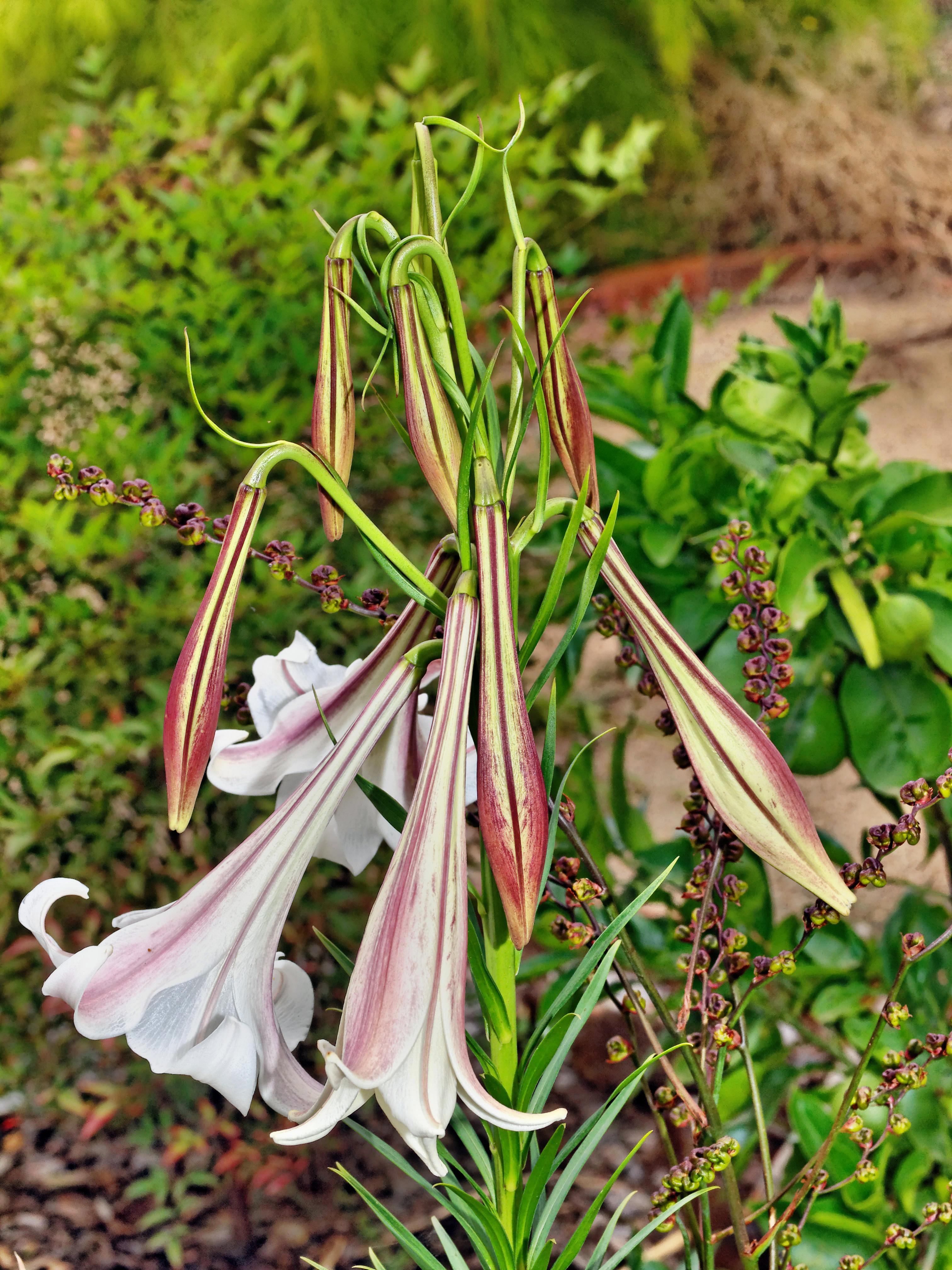
A year ago we bought a Lilium formosanum, which looked pretty, but
which only bore a single flower. I was beginning to think that it wasn't worth the trouble,
but this year it has grown significantly. I had expected it to produce multiple bulbs, but
instead the existing one has produced many more flowers:
The pod is from an Acanthus, which we've
had since we moved in (and had great difficulty removing). But this is the first time I've
seen a seed pod. The flower is growing in front of my office window, and it looks like the
Romneya coulteri (also
called Californian Tree Poppy) that we bought in Lambley Nurserylast December, and
arguably the foliage is similar. It's about 10 metres from that bush, which is now past
flowering, so it's conceivable that it has self-seeded. Possibly it's a better place than
where we planted it: it has long, spindly growth, and it doesn't seem to like the wind.
Another interesting plant is this. It's probably a weed, but it's taking a long time to
flower if it is, and I can't recall having seen it before. I'll keep my eyes on it.
The roses were looking pretty unhappy last month, but they seem to have recovered a bit. In
particular, the Iceberg roses (first photo) on the south side of the verandah are flowering
again. I suspect inadequate irrigation explains multiple problems, like why
the Osteospermums still aren't
flowering.
The Salvias are nearly all flowering now.
Here a Salvia “Bonfire” that I got from the Friends
of the Ballarat Botanical Gardens, and while the “Salvia diesaustraliae” that I got
last Australia Day has never flowered, it looks like it's trying now:
One of this kind of succulent has bloomed before, but didn't look overly happy. This one
is behind the pond, and it's getting more water, which it seems to enjoy:
A number of plants have survived disadvantages.
The Alyogyne huegelii that got
blown over by the wind two weeks ago has
not even stopped flowering—it's as happy as ever.
The Aloysia citrodora that we
transplanted and then didn't water now has sufficient water, and it's recovering enough to
flower, though it still has a way to go before it's as big as it used to be:
One of the Cyclamens that I got from the
Friends in early October has hardly stopped flowering,
and now most of the others have joined in, though the first two (kept indoors) have lost
most of their leaves:
My carefully nurtured Chile poblano plant
has suffered from multiple problems, including root rot and particularly vicious attacks of
aphids. It's still alive, but not looking healthy. On the other hand, some of the
seedlings I planted in spring are now looking much happier, and the first fruits are
appearing:
Yvonne is thinking of getting Nemo certified for the Delta society, who visit people in hospital with dogs. The certification requires a number of abilities,
including—obviously—behaving correctly when meeting strangers. So Yvonne thought that we
should take him down Bridge Mall and
give him some experience:
While in town, also went to
the Botanical Gardens,
partially to walk Nemo, and partially to see what it looked like at this time of year. The
latter wasn't very interesting, apart from some well-known plants:
The did have an exhibition of Fuchsias,
however. Now that the ornamental vine covers most of the verandah roof, I've been thinking
of replacing the Petunias in the hanging
baskets with something better attuned to the lighting levels, and Fuchsias were one of my
prime choices. They had a very interesting collection, unfortunately not for sale. I'll
have to ask the Friends if any are to be had:
While in town, also dropped in at the Ballarat
Library to pick up a couple of DVDs I had requested. One was “The Italian Job”, coincidentally (in 1969)
one of the first films involving computer-related crime. The web site couldn't find one in
the Ballarat library, but that didn't stop it offering me 13 irrelevant titles. Finally I
found one, and of course it was wrong again: it wasn't fiction. That's two out of three
DVDs in the last couple of weeks that, thanks to inadequate documentation. Now that I have
a few more tricks up my sleeve, took another look (“search all libraries”). 10 titles, all
of them either “DVD” or “Videorecording”. Some of them even have dates: 2002, 2003, 2004.
It proves that there was a remake done in 2003, and that seems to be more popular (at least with librarians) than the original
1969 version. But what's 2002
and 2004? After much searching, discovered that the 2004 version was the 2003 version, and
the 2002 version (available
in Myrtleford
and Mildura) is the 1969 version. So I
put a “hold” and got this information, which makes it immediately clear which one I am going
to get:
Hold(s) Placed
The Italian job [videorecording]
DVD F ITAL
Pickup at: Ballarat Library
Looking at the HTML is even more revealing. It had many empty lines, which I've removed
here:
<div class="defaultstyle" colspan="4"> <!-- Print the items on which holds were placed -->
<p>
<!-- check if holds failed and or placed-->
<strong>Hold(s) Placed</strong><br/>
The Italian job [videorecording] <!-- title -->
<br/>DVD F ITAL <!-- call number -->
<br/>Pickup at: Ballarat Library<br/><br/>
</p>
</div>
Also while in town, dropped in at ALDI and
bought one of this week's specials:
a DAB+ radio, for only $30. They had
been on sale since Saturday, and the numbers had dwindled from an estimated 80 to an
estimated 30.
Back home, tried it out. It only has a rod antenna. It did its search and came back with
the information “No coverage”. So off to check where there's coverage. That's simple:
state capital
cities only. No coverage in Dereel,
no coverage in Ballarat. So ALDI sent
hundreds of these devices to their three outlets in Ballarat (and presumably similar
quantities elsewhere) where they can't be used except as a normal FM receiver. Isn't it
good that you can return the things with no questions asked? But I wonder if heads will
roll.
Spent much of the afternoon working on Chris Yeardley's photos. In principle there's no
hurry, but it required significant uploads—there were a total of 575 MB of photos, which
also overflowed the tiny disk we have available on the server—and today was the last day of
our monthly ISP billing period. We had 1.2 GB (out of 9 GB) over, so it was clearly the day
to do things.
Lots of experiences in the process, mainly related to resetting the camera times. I've seen
this before with the Hackers
barbecue two years ago, and I wrote a program to do that at the time. But it's still
amazingly complex, and it's far too easy to do it twice or in the wrong direction. Apart
from that, I found myself revisiting code I wrote years ago, and also installing my own
infrastructure for her. Nothing really difficult, but somehow there were so many things
going on today.
We certainly used up our quota. Today's also traditionally the day where Yvonne soaks up our remaining allowance with YouTube downloads, and we ended up overrunning our quota
by a small margin:
Another power failure at 4:11 this
morning. That's the fourth this year. This time last year we had already had 9 failures,
and it would be tempting to hope that things are improved. But the year before that it was
7, the year before that it was 5, and the year before that 4. So maybe it's just random
fluctuation.
That was a set of patches to an old version of wview that ran only on NetBSD, an
operating system that I no longer have running all the time, so I had a fair amount of work
to do: apply the patches, migrate from NetBSD to FreeBSD, and update the patches to the latest version of wview.
I never finished. Somewhere along the line I gave up and wrote my own software instead.
Why? wview is a relatively complete system, but it gave me so much pain that I
thought it would be easier to write my own software. I was right.
It seems that the author of wview has recently become aware of something I said,
though he doesn't say what. Today I received a message from him that shows that the best tradition of the USENET flame is not yet dead:
Finally, your entire attitude about other people's work truly is emetic. You are either
becoming senile (and thus a moron) or you are just a moron.
In passing, this use of the word “emetic” is interesting. I use it a lot, but few others
do. On asking, it proved that he had, indeed, copied my usage. To
quote Charles Caleb Colton,
“Imitation is the sincerest form of flattery”.
Still, he raises some questions. Why did I dump wview? It's a mature system with
many features. I didn't do it lightly. There are a number of reasons. Looking back at my
diary of the time, I find:
It didn't support my weather station. I knew this, of course, but it meant significant
effort just to get it to work with the station.
Error reporting was flaky. It had a requirement that passwords in the configuration
file must not have spaces in them, but it didn't complain if you put them in; it just
truncated them, causing me significant problems on at least one occasion.
It used the Three Ugly Sisters, System V IPC (SHM, SEM and MSG), or at least System V
semaphores, something so distasteful that nobody appears to have written a Wikipedia
page on the subject. They also caused problems when the processes crashed and didn't
remove the old data structures.
Starting wview had to be done with a script, and it was very difficult to ensure
that the initial conditions were right (no processes running, SEM semaphores removed).
It also meant that I couldn't find a way to debug the daemon, I think because of timing
issues with other processes.
The information returned by the station is in metric units, sort of. The wind speed,
for example, is in units of 0.1 m/s. wview translated everything into American
units first, and if you selected metric units it translated them back again. In the
process it lost a lot of accuracy. 0.1 m/s is 0.36 km/h; wview stored in units
of 1 mph (1.6 km/h), so it was returning values like 2, 3 and 5 km/h, but not 1 or 4.
Though wview had many features, there are some that it didn't have, including
comparisons between weather stations and loading archival data from the station.
The interpersonal communication with the project author proved to be abrasive. In
particular, he required that I
reply to mail messages upside-down. I
don't do that, so I couldn't communicate. Today's message suggests that nothing has changed there.
There are other issues, like hard-coded pathnames such as /usr/local, which made it a
pain with NetBSD, and two different databases (sqlite3 for the configuration and MySQL or PostgreSQL for the weather
station data), but they're just uglinesses, not enough reason to drop the product.
So what options were left? Modify wview to do what I want? Yes, that would have
been a possibility, but for that it's too ugly. By the time I came to the conclusion to
ditch it, I had spent over two months work. Despite significant pain with libusb, I had my own version up and stumbling in over a
week, and it had replaced wview in two. It would be incorrect to say that it has
worked to my satisfaction over the last more than two years, but I've never had the pain
that I had with wview.
What would I do now? wview now supports the my weather station. Maybe it's more
stable. But it still won't do some of the things that I want. So I'll compare the code
carefully and possibly come up with some improvements in the protocol, which is still flaky.
There's more to say, but I'll wait for the results of further correspondence with the
author.
It's been at least 35 years since my wife and I started collecting a series of Time-Life
cookbooks. In general, they're very good, though there are the usual issues: although they
were German translations, they measured things in US units such as cups, and they had some strange substitutions. One
that I didn't notice initially was for pollo
en adobo, a Mexican recipe for chicken in mild chili sauce. The recipe calls for:
In Germany I had never seen an ancho chile. They're anything but normal: big, black
and almost completely mild. We substituted normal chiles, as the recipe asked, and created
something that nearly blew our heads off. It wasn't until a few years later that we visited
Mexico and discovered the truth.
So I modified the recipe. But not enough. We made it today, for the first time in 3 years.
Yes, now the chiles are correct, but other quantities aren't. We started off with things
like ¼ teaspoon of cinnamon powder and ½ teaspoon of ground coriander, clearly far too
little. On the other hand, there was too much sauce. I've been gradually modifying the
quantities, but we're still not there. Today it was 2.5 g of cinnamon (about one stick) and
4 g coriander, in ⅓ of the quantity of liquid, and we're gradually getting there. It seems
that my oldest recipes are also the least reliable.
The pollo en adobo wasn't the only
experience today. Three weeks ago I
baked the first loaf of bread with some new flours, and the results weren't quite what I
expected. The big difference was that I was using pure wheat flour instead of “Manhattan
Light Rye” bread mix, but the different amount of water needed puzzled me. So we bought a
small pack of Manhattan Light Rye, and today I tried with the new flour and the old recipe.
Result: yes, again I needed 40 ml less water. Presumably the flour itself made up for the
rest of it. I hadn't expected there to be so much moisture in flour.
This morning Yvonne pointed out something to me that I should
long have noticed: one of the fuchsias
was completely overgrown with Lonicera.
Removed that to find significant bare spots. Here before (first image) and after:
In general, though, I've been so busy lately that I have neglected the garden. Wanted to do
something about that today, but the March flies kept me at bay, as this image from the ozanimals.com web site shows:
Spread some fertilizer (and ran out of it), pruned some Cannas, and that was about that.
I've been wearing glasses now for nearly 50 years, and I still haven't found out how to keep
them clean. Somehow they always seem to smear, something that is particularly evident in
sunlight and when driving at night. I don't have the same issue with my camera lenses, but
I suppose they get treated better; certainly they're less exposed to the kinds of fats that
cause the smearing. Decades ago I took to washing the glasses with detergent, but that
tends to cause the frame to corrode.
Last month I picked up some new glasses, and they gave me a “$20” cleaning kit: microfibre
cloths and some kind of spray-on cleaner. They promised that they wouldn't smear. They
didn't deliver. The spray-on cleaner left residues, so I'm back to detergent, though now,
because of the new, softer plastic lenses, I'm using the microfibre cloths to dry them, with
only moderate success. Am I the only person to be this fussy?
It's been the best part of 2 months since I started reorganizing the north central area of the garden. But then I had issues,
including heat, wind, weeds and laziness. I got as far as removing
the gazanias and spraying some weed
spray, but it didn't work very well, and so it just dragged on. There were a couple of
plants in pots waiting to be planted, but I didn't want to do so until I had killed off all
the weeds. So far, the weeds seem to be winning. And the plants are looking clearly
unhappy, so I decided to plant first and fight the weeds later—exactly what I originally
didn't want to do.
So I braved the March flies and at least got as far as planting the hot little root balls into the considerably cooler
soil. There's a Dodonea viscosa
(I think) that we brought from Wantadilla, and which has
spent over 5 years in a pot,
the Correa reflexa that we bought
last winter, and
the Plumbago auriculata that
we bought on Australia Day. But I still haven't found
space for the new Abutilon and
the Dietes that we bought on Australia
Day. Hopefully the March flies will let up soon.
Right from the beginning using
DxO Optics "Pro" I had a problem that it didn't preserve
the EXIF data from the original images. Not
that big a deal: I wrote a little script to copy the data
from the source. But after all, this is commercial software, and I am entitled to support,
so I sent in a problem report and got a very quick response: “It works for me”. That wasn't
a “case closed” situation, though: they gave me the source of an image to compare with, and
a lot more details of how to report the problem.
Today I (finally) got round to downloading the image, which wasn't easy. It took me about 4
hours and 18 attempts to get it; the connection kept timing out. Tried the image, and how
about that! It worked. Also tried some comparable images with Chris Yeardley's Nikon D70S,
and that worked too. So what's the issue? To be thought about.
Part of investigating the EXIF issue with
DxO Optics "Pro" involved taking similar photos with my Olympus E-30 and Chris
Yeardley's Nikon D70S. Some time ago I had
considered moving to Nikon, and one of the issues was better dynamic range. Times have
changed since then, and now I can process the images with DxO's
“HDR” “preset”, so when I took
my photos, I chose subjects which could benefit by this kind of processing. The results
were interesting. It proves that there are at least 4 different levels of processing:
No processing at all, just a straight conversion of the raw image.
“Default” conversion with DxO. This gives much better shadow detail.
“HDR” conversion with DxO. This gives even better shadow detail.
Any of these passed through the Ashampoo Photo
Optimizer. In practice, I only tried it with the “HDR” version.
And the results. First the Olympus. Moving the cursor over the
images gives the next sequential image with wraparound.
It's clear that each step improves the shadow detail. But what about the Nikon? Again, of
course, it gets better all the time. But what really got me was the last image, the
optimized one:
I don't quite know what to make of the very last image. It doesn't seem to have much to do
with DxO, but I don't understand why there's such a big difference.
Yesterday's experiments showed that the EXIF
data problem with DxO
Optics "Pro" was limited to my images from my Olympus E-30. Even DxO's own
images didn't trigger the problem. But why? What's the difference? Different firmware?
That's hardly likely to change the image file format.
Then it occurred to me: for each raw Olympus file that I read in, I perform (effectively):
Could it be that? Tried adding an author entry to DxO's trial image and bingo! it
(silently) didn't copy the EXIF data. Tried it on one of the raw images from Chris
Yeardley's Nikon, and things still worked correctly. So it's an issue with Olympus and
custom EXIF data. Now to prepare a report, including—as requested—logs of what I've done.
The other thing that I noticed yesterday was a difference between the shadow detail in
the “HDR” “preset”. Tried
again today with one of the weekend photos, the one east from the verandah. Here the
results, first Olympus, then Nikon:
Which is better? Out of the box, the colour temperature of the Nikon seems better. And
maybe that's indicative of better shadow detail. Still more investigation needed.
Last November we bought 5 new fish for the pond,
bringing the total to 6. Three of them were goldfish, the other three were darker in colour
but probably also related. Since then, the pond got so murky that we could only (sometimes)
see the golden ones, and a couple of weeks ago I found a Little Cormorant in
the pond. He didn't eat any of the golden ones, but the others?
For some reason the water is clearing, and we can now see deeper into the water. Yes, the
darker fish are still there, but they're not very big. Still further investigation shows
that they have made up for it by increasing in number. I counted 6 of them: they've had
offspring already. It's still not clear if all of the original fish are there, but for the
time being it looks as if we're winning.
The third tuner on cvr2, my TV receiver box, has died. Yes, I can buy a new one, but
a number of reasons speak for getting a “set-top box”, a modern word for “tuner”: the price
isn't significantly different, you can use it to watch TV directly, it's a separate piece of
equipment, so it probably won't fail at the same time, and it's kosher when calling up TV
stations reporting reception problems: in the past when I've reported problems, they asked
me what equipment I had, and when I told them it was a computer, they weren't interested in
investigating. ALDI had one on offer a couple
of weeks ago, so I bought it, and today (first time I needed 3 tuners running at the same
time) I set it up. It has a USB slot for mass storage, so I dragged out an old random 8 GB
USB stick and tried it out. “USB device inserted”. “No disk found”. I
guessed—correctly—that the latter message meant “what kind of partition is that?”.
So: create a FAT32 file system on the
stick. How do I do that? I have enough pain with FreeBSD USB interfaces that I didn't even try. Put it in boskoop, my Apple,
instead. “Partition type not recognized. Initialize?”. OK, tried that. After 5 minutes
of “erasing”, while iostat showed about 40 single-sector I/Os a second, I gave up.
No way to cancel, so I just pulled the stick, and after a while
the programApplication stopped with no comment.
Put it into braindeath, the Microsoft XP box I have on loan from Chris Yeardley. It
told me I had to reboot before it could do anything with the stick. I thought those days
were over. So I put it in dereel, my FreeBSD box, and ran mformat, which was
happy enough, though it, too, only managed 40 I/Os a second, so maybe that's a function of
the stick. But it finished in a fraction of the time I waited on the Apple. I wonder if
Apple really tries to write the entire device.
Once in the tuner, it was relatively simple to record a programme. And I could take it out
and plug it into teevee, the TV player computer, and play it. Almost. This stick is
so slow that I couldn't seek, and there were reception problems that I didn't have on a
simultaneous recording on cvr2. They could really be reception problems, but at that
speed it could just be data overrun.
All in all, though, not a bad result. Now I need to find a spare USB disk and try again
with something that can handle the data rates.
Another hot day today, a maximum temperature of 41.3°, so I was happy to spend the day
mainly inside. But Yvonne wanted to go to the monthly “car
boot sale” on the main road where the General Store used to be, so off to take a look. The
weather had taken its toll: there was almost nobody there. That didn't stop Yvonne, though,
who got a floor vase and wanted to buy some second-hand glasses.
The glasses made more sense than it would appear. We've been looking for (perfectly normal)
wine glasses like that for months, but it seems that we will have to go to Melbourne to find
them. These ones looked like almost exactly what we were looking for. But they didn't want
to sell them to us, not alone: they were in a box with all sorts of other junk, and they
only wanted to sell it complete, for $5.
But I didn't want all the stuff, so I offered $4, and got it for that price and the
undertaking that I would recycle the box (specifically, that I would tear it up and put it
on the compost heap). There's really a lot of junk in there. Apart from 6 good glasses,
there were lots of old-fashioned ones, an electric knife, other kitchen equipment, and the
following:
That's a glass of the kind we wanted, but with a ring about 5 mm wide broken off the top,
leaving only a small tip, and then some kind of aid to giving up smoking, an unidentified
but broken ornament, a lolly paper and what appears to be a cinnamon stick, but which has
long since lost any aroma.
House photo day again today, and the Bureau of
Meteorology let me down. Yesterday they forecast light winds, 10-15 km/h, which isn't
too bad, but this morning it was 40 km/h, decidedly a problem. If I had known that, I could
have taken the house photos yesterday. What the weather station actually recorded was a
maximum gust of 27.5 km/h, but that caused significant problems with stitching the
panoramas—most of them needed manual intervention.
And I made many more panoramas than usual, in particular to compare Chris Yeardley's
Nikon D70s with
my Olympus E-30.
One problem with this particular camera is that the flash doesn't work; even if it did, I
don't have an appropriate flash unit for it. So for the two difficult panoramas, the
verandah centre and the shade area (“garden se”) I took three different sets of images: one
as normal, E-30 and flash, then E-30 without flash and D70s without flash.
The processing took me all day, not helped by the requirement to manually adjust almost
every panorama. I didn't finish the “garden se” panoramas, but I did make the verandah
centre ones. The results were interesting. As I've been having lately, the normal verandah
centre panorama requires significant manual tweaking. The one without flash didn't. The
one with the Nikon required many more images, since the shortest focal length I had was the
standard AF-S DX Zoom-Nikkor 18-70mm f/3.5-4.5G IF-ED at 18 mm, equivalent to a 27 mm
full-frame with fields of view 66.5° horizontal and 47° vertical, while with the Olympus I
had the Zuiko Digital ED 9-18mm F4.0-5.6 at 9 mm, comparable to 18 mm full frame (88°
horizontal, 72° vertical). So I had to take many more images to get the same coverage. I
also had significant problems with the Nikon autofocus, which sometimes took several
attempts to find focus. I should have been able to use manual focus, but I didn't have a
manual and couldn't work out how to set it.
The results? Independently of the comparison between Olympus and Nikon, it's clear that
the “HDR” functionality of
DxO Optics "Pro" is insufficient to bring out shadow detail in bright sunshine. Here the garden centre
panorama after processing with DxO, and after further processing with Ashampoo Photo Optimizer. Clearly it's struggling.
Looking at the verandah, the flash version got so completely confused that by the time I
finally got it converted, it was standing on its head—not that that was a big issue to fix.
The Nikon's orientation sensor had difficulties deciding which way it was pointing, so I
ended up with some of the images on their side, but Hugin didn't have any difficulty with
them. Here a comparison: Olympus flash, Olympus no flash, Nikon no flash:
Which is best? The rafters in the Nikon version look brighter, and so does the area round
the barbecue at the extreme left, and the colour balance is generally a little different.
But there's no clear winner there. Interestingly, the individual Nikon images got converted
surprisingly differently. Here two consecutive component images:
It's surprising that Hugin was able to recover the colours.
So what have I learnt so far? Nothing definite from the Nikon, but clearly I can't rely on
DxO alone to get the shadow detail I need. What I really need is a camera with a 16 bit
deep sensor instead of the 12 I have now, and which Olympus is still using in their newest
offerings. Why do people keep increasing the number of pixels instead of their quality?
Unpacked the junk box today—and there's really some junk in it! Lots of accessories, some
unused, for unknown kitchen equipment (not delivered), lots of measuring spoons with
dubious units. What's “½ cup?” on a spoon?
But we've been there before. I had undertaken to tear up the box and put it on the compost
heap, so I did:
Finished the my photo processing that I started yesterday, with no spectacular revelations.
Once again it seems that the results from the Nikon Nikon D70s (first image)
were better than those from the Olympus E-30:
Why is that? An obvious answer would be “deeper pixels”. Looked at the Nikon D70s manual, but it
didn't reveal anything that complicated in the specs, just that it had a 6 MP sensor. Went
looking at DxO's camera comparison pages and
finally found a page, to which I can't link directly, that showed that they both have 12 bit
pixels, and that the Nikon has marginally less dynamic range than the Olympus. So why the
difference? Is it just processing? The shadow under the tree fern is very much lighter in
the Olympus photo than in the Nikon photo, so it's quite possible. Still more unanswered
questions. But wouldn't a 16 bit sensor be nice?
Into town for a blood test today, and also to Big W to buy a new “electric kettle”, really a jug. Our 30-year-old one has
presumably a damaged element: it blows
the RCD, and the $7.96 I
paid for the new one is less than the cost of a new element.
But what a pain Big W is! In fact, there's a German pun in there: the letter W is
pronounced like the word for pain, Weh. Trying to check out I found the following situation
at the checkouts:
Only one cashier, and a very long line waiting to check out. At other places they would add
additional cashiers. Went to the information stand, but they were busy too, so spoke to
Flo, the guard they always have at the entrance (why? They don't do that elsewhere). She
couldn't care less, but said I could speak to the manager, but I'd have to move round to
information, out of her field of view. By now information was free and was happy to accept
my payment, so I asked Flo to relay my dissatisfaction to the manager. “I just work here.
There's a complaints box over there”.
Yes, this is a cheap shop. Yes, Flo may be an exception. But does that kind of attitude do
anybody any good? Quite possibly there's a work atmosphere there that explains it.
While at Big W, looked through the
garden department, though I didn't find anything to buy. But they
had cyclamens there, and like the ones I
have at home, they, too, were blooming:
Those labels that could be bothered to say anything about the flowering time told me what I
already thought: late winter and spring. So why are so many cyclamens flowering now at the
end of the summer?
While looking for information about
the UNIVAC 1108 Master File Directory
today, stumbled across bitsavers.org today.
It's not new, and—most emphatically—neither is the content. It includes documents that were
old when I entered the industry 40 years ago. It looks as if there's a lot to explore
there.
My interest in the MFD was a supposition that it might have a relationship to
the Unix directory structure. It doesn't.
It is much more complicated, centralized, and has features that are rare today, such
as file versioning at a basic level. That in itself is worth reading up on, on page 537 of
the “programmer's bible”, UP 4144. This is the same manual that I had put on my desk on the first day of my
working life, at UNIVAC
in Frankfurt/Main on 2 May 1973.
Like most people, I've run into
the Jehovah's Witnesses
several times in the course of my life. Unlike most people, I've talked to them rather than
(directly) chasing them away. The first time was over 45 years
ago, and I kept asking them questions until they left of their own accord. The next
time (the same people) was 9 months later, though on this
occasion only one of them left.
But at the time they had important information for me: the world would end in 1975. So my
first question was: when will the world end? They were rather cagey about that, but agreed
that it will not end in 1975. Instead they came up with questions like “do you believe that
the Bible is the Word of God?”. What does that question mean? That's what I asked them.
What do you mean by “believe”? What do you mean by “Word”? Clearly it's not the usual
term, since it's more than one word. And it's clear that even the books
of Moses weren't written by Moses, since
they contain content describing his death.
I don't really know that much about the Bible, and real Bible scholars would refute me at
every turn, but it's fun discussing with people who want to discuss the Bible and aren't
really that firm in it. For example, the younger (from the inscription on her Bible her
name is probably Jazmin) didn't know that there were two copies of
the Ten Commandments in the
Bible. From her answer, it seems that the Jehovah's Witnesses
quote Exodus 20. There was also
the question of whether Jesus is
the Messiah, given that the Messiah was
supposed to liberate Jerusalem, not die there. Some of his Bible quotations were a little
dubious, for example from the Psalms, but
when he got to the Apocalypse
it was clear that we were getting off topic. They
thought so too, and said that they had to go and meet some friends—they wouldn't be lying
now, would they?
It wasn't until they left that I realised that we hadn't discussed specific Jehovah's
Witness beliefs at all. But that's now three times that I've talked them to exhaustion.
Slow day today, which at least gave me some time to attend to the garden, which I've been
neglecting lately. Started yet again on mulching the north-central bed, which I started
working on two months ago, braving the
March
flies, and was about ready to put some mulch down at one end when I discovered that
Yvonne had taken the wheelbarrow to clean up elsewhere.
Attended to the north bed instead: a while back I had mulched on one side, but the other
side still looks very dry. I suspect that
the Watsonias (now past
flowering) have used up a lot of water and nourishment, so removed them, in the process
finding a lot of smaller bulbs,
probably Freesia
and Sparaxis. Hopefully the roses will
now be happier.
We've looked at a number of cookbooks lately: about a year ago I bought a cookbook called
“Culina Mediterranea” at a cheap book store (since closed down)
in Ballarat. As the name suggests, it's
about Mediterranean cookery. I already have lots of books about French, Italian and
Spanish cookery, but this book also includes eastern and southern Mediterranean cuisine, and
with a total of 380 recipes for $40, it seemed worthwhile just for them.
Then we bought a couple of cookbooks at ALDI: “At home and in the mood” by Luke Mangan and “The Press Cluβ”
by George Calombaris. The latter proved to be too complicated for us, but we kept the
former, and Yvonne has put lots of little stickers in the
(mainly fish) recipes that she likes.
After that, Chris Yeardley found a book left behind by Fifi when she left: “500 Resep Lezaaat Masakan
Indonesia”, published by Galangpress. Chris doesn't understand Indonesian, so she gave it to me.
As if that wasn't enough, Chris Yeardley was
in Việt Nam earlier this month, and she
brought me back two cook books with surprisingly similar titles and authors: Những món ngon
Việt Nam by Nguyễn Thu Hương and Những món ăn
Việt Nam by Nguyễn Thu Tâm. Both have the badge of authenticity that they're in dual
English and Vietnamese.
And then I spoke to Chris about Jamie Oliver, and she told me that he's apparently an
advocate of good food as opposed to junk food, and lent me yet another book, Jamie's 30 minute meals.
That's a total of 9 books. One I have already returned. What about the others? To my
surprise, Yvonne liked “One pot French”. It's not exactly as if we don't have lots of
French cookbooks already, but we tried a number of recipes from it, and they weren't bad.
We were thinking of buying the book, but gradually our interest petered out. I renewed it
once, but I don't think I'll do so again.
The Jamie Oliver books are a different matter. Looking at the title “jamie
does Spain, ItalyGreece, Morocco, Sweden andand France”, it's clear what's most important. The
title page shows not food, but the cook. And the book itself, 400 pages of it, contains
about 60 recipes, grouped as two pages unrelated jumbled photos, one page recipe, one page
related photo, and every so often, for good measure, another pair of photos related only to
Jamie. I've never liked cookbooks that put the cook before the food, and this is no
exception. We didn't find anything worth cooking in it. The same applies to "Jamie's 30
minute meals". Again unrelated photos predominate, and I just can't be bothered looking for
the recipes.
We went through the Luke Mangan book and “Culina Mediterranea” and found many recipes we
liked (more PostIt tags in the pages), but for some reason we haven't made many of them.
In the case of Culina Mediterranea part of it is a question of ingredients, which we should
be able to get in Melbourne.
Clearly we need to look at them more carefully.
The universally intelligible part of the title “500 Resep Lezaaat Masakan Indonesia” says
most of it: 500 (easy) Indonesian recipes. Also very cheap. Many of the recipes are
duplicates with different instructions and different measurements. One recipe stands
out: Rendang with 1 kg of beef and 300
grams of chili. I don't know if I'll ever use this book except for reference.
That leaves the Vietnamese cookbooks. They're relatively cheap and have few illustrations.
While I don't like the Jamie Oliver approach, the opposite is also an issue, especially for
cuisine that I don't understand well. But before we next go to Melbourne, we'll go through
them. There's no difficulty getting just about any Vietnamese ingredients
in Footscray.
In summary, though: the Vietnamese cookbooks are useful because they point me at a cuisine I
don't know. Culina Mediterranea does the same for the North African cuisines. But the rest
are, at best, suggestions that modify existing dishes, and you don't need that too often.
And the prices per recipe of these books are remarkably different.
It's been some time since I effectively completed my panorama hardware setup. Almost. I'm
still using the Manfrotto3416 levelling base. It has severe
disadvantages:
It has a limited travel, only about 5°, not enough for even normal unevennesses. So I
frequently have to adjust the length of the tripod legs to get the head level.
The screws are offset 120° from each other, so you can't adjust in one direction
independently of the perpendicular direction.
In general, the screws are not in the middle point when you finish, and there's no easy
way to return them there, thus further limiting the travel.
What are the alternatives? Linhof had one that I can no longer find on their web site, but
which would have been far too expensive anyway. It's effectively a kind of compact, heavy
duty pan and tilt head. In passing, it's amazing how many photo equipment web sites hide
their products or move the pages and hide the new ones not only from their own search
engine, but from Google as well. It doesn't
show up in their amazingly pixellated catalogue either.
In the past I've used the ballhead that came with one of my tripods. The ball diameter was
probably only about 20 mm, and it wasn't really stable enough. But there are better ones.
Really Expensive Stuff offer a BH-55 ballhead with a ball diameter of 55 mm and a maximum load of 23 kg, for $455.
For that price I could buy a cheaper ballhead and a good lens. What does eBay have to offer? Spent most of the afternoon
researching, without coming to a real conclusion. What I did find was that there are a
number of ballheads available, none as big as the BH-55. And they sometimes specify maximum
load, ball diameter or both. A number are available in the price range $30 to $40 with
maximum load of 8 to 10 kg. Those that specify ball diameters nearly all have 36 mm balls.
Really Right Stuff also has one in this range, 8 kg and a 40 mm ball, for only $375, or about 10 times the price.
There are more expensive heads on eBay, but they don't seem to get any better beyond the $40
mark.
What's the difference? Not much that I can see. In particular, neither has a spirit level
on top. RRS offer a different model with a spirit level for $390, but it seems to be limited to
L-plates. Some of the heads on eBay have a level—in one direction only! Many more have
this stupid vertically-mounted compass built into some of the screws.
So the real issue is a spirit level. Can I find one? Not quite. Nearly all the levels I
could find are designed for flash shoe mounting. Wouldn't you think there was a need for a
stick-on level? I did find one, but it doesn't look very good. I suppose I should play
around with the flash shoe mounted level I already have and see how accurate that is.
In all the eBay stuff, of course, there's a question of whether you believe them. One head
contains the interesting information:
Is that really 45 mm? It doesn't look it. And the load information is clearly reversed.
Do you have a comment about something I have written? This is a diary, not a
“blog”, and there is
deliberately no provision for directly adding comments. It's also not a vehicle
for third-party content. But I welcome feedback and try to
reply to all messages I receive. See the diary overview for more details. If you do
send me a message relating to something I have written, please indicate
whether you'd prefer me not to mention your name. Otherwise
I'll assume that it's OK to do so.